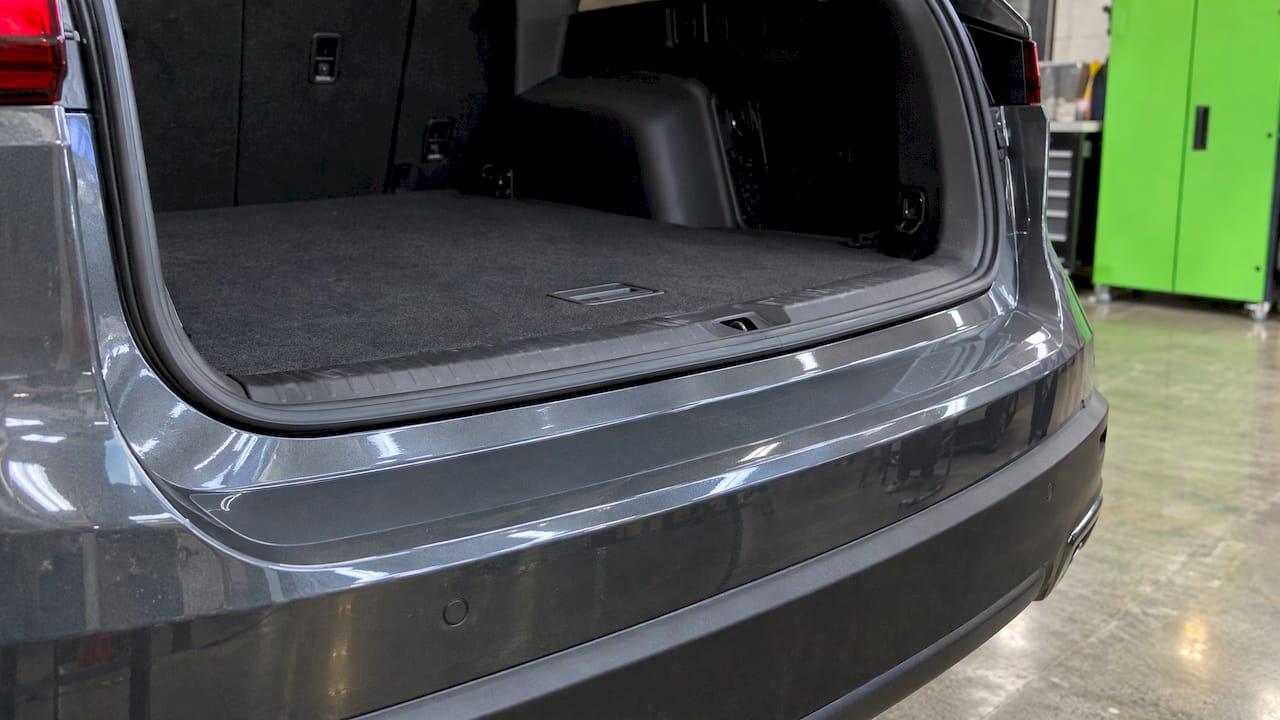
Trunk sill PPF is a strip of clear paint protection film that covers the lip you drag luggage, grocery bags and gear across every time you load the car. It keeps that painted edge from turning into a patch of scratches. The film only does its job if it is cut for your exact model, applied to clean, fully cured paint, and backed by a warranty the manufacturer will honor. That is why we put it in the hands of an installer, in a climate-controlled shop, instead of treating it as a stick-on accessory.
TL;DR
- The trunk sill (the painted lip at the rear opening) takes more scuffs than almost any other panel, and clear film absorbs the abuse instead of your paint.
- Fit matters: the pattern has to match your model, year and trim, and on many Teslas the bumper sensors decide which version you need.
- Film warranties are written around the film's own defects and, for several major brands, around professional installation.
- Bubbles, lifting edges and dust under the film are installation problems. A clean, climate-controlled bay prevents them.
- Trunk sill film is most useful when it is planned together with the rest of your PPF coverage. Start on our paint protection film page.
Table of Contents
- What a trunk sill guard actually protects
- Matching the film to your car
- What to confirm before you book any PPF work
- Why installation decides how the film looks in a year
- Caring for trunk sill film
- Trunk sill film as part of a bigger plan
- Get your trunk sill protected in Van Nuys
- Our perspective
- FAQ
- Sources
What a trunk sill guard actually protects
Open the trunk or hatch and look at the edge you lift things over. On a sedan it is the painted lip below the trunk opening. On an SUV or hatchback it is the rear sill, often a flat painted ledge just above the bumper. Everything you load slides or drags across it: suitcases with hard wheels, tool bags, strollers, coolers, a dog's claws. Because it faces up and out, it also collects belt buckles and keys.
Paint protection film (PPF) is a clear, flexible urethane layer that sits on top of the paint. Product makers describe the same idea for door sills, door edges and trunk ledges: a nearly invisible, custom-fit film that guards against scratches, scuffs and chips and uses self-healing technology, so light marks soften with warmth. That is the point of a trunk sill piece. It takes the scuff so the paint underneath does not.
The damage it prevents is cosmetic but expensive to reverse. Once a clear coat is scratched through on a horizontal lip, you are looking at polishing, touch-up or a respray of a panel that sits right in your line of sight every time you load the car. Film costs far less than any of those.
Who gets the most from it
- Families: car seats, strollers, sports bags and groceries all cross the sill daily.
- Tesla and other EV owners: low, wide rear openings and glossy paint show every scratch.
- Enthusiasts and new-car owners: if you are keeping the original paint pristine, the sill is the first place it fails.
- Business owners: vans and work vehicles that carry tools and product take a beating, and a branded or wrapped vehicle looks worn fast when its loading edge is scarred.
Matching the film to your car
A trunk sill is not a generic strip. The curve, the width of the ledge, the bumper cutouts and the trim all change from one model to the next. Pre-cut patterns exist to solve this: you pick year, make, model, body style and trim, and the pattern is shaped for that panel, which reduces trimming on the vehicle. The better the fit, the less film edge is left floating or stretched.
Three things to pin down before any film goes on:
- Model year and generation. A refresh can change the sill shape even when the car looks identical.
- Trim and options. Trim level decides what sits on or near the sill, such as sensors, badges, or a power liftgate edge.
- Coverage you want. Just the flat lip, the lip plus the vertical face, or the lip as part of a larger rear-bumper package.
Tesla owners: the sensor question
Tesla trunks are a good example of why generic film goes wrong. On the Model Y, trunk sill film is sold in versions with ultrasonic sensor cutouts for 2020 to 2022 builds, without cutouts for 2022 and later, and a separate version for the 2026 Juniper refresh. Choosing the wrong one means film over a sensor or a gap where film should be.
This is the kind of detail we handle every day. Tint & Wraps Customs specializes in Tesla and EV installations, and our approach is built around zero sensor interference and a factory-quality fit. If you drive a Model 3, Model Y or another EV, tell us the exact year and build when you book so the pattern and placement are right the first time.
What to confirm before you book any PPF work
Whether the sill is its own small job or part of a bigger package, get these points settled in writing:
- Panel list. Which exact surfaces get film: the flat lip, the vertical face, painted trim, door handles, door edges? Coverage should be confirmed in writing, including where film boundaries and seams will show and which edges are wrapped.
- Full film name. The brand alone is not enough. Warranty terms differ by film line, and package names vary by vehicle, so ask for the full product name and the list of panels.
- Finish. Gloss, satin or matte film changes how the sill looks next to the surrounding paint.
- Warranty and care instructions. Keep the paperwork together with your build sheet.
On our side, we back our film with manufacturer warranties. Our warranty guide explains why registering within 30 days protects your coverage.
What a film warranty covers
Film warranties address the film's own failures. Spec-sheet comparisons of the major brands show 10-year warranties against yellowing, cracking, blistering and delaminating on premium lines, with some tied to professional installation and with care notes that include avoiding automatic car washes and high-pressure spray at the edges. They do not cover a stone going through the panel or an edge that lifts because of poor installation or a bad wash.
That last point is why where the film goes on matters as much as which film. A self-installed kit gives you the film's physical protection but, according to a review of manufacturers' own terms, not the manufacturer's warranty coverage. On a small sill piece you might shrug at that. When you have invested in a new car, you want the warranty attached to the work.
Why installation decides how the film looks in a year
A trunk sill is small, but it is one of the harder spots to finish cleanly. It has a bend, a hard edge, and sits low where dirt collects. The manufacturers' own instructions show how exacting the job is. One film maker's guidance calls for keeping the film wet while squeegeeing, removing larger water bubbles by lifting and re-squeegeeing, degreasing edges, seating film on a flat surface without overhang, and waiting one to two hours before returning the car to use.

Another film maker states its product is intended and warranted for fully cured factory paint in like-new condition, and that residual solvents in uncured paint can cause shrinkage, bubbling or blistering. In plain terms: the paint beneath the film has to be in good shape first, and a fresh respray is a risk.
Where installs go wrong
| Problem | What causes it | What prevents it |
|---|---|---|
| Dust or lint under the film | Open garage, driveway or breezy bay | A dust-free, climate-controlled facility |
| Lifting edges | Poor edge prep, contamination, or film stretched over a curve | Clean edge prep and a pattern cut for the model |
| Bubbles and haze | Trapped slip solution or air | Careful squeegee work and enough cure time |
| Film over sensors or trim | Wrong year or trim pattern | Confirming the build before cutting |
| Visible seams | Hasty alignment | Planning where boundaries fall before the film goes on |
Our shop in Van Nuys is climate-controlled and dust-free, which is the single biggest advantage for clear film: it is the one product where a speck of dirt stays visible for the life of the install. Every vehicle gets the same controlled environment, and with over 1,000 vehicles protected, our team has worked across a wide range of makes.
If an edge does lift on any vinyl or film, the cause is usually surface prep or contamination, and the logic of the repair is explained in this guide on how to fix lifting vinyl edges. For clear film on paint, though, a lifting edge is a sign the install needs to be redone properly, which is easier to avoid than to fix.
Caring for trunk sill film
Trunk sill film is easy to live with, and a few habits keep it clear:
- Give it time to cure. Follow the aftercare window your installer gives you before heavy loading or washing.
- Wash gently. Hand washing with a pH-neutral soap is the safest routine. If you use a car wash, skip high-pressure spray aimed at the edges of the film, since manufacturers' care notes warn against it.
- Load with a little care. The film is there to absorb scuffs, but a lifted edge can start from a sharp corner dragged repeatedly in one spot.
- Remove mineral deposits promptly. Hard water spots left to bake on can mark film. Rinse and dry after washing.
Our PPF maintenance guide covers the full routine, and our PPF lifespan article explains what to expect over the years.
Trunk sill film as part of a bigger plan
The sill rarely wears alone. The same loading habits that scar the sill also scuff the rear bumper top, and the same car door that dings in a parking lot has an edge and a rocker panel that take rock chips. Planning your film coverage together means one visit, one film, one warranty and consistent edges. Our PPF packages run from the Track Pack to Full Front and Full Body, and you can read how installer time scales in our PPF install time guide. If you want to see how pricing works, our PPF cost article explains what drives it, and for the lower body, see why rocker panel PPF backed by a 3M warranty is a natural companion to the sill.
Choosing between film lines? Our comparisons of XPEL and 3M, STEK and XPEL and SunTek and XPEL lay out the differences. For a broader view of what film does for paint, start with PPF benefits.
Get your trunk sill protected in Van Nuys
Tint & Wraps Customs is based in Van Nuys, CA, serving drivers across the San Fernando Valley. We install paint protection film in a climate-controlled, dust-free facility, we are experienced with Tesla and EV installations, and our work is backed by manufacturer warranties. Tell us your make, model, year and trim, and we will plan film for the sill and the surrounding panels that take the same abuse. See the options on our paint protection film page or reach us through our site.
The same shop also handles window tinting, ceramic coating, vehicle wraps and chrome delete, so a protection plan for the whole car can be done in one place.
Our perspective
Most people think of PPF as a hood-and-bumper product. The trunk sill is the panel owners wish they had covered, because it gets damaged by habit, not by accident. Nobody plans to drag a suitcase across it. It just happens on the fifth airport run.
The film itself is only half the story. We care about the environment it goes on in. Our facility is climate-controlled and dust-free because clear film leaves nowhere to hide a mistake. On a Tesla, we also think about the sensors and the exact model year, because a sill that looks perfect but interferes with the car is not a finished job.
We register the manufacturer warranty on the work and we want you to know exactly which panels are covered before the car comes in. That is how we would want our own car handled.
Jake
FAQ
Is trunk sill PPF worth it?
If you load the trunk regularly, yes. The sill is a high-contact painted edge, and clear film takes the scuffs instead of the paint. It is also one of the least visible places to wear film, so you get protection without changing how the car looks.
Can I take a car with PPF through a car wash?
Gentle washing is fine for most owners, but manufacturers advise avoiding automatic washes and high-pressure spray near film edges, and your installer will give you aftercare timing for a new install. Hand washing is the safest routine for the first weeks.
How long does trunk sill film last?
Premium films carry warranties of up to 10 years against yellowing, cracking, blistering and delaminating, depending on the film line. Real-world life depends on loading habits, washing and sun exposure. Our PPF lifespan guide goes deeper.
Will it fit my Tesla without blocking the sensors?
It will when the pattern matches your exact year and build, since sensor cutouts differ between model years. Tell us your Model 3 or Model Y year when you book and we plan the fit around it.
Sources
- Tesla Model Y ScratchProtection | WeatherTech
- Precut Paint Protection Film Kits
- Rear Trunk Protection - PPF for Model Y
- Choose your PPF coverage | PaintProtectionFilm.org
- 10 Questions to Ask a PPF Installer Before You Book
- PPF Film Brands by Spec Sheet and Warranty | Service VIN
- Best Paint Protection Film & DIY PPF Kits (2026) | CarCareRank
- Installation instructions | Legend PPF
- IB4.40 Dry Apply PPF Guidelines | Avery Dennison
- How to Fix Lifting Decal Edges