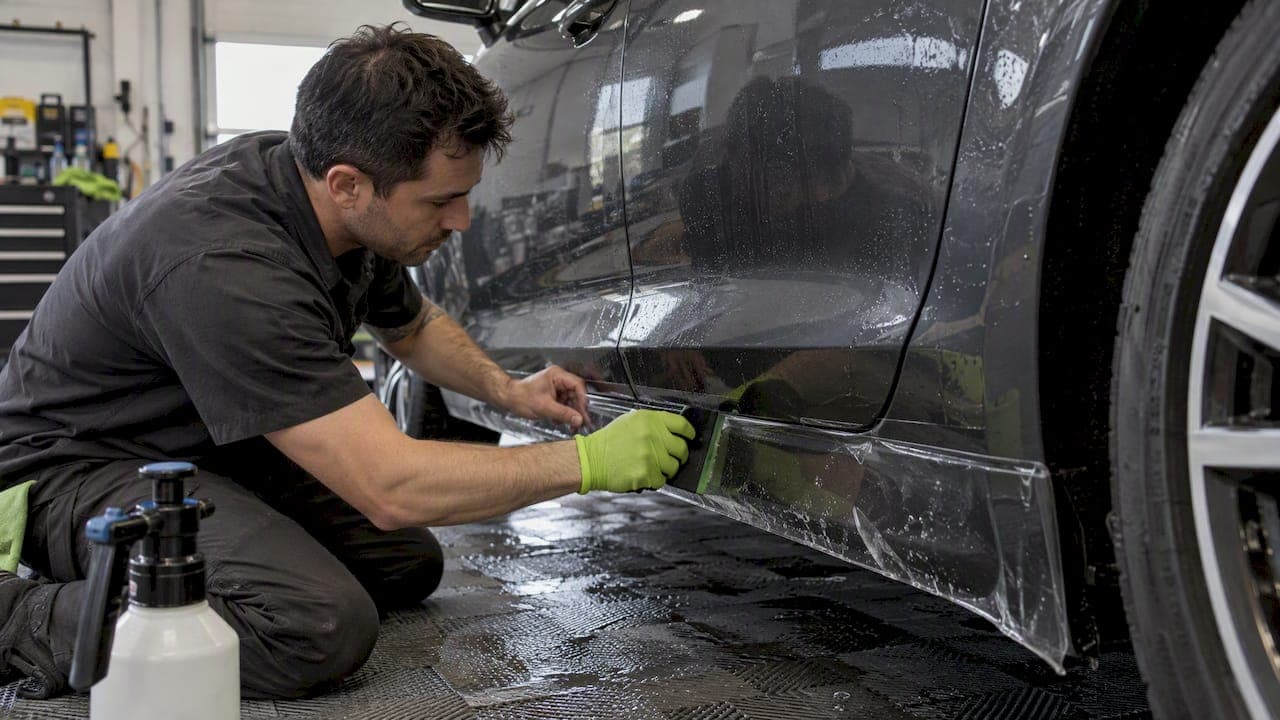
Paint protection film works well on rocker panels when the panel is clean, rust-free, and installed by someone who knows how to handle tight curves and rolled edges. The toughest part isn't the film itself, it's the install: complex contours and poor prep are where most problems start. Look for shops that reference manufacturer data, like the 3M Scotchgard Pro Series 200, back their work with a manufacturer warranty and install in a climate-controlled bay.
TL;DR:
- Proper installation by a professional in a climate-controlled environment ensures the film conforms smoothly to complex rocker panel curves and reduces edge lifting.
- PPF on rocker panels absorbs impact from road debris, but it can still tear or bruise from sharp impacts like curb strikes or large rocks.
- DIY kits often lack the precise fit needed for curved surfaces and may result in damaged edges or trapped dust, making professional installation more reliable for high-value vehicles.
- Regular cleaning every one to two weeks with pH-neutral soap and avoiding abrasive tools helps maintain the film's clarity and adhesion, especially around seams and edges.
- Attaching film over rusted panels is detrimental, as moisture trapping accelerates corrosion; rust repair must precede any PPF application.
Table of Contents
- Why PPF helps rocker panels in the first place
- What a professional rocker panel install actually looks like
- DIY kits versus hiring a professional installer
- What rocker panel PPF costs and how long it lasts
- Keeping rocker panel PPF in good shape
- What I've learned fitting film around rocker panels
- Get your rocker panels protected the right way
- Where these numbers and claims come from
- Sources
- FAQ
Why PPF helps rocker panels in the first place
Rocker panels take a beating. They sit low, catch tire spray, road salt, and gravel kicked up from the panel just ahead of them, and they're often the first thing to show chips on a used car. Polyurethane PPF works by absorbing that impact energy across a flexible layer instead of letting it transfer straight into the clear coat, which is how it prevents the small chips and scuffs that come from everyday driving.
Higher-end films add a self-healing topcoat that smooths out light swirls and scratches with heat, along with clarity meant to stay close to invisible over time. The 3M Scotchgard Pro Series is one example built around that combination, with 3M's own materials pointing to scratch and stain resistance along with that self-healing layer. Shops typically offer it in gloss or satin finish depending on how much the owner wants the film to show.
None of that makes the film indestructible. A hard enough impact, like a curb strike or a sharp rock at highway speed, can still tear through the film or bruise the paint underneath. PPF lowers the odds of damage from routine driving, it doesn't eliminate risk entirely.
What a professional rocker panel install actually looks like
A rocker panel is a narrower, more complicated piece of real estate than a hood or fender, so the workflow looks different from a flat-panel job.
- The installer checks paint condition, looks for rust or chips already present, and fully decontaminates and degreases the surface before any film goes down.
- The panel gets patterned to the car, and the installer decides between wrapping the film around the bottom edge or stopping at a butt edge, placing seams where they're the least visible and the least likely to catch debris.
- Edges get trimmed and tucked by hand, since rocker panels often curve into wheel wells and body lines where a flat cut would leave a lifted corner.
A rocker panel set usually takes less time than a full hood or bumper, but the margin for error is tighter because of those curves. That's part of why a dust-free, climate-controlled shop matters here: airborne particles under the film show up as bumps right along an edge you're going to be looking at every time you walk up to the car, and a stable temperature keeps the adhesive behaving the way it's supposed to during application.
DIY kits versus hiring a professional installer
A DIY rocker panel kit is pre-cut film sized to a specific make and model, sold with the idea that an owner can apply it with a heat gun and a squeegee. In practice, the tight curves and rolled edges on most rocker panels make this one of the harder DIY PPF jobs, not an easy starting point. Trapped dust, lifted corners, and film that doesn't fully conform to the curve are the most common results.
Professional installers deal with these shapes often enough to avoid the fitment and adhesion issues that trip up a first-time installer, and a shop-installed job typically comes with a manufacturer-backed warranty that a DIY kit doesn't carry.
DIY can be a reasonable call on flat, simple sections of a panel with no complex curves. For rocker panels specifically, or for a higher-value vehicle where a bad edge is expensive to redo, a professional install is the safer route.
What rocker panel PPF costs and how long it lasts
Pricing for rocker-panel-only coverage runs lower than full-front or full-body packages, since it's a smaller surface area with less labor involved, though exact numbers vary by shop and vehicle. A detailed breakdown of typical ranges and what drives them is covered in this PPF cost guide.
Film lifespan depends on a mix of factors: the grade of film used, how much UV and road salt exposure the panel sees, and how well it was installed in the first place. A film applied with trapped dust or a rushed edge will fail at that edge well before the rest of the panel shows wear.
When damage does happen, repairs usually fall into one of three categories: a small patch over a localized chip, rework of a lifted edge, or, if the film has yellowed or degraded broadly, a full re-wrap of the panel. Catching problems early keeps the fix small.

Keeping rocker panel PPF in good shape
Rocker panels sit closest to road grime, so they need more attention than the rest of the car, not less.
- Wash every one to two weeks with a pH-neutral soap, since road salt and brake dust build up fastest down low.
- Skip abrasive pads or harsh solvents, which can cloud the film's topcoat or weaken the edge seal over time.
- Check seams and edges during each wash. A soft edge that's just starting to lift can often be reset, while a seam that's curled and collecting dirt usually needs a section re-installed.
Pro Tip: Run a fingernail gently along the bottom edge of the panel during a wash. If you feel a catch instead of a smooth line, get it looked at before it grows.
One rule matters more than any cleaning routine: never install PPF over active rust. Film traps moisture against the metal, which accelerates corrosion instead of hiding it. Rust needs to be treated and the panel properly prepped first. For a rocker panel that's already rusted, film is a cosmetic patch at best and not a substitute for addressing what's underneath, more on that tradeoff in this rock chip protection guide.

What I've learned fitting film around rocker panels
Rocker panels are unforgiving. The curve into the wheel well and the way the edge rolls under the car leave no room for a sloppy trim line, and that's doubly true on EVs, where battery pack seams and charge port locations change where a seam can sit. A clean edge there isn't cosmetic, it's the difference between film that lasts years and film that starts peeling in a season.
Professional installers typically complete rocker panel jobs in climate-controlled bays and back their work with manufacturer warranties while applying careful attention to fit on Tesla and other EV platforms. Experienced shops often achieve a strong reputation by focusing on these details.
— Jake
Get your rocker panels protected the right way
A rushed rocker panel job shows up fast, in lifted edges and dust bubbles right where you'll notice them. A climate-controlled facility removes dust and temperature swings that cause installation problems, and installs are often backed by manufacturer warranties.
- A full inspection and surface prep before any film is cut.
- Professional patterning suited to your rocker panel's curves and seams.
- A post-install check and manufacturer-backed warranty coverage.
Get a quote through our paint protection film page and ask us about rocker-panel-specific coverage.
Where these numbers and claims come from
Manufacturer details come from 3M's Scotchgard Pro Series 200 technical data sheet, and installation booking details are on our PPF service page.
FAQ
What is the downside of PPF?
PPF can show edge lift or yellowing over time, especially with lower-grade film, poor installation, or heavy UV exposure. It also adds cost over leaving paint unprotected, and repairs on damaged sections sometimes require a partial or full re-wrap of the panel.
How can I cover up rusted rocker panels?
Film should never go over active rust, since trapping moisture against corroded metal makes it worse. Rust needs to be treated and the panel properly repaired first, and only then is it a candidate for PPF or other protective coverage.
How much does a PPF usually cost?
Cost depends on coverage area, film grade, and vehicle, with rocker-panel-only jobs priced lower than full-front or full-body packages. A detailed breakdown of typical ranges and what drives them is in this cost guide.
Does PPF really protect against rock chips?
Yes, polyurethane PPF is designed to absorb impact energy from road debris and reduce the chips that routine driving causes, and manufacturer data for films like the 3M Scotchgard Pro Series specifically points to this kind of protection. It isn't indestructible, and a hard enough impact can still damage the film or the paint underneath.