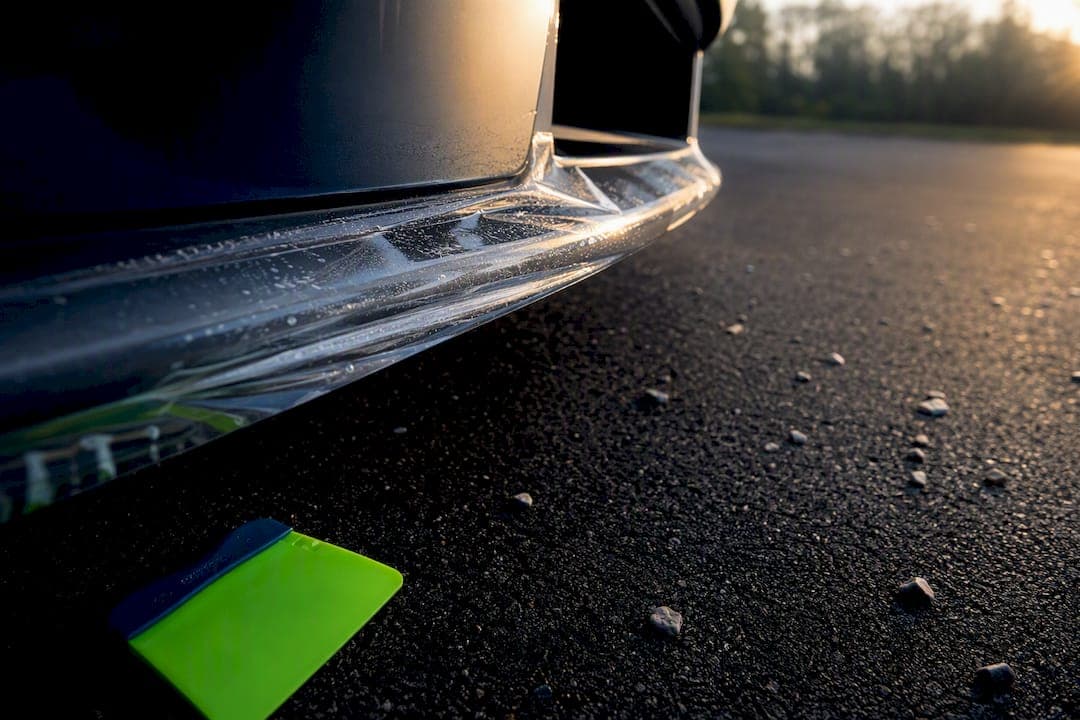
Paint protection film is the most effective way to stop rock chips before they happen, because it physically absorbs impact energy that would otherwise chip your paint. Windshield protection film handles the glass, textured chip guards cover rocker panels and lower body sections, and none of these work as well when installed at home as they do with a professional who checks fitment, ADAS sensors, and edge sealing.
TL;DR:
- Professional installation in a climate-controlled environment ensures proper fitment, edge sealing, and maximum film longevity, preventing early edge lift and bubbling.
- The most common PPF coverage areas are the hood, front bumper, fenders, mirrors, and rocker panels, which take the brunt of road debris impacts.
- Up to 10-year warranties available on quality PPF lines like 3M's Scotchgard, backed by self-healing technology and stain resistance, reflect confidence in impact protection.
- Windshield protection film requires high optical clarity and shorter warranties, making it more suitable for drivers with heavy gravel road exposure or frequent impact risks.
- DIY PPF application often results in visible gaps, bubbles, or poor adhesion, and is best limited to small, flat, low-visibility areas rather than full-panel coverage.
Table of Contents
- What Is Rock Chip Protection and How Does PPF Prevent It?
- Do You Need Windshield Protection Film Too?
- What Are Chip Guard Coatings and When Should You Use Them?
- PPF vs Ceramic Coating vs Wax: What Actually Stops Rock Chips?
- Which Coverage Package Fits Your Driving Habits?
- DIY vs Professional Installation: What's the Real Cost Difference?
- How Do You Maintain PPF and Know When to Replace It?
- What Should You Look for in a Rock Chip Protection Installer?
- What Vehicle Owners Get Wrong About Rock Chip Protection
- Ready to Protect Your Car From Rock Chips?
- Sources
What Is Rock Chip Protection and How Does PPF Prevent It?
Rock chip protection refers to any material or coating applied to a vehicle's exterior to stop road debris, gravel, and small stones from denting or chipping paint. The industry standard for this job is paint protection film, or PPF: a clear thermoplastic urethane film that gets applied directly over factory paint on the panels that take the most abuse.
PPF works because of what it's made from. The film absorbs and disperses the kinetic energy of a flying rock on impact rather than letting that energy transfer straight into your clear coat. Industry-standard films typically run around 8 mil thick, and most modern PPF lines add a self-healing topcoat that uses heat, either from the sun or a heat gun, to smooth out light scuffs and swirl marks on its own.
Not every panel needs the same level of coverage. PPF is concentrated on the areas that statistically eat the most road debris:
- Hood — takes direct hits from anything kicked up by the vehicle ahead of you
- Front bumper — the lowest, most exposed panel on the front end
- Fenders — catch spray and debris kicked outward by your own tires
- Side mirrors — sit right in the airflow path at highway speed
- Rocker panels — absorb splash and grit thrown up from underneath the car
Statistic Callout: Many manufacturer PPF lines, including 3M's Scotchgard Paint Protection Film Pro Series, carry consumer warranties extending up to 10 years, backed by self-healing technology and stain resistance built into the film itself. That's not a marketing gimmick. It reflects how confident manufacturers are that the film, not the paint underneath it, takes the abuse over the life of the vehicle.
The real-world case for PPF isn't theoretical. Vehicles that spend years on gravel roads or long highway commutes show factory paint preserved underneath the film after what amounts to thousands of small impacts, while an unprotected hood on the same route ends up pitted and touched up within a couple of seasons. That's also why PPF is OEM-approved by many manufacturers for limited factory applications on certain models. If the people building the car trust it enough to apply at the factory, that tells you something about how the film performs under real conditions, not just in a lab.
If you're comparing this to a cosmetic vinyl wrap, it's worth understanding the difference between protection and appearance before you spend money on the wrong product.
Do You Need Windshield Protection Film Too?
Your windshield takes a different kind of beating than your hood, and it needs a different kind of film. Windshield protection film, or WPF, is engineered specifically for optical clarity and impact resistance on glass rather than painted surfaces, which is a much stricter standard since even minor distortion becomes a visible, distracting problem right in your line of sight.
WPF differs from body PPF in a few important ways:
- Optical clarity is non-negotiable. Any haze or waviness that would be barely noticeable on a hood becomes a visible smear across your windshield at night.
- Warranties tend to run shorter. Front glass takes more direct stress from wiper cycles, temperature swings, and higher-speed impacts, so windshield film warranties are often shorter than the multi-year coverage you'll see on body panel film.
- ADAS compatibility has to be checked. Modern windshields often house forward-facing cameras and sensors for lane-keeping and automatic braking, and installers should test those systems after installation to confirm the film hasn't distorted the camera's view.
- Cost-effectiveness depends on your commute. If you drive a lot of gravel roads or trail behind trucks on the highway daily, WPF can be more economical than repeatedly repairing chips and replacing windshields over the years.
For most drivers, WPF makes the most sense as an add-on to body PPF rather than a standalone purchase. If your commute is mostly city streets with light traffic, a single windshield chip repair now and then might cost less over time than the film itself. If you're regularly behind gravel trucks or logging highway miles daily, the math flips.
What Are Chip Guard Coatings and When Should You Use Them?
Chip guard coatings are textured protective coatings designed for the lower body panels, wheel wells, and rocker panels where full PPF coverage isn't always practical or affordable. Rather than a clear film, these are typically sprayable products, ranging from aerosol touch-up cans to professional-grade 2K urethane systems, that build up a textured, rubberized layer over the paint.
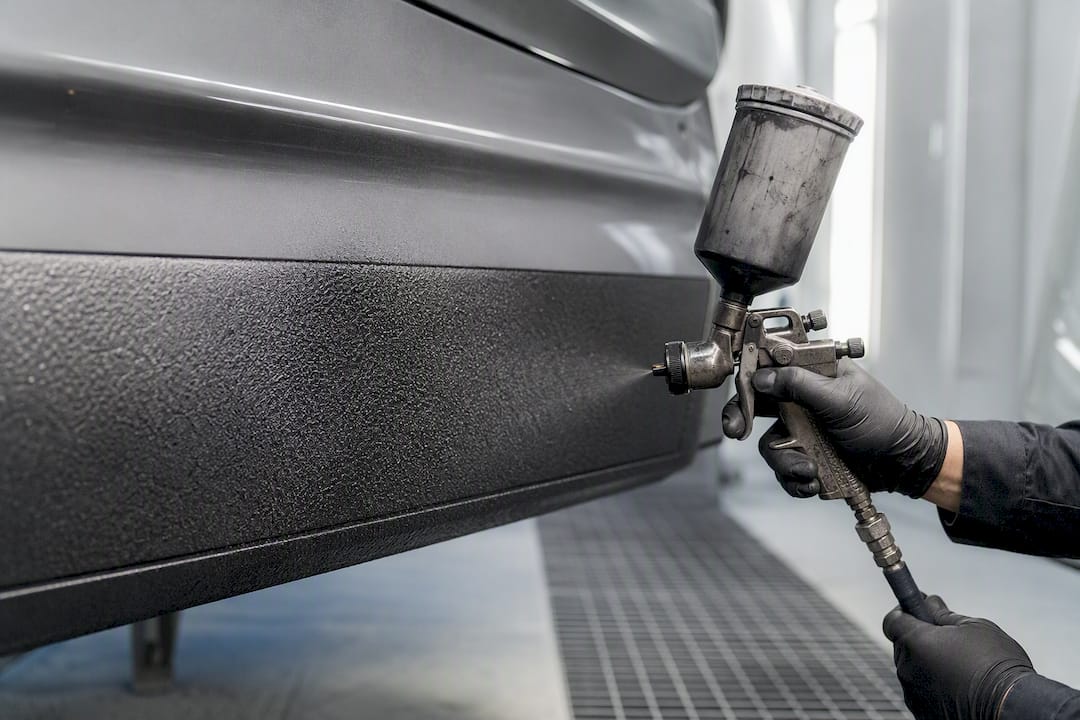
The appeal here is texture matching. Many chip guard products come in a range of textures from fine to coarse, letting an installer replicate the factory finish on rocker panels rather than leaving an obvious patch of smooth film against a textured OEM coating.
A few things separate chip guards from PPF in practice:
- Durability trade-off. A quality 2K urethane chip guard holds up well against gravel and salt spray, but it doesn't self-heal the way PPF does, and scratches through the coating stay put.
- Best fit for heavy-use conditions. Owners who drive unpaved roads regularly, live somewhere with harsh winters and heavy road salt, or tow trailers through gravel lots tend to see the most value from a chip guard on rockers and wheel wells.
- Budget-friendly alternative. For owners who can't justify full-panel PPF everywhere, a chip guard on the rocker panels covers the highest-risk lower body area for a fraction of the cost.
The honest limitation is texture matching. A good installer can get close to factory finish, but coatings applied by less experienced hands can look inconsistent next to the surrounding paint, so this is one area where installer skill matters as much as the product itself.
PPF vs Ceramic Coating vs Wax: What Actually Stops Rock Chips?
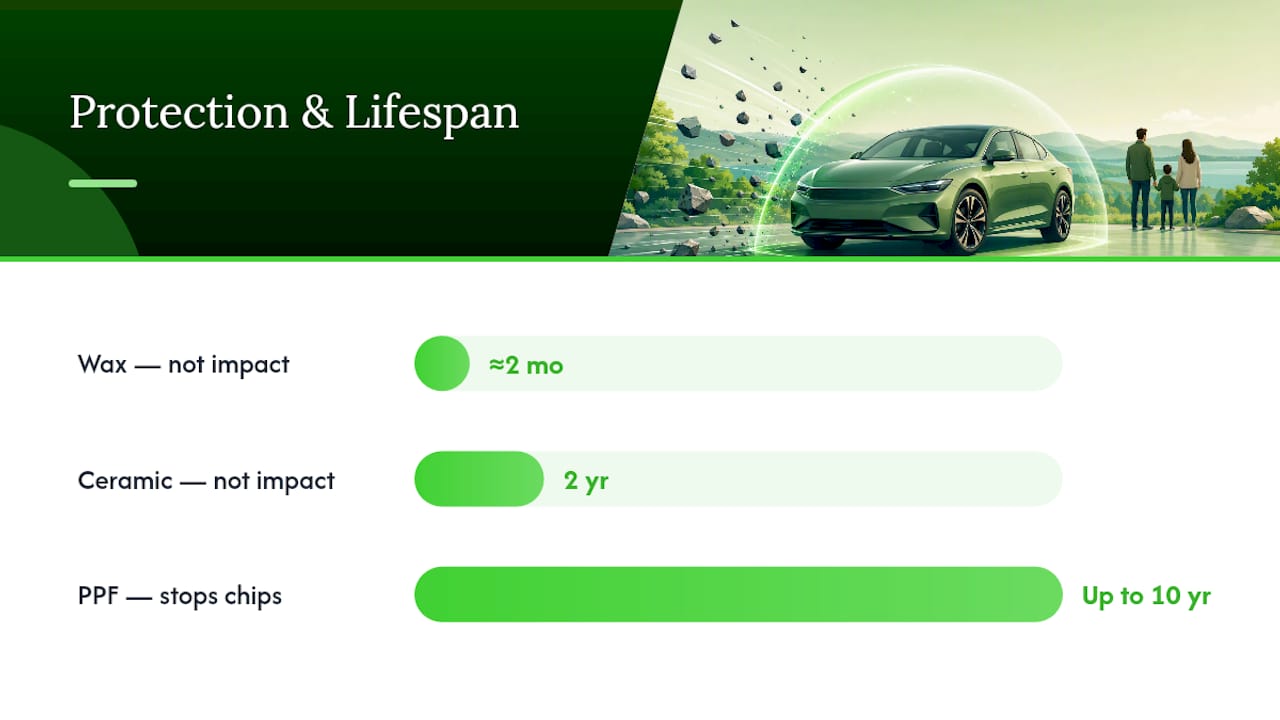
Only one of these three actually stops a rock chip: PPF. Ceramic coating and wax both sit on top of your paint as thin chemical layers, and neither one has the thickness or elasticity to absorb the kinetic energy of a flying stone. What they're good at is a completely different job.
Here's the breakdown of what each product category actually does:
| Product | Protects against | Does NOT protect against | Typical lifespan |
|---|---|---|---|
| PPF | Rock chips, road debris, minor abrasions | UV fading, water spots, chemical etching | Up to 10 years |
| Ceramic coating | UV damage, oxidation, chemical stains, easier washing | Physical impacts, rock chips | 2 years |
| Wax | Light UV exposure, adds temporary shine | Physical impacts, chemical etching, most weather exposure | Weeks to a few months |
Ceramic coatings build a hard, glossy, hydrophobic layer that resists chemical staining and UV oxidation and makes washing easier, but that layer measures in microns, not mils. A rock traveling at highway speed doesn't care how hydrophobic your paint is. This is exactly why industry sources consistently recommend a hybrid approach: PPF on the high-impact panels (hood, bumper, fenders, mirrors) and ceramic coating over the rest of the car, including the PPF itself.
Pro Tip: Ceramic coating over PPF isn't redundant, it's complementary. The ceramic layer adds UV and chemical resistance on top of the film's impact protection, and it makes the self-healing topcoat easier to keep clean since dirt and grime don't bond to the surface as aggressively.
Cost and lifespan run in roughly opposite directions across these three options. Wax is cheap and short-lived. Ceramic coating costs more upfront but holds up for a few years and needs less frequent reapplication than wax. PPF costs the most initially but can last up to a decade with proper care, making it the only one of the three that genuinely changes the long-term condition of your paint rather than just maintaining its surface.
Which Coverage Package Fits Your Driving Habits?
Coverage packages generally fall into a few standard tiers, and picking the right one comes down to how and where you actually drive, not how much you're willing to spend.
- Partial front package covers the leading edge of the hood, the front bumper, and mirror caps. This catches the majority of highway-speed impacts for drivers who mostly deal with occasional debris on paved roads.
- Full front package adds full hood coverage, full fender coverage, and headlights on top of the partial package. This is the standard recommendation for daily highway commuters and anyone who regularly follows trucks or trailers.
- Rocker panel package targets the lower body sections that catch splash-up and road grit thrown by your own tires, often paired with a chip guard coating rather than clear film for cost reasons.
- Full vehicle wrap covers every exterior panel, typically chosen by owners keeping a vehicle long-term, prepping for resale, or simply wanting maximum protection without exceptions.
The panels most likely to suffer damage without protection are the front bumper and leading hood edge, since these take the most direct hits at speed. Rocker panels come in second, especially for owners who drive gravel roads or through winter road salt regularly.
Your driving pattern should drive the decision more than your budget alone. A city commuter doing mostly stop-and-go traffic under 45 mph gets diminishing returns from a full front package. A driver doing 500 highway miles a week or living somewhere with unpaved roads sees that same package pay for itself in avoided touch-up paint work within a year or two.
Warranty coverage typically scales with the package. A full front installation usually comes with a longer, more comprehensive manufacturer warranty than a partial package, since the installer has more control over seam placement and edge sealing across a larger, more continuous surface.
DIY vs Professional Installation: What's the Real Cost Difference?
DIY kits run cheaper on paper, but the failure rate tells a different story. Full-panel or full-vehicle PPF installation is one of those jobs where the tools and the film are only part of the equation. The skill of the installer accounts for most of what separates a flawless finish from a visible, frustrating mess.
Rough cost expectations break down like this:
- DIY kits for a partial hood or bumper typically run in the low hundreds of dollars, not counting the squeegees, heat gun, and slip solution you'll also need.
- Professional partial-front installs cost more but include labor, precise panel-specific templates, and warranty coverage.
- Professional full-vehicle installs represent the highest upfront cost but come with the longest coverage and the most consistent finish across every panel.
For a deeper breakdown of what drives pricing in either direction, it's worth reading through what actually affects PPF cost before comparing quotes.
Statistic Callout: Installer guidance consistently points to one detail as the biggest predictor of long-term success: applying film in a climate-controlled environment with proper paint correction beforehand and OEM-graded edge-sealing technique. Skip that step, whether through a rushed DIY job or a shop working outdoors, and edge lift and delamination show up within months instead of years.
The common DIY pitfalls are predictable once you know what to look for:
- Mis-cut film that doesn't match panel curves, leaving visible gaps or overlap at edges.
- Edge lifting within the first few months from improper adhesion or seams too close to panel edges.
- Trapped debris or bubbles under the film from installing outside a clean, controlled space.
- Optical distortion from stretching the film unevenly during application, especially around curved surfaces like mirrors and bumpers.
DIY makes sense for small, flat, low-visibility areas like a single headlight or a mirror cap, where a mistake is cheap to fix. It stops making sense the moment you're covering a full hood or anything with complex curves, since a botched install often costs more to remove and redo than a professional job would have cost in the first place. Manufacturer-backed warranties also typically require professional installation to remain valid, which matters if you're counting on that coverage down the line.
How Do You Maintain PPF and Know When to Replace It?
PPF needs a gentler cleaning routine than bare paint, mainly because the self-healing topcoat and the film's edges are more sensitive to abrasive products than a factory clear coat is. Stick to a pH-neutral car shampoo, soft microfiber wash mitts, and skip abrasive polishes or compounds entirely, since those can dull the self-healing layer over time.
The self-healing mechanism itself has real limits worth understanding before you rely on it too heavily:
- Minor scuffs and light swirl marks typically smooth out on their own with heat from sunlight or a heat gun.
- Deep gouges or cuts through the film will not heal and require a panel or section replacement.
- Extreme cold slows the healing response, so a scuff picked up in winter might not fully disappear until warmer weather returns.
Realistic lifespan expectations run from several years up to a decade, depending heavily on film quality, climate exposure, and how consistently you maintain the film. Manufacturer ranges commonly cite up to 10 years under proper care, though film living through harsh winters with heavy road salt tends to show yellowing or edge lifting sooner than that ceiling. For a closer look at what actually shortens or extends that window, see this breakdown of PPF lifespan factors.
If a ceramic coating gets layered over the PPF, maintenance actually gets easier, not harder. The hydrophobic surface sheds dirt and grime faster, which means fewer aggressive wash sessions and less risk of introducing swirl marks into the film's surface over time. For matte or satin finishes specifically, ceramic coatings designed for those surfaces require their own maintenance approach to avoid glossing up a finish that's supposed to stay flat.
What Should You Look for in a Rock Chip Protection Installer?
A shop's facility tells you almost as much as their portfolio does. Installations done in a climate-controlled space, with proper paint correction before the film goes on and OEM-graded edge sealing, consistently show fewer edge-lift and delamination problems down the road. That's not a small detail. It's the difference between film that lasts a decade and film that starts peeling at the corners within a year.
A few red flags are worth walking away from immediately: no portfolio of completed work, no written warranty terms, visible dust or debris trapped under film samples in the shop, or an installer who can't clearly explain what film brand and mil thickness they're using. A quick post-install checklist should confirm uniform adhesive edges, zero trapped debris or bubbles, consistent optical clarity with no orange peel texture, and a manufacturer-stamped film label attached to your warranty paperwork.
Tint & Wraps Customs performs installations in a climate-controlled facility in Van Nuys, with specific experience on Tesla and other EV platforms where panel gaps and camera housings require extra attention. Manufacturer-backed warranties come standard on PPF installations, giving owners documented coverage rather than a verbal promise.
What Vehicle Owners Get Wrong About Rock Chip Protection
Most people treat rock chip protection like a single product decision. It isn't. The real question is which threat you're protecting against on which panel, and the conventional advice, slap on a ceramic coating and call it done, misses that entirely. Ceramic coating is excellent chemistry. It just isn't a rock chip solution, and marketing that blurs that line does owners a disservice.
The bigger mistake is underestimating installation quality. Owners spend real money comparing film brands and mil thickness, then hand the job to whoever quotes lowest without asking about their facility or edge-sealing process. A mediocre install of a great film will fail before a great install of a decent film does.
If there's one thing to prioritize first, it's this: figure out your actual driving pattern before you spend a dollar. Highway commuters and gravel-road drivers need front-end PPF more than anything else on this list. Everyone else should start smaller and expand coverage as their driving habits or budget change.
— Jake
Ready to Protect Your Car From Rock Chips?
A climate-controlled facility built specifically to eliminate the dust, debris, and temperature swings that cause edge lift and bubbling down the road provides a reliable alternative to piecing together DIY kits and guessing at installer quality. Whether you need full-hood PPF, windshield protection film, chip guard coatings on your rockers, or a ceramic coating layered over it all, the work happens under one roof with manufacturer-backed warranty coverage attached to the finished job.
Installers who understand the specific needs of Tesla and EV platforms, including panel gaps, camera housings, and charging ports, provide tailored service rather than treating every vehicle the same. Having served many customers, the shop has encountered common failure modes of DIY installations and developed processes to avoid them. If you're ready to stop guessing about coverage and get a package matched to your actual driving habits, request a quote at Tint & Wraps Customs and get your vehicle scheduled for protection.