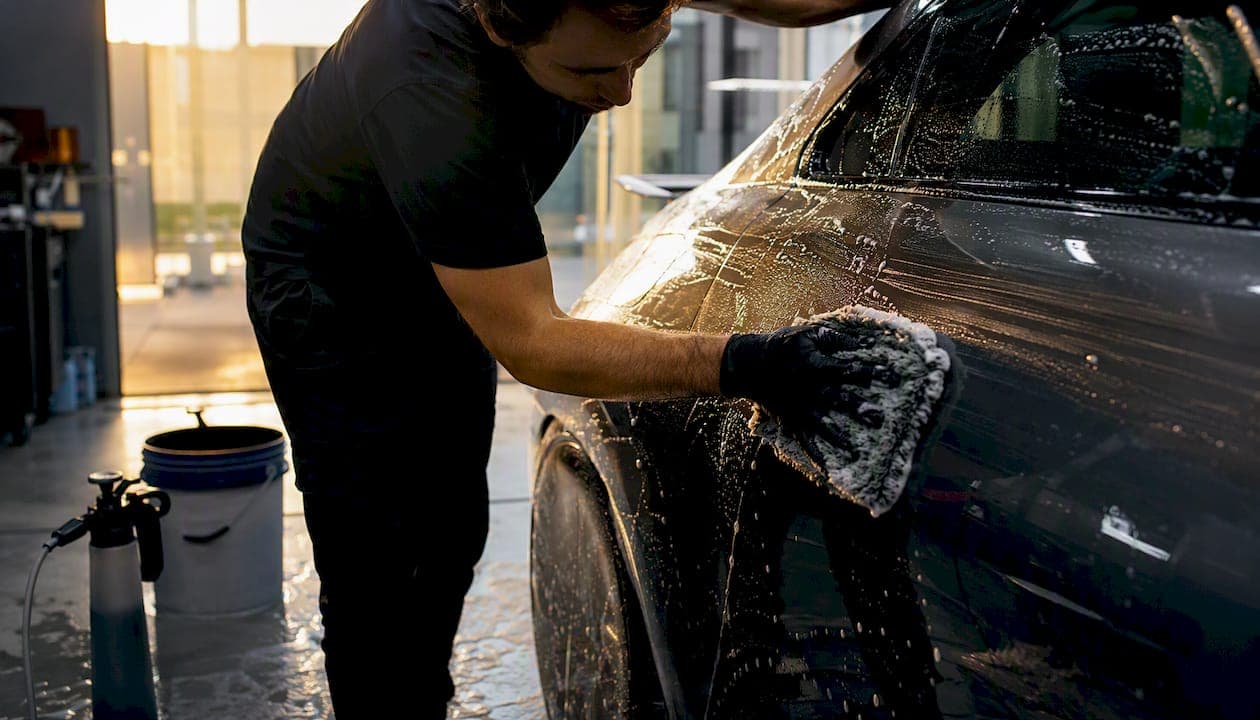
Paint protection film is genuinely low-maintenance, but "low" doesn't mean "none." The core rule: wash gently every one to two weeks with a pH-neutral soap, avoid anything abrasive, and inspect the edges quarterly. That's most of it.
PPF (paint protection film) is a clear or matte thermoplastic urethane film bonded to your vehicle's painted surfaces. It absorbs stone chips, resists chemical etching from bird droppings and tree sap, and deflects light abrasions that would otherwise reach your clearcoat.
Quick-start checklist:
- Wash every 1–2 weeks using pH-neutral shampoo and a soft wash mitt
- Never use automated brush car washes or petroleum-based waxes
- Inspect edges and seams regularly for lifting or adhesive discoloration
Pro Tip: Small moisture pockets under fresh film are normal and will disappear on their own during the curing period. Don't try to press them out.
Key Takeaways
Consistent, gentle washing and quarterly edge inspections are the two habits that determine whether your PPF reaches its full rated lifespan or fails years early.
| Point | Details |
|---|---|
| Curing window is non-negotiable | Wait 7–14 days after installation before the first wash to let the adhesive bond fully. |
| Wash gently, wash often | Hand wash every 1–2 weeks with pH-neutral shampoo and a two-bucket method. |
| Avoid brush washes and petroleum waxes | Both cause edge lift and yellowing; use touchless washes and synthetic sealants instead. |
| Ceramic coating reduces maintenance burden | A ceramic layer over PPF improves hydrophobicity and extends sealant reapplication intervals. |
| Tintandwrapscustoms offers the full care cycle | PPF installation, annual health checks, ceramic coating, and spot repairs in Van Nuys, CA. |
Table of Contents
- How to wash your PPF without damaging it
- Dos and don'ts every PPF owner should know
- Which car washes are actually safe for PPF?
- A maintenance schedule that actually works
- How to handle stains, scratches, and damage
- Should you add a ceramic coating over your PPF?
- Installer tips from the shop
- What most owners get wrong about PPF care
- Tintandwrapscustoms keeps your PPF performing year after year
- Sources
How to wash your PPF without damaging it
The washing routine matters more than most owners expect. Done wrong, even a routine wash can lift edges, introduce swirl marks, or accelerate yellowing. Done right, it takes about 20 minutes and keeps the film performing for years.
Step 1: Respect the curing window
Wait 7–14 days after installation before the first wash. During that window, the slip solution under the film is still evaporating and the adhesive is forming its final bond. Washing too early risks lifting edges and trapping water beneath the film. Any small moisture pockets you see are normal and will clear on their own.
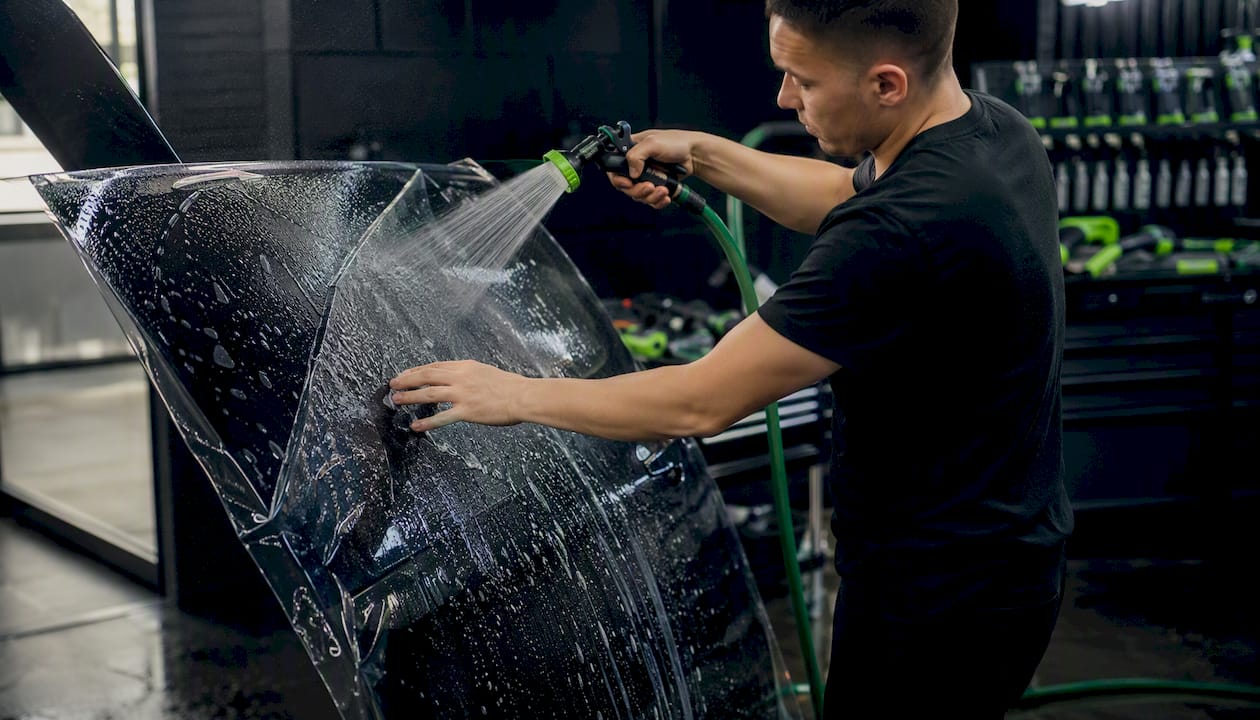
Step 2: Pre-rinse with low pressure
Start with a contactless rinse using a pressure washer or a foam cannon. Keep the nozzle 12–24 inches from the surface and use a wide-angle tip (40 degrees is ideal). Never aim the stream directly at film edges or seams. The goal here is to float loose dirt off the surface before any contact is made.
Step 3: Two-bucket hand wash
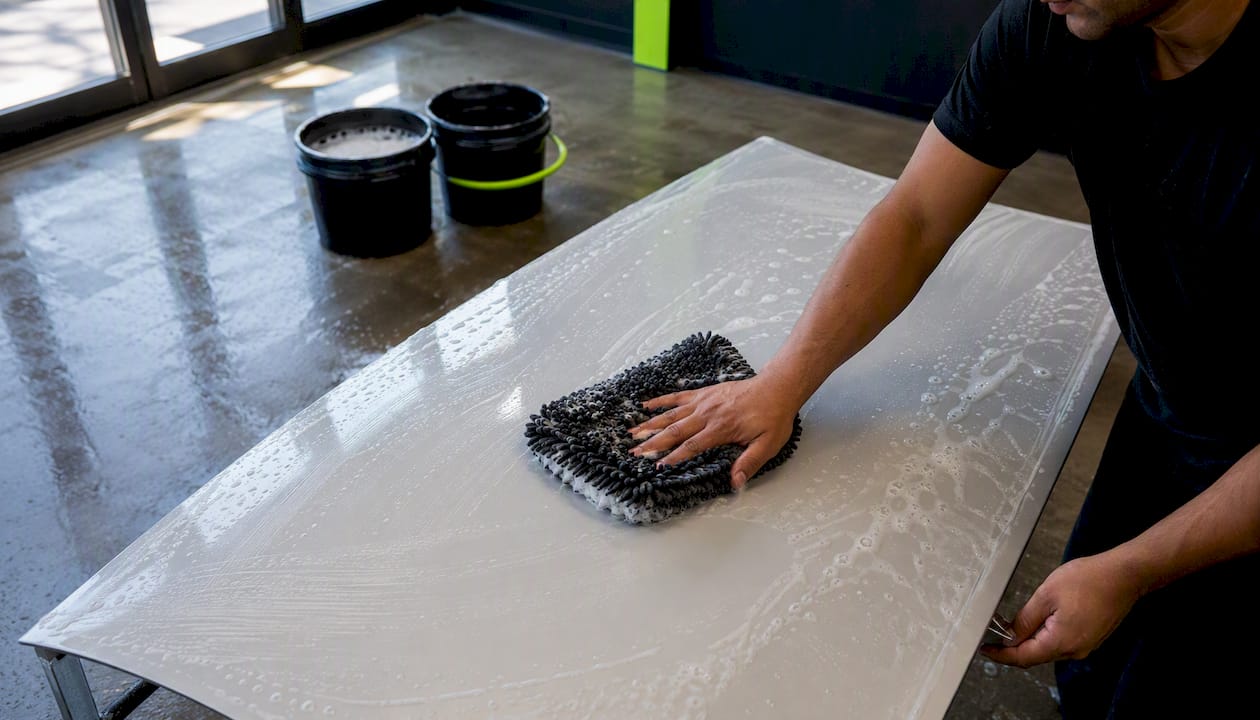
Fill one bucket with pH-neutral car shampoo and water, the second with clean rinse water. Use a soft microfiber wash mitt and work in straight lines, not circles. Rinse the mitt in the clean bucket after every panel. Manufacturer-style care guidance consistently points to this method as the safest for PPF because it prevents grit from being dragged across the film repeatedly.
Step 4: Final rinse and drying
Rinse from top to bottom. For drying, a high-GSM microfiber towel (800 GSM or above) is the standard choice. Blot, don't drag. An electric air blower is an even better option if you have one, since it eliminates contact entirely and gets into panel gaps where water hides.
Warnings to keep in mind:
- Don't wash panels that are hot to the touch. Heat causes soap to dry fast and leaves residue that's hard to remove without scrubbing.
- Don't spray directly at edges, even during rinsing.
- Refresh your rinse bucket regularly. Dirty rinse water defeats the whole two-bucket system.
Pro Tip: A foam cannon pre-soak is worth the extra step on heavily soiled vehicles. It softens contaminants before contact, which means less pressure on the mitt and less risk of micro-scratches. For a lightly dusty car, a careful hand wash alone is fine.
Dos and don'ts every PPF owner should know
Do these
- Use pH-neutral shampoo every time. Alkaline or acidic cleaners degrade the film's top coat over time.
- Rinse before touching the surface. Any grit dragged across dry film scratches it.
- Use the two-bucket method. It's the single most effective way to prevent swirl marks.
- Remove bird droppings, tree sap, and bug splatter quickly. These are acidic and will etch into the film if left to bake in the sun.
- Keep pressure washer distance at 12 inches minimum from edges.
Don't do these
- Automated brush car washes. Rotating brushes create swirl marks and can catch edges, causing lift. Brush-based washes increase the risk of edge lifting significantly compared to touchless methods.
- Abrasive polishes or cutting compounds. These strip the self-healing top coat.
- Petroleum-based waxes. Waxes containing petroleum distillates can yellow or cloud the film over time. Synthetic sealants and ceramic-infused sprays are the safe alternatives.
- Clay bars directly on PPF. They're too aggressive for the film's surface.
- Steam cleaning near edges during the first 30 days.
Red flags that mean call a pro
- Edges lifting or curling at corners
- Persistent yellowing that doesn't respond to cleaning
- Dark adhesive lines visible beneath the film
- Water ingress that doesn't clear after drying
Which car washes are actually safe for PPF?
Not all car washes treat your film the same way. Here's how the main types stack up:
| Wash Type | PPF Risk Level | Notes |
|---|---|---|
| Hand wash (two-bucket) | Lowest | Best option for film longevity |
| Touchless automatic | Low | Acceptable for routine use; check chemical strength |
| Soft-cloth / foam automatic | Moderate | Foam strips are gentler than brushes but still contact the film |
| Rotating brush automatic | High | Avoid entirely; causes swirl marks and edge lift |
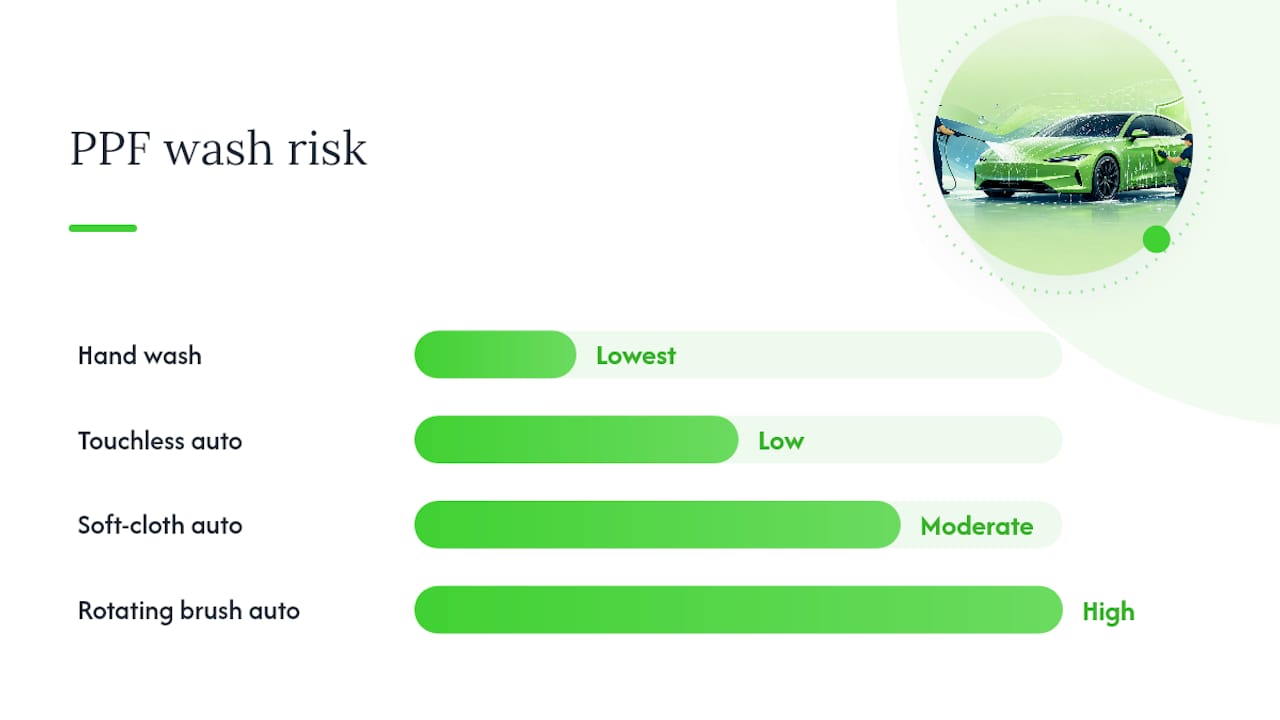
Touchless washes are the only automated option worth considering for PPF. They use high-pressure water and detergents without physical contact, which keeps the risk of edge lift low. That said, some touchless washes use aggressive alkaline detergents to compensate for the lack of scrubbing. If you're using one regularly, check whether the facility uses pH-neutral or low-alkaline chemistry.
Pressure washer rules:
- Stay 12–24 inches from the surface at all times
- Use a 40-degree wide-angle nozzle, never a zero-degree or 15-degree tip
- Never spray directly at film edges or seams, even at safe distances
- Avoid sustained pressure in one spot
After any touchless wash, run your hand along the edges of the film on your hood, mirrors, and bumper. If anything feels raised or soft, have a professional check it before the next wash.
A maintenance schedule that actually works
The curing window
The first 7–14 days after installation are the most critical. During this period, avoid washing entirely, skip steam cleaning, and keep the car out of heavy rain if possible. Surface moisture pockets are normal and will resolve as the adhesive cures.
Routine schedule
| Interval | Task |
|---|---|
| Every 1–2 weeks | Hand wash with pH-neutral shampoo |
| Every 3 months | Edge and seam inspection; remove any contaminant buildup at film borders |
| Every 6 months | Apply a PPF-safe synthetic sealant or ceramic spray topper |
| Annually | Professional health check: edge integrity, adhesive fatigue, top-coat rejuvenation |
Owners in high-dust environments (desert regions, construction zones) or those who park outdoors year-round should wash closer to the weekly end of that range. Garage-kept vehicles in mild climates can stretch to biweekly without issue.
Lifespan expectations
Most quality PPF carries a manufacturer warranty lasting several years. The actual lifespan under that warranty depends heavily on how consistently the film is maintained. Owners who wash regularly, avoid abrasive products, and schedule annual professional inspections to restore top-coat hydrophobicity tend to see film perform at or near its full rated life. Owners who skip inspections, use incompatible products, or run through brush washes regularly often see edge lift and yellowing well before the warranty period ends.
For a full breakdown of what PPF packages typically cost and what warranty bands cover, the PPF cost guide covers the current market in detail.
How to handle stains, scratches, and damage
Bird droppings, bug splatter, and tree sap
Speed matters here. Acidic contaminants like bird droppings and tree sap should be addressed as soon as you notice them, ideally within a few hours on a hot day. The method:
- Saturate the area with a pH-neutral detailer spray or diluted car shampoo. Let it dwell for 30–60 seconds.
- Gently lift the softened contaminant with a damp microfiber cloth. No scrubbing.
- Rinse the area clean and dry it immediately.
- For stubborn tree sap, isopropyl alcohol (diluted to 50%) applied with a microfiber pad works without harming the film. Dwell briefly, then lift.
Road salt and tar
Winter road salt is corrosive and accumulates in panel gaps and along film edges. Rinse the underside and lower panels thoroughly after driving in salted conditions. For tar spots, a dedicated tar remover that's confirmed PPF-safe is the right tool. Apply, dwell, wipe gently.
Light scratches and swirl marks
This is where self-healing film earns its name. Minor surface scratches on modern PPF often disappear with heat. Park in direct sunlight for 20–30 minutes, or pour warm (not boiling) water over the affected area. The film's elastomeric top coat flows back into place. This works for light swirl marks and fine scratches. It won't fix deep gouges or rock chips that have broken through the film.
Rock chips and edge lift
A rock chip that penetrates the film but hasn't reached the paint beneath is still doing its job. Monitor it. If the chip is large, the edges of the damaged area start lifting or you can see the paint underneath, it's time for a professional assessment. Partial panel replacement is often the right call and is far cheaper than a full repaint.
When to call a professional:
- Edges lifting at corners or along panel borders
- Adhesive discoloration (dark lines or browning visible beneath the film)
- Large rock chips with exposed paint
- Persistent yellowing or hazing that doesn't respond to cleaning
- Any warranty evaluation or claim
For headlight-specific film care, which has its own set of considerations, the headlight PPF guide covers the details.
Should you add a ceramic coating over your PPF?
Yes, and most installers recommend it. A ceramic coating applied over PPF creates a hydrophobic layer that causes water to bead and sheet off the surface, which means contaminants bond less firmly and routine washing takes less effort. The coating acts as a sacrificial top layer over the film, taking the daily environmental abuse before it reaches the PPF itself.
Benefits of ceramic over PPF:
- Water beads aggressively, reducing water spot formation
- Bird droppings and sap are easier to remove before they etch
- Less frequent sealant reapplication needed
- The film's self-healing properties remain fully intact beneath the coating
Maintenance differences with ceramic over PPF:
- You can extend your sealant reapplication interval from every 6 months to roughly every 12–18 months
- The wash routine stays the same (pH-neutral soap, two-bucket method)
- The ceramic layer will eventually degrade and need recoating, typically every 2–3 years depending on the product and exposure
When to skip it: If you're planning to sell the vehicle within a year or two, or if budget is a constraint, the film alone still provides strong protection. The ceramic layer is an upgrade, not a requirement. Check the ceramic coating warranty guide before committing, since some film warranties have specific language around aftermarket coatings applied over the film.
Pro Tip: Have the ceramic coating applied at the same shop that installed your PPF. They'll know the film's cure state, edge condition, and which coating chemistry is compatible with the specific film brand.
Installer tips from the shop
These are the checks and habits that separate owners whose film lasts a decade from those who come back with edge lift at year three.
Pre- and post-wash inspection checklist:
- Run a finger along every film edge after washing. Any raised section needs attention before the next wash.
- Check seams on the hood, mirrors, and bumper corners. These are the highest-stress points.
- Look for adhesive discoloration (browning or darkening beneath the film) at panel edges.
- After drying, hold a light at a low angle across the film. Hazing, orange peel changes, or dull patches indicate top-coat degradation.
Installer-recommended products and tools:
- pH-neutral car shampoo (look for a pH of 6–8 on the label)
- 800-GSM or higher microfiber drying towels
- Ceramic spray toppers for between-wash protection
- 40-degree wide-angle pressure washer nozzle
- Electric air blower for contactless drying
Edge care: The edges are where film fails first. Keep spray angles away from seams, and if you notice any edge starting to lift, don't try to press it back down yourself. Adhesive reactivation requires heat and the right tools.
Annual top-coat rejuvenation, applied by a professional, restores hydrophobic performance when the film's surface starts to lose its water-beading ability. This is especially relevant in high-UV environments like Southern California, where sun exposure degrades top coats faster than in cooler climates.
Pro Tip: Climate-controlled installation matters more than most owners realize. Film applied in a dusty or temperature-variable environment traps contaminants under the adhesive and cures unevenly, which shortens its effective life regardless of how well you maintain it afterward.
For owners of Teslas and other EVs, which have specific paint characteristics and panel geometries, the Tesla paint protection guide covers model-specific considerations worth knowing.
What most owners get wrong about PPF care
The biggest mistake isn't using the wrong soap. It's treating PPF like it's indestructible because it's a "protection" product.
PPF protects your paint. Nothing protects the PPF except your maintenance habits. Owners who skip the curing window, run through brush washes "just once," or let bird droppings sit for days because the film "can handle it" are the ones who end up with yellowed, lifting film at year four on a product rated for ten.
The second mistake is ignoring edges. The film's surface is durable. The edges are not. Every high-pressure spray aimed at a seam, every brush catching a corner, every clay bar dragged across an edge is a small failure waiting to compound. Quarterly edge checks take five minutes and catch problems before they become panel replacements.
One thing that genuinely surprises owners: the self-healing property has limits. It works on surface-level scratches with heat. It does not work on deep rock chips, cuts, or damage that reaches the adhesive layer. Expecting the film to "heal itself" out of a significant impact is how owners miss the window for a clean repair and end up with a larger replacement job.
Tintandwrapscustoms keeps your PPF performing year after year
PPF is a long-term investment, and the shop that installed it should be the one helping you maintain it. At Tintandwrapscustoms in Van Nuys, CA, the team handles the full protection lifecycle: PPF installation in a climate-controlled facility, annual film health checks, ceramic coating over PPF, and spot repairs when damage happens.
Every vehicle that comes through gets a manufacturer-backed warranty and an installation environment that gives the film its best possible start. Over 1,000 vehicles protected in the San Fernando Valley, including a strong track record with Tesla and EV owners who need precise panel-fit work.
If your film is past its first year, or if you've noticed any edge lifting or hazing, an annual inspection is the right next step. Book your PPF health check at Tintandwrapscustoms and get a clear picture of where your film stands before small issues become expensive ones.
Sources
- PPF Maintenance: Washing and Care Guide After Installation
- PPF Maintenance and Aftercare: The Master Craftsman’s Guide (2026)
- Best Way to Maintain PPF with Ceramic Coating (2025 US ...
- Engineerskill