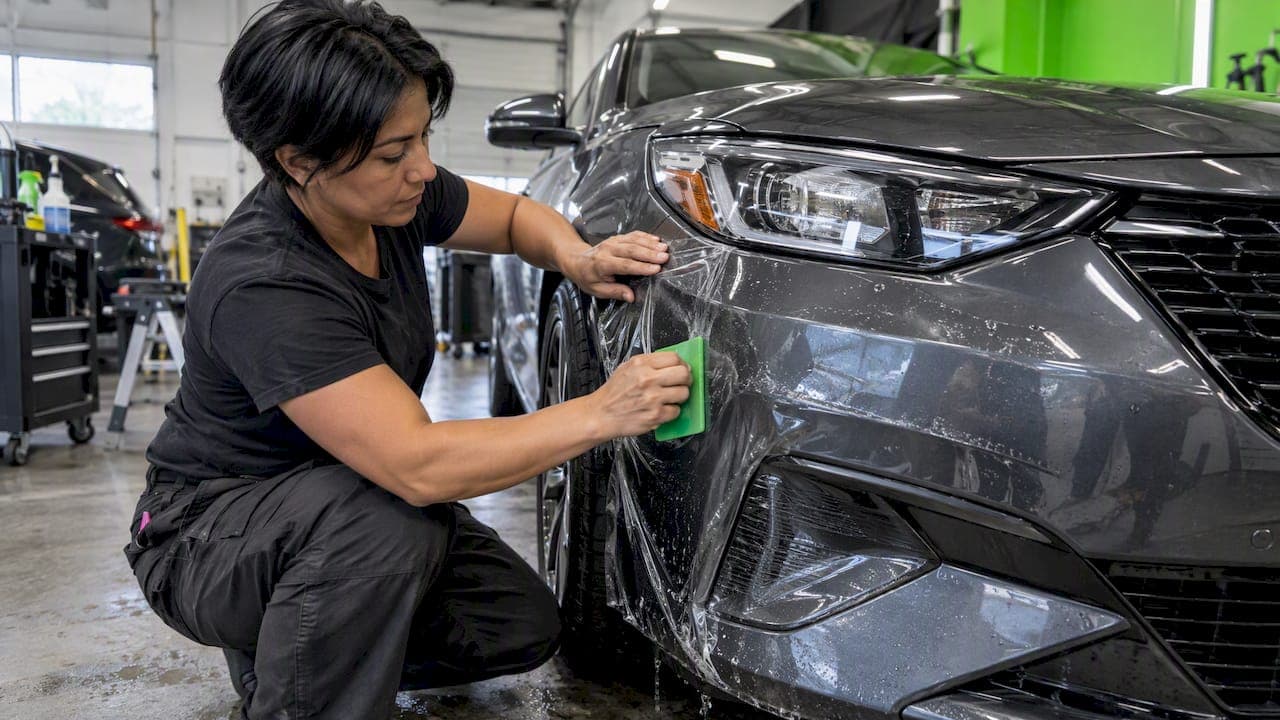
Paint protection film (PPF) is a clear, flexible urethane layer applied over your paint. Its main benefits are defense against rock chips and scratches, resistance to stains and UV damage, a self-healing surface for light marks, and a better chance of keeping the original finish intact for years. It does not make paint invincible, and it works best when a trained installer puts it on clean, well-bonded paint.
Below, we go through each benefit, what it means in daily driving, where the film's limits are, and how to decide which areas of your car are worth covering.
TL;DR
- PPF acts as a sacrificial barrier: road debris hits the film instead of your paint.
- Light scratches in quality self-healing film can disappear with time, sun or gentle heat. Deep gouges can still get through.
- It helps with bird droppings, bugs, tree sap, road tar and UV fading on the painted surface. It does not shield the people inside the car from UV; window tint does that.
- Poor installation or weak paint can cause problems, so the installer and the paint's condition matter as much as the film.
- Most owners start with the high-impact areas (front bumper, hood, fenders, mirrors) and expand to a full front or full body if they want it.
Table of Contents
- Why owners put film on their cars
- Benefit 1: Rock chip and scratch protection
- Benefit 2: Self-healing for swirls and light scratches
- Benefit 3: Resistance to stains, bugs, sap and road grime
- Benefit 4: UV protection for the paint (and what it does not cover)
- Benefit 5: Appearance that stays closer to new
- Benefit 6: Resale value
- Benefit 7: Long service life and a warranty
- Where PPF has drawbacks
- Where to put film: coverage levels
- Our perspective
- Get PPF installed in Van Nuys
- FAQ
- Sources
Why owners put film on their cars
Paint is thin. The clear coat on a modern car is the only thing standing between metal and a daily barrage of gravel, sand, insects and sun. PPF adds a replaceable layer on top of it. Hagerty describes it as a barrier against stone chips, bird and tree droppings and UV rays that doesn't detract from the car's looks. Edmunds calls it a sacrificial layer between road hazards and the finish.
That idea is the whole logic of PPF. You accept that something will get hit. You decide whether it is the film or the factory paint. When the film is damaged or worn, it can be removed and replaced, and the paint underneath is still there. A respray or a touch-up pen is a much bigger job.
In the San Fernando Valley, that matters more than most places. Freeway miles on the 405, 101 and 5, construction debris, strong sun for most of the year and cars parked outdoors all add up. A car that looks fine at year one can look tired by year four without any single dramatic event.

Benefit 1: Rock chip and scratch protection
This is the benefit most people buy PPF for. Chips happen at the front of the car, where it meets everything the vehicle ahead kicks up. 3M states its film is designed to protect paint from rock chips, scratches, bug damage, road tar, stains and harsh UV weathering.
Manufacturers also test for it. XPEL's technical data sheet for its Ultimate Plus film reports no detrimental effect in stone-chip testing under its stated ASTM D3170/SAE J400 conditions. Those are lab conditions, not a promise about every pebble at 75 mph, but they show the film is built and measured for this job.
What you will notice in practice:
- Fewer pits on the leading edge of the hood and bumper.
- Fewer light scratches from door-edge contact, keys, bags and car wash grit around handles and sills.
- Less visible wear on lower rocker panels, which take a beating from gravel and curbs.
The film has limits. Heavy impacts, sharp objects and deep scratches can cut through it. The film's job is to take the everyday abuse, not stop a collision. If rock chips are your biggest worry, our installer notes on rock chip protection go deeper on where and how film holds up.
Benefit 2: Self-healing for swirls and light scratches
Many premium films have a top coat that recovers from minor marks. XPEL's data sheet says its clear coat uses elastomeric polymers that let scratches in the surface heal over time. 3M describes the same idea as removing minor scratches or marks with heat applied to the film.
How fast? XPEL's care guidance says light scratches on Ultimate Plus self-heal in 20 to 30 minutes at room temperature, and in cold conditions warm water at 120°F can speed things up. LLumar says its Valor film heals surface scratches with sun or engine heat.
In California, a car sitting in the sun often does the work for you. A fine scratch from a zipper or a wash mitt can fade by the time you walk back to the car.
What will not heal:
- Scratches that cut through the top coat into the film body.
- Gouges, punctures and tears.
- Damage to any part of the car that is not covered.
Self-healing varies by film, so ask which product is going on your car and what that manufacturer says it does.
Benefit 3: Resistance to stains, bugs, sap and road grime
Bird droppings, bug splatter and tree sap are acidic or sticky, and they can etch unprotected clear coat if left. Film gives them something sacrificial to sit on. RAC lists road debris, scratches, chips, UV, bird droppings, tree sap and road salt among the things PPF shields against. LLumar says its film gives better defense against acid rain, bird droppings and tree sap.

Many films also have a hydrophobic top surface that sheds water. LLumar notes that environmental conditions and cleaning products can affect that hydrophobic behavior, so it is not permanent. If you want extra slickness and easier washing, a ceramic coating can be added over the film. We cover the timing in ceramic coating over PPF, including the manufacturer's wash wait.
The film does not mean you can ignore the car. XPEL tells owners to remove bugs, bird residue and hard-water spots promptly. Film makes cleanup easier and safer. It does not make contamination harmless.
Benefit 4: UV protection for the paint (and what it does not cover)
Sun fades and oxidizes paint, especially reds, blacks and other saturated colors, and it dries out clear coat over time. PPF helps. RAC notes it protects paint from UV rays that can cause fading and discoloration, and 3M lists UV weathering among the hazards its film is designed to handle.
One point trips people up. PPF goes on the painted body. It does not protect you, your kids or your dashboard from the sun coming through the glass. For that you need window tint. If your family spends time in the car, a quality ceramic or carbon film on the glass is the right tool, and it pairs naturally with PPF on the outside. See our window tinting options for how those films differ.
Think of the two as covering different surfaces:
| Surface | What protects it | What it guards against |
|---|---|---|
| Painted body panels | PPF | Chips, scratches, stains, UV fading |
| Side and rear glass | Window tint | Heat, glare, UV reaching occupants and interior |
| Headlights and taillights | Tint or clear film | Cosmetic change, some surface protection |
Benefit 5: Appearance that stays closer to new
Good PPF is nearly invisible. It keeps the factory color and gloss, which is why enthusiasts who like their paint choose it over a wrap. If you want to change how a car looks, a vinyl wrap does that. If you want to keep how it looks, film does. We compare the two in PPF vs vinyl wrap.
RAC says PPF gives a seamless, sleek look and helps maintain a vehicle's value. There are also finishes for special paint. Owners of matte and satin cars can get a film that keeps the non-gloss look, though it requires its own prep, which we outline in PPF on matte paint.
Benefit 6: Resale value
Buyers pay for clean, original paint. Chips on the nose and swirls on the hood are the first things they see. One market report claims that after three years of ownership cars with PPF showed an average resale value increase of 10 to 15%. Treat that as an industry estimate, not a guarantee. Your result depends on the car, mileage, condition and market.
The logic is easier to trust than the number: original paint in strong condition is worth more, and film is one way to keep it that way. That is especially true for rare or collectible cars. For a view on how buyers weigh originality, see this look at original vs. restored classic cars.
If you will keep the car for ten years, the value is in how it looks and drives every day, not just at sale.
Benefit 7: Long service life and a warranty
The film lasts. Edmunds says that under ideal conditions, modern PPF can last up to 15 years. Real life is shorter and depends on film, sun exposure, washing and care. Avery Dennison lists an expected outdoor durability of five years for its Supreme PPF Enduro, which shows that products differ. Our guide to PPF lifespan covers what shortens and extends it.
Warranties matter here. Edmunds notes that PPF must be professionally applied by an authorized installer to qualify for warranties. That is one more reason to leave installation to a shop rather than a kit.
Where PPF has drawbacks
A fair list of benefits needs a fair list of limits.
- Cost. Hagerty says PPF can be expensive and labor-intensive to install. Price depends on coverage, vehicle size, panel shapes and film. We quote after seeing the car.
- Installation quality. The same source warns that poor application can leave bubbles, dirt and marks under the film. A clean, dust-controlled bay and an experienced installer prevent most of this.
- Paint condition. Hagerty says compromised paint may flake off when film is removed, and original or older repainted surfaces can be a gamble. Spinny makes the same point: suitability depends on how well the paint is bonded to the panel. A good installer inspects before quoting.
- Care. Treat it like paint, with some extras. XPEL warns against unapproved solvents, chemicals and abrasives and says pressure washing close to film edges can lift or damage the film.
- Removal. At end of life, the film comes off. That is straightforward on sound paint, and we cover the typical numbers in PPF removal cost.
Where to put film: coverage levels
You do not have to wrap the whole car. Hagerty notes film is generally applied to areas exposed to road debris: the front bumper and fenders, hood, mirror caps and lower rocker panels.
Our PPF page lists three common packages:
- The Track Pack: a targeted package for the highest-impact areas.
- Full Front: the bumper, hood, fenders and mirrors, where most chips happen.
- Full Body: every painted panel, for owners who want the most coverage.
How to choose:
- Daily commuter on freeways: start with Full Front.
- Weekend or track car: the Track Pack covers the areas that see abuse, and you can add panels later.
- New or high-value car you plan to keep: Full Body gives uniform protection and a consistent look.
- Leased car: consider the front end only, and check your lease terms.
If you are comparing film brands, our write-up on XPEL vs 3M PPF lays out the differences. For planning your drop-off, see PPF install time.
Our perspective
Most customers who come to us after a bad chip say the same thing: they wish they had done it before. We understand that, but we try not to sell fear. PPF is worth it when the car matters to you and you plan to keep it, and it is not the right call for every vehicle.
Here is how we think about it:
- Prep is half the job. We install in a climate-controlled, dust-free facility because dust under film is permanent. Temperature and cleanliness decide how a panel lays down.
- Check the paint first. If a panel has a bad repaint or weak adhesion, we tell you before we cover it.
- Tesla and EV owners are a big part of our work. These cars have sensors, cameras and unusual panel shapes, and we install with those in mind so nothing interferes with how the car operates.
- Pair the right products. Film on the paint, tint on the glass, and ceramic coating where it fits. Each does a different job.
- Match the film to the goal. If you want a new color, we will say a wrap is the better tool.
We have protected more than 1,000 vehicles in the Valley, and the best result is the one you stop thinking about because the car just keeps looking right.
— Jake
Get PPF installed in Van Nuys
If you want film done right, we install paint protection film at our Van Nuys shop, in a climate-controlled facility, with manufacturer-backed warranties. Tell us about your car and how you drive it, and we will recommend coverage that fits.
If the sun is your concern inside the car, ask about window tint in the same visit. You can see all our services on the Tint & Wraps Customs homepage.
FAQ
Does PPF protect me and my family from UV rays inside the car?
No. PPF covers the painted exterior, so it protects the paint from fading. The sun that reaches passengers and the interior comes through the glass, and window tint is what addresses it. Many owners add both.
Is PPF worth it on a new car?
Usually, if you plan to keep the car and drive it on freeways. New paint is the best surface for film, and covering the front end early prevents the first chips. Gains are smaller on a car you will sell soon or one that already has paint damage.
Can PPF get damaged or leave marks?
The film can be scratched deeply, torn or lifted at the edges if poorly cared for. Hagerty notes that weak or repainted paint may flake when film comes off, which is why we inspect paint before installing. Proper washing and PPF-safe products keep it in good shape.
How is PPF different from ceramic coating?
PPF is a physical film that absorbs impacts and light scratches. Ceramic coating is a thin chemical layer that adds gloss and makes washing easier, but it does not stop rock chips. Many owners use film on the front end and coating over everything.
How long does PPF last?
That depends on the film, sun exposure and care. Edmunds says modern film can last up to 15 years under ideal conditions, while some product sheets list shorter expected durability. Ask your installer which film is going on and what its warranty covers.
Sources
- Car Paint Protection Film (PPF): Is It Worth It? (Edmunds)
- What You Need to Know About Paint Protection Film (Hagerty)
- Scotchgard Paint Protection Film Pro Series 200 Gloss (3M)
- XPEL Ultimate Plus technical data sheet, stone chip testing
- XPEL Ultimate Plus technical data sheet, self-healing clear coat
- XPEL Product Care Instructions
- Valor Paint Protection Film (LLumar)
- The pros and cons of Paint Protection Film (RAC Drive)
- Paint Protection Film Market report (Market.us)
- Supreme PPF Enduro product data sheet (Avery Dennison)