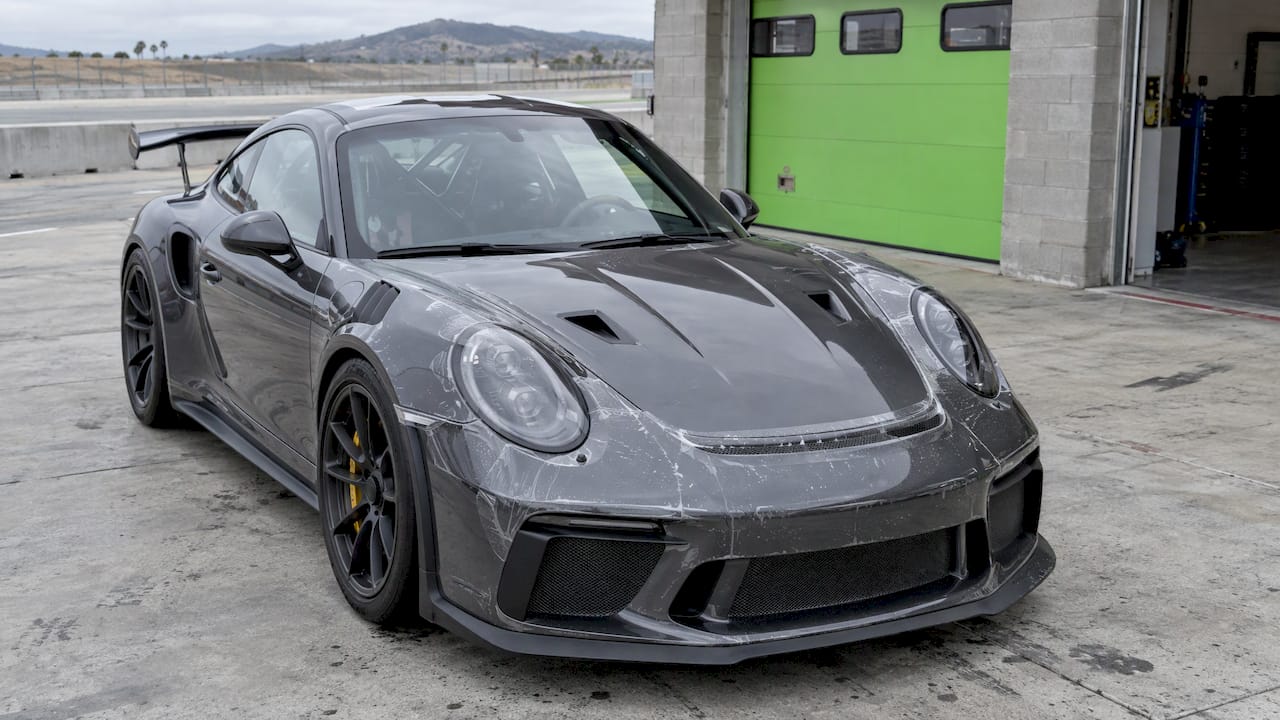
For a car that sees track days, the best paint protection film (PPF) setup is usually a track pack: clear film on the front end and the other panels that take the most strikes, installed by a shop that can show you the exact film, the install conditions and the warranty paperwork. Full-body film is rarely needed. Skipping film on the nose is the most common way to end up with a chipped hood. At Tint & Wraps Customs in Van Nuys, CA, we offer a Track Pack alongside Full Front and Full Body PPF, installed in a climate-controlled facility, so you can match coverage to how you drive.
This guide covers what track PPF protects against, how the coverage levels differ, how installation and aftercare work, and what to confirm before you hand over your keys.
TL;DR
- Rock chips are the main enemy at track days and autocross. The Porsche Club of America says they are the most common source of front-end damage, usually from debris thrown up by the car ahead.
- Coverage runs from a small clear bra to full front to full body. For most track drivers, a targeted pack on the high-strike panels gives the best protection for the money.
- Film quality, installation conditions and the warranty paperwork matter as much as the coverage map.
- Follow the film maker's wash-wait window after install, and never pressure wash near film edges.
- Our Track Pack, Full Front and Full Body options are listed on our paint protection film page.
Table of Contents
- What track PPF actually protects against
- Track pack, full front or full body: which coverage fits
- What to check about the film itself
- How PPF is installed on a track car
- Warranty: product coverage versus workmanship
- Aftercare for track-day PPF
- What track PPF costs
- Perspective
- Ready to protect your track car
- FAQ
- Sources
What track PPF actually protects against
Paint protection film is a clear, flexible urethane layer applied over factory paint. On the street it handles gravel, bug acid and light scuffs. On track, the job is more specific: absorbing the stream of small stones, rubber pieces and debris that cars throw backward at speed.
The Porsche Club of America's autocross guide describes the mechanism clearly. Sticky tires pick up road debris and fling it at the car behind, and the damage lands in the same high-strike areas every time: the front bumper, the leading edge of the hood, the fenders and the mirrors. That repeatable pattern is why track-focused film is planned around zones, not around the whole car.
Film is not magic. A hard, sharp strike or an aggressive chemical can still get through, so no honest installer promises a chip-proof car. What film does is take the many small hits that would otherwise leave a crater in your clear coat, and it spares you from repainting a hood every season.
If you want a broader look at what the film does day to day, our article on PPF benefits covers it.
Track pack, full front or full body: which coverage fits
There are three common levels. The Porsche Club of America describes the range this way: a clear bra covers the front bumper and the hood edge, full-front coverage adds the rest of the front end, door pillars and side mirrors, and full-vehicle PPF covers everything. The club calls full-vehicle film often overkill for autocross.
| Coverage level | What it generally covers | Best for |
|---|---|---|
| Clear bra | Front bumper and leading hood edge | Occasional events, tight budgets |
| Full front | Entire front end, pillars and mirrors | Daily drivers that also see the track now and then |
| Track pack | A targeted set of high-strike panels beyond the nose | Regular track days and spirited driving |
| Full body | Every painted panel | Show cars, collectors, cars that are also driven hard every day |
Our Track Pack is built for cars that see track days. The details of what it includes are on our track pack PPF article, which describes it as a five-panel package. If your car is mostly a daily driver with the occasional event, our full front PPF guide explains why that level suits it. For a car where every panel matters to you, we also install Full Body film.
How to decide which panels matter
Start with where stones actually land, then add how you drive.
- Front clip first. Bumper, hood, fenders and mirrors take the most direct hits at any speed.
- Lower side panels next. If you follow other cars closely or run on tracks with loose gravel at the edges, rocker panels and the lower doors collect debris.
- Rear impact zones last. These matter if you are often followed at close range, such as in group sessions or on a drag strip.
- Consider your car's shape. Low splitters, wide fenders and sharply raked hoods all change which edges are exposed.
The point of a pack is to put film where your car gets hit, not to pay for coverage on the roof and trunk lid that rarely see a stone. When you bring your car in, we can look at it with you and talk through the right coverage for how you use it.
What to check about the film itself
Not all clear film is equal, and the differences show up on track: heat, sun and abrasion are harder on film than a commute is. Four questions are worth asking any installer.
- Which exact product line is going on the car? A shop should name it, not say "premium film". The manufacturer's product warranty depends on it.
- Is it a thermoplastic urethane with a self-healing top coat? Self-healing means light swirls and scratches can disappear with warmth. Avery Dennison's application bulletin says light scratches self-heal in 20 to 30 minutes at room temperature, or faster with 120°F warm water. Our guide to self-healing PPF explains how that behaves in real use.
- How does the film look on your color? Haze or an orange-peel texture shows most on black and dark metallic paint. Look at a dark panel in direct sun and at a shallow angle, not just under shop lights.
- What does the warranty cover, and who backs it? More on that below.
You do not need to become a materials chemist. You need an installer who can answer those questions without hesitation.
How PPF is installed on a track car
Installation is where most of the quality is won or lost, and it is slow, careful work. The steps are set by the film makers.
- Wash and decontaminate. 3M's installation guide prescribes washing, cleaning off adhesive residue and clay-bar decontamination before film touches the car. Any grit left on the paint ends up under the film permanently.
- Prepare the surface. The same guide has a 15-minute wait for adhesive to dry before the film is pressed down.
- Apply with slip and tack solutions. Avery Dennison's bulletin specifies a slip solution of 1 liter of water with 2 mL of baby soap, and a tack solution of 75% water and 25% isopropyl alcohol. Film is squeegeed with a 50% stroke overlap, and it is stretched over curves without heat.
- Check the paint. Avery Dennison warns that paint that is not factory original must be fully dry, hardened and free of scratches before film goes on, or the film can fail to bond, shrink or blister.
- Cure. The film needs time to settle before it sees water or hard use.
That last point on paint deserves attention on a track car. If you have had a respray or touch-ups after a prior incident, tell the installer up front. Paint that has not fully cured is a reason to wait, not a reason to rush.
Why the installation environment matters
Dust is the enemy of clear film. A particle trapped under the film shows as a permanent bump, and on a hood you will see it every time the sun hits it. That is why we install in a climate-controlled, dust-free facility. Stable temperature and clean air help the film lay down and the adhesive behave the way the manufacturer intended.
For Tesla and other EV owners, we also pay attention to sensor areas and fit. Our Tesla expertise is built around factory-quality fit with no sensor interference.

How long does it take?
Time depends on the coverage level, the car and its paint condition. A front-end pack is a much shorter job than a full-body wrap of film. We will give you a timeline when we look at your car, rather than a one-size number.
Warranty: product coverage versus workmanship
Two different promises sit behind a PPF job, and they are easy to confuse.
- Manufacturer warranty. This covers the film itself against defects such as yellowing, cracking or peeling, for the period the manufacturer sets. Our installations carry manufacturer-backed warranties.
- Installer workmanship coverage. This covers how the film was applied: lifting edges, contamination under the film, poor seams.
Registration is part of making the manufacturer warranty real. The typical record ties the film to your VIN, the install date and the installer. Our article on registering within 30 days walks through why that window matters.
It also helps to know that other warranties on your car are separate. A carmaker's rust perforation warranty, for example, deals with corrosion through body panels, not with stone chips or film. Film coverage stands on its own paperwork, so keep it with your car's records.
One honest limit applies to any film: a stone that cuts through the film is generally handled as impact damage, not as a defect. Film is built to absorb strikes, and the warranty protects you from the film itself failing.
Aftercare for track-day PPF
Film lasts longer when it is washed and handled properly, and track cars get dirty fast.
- Wait before the first wash. Avery Dennison says to wait 48 hours after installation. 3M's guide recommends waiting one week before washing or waxing. Follow the sheet for the film on your car and ask your installer which applies.
- Wash gently and in the shade. Hand wash on a cool surface. Avoid hot panels, especially right after a session.
- Never aim a pressure washer at film edges. Avery Dennison warns against it because water at pressure can lift edges. That includes the coin-op bay at the track.
- Seal it. Avery Dennison suggests sealing the film at least every 3 months with a sealant or a wax free of petroleum distillates.
- Let small scratches heal. Warmth does the work. Do not rub at them.
After a hard weekend, wash the car before brake dust, rubber and bug residue bake on. Our PPF maintenance guide has a full routine, and you can add a ceramic coating on top of the film for easier cleaning, as covered in our piece on ceramic coating and rock chip protection.
What track PPF costs
Price depends on the coverage level, the size and shape of the car, and the condition of your paint. Existing chips and scratches need attention before film goes on, because film seals in what is underneath. Full body coverage costs more than a track pack, which costs more than a clear bra. Because the work is quoted per car, we do not publish a set price. Our PPF cost guide explains what drives a quote, and the fastest way to a real number is to bring the car in.
Perspective
Most track drivers ask us the wrong first question. They ask how much film they can afford, when the better question is where their car actually gets hit.
We build coverage around that. A car that runs a few events a year and drives to work on weekdays usually does well with full front. A car that spends its life in session after session gets a track pack so the nose and the other exposed panels are covered. Full body is for owners who want every panel protected, and we do that too.
What we care about most is the part you cannot see once the car leaves: a dust-free, climate-controlled bay, clean prep, film that is registered under a manufacturer warranty. That is how we have protected more than 1,000 vehicles, and it is why our customers keep telling us they notice the attention to detail.
If you drive a Tesla or another EV, we take the same care around sensors and edges so the fit looks like it came from the factory.
Jake
Ready to protect your track car
We install Track Pack, Full Front and Full Body paint protection film at our Van Nuys shop, with manufacturer-backed warranties on the film. Tell us how often you run and what you drive, and we will recommend the coverage that makes sense for your car. See the options on our paint protection film page.
If you also want the rest of the car sorted, we do ceramic coating, window tinting and headlight tinting in the same facility.
FAQ
Is full-body PPF worth it on a track car?
For most drivers, no. The Porsche Club of America calls full-vehicle film often overkill for autocross, because damage concentrates on the front end. Full body makes sense if you want every panel protected for show or resale, and we install it when that is your goal.
How long should I wait before taking a freshly filmed car on track?
The film needs time to cure, and the maker's wash-wait window is a floor, not a plan. Avery Dennison says 48 hours before washing and 3M says one week before washing or waxing. Ask us at pickup how long to wait for the film on your car.
Can PPF be removed after track use?
Yes. Film can be taken off, and a good install on sound paint comes off without harming it. Paint that was resprayed or not fully cured is the exception, which is why we check paint condition before we start.
Does PPF make a car rock chip proof?
No, and any shop that says so is overpromising. Film absorbs most of the small strikes that would chip bare paint, but sharp objects and very hard hits can still get through. Our rock chip protection article goes into what to expect.
Can I put a ceramic coating over PPF?
Yes, and many owners do it to make washing easier after dirty track weekends. We cover that combination in our guide to ceramic coating and rock chip protection.
Sources
- 5 Tips for Protecting Your Porsche Paintjob for Autocross, Porsche Club of America
- 3M Paint Protection Film Installation Solutions Guide
- Avery Dennison IB4.30 Paint Protection Film Application
- Rust perforation warranty explained