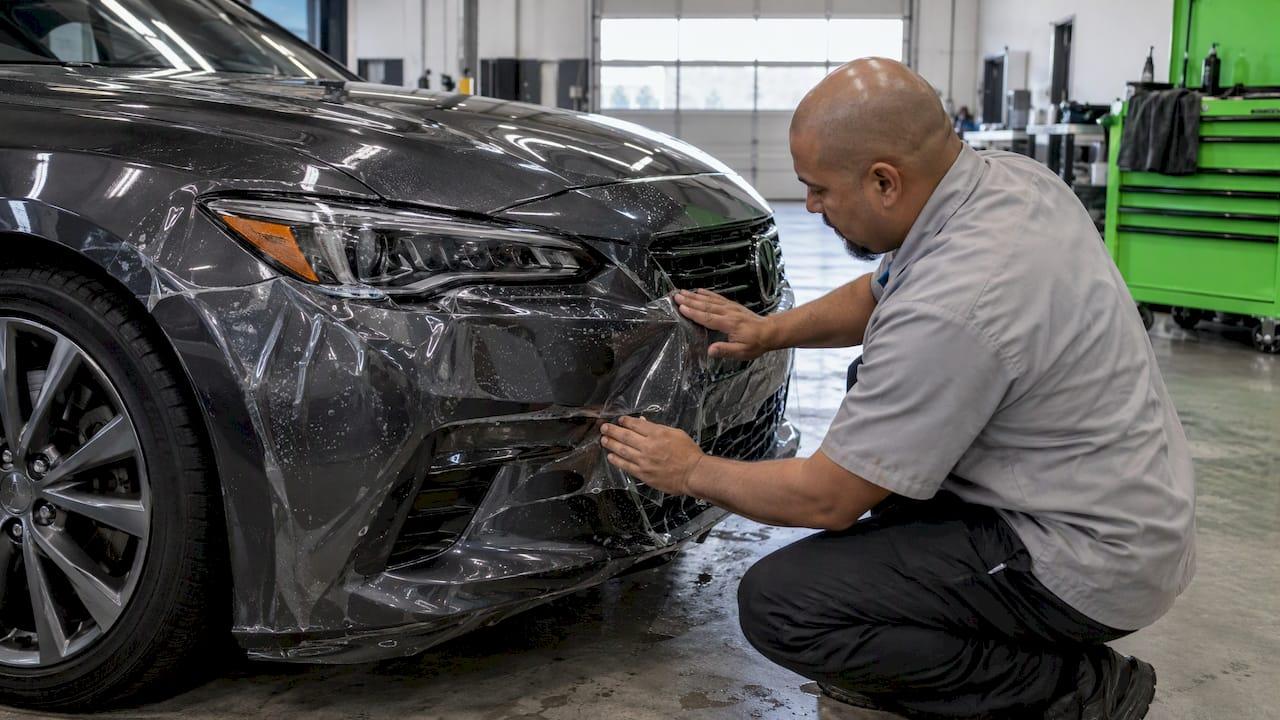
Ceramic coating does not stop rock chips. Paint protection film (PPF), a clear urethane layer applied over your paint, is the product built to take stone impacts. A ceramic coating then goes on top of the film or over the remaining panels, so you get impact protection and easy cleaning together. At Tint & Wraps Customs in Van Nuys, we install both in a climate-controlled facility, and we match the layout to how and where you drive.
This guide explains what each product does, where chips actually happen, how to choose coverage for your driving, and what to do about chips you already have.
TL;DR
- Ceramic coating bonds to paint as a thin, glass-like layer that repels water and contaminants. It does not protect against rock chips or deep scratches.
- PPF is a flexible physical barrier. It is the right product for the bumper, hood, fenders and mirrors, where stones land.
- The two work together: film on high-impact areas, coating over the film and the rest of the car.
- Existing chips should be repaired before any coating or film goes on, so the surface underneath is sound.
- Daily highway miles, a gravel road or a leased vehicle all point toward film on at least the full front end.
Table of Contents
- Does ceramic coating prevent rock chips?
- Why paint protection film handles rock chips
- Film and coating together
- How to choose rock chip protection for your driving
- What to do about rock chips you already have
- A worked example
- Why this work is best done by a specialist shop
- Our perspective
- Book your protection in Van Nuys
- Keeping the protection working
- FAQ
- Sources
Does ceramic coating prevent rock chips?
No, not in any way you can rely on. A ceramic coating is a liquid that cures into a hard, very thin shell on top of your clear coat. The Porsche Club of America describes it as a molecular bond with the paint that creates a glass-like shield against water and contaminants, and says plainly that it will not protect from rock chips and deep scratches.
The reason is physics, not product quality. A stone thrown up by the tire of a truck ahead of you at 65 mph carries a lot of energy in a very small area. A rigid, micron-scale layer bonded to the paint has no give. When the stone hits, the force goes straight through the coating into the clear coat and base coat beneath. The coating and the paint fail at the same spot.
That is why many of the pages ranking for this question give the same answer: coating is for gloss, chemical resistance and easier washing, and film is for impact. We agree with that split, and we install both.

What ceramic coating does protect against
Ceramic coating earns its place for the everyday damage that is not an impact:
- Water and contaminants. The hydrophobic surface sheds water, road film, bird droppings and bug residue more readily, so they are easier to rinse off before they etch the paint.
- UV exposure. Southern California sun is hard on clear coat. A coating adds a sacrificial surface layer between sunlight and your paint.
- Light marring. Fine swirls from washing are less likely to show on a hard, slick surface.
- Gloss and wash time. Paint looks deeper and cleaner, and the car washes faster.
For more on what a coating does day to day, see our guide to ceramic coating benefits. Our ceramic coating page lists the 1-year, 5-year and lifetime options we offer.
Why paint protection film handles rock chips
PPF is a clear, flexible thermoplastic urethane film that we install directly on the painted surface. Because it is a thick, elastic layer rather than a hard shell, it takes the hit instead of your paint. The Porsche Club of America notes that high-quality film can do what a ceramic coating cannot: protect paint from rock chips and scratches, and that the film's clear top layer gives it self-healing properties for light scratches.
Three practical differences matter to you as an owner:
- Thickness and flexibility. Film is many times thicker than a coating and it flexes. That is what lets it absorb a stone's energy and spread it out.
- Replaceable. If a panel of film is damaged badly, the film is what gets replaced, not the paint under it.
- Self-healing top layer. Light swirls and fine scratches in quality film can disappear with heat, such as a sunny day or warm water.
We go deeper on this in what paint protection film actually does and in our installer notes on rock chip protection.
Film and coating together
The two products are not rivals. The usual professional approach is to install the film first and then apply the ceramic coating over it. The film handles impact. The coating on top gives the surface the slick, easy-to-clean behavior and helps keep the film looking clean. The panels with no film get the coating directly.
This is the layout many owners choose:
| Area | Main risk | What protects it |
|---|---|---|
| Front bumper, hood leading edge, fenders, mirrors | Stone impacts at speed | PPF, then ceramic coating over the film |
| Rocker panels and lower doors | Gravel spray from your own tires and traffic | PPF, then ceramic coating over the film |
| Roof, doors, trunk, upper panels | UV, bird droppings, water spots, wash marring | Ceramic coating |
| Headlights | Stone pitting and haze | PPF or film made for lenses |
There is one timing detail worth knowing. Film installers typically ask you to wait before washing a freshly filmed car, and coating over film has its own rules. We cover it in ceramic coating over PPF, including the manufacturer's 72-hour wash guidance.
How to choose rock chip protection for your driving
Coverage is a decision about where the stones come from. Ask yourself these questions.
How much of your driving is highway?
Speed is the biggest factor. Chips come from stones thrown up by tires and from debris kicked off the road at closing speeds. A commute that includes long stretches on the 405, 101 or 5 puts more stones in your path than the same mileage on surface streets. If you drive 40 to 60 miles a day on freeways, film on the front end is the sensible baseline.
Do you drive on gravel, dirt or construction zones?
Gravel roads, canyon routes with loose shoulder material and construction zones all raise the odds of chips on the lower body as well as the front. In that case, think beyond the bumper and hood. Rocker panels and the lower part of the doors take the spray. Our guide to rocker panel PPF explains how that area is protected.
What color is the paint?
On dark paint, chips and swirls show quickly because the exposed light primer or metal contrasts sharply with the finish. If you own a black or other dark car, see PPF for black cars.
How long will you keep the car, and is it leased?
The longer you keep a vehicle, the more miles of road debris it takes. On a lease, front-end paint chips can turn into charges at return. Film on the exposed areas is a straightforward way to keep the paint in the condition you started with.
Which coverage level fits?
Our paint protection film page lists three packages:
- The Track Pack for the most exposed areas of the car.
- Full Front for the whole front end. Our guide to full front PPF for daily drivers explains why this suits commuters.
- Full Body for every painted panel.
If you are unsure which one fits, tell us your daily route, your parking situation and how long you plan to keep the car. That is usually enough to point to the right package.
What to do about rock chips you already have
A coating cannot fill a chip in paint. It is a thin layer that follows the surface, so a chip that has reached the base coat or primer stays a chip. Two points follow from this.
Paint chips. Have them repaired and the paint made sound before anything is applied over them. Film over an open chip can trap moisture and dirt against bare metal, and a coating bonded over damage locks the damage in. A clean, sealed surface is the foundation for both products.
Windshield chips. Glass is a separate matter. Windshield chips are usually repaired by injecting resin into the damage and curing it. Glass Doctor says a chip under about one inch is usually a candidate for resin repair, while larger damage typically calls for replacement. Another glass service lists the limits as a chip smaller than half an inch and at least 2 inches from any edge. These are the glass shop's rules, so get a windshield chip looked at promptly. A small chip can spread into a crack. If a chip is in your line of sight or near the edge, have a glass professional inspect it. A ceramic glass coating helps with water behavior, not chip repair. Our post on ceramic glass coating explains what it does.

A worked example
Take a leased Tesla Model Y that does 50 miles of freeway commuting five days a week. The exposed area is the nose: bumper, hood edge, fenders, mirror caps and the lower front of the doors. A ceramic coating alone would make the car easier to wash and keep the gloss, but a stone at 65 mph would still chip the paint.
The layout that fits is Full Front film on those panels and a ceramic coating applied over the film and over the rest of the body. The front end takes the stones. The coating keeps the whole car easy to clean and protected from UV. At lease return, the front paint is as it was at delivery.
A car that mostly sees surface streets and a garage has a different profile. For that owner, a ceramic coating on the whole car is often the main protection, with film on the bumper and hood edge as the option for a little extra.
Why this work is best done by a specialist shop
Both products depend on a clean, controlled installation. Dust under film shows as specks, and a coating cured in a dirty bay traps contamination in the finish. We do our installations in a climate-controlled, dust-free facility in Van Nuys for exactly this reason. We have protected over 1,000 vehicles, and customers have given us a 5-star rating for attention to detail.
For Tesla and other EV owners, fit matters in a different way. Our installations on Teslas are done to preserve the factory-quality fit and avoid sensor interference, which is a particular concern around the front-end sensors and cameras. Film and coating from us come with manufacturer-backed warranties.
Our perspective
We hear the same question every time someone considers a ceramic coating: will it stop chips? Our honest answer is that a coating and film do two different jobs, and the best result comes from using each for what it does.
For a car that sees freeway miles, we start the conversation with the front end. That is where stones land, and film is the layer designed to take them. Once the film is on, a ceramic coating over it makes the car easy to wash and protects the finish from sun. For the rest of the body, a coating alone is a strong choice.
We also care about how the work is done. Our climate-controlled facility keeps dust out of the film and the coating, and our Tesla work is aimed at a clean fit with no interference with sensors. Our warranties are backed by the manufacturers of the products we install.
If you tell us how you drive and how long you plan to keep the car, we can recommend a layout that fits.
Jake
Book your protection in Van Nuys
If you want chip protection that works and a finish that is easy to keep clean, our paint protection film and ceramic coating services are designed to be installed together. We offer film from The Track Pack to Full Body, and ceramic coating in 1-year, 5-year and lifetime options. Tell us about your car and your commute, and we will recommend where the film should go.

If you are also planning tint or a color change, we can plan the work together. See our window tinting and vinyl wrap options.
Keeping the protection working
A few habits make either product last.
- Wash regularly with a gentle method. Dirt left on film or coating is what dulls it. See our PPF maintenance guide.
- Follow the cure time. Give new film or coating the wash-free period your installer gives you.
- Keep the car out of the sun when you can. Shade and garages reduce heat and UV on all finishes.
- Fix new damage promptly. A new chip in unfilmed paint should be sealed before it grows or rusts.
FAQ
Does ceramic coating prevent rock chips?
No. Ceramic coating forms a thin, hard layer that resists water, UV and light marring, but it does not protect from rock chips. Paint protection film is the product designed to absorb stone impacts, and a coating can be applied over it.
Can ceramic coating fill an existing rock chip?
No. A coating follows the surface and cannot rebuild missing paint. Repair paint chips first, then apply film or coating over sound paint. Windshield chips are repaired with resin by a glass professional, and the repair is time-sensitive because chips can spread.
Should I get PPF, ceramic coating or both?
For cars that see freeway driving, gravel or a lease, both is the strongest setup: film on the front end and other exposed panels, with the coating over the film and the rest of the car. If you mostly want gloss and easy washing, a coating alone covers that.
Which areas of the car should get film first?
The front bumper, hood, fenders and mirrors take the most stones. Rocker panels and lower doors are next if you drive on gravel or in traffic. Full Front covers the whole front end.
Is a Tesla different from other cars for film and coating?
The work is the same in principle, but the front end of a Tesla has sensors and cameras, so fit matters. We install on Teslas with the aim of a factory-quality fit and no sensor interference.
Sources
- Porsche Club of America: Chasing Perfection and Protection, The Science Behind Paint Protection
- Glass Doctor: Windshield Chip Repair
- Vetro Auto Glass: We Stand By Our Work