A DIY 9H spray-on kit gets you roughly one to two years of protection; a pro single-layer application stretches that to two to four years; a premium multi-layer or graphene-infused install from an experienced shop can hold up for five to seven years or more. Every one of those numbers assumes a garaged car and a decent wash routine. Skip prep or park outside in a hot climate, and cut the estimate roughly in half.
TL;DR:
- Durability depends more on application quality and prep work than on brand or product type, with proper surface cleaning being essential for bonding.
- Professional installations in controlled environments typically last two to four years, while premium systems can reach five to seven years with proper maintenance.
- Coatings under direct sun, outside storage, or exposed to abrasive wash tunnels degrade faster, often halving the expected lifespan.
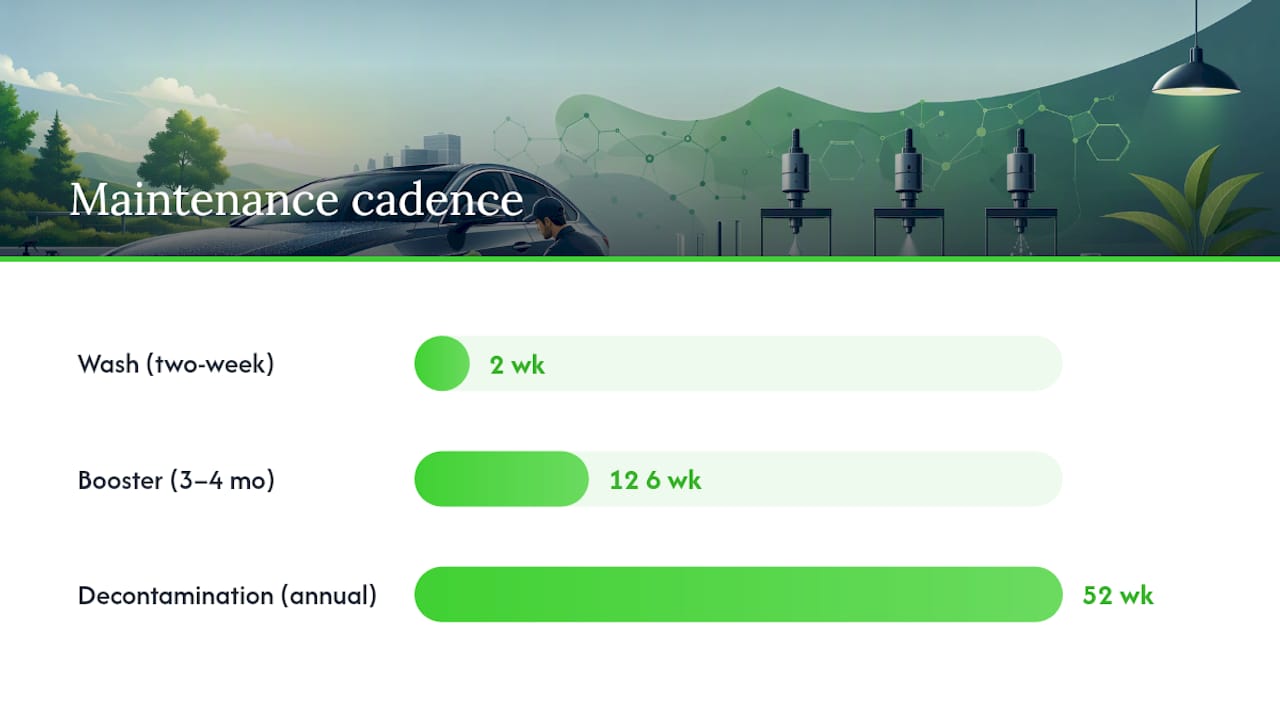
- Regular maintenance, including bi-weekly washing, quarterly boosters, and annual decontamination, can extend coating life significantly.
- Most coatings that appear to fail are simply contaminated or thinned, not chemically broken down, and can often be restored with proper cleaning.
Table of Contents
- Realistic Ceramic Coating Durability by Product Tier
- What Actually Controls Ceramic Coating Durability?
- A Maintenance Routine That Actually Extends Coating Life
- Is Your Ceramic Coating Actually Failing?
- Reading Ceramic Coating Warranty Claims Correctly
- What Our Installs Tell Us About Real-World Longevity
- Book a Climate-Controlled Ceramic Coating Install
- Sources
Realistic Ceramic Coating Durability by Product Tier
Ceramic coating durability breaks down almost entirely by what you're applying and who's applying it. That's the single biggest variable, bigger than brand, bigger than price point on the bottle.
Here's how the tiers actually shake out in the real world:
- Spray toppers and sealant boosters: 2 to 6 months. These aren't true ceramic coatings; they're a quick hydrophobic layer over an existing coat or bare paint.
- DIY 9H kits: 1 to 2 years on a garaged vehicle with hand washing; often under a year if the car lives outside and gets brush-washed at a tunnel.
- Prosumer/mid-tier 9H coatings: 2 to 4 years, assuming decent prep and consistent maintenance.
- Professional single-layer coatings: 2 to 4 years in most climates.
- Premium multi-layer or graphene systems, professionally installed: 4 to 7 years, sometimes longer, in a garaged car with regular boosters.
The gap between garage and outdoor storage is bigger than most owners expect. A coating baking under direct sun in Phoenix or Van Nuys degrades faster than the same product on a car that spends nights under a roof. Brush-wash tunnels also introduce fine swirl marks that thin the coating's sacrificial top layer faster than a hand wash ever would. When a shop or brand advertises a "lifetime" coating, such claims usually come with requirements for annual inspections, documented maintenance, and use of approved products; it is not simply a one-time application providing permanent protection.
What Actually Controls Ceramic Coating Durability?
The chemistry matters less than the prep. Coatings bond to paint through a curing reaction, and that reaction only works if the surface is clean at a molecular level. Residual polish oils, wax remnants, or a rushed isopropyl alcohol wipe leave a barrier between the coating and the clear coat. That's arguably the most common reason coatings fail early: not bad product, but a surface that was never truly ready to bond.
Different coating chemistries wear differently, too:
- SiO2 sol-gel coatings form a glass-like layer that degrades through UV exposure and abrasion, thinning gradually rather than failing all at once.
- Polysilazane coatings cross-link differently and tend to hold gloss longer under UV stress.
- Graphene-infused formulas add scratch and heat resistance on top of a SiO2 or polysilazane base, which is part of why premium multi-layer systems land at the top of the durability range.
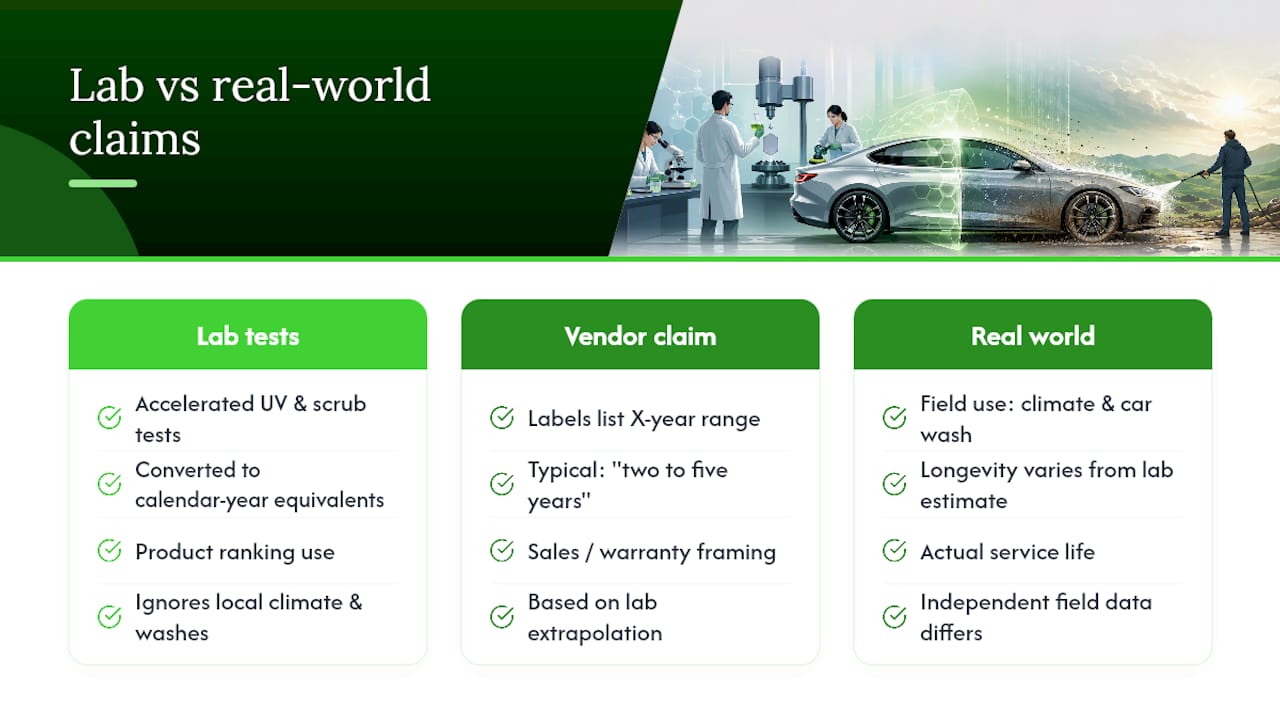
Labs measure this decay with a goniometer, which tracks contact angle, the angle water beads form on the surface. A fresh, healthy coating holds a contact angle above 100 degrees. Once it drops toward 80 degrees, the coating is functionally bare even if it still looks glossy. Manufacturers also run accelerated aging using ISO 16474 UV exposure and ASTM G154 protocols, alongside abrasion testing similar to ASTM D2486 scrub cycles, to simulate years of sun and washing in weeks. Those tests are genuinely useful for comparing products against each other. They're far less useful as a promise about your specific driveway.
A Maintenance Routine That Actually Extends Coating Life
Ceramic coating maintenance isn't complicated, but skipping it is the fastest way to shave years off a coating's field life. Here's the cadence that keeps a professional install performing closer to its upper range:
- Wash every two weeks using the two-bucket method: one bucket of soapy water, one for rinsing your wash mitt, so you're not dragging grit back across the paint.
- Use a pH-neutral shampoo, never a stripping dish soap or anything labeled "wax removing."
- Dry with a microfiber towel or blower, not an old bath towel that introduces fine scratches.
- Apply a booster every 3 to 4 months. Boosters restore the sacrificial top layer that thins from washing and UV exposure, and running four a year is one of the more cost-effective habits an owner can adopt to keep beading strong.
- Do a full decontamination and clay treatment annually, paired with a visual inspection for thinning spots, usually high-touch panels like the hood and roof.
- Bring the car to a professional if beading weakens across the whole vehicle, not just one panel, since that usually signals the coating itself rather than a localized contamination problem.
Pro Tip: Keep a simple log of wash dates and booster applications. If you ever need to file a warranty claim, that log is often the difference between an approved claim and a denied one.
For a full shop-recommended schedule that keeps warranty coverage intact, see the ceramic coating maintenance guide. Product-specific guidance on shampoos and booster selection is also available from Diamondbrite's coating care resources.
Is Your Ceramic Coating Actually Failing?
Most "failed" coatings aren't dead, they're dirty. Owners often mistake surface contamination for chemical breakdown, and a proper decon wash restores beading that looked gone for good.
Run these checks before assuming you need a full strip-and-recoat:
- Water sliding off in sheets, not beading: try a clay bar decontamination and a booster first.
- Beading is present but weak or spread out: the coating is likely still active, just due for maintenance.
- Gloss looks dull across large panels even after washing: that's often UV-related thinning, not contamination.
- Fine scratches visible under direct light with normal beading elsewhere: that's mechanical wear, not coating failure, and a light polish plus recoat on that panel may be all you need.
Reading Ceramic Coating Warranty Claims Correctly
Warranty terms almost always come with strings attached. Most require annual professional inspections, use of approved maintenance products, and proof you didn't take the car through an automated brush wash. Miss one of those and the warranty can be voided regardless of how the coating actually looks.
The "X-year" number on the label comes from lab extrapolation, not a guarantee. A shop or brand quoting five years is typically citing accelerated UV and scrub-cycle testing converted into calendar-year equivalents, a method that's useful for ranking products but doesn't account for your climate or your car wash habits. Vendor pages will state a range like two to five years, which is worth comparing against independent field data rather than taking at face value. Spending $60 to $80 four times a year on boosters over a five-year warranty period is almost always cheaper than an early strip-and-recoat. For the specific clauses to check before you sign anything, review what a ceramic coating warranty actually covers.
What Our Installs Tell Us About Real-World Longevity
The gap between a coating that lasts two years and one that lasts seven almost never comes down to the product itself. It comes down to what happened in the 48 hours before it went on. Skipped decontamination, leftover polish oils, and rushed IPA wipes are the recurring culprits behind early failure, and they're avoidable with the right prep environment.
That's part of why installs done in a controlled setting, away from dust, humidity swings, and temperature spikes, tend to hold up closer to the upper end of the range. Warranty-backed coatings also require documented maintenance: scheduled inspections and approved wash products, not a one-time spray and forget approach.
— Jake
Book a Climate-Controlled Ceramic Coating Install
There's a reason the prep environment matters as much as the product. Ceramic coatings installed in a climate-controlled facility can avoid dust, humidity, and temperature swings that cause bonding problems during cure, which are common causes of early coating breakdowns.
Some installs include manufacturer-backed warranty coverage, along with guidance on maintenance to help keep warranty validity. If you're weighing whether a coating is worth it for your car, this owner's guide to ceramic coating value breaks down cost against realistic lifespan across tiers. Electric vehicle owners can receive specialized treatment considering their vehicles' specific paint and panel needs, often performed in controlled conditions. Book an inspection or ask about a maintenance plan through Tint & Wraps Customs to get a coating installed the way it's supposed to be done the first time.
Sources
- How Long Ceramic Coating Actually Lasts · CarCareTruth
- What do 3-year, 5-year and 10-year durability claims on nano-ceramic coatings actually mean? · Nasiol
- How Long Does Ceramic Coating Last? | FEYNLAB®
- Why Ceramic Coatings Fail (And What Actually Makes Them Last) | Dr. Beasley's