
Expect to spend $50–$300 for a DIY kit (plus $300–$500 if you need paint correction gear) or $600–$3,500 for professional installation, depending on your vehicle's size, paint condition, and the coating tier you choose. Those ranges come directly from auto parts retailer pricing data and reflect real-world U.S. shop quotes.
Here's the quick breakdown by buyer profile:
- DIY kits: Best for budget-conscious owners with detailing experience and a clean, defect-free vehicle, typically lasting a couple of years.
- Basic professional install: Entry-level pro work on a compact sedan with minimal prep, usually offering a few years of protection.
- Mid-tier professional: The sweet spot for most daily drivers and SUVs, including paint correction and multi-layer application with several years of coverage.
- Premium professional: Multi-stage correction, long-warranty coatings, and full add-ons for enthusiasts, luxury vehicles, and exotics.
If you drive a daily commuter and want real protection without the guesswork, a mid-tier professional package is where the math works out best.
Table of Contents
- How much does ceramic coating cost by vehicle size and tier?
- What drives the final price on your quote?
- How long do coatings last, and what maintenance will you pay for?
- Is ceramic coating worth it for your situation?
- DIY vs. professional installation: which one actually makes sense for you?
- What does a professional install actually look like, and how long does it take?
- How to evaluate quotes and spot red flags before you commit
- Why climate control, paint correction, and manufacturer-backed warranties actually matter
- Additional costs you should budget for beyond the base quote
- Key Takeaways
- The part most pricing guides won't tell you
- Get an accurate quote from Tintandwrapscustoms
- Useful sources and further reading
How much does ceramic coating cost by vehicle size and tier?
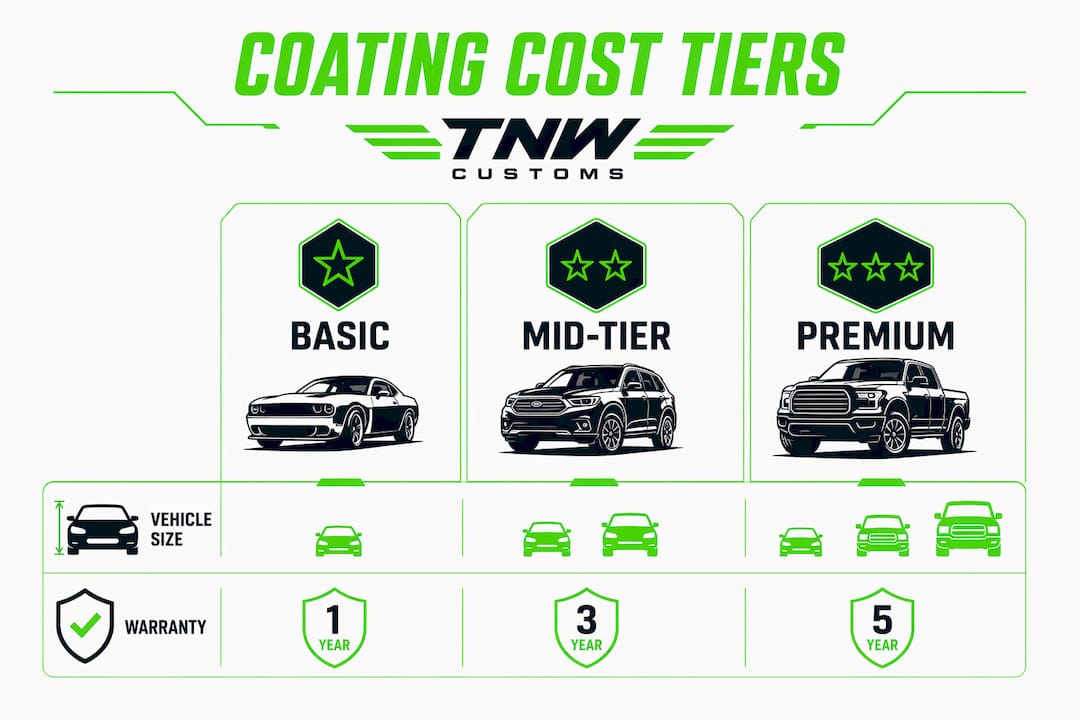
The coating tier and vehicle size together determine most of your quote. Here's how those variables stack up:
DIY kits
Consumer spray and liquid products typically cost $50–$300 for the coating itself. That price covers the product only. A realistic first-time DIY setup that includes a polisher, pads, and compounds adds $300–$500 more if you want any paint correction capability. Total DIY outlay can be $350–$800 for a complete first attempt.
Professional tiers by vehicle size
| Vehicle Type | Basic | Mid-Tier | Premium |
|---|---|---|---|
| Compact sedan | Entry-level pricing typical of smaller cars | Mid-range pricing for most sedans | Higher-end pricing for premium protection |
| Midsize sedan / SUV | Slightly higher than compact vehicles | Mid-range pricing for midsize vehicles | Premium pricing reflecting longer warranties |
| Full-size truck / large SUV | Higher due to size and surface area | Mid-to-high range for large vehicles | Premium tier reflects extensive protection |
| Luxury / exotic | Elevated starting cost due to vehicle value | Mid-to-premium range to protect high-end finishes | Highest end of pricing scale for exotic cars |
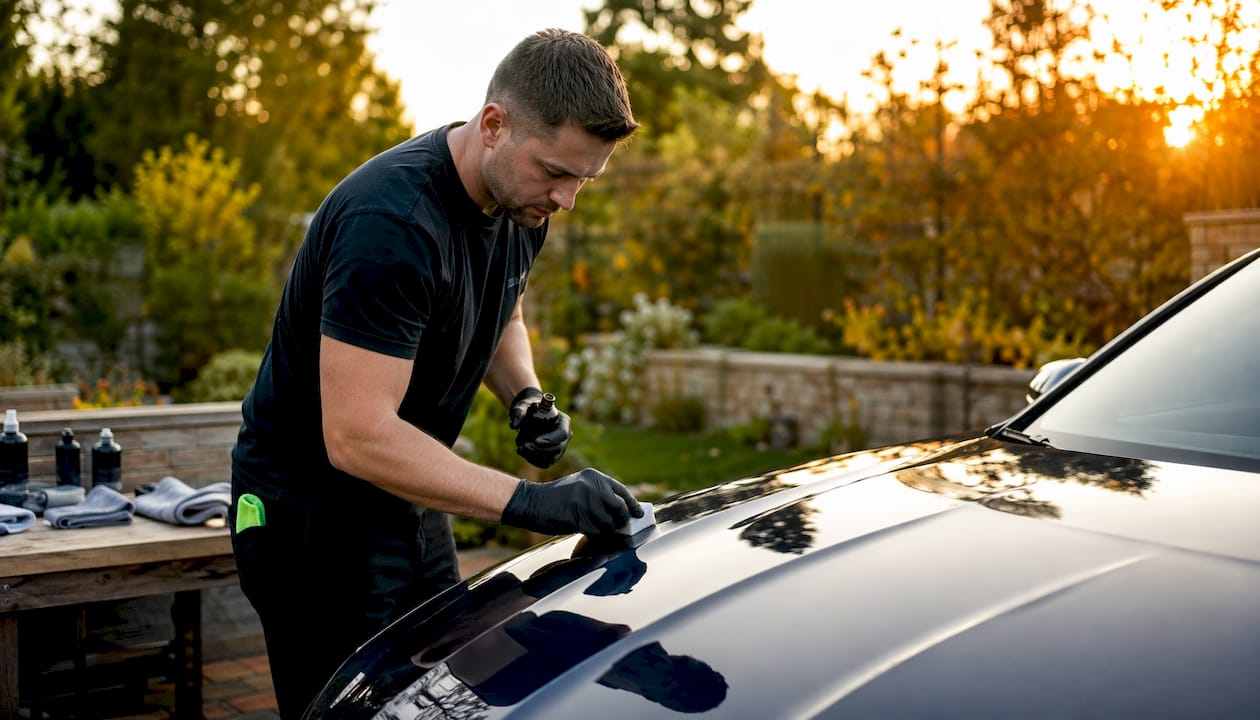
One thing that surprises most owners: a professional installer uses only a small amount of coating product for a standard sedan. The product itself is a small fraction of the invoice. Labor, paint correction, and shop overhead are where the money goes.
What drives the final price on your quote?
Five variables account for most of the spread between a $700 quote and a $3,000 quote.
Paint condition and paint correction is the single biggest swing factor. Heavy swirl marks, oxidation, or scratches require machine polishing before any coating goes on. Serious defects can add significant labor time and cost to the final bill. Shops that advertise suspiciously low base prices almost always exclude this step.
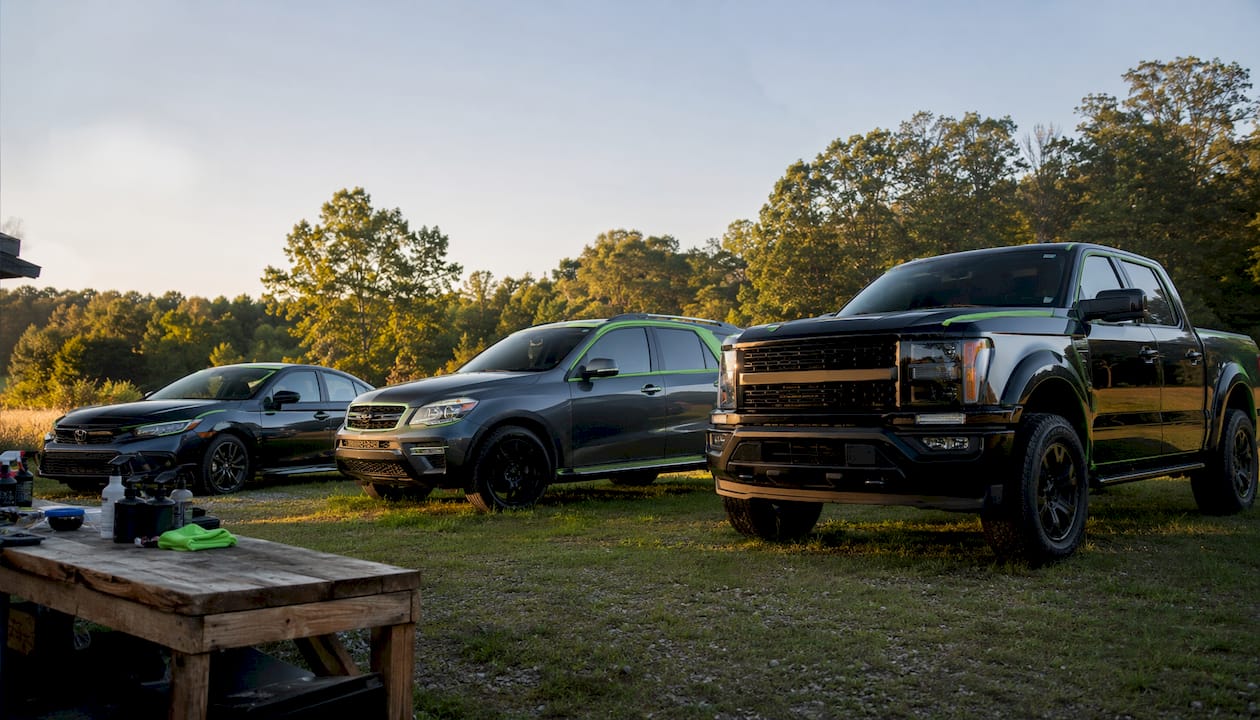
Vehicle size and surface area scale material and labor costs directly. A full-size truck typically has substantially more paintable surface than a compact sedan, and that difference shows up in every line of the quote.
Coating chemistry and warranty length matter more than most buyers realize. SiO₂ concentration, graphene additives, and multi-layer systems all affect durability and price. A two-year consumer-grade coating and a seven-year manufacturer-backed system are not the same product, even if both get called "ceramic coating."
Shop location carries a real premium. Major metro areas often charge more than smaller markets, driven by higher overhead and labor rates. A mid-size city quote might be substantially less than a similar job in high-cost cities such as Los Angeles or New York.
Add-ons compound quickly. Glass coating, wheel coating, trim protection, and interior ceramic treatments each add $150–$400 depending on the shop. Pairing ceramic coating with paint protection film (PPF) on high-impact zones is a popular upgrade that adds $500–$1,500 or more.
Pro Tip: Ask every shop to itemize paint correction separately from the coating application. That single line item tells you more about the quote's honesty than anything else.
How long do coatings last, and what maintenance will you pay for?
Lifespan varies sharply by product tier:
- Spray and consumer liquid coatings: 6 months to 1.5 years with regular washing
- Consumer-grade liquid kits (DIY): 1–2 years under normal conditions
- Pro-grade entry coatings: 2–3 years with proper maintenance
- Mid-tier professional coatings: 3–5 years, often backed by a manufacturer warranty
- Premium multi-layer systems: 5–10+ years with annual inspections
Maintenance is not optional if you want the coating to reach its rated lifespan. A pH-neutral car wash regularly is the baseline. Avoid automatic brush washes entirely — the abrasion degrades the coating faster than weather does. Annual inspections and ceramic-safe detail spray top-ups are commonly recommended by shops, with associated maintenance costs.
The math on annualized cost: A mid-tier professional job spread over several years works out to a few hundred dollars per year before maintenance. Adding annual upkeep costs increases the total yearly expense, but it can still be competitive compared to traditional waxing and detailing expenses.
Long-term value tends to favor the higher upfront spend when the coating's lifespan and reduced maintenance offset several years of wash and buff cycles. For vehicles with custom or specialized paint, proper maintenance routines become even more critical — custom paint cars need specific care to preserve both the coating bond and the underlying finish.
Is ceramic coating worth it for your situation?
The direct answer: yes, for most owners who plan to keep their vehicle for more than two years. No, if you're flipping the car in six months or it already needs a repaint.
Daily driver, long-term owner: A mid-tier pro package pays for itself in reduced detailing costs, preserved paint, and resale value. Buyers notice paint condition, and a coated car with documented protection history commands a premium at trade-in. Protective services like ceramic coating affect long-term vehicle value in ways that show up concretely at appraisal time.
Resale-focused owner: A two-year professional coating applied before listing can return more than its cost in negotiating power, especially on vehicles over $30,000.
Show car or exotic owner: Premium multi-layer systems with graphene or SiO₂ boosters are standard practice. The cost is real, but so is the protection against UV fade, bird etch, and water spotting on paint that costs thousands to respray.
Budget DIY owner: If your paint is already in good shape and you have the patience to prep properly, a quality consumer kit gives you meaningful protection for under $300. The risk is application error — streaks, high spots, and uneven coverage that require professional removal to fix.
A mid-tier professional package at $1,000–$2,000 represents the best value for most sedan and SUV owners, covering two-stage correction, multi-layer coating, and 3–5 years of protection.
DIY vs. professional installation: which one actually makes sense for you?
DIY kits reduce upfront cost by 70–80% compared to professional work. That's the headline. The fine print is what most buyers skip.
When DIY works
- Your paint is already in excellent condition with no significant swirls or scratches
- You have a clean, temperature-controlled space (a garage, not a driveway in direct sun)
- You're comfortable with a dual-action polisher and have used one before
- You accept a 1–2 year lifespan and plan to reapply
When professional installation is worth the premium
- Your paint has visible defects that need machine correction first
- You want a manufacturer-backed warranty that transfers to a new owner
- You're coating a luxury, exotic, or high-value vehicle where a failed DIY attempt costs thousands to fix
- You don't have 10–20+ hours to dedicate to proper prep and application
The primary difference between DIY and professional work is application risk. Pros bring a climate-controlled environment and paint-correction expertise that substantially reduce failure risk. A botched DIY application isn't just a cosmetic problem — professional removal and recoating can cost $300–$600 on top of whatever you already spent.
Hidden costs to factor in for DIY: additional tools and supplies such as a polisher, backing plates and pads, compounds and polishes, microfiber towels and applicators, increase the total investment beyond the cost of the coating itself. A realistic DIY total can be several hundred dollars before you start working on the car.
What does a professional install actually look like, and how long does it take?
A professional ceramic coating job is a multi-day process, not an afternoon service. Here's the typical workflow:
Day 1 — Inspection and decontamination (2–4 hours): The shop inspects paint under lighting, notes defects, and runs a full decontamination wash including clay bar treatment to remove bonded surface contamination.
Day 1–2 — Paint correction (4–20+ hours): This is the variable. A light single-stage polish on clean paint takes 4–6 hours. Heavy two-stage correction on a neglected vehicle can run 15–20+ hours across two days.
Day 2–3 — Coating application and flash time (4–8 hours): The coating goes on in a climate-controlled bay. Each layer needs flash time before the next is applied. Temperature and humidity control during this phase are critical — a climate-controlled install materially reduces the risk of high spots and uneven coverage.
Day 3–4 — Cure and QA (24–48 hours): Initial cure happens in the shop. Most coatings reach full hardness in 7–14 days. Shops typically ask you to avoid rain and car washes for the first 7 days.
Total shop time for a basic job: 1–2 days. Mid-tier with correction: 2–3 days. Premium multi-stage: 3–5 days.
How to evaluate quotes and spot red flags before you commit
Use this checklist when comparing shops:
- Paint inspection report: Does the shop document current paint condition in writing before quoting?
- Prep included: Is decontamination and at least a single-stage polish included, or quoted separately?
- Number of coats: How many layers are applied, and what is the product name and SKU?
- Warranty terms: Is it a manufacturer warranty or a shop warranty? What voids it?
- Transferability: Can the warranty transfer to a new owner if you sell the vehicle?
- Exclusions: What surfaces are not covered (trim, rubber, glass)?
Questions to ask every shop:
- What specific coating product do you use, and what is the manufacturer's rated lifespan?
- Who performs the paint correction — a certified technician or a general detailer?
- What are the temperature and humidity conditions in your installation bay?
- What maintenance does the warranty require, and how is compliance verified?
Red flags that should stop you from booking:
- A quote under $500 for a full sedan with paint correction included
- Vague warranty language ("lifetime protection" with no written terms)
- No climate-controlled facility or no answer when you ask about installation conditions
- No before/after photos from real customer vehicles
Pro Tip: Ask to see the shop's warranty document before you book, not after. A legitimate manufacturer-backed warranty is a physical or digital certificate with the product brand's name on it — not just the shop's verbal promise.
Why climate control, paint correction, and manufacturer-backed warranties actually matter
At Tintandwrapscustoms in Van Nuys, CA, the installation process reflects what the research consistently shows: prep and environment determine outcomes more than the coating product itself.
- Climate-controlled facility: Every vehicle is coated in a temperature and humidity-regulated bay, eliminating the application failures that come from garage installs or outdoor work.
- Manufacturer-backed warranties: Tintandwrapscustoms offers warranties backed by the coating manufacturer, not just a shop promise — meaning the coverage has teeth.
- 1,000+ vehicles protected: That volume means the team has seen edge cases, difficult paint conditions, and complex vehicle geometries that a newer shop hasn't encountered.
- 5-star customer rating: Consistent across verified reviews, reflecting repeat clients who return with additional vehicles.
- Before/after inspection photos: Documented at every job, giving owners a clear record of paint condition pre- and post-coating.
Paint correction before coating is not optional for quality results. Sealing defects under a ceramic layer locks them in permanently — they become visible every time light hits the panel at an angle.
Pro Tip: Request the installer's certification for the specific coating product they use. Most reputable manufacturers (like Gyeon, Feynlab, and IGL Coatings) run certified installer programs. Certification means the installer has been trained on that product's specific application protocol.
Additional costs you should budget for beyond the base quote
The base ceramic coating price rarely tells the whole story. Here are the line items that commonly appear on final invoices:
Paint correction: Light single-stage polish is sometimes included in mid-tier packages. Heavy multi-stage correction is almost always a separate charge, adding $300–$1,000+ depending on defect severity and vehicle size.
Surface preparation products: Clay bar treatment, iron decontamination spray, and panel wipe are standard prep steps. Some shops bundle these; others itemize them at $50–$150.
Add-on surfaces: Glass coating ($150–$300), wheel coating ($200–$400 for a set), trim coating ($100–$250), and caliper coating ($150–$300) are each separate services. Bundling them at booking usually saves 10–15% versus adding them later.
Maintenance products: A ceramic-safe wash soap, detail spray, and drying towels are purchases you'll need to make. Budget $75–$150 for a quality starter kit from brands like CarPro, Gyeon, or Koch-Chemie.
Annual maintenance visits: Many manufacturer warranties require documented annual inspections. These typically run $100–$250 per visit and are worth it — they catch early delamination or water-spot etching before it becomes a full recoat situation.
Key Takeaways
Professional ceramic coating costs $600–$3,500 in the U.S., with the $1,000–$2,000 mid-tier range delivering the best value for most vehicle owners when paint correction and a manufacturer-backed warranty are included.
| Point | Details |
|---|---|
| Realistic price bands | DIY runs $50–$300 (plus $300–$500 in gear); professional installs range $600–$3,500 by tier and vehicle size. |
| Top cost driver | Paint correction is the biggest variable, adding $500–$1,000+ to any professional quote when defects are present. |
| DIY vs. pro decision | DIY works only on defect-free paint in a controlled environment; professional installs justify the premium with warranties and climate-controlled application. |
| Annualized value | A $1,500 mid-tier pro job over five years costs roughly $300 per year before maintenance — less than most owners spend on wax and detailing. |
| Tintandwrapscustoms | Offers climate-controlled installs, manufacturer-backed warranties, and a documented track record of 1,000+ vehicles protected in Van Nuys, CA. |
The part most pricing guides won't tell you
Most ceramic coating articles lead with the low number to grab attention, then bury the real cost in a footnote. The honest version: if your paint needs correction — and most vehicles over two years old do — your quote will be higher than the advertised starting price, sometimes significantly.
The shops worth hiring are the ones that tell you this upfront, show you the paint condition before they quote, and hand you a written warranty document with the manufacturer's name on it. A $700 quote that skips paint correction and installs in an open bay is not a deal. It's a deposit on a recoat job in 18 months.
What actually separates a $1,000 job from a $2,500 job isn't the coating product — it's the hours of prep, the controlled environment, and the accountability that comes with a real warranty. Buyers who focus only on the coating price miss the 60% of the job that determines whether it lasts.
Get an accurate quote from Tintandwrapscustoms
Tintandwrapscustoms gives Van Nuys and San Fernando Valley drivers something most shops don't: a transparent, inspection-based quote process in a climate-controlled facility, backed by manufacturer warranties and a 5-star track record across 1,000+ vehicles.
Before you reach out, have these ready to get the most accurate number:
- Three photos of your vehicle (front quarter, rear quarter, and a close-up of the worst paint panel)
- Your vehicle's age and maintenance history (last detail, any prior coatings or sealants)
- Known paint defects (swirls, scratches, water spots, oxidation)
- Your warranty preference (2-year, 5-year, or lifetime-backed options)
- Add-ons you're considering (glass, wheels, trim, PPF combo)
Book your ceramic coating inspection at Tintandwrapscustoms and get a written, itemized quote with no hidden prep charges.
Useful sources and further reading
- AutoZone — How Much Does It Cost to Ceramic Coat a Car?: Solid baseline for DIY vs. professional price ranges with practical context on what drives cost differences.
- Vinyl Wrap Calculator — Ceramic Coating Cost Calculator: Interactive tool for estimating costs by vehicle size and coating tier; useful for building a realistic budget before you call a shop.
- FEYNLAB — Ceramic Coating Cost: How Much Should You Pay?: Manufacturer-side perspective on tier pricing, DIY savings percentages, and metro price premiums.
- AutoDetailPedia — How Much Does Professional Ceramic Coating Cost?: Detailed breakdown of labor vs. material costs and the real impact of paint correction on final invoices.
- Chemical Guys — How Much Does It Cost to Ceramic Coat a Car?: Covers professional tier pricing and the true cost of equipping a DIY setup for paint correction.
- Tintandwrapscustoms — Van Nuys Vehicle Protection Services: Booking page for ceramic coating, PPF, window tinting, and wraps in the San Fernando Valley.