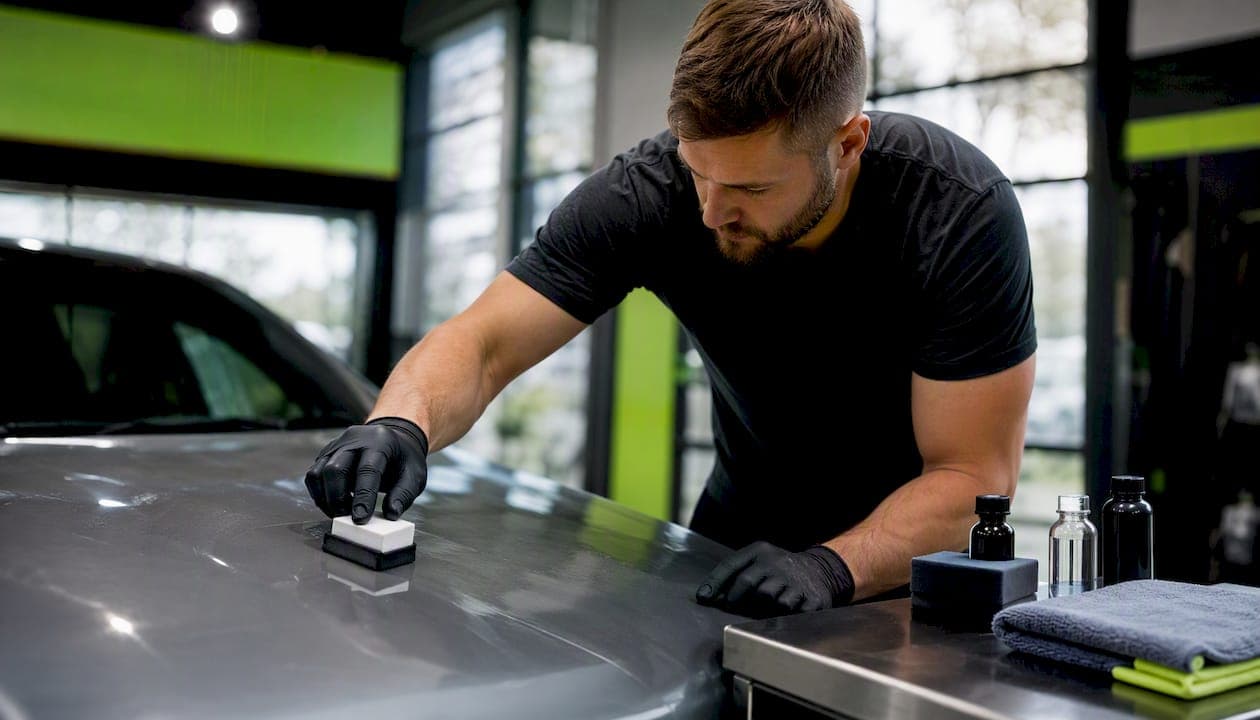
Yes, ceramic coating is worth it for most U.S. vehicle owners who plan to keep their car for two or more years, park outside regularly, and care about maintaining paint gloss without constant waxing. The protection is real, the maintenance savings add up, and the results on corrected paint are genuinely impressive. That said, it is not a magic shield, and the wrong expectations will leave you disappointed.
Quick rules of thumb:
- Worth it: You keep your car 2+ years, park in the sun or near the coast, and want easier weekly washes with better-looking paint.
- Worth it: You've recently had paint correction done and want to lock in that investment.
- Not worth it: Your paint has swirls, scratches, or oxidation you haven't fixed. Coating over damaged paint seals those defects permanently.
If you're trading in within a year, running your car through a brush automatic wash weekly, or working with a budget under $200 for a daily beater, the math probably doesn't favor a professional coating. For everyone else, read on.
Key Takeaways
Ceramic coating is worth the investment for owners who park outside, plan to keep their vehicle several years, and are willing to maintain the finish with proper washing habits.
| Point | Details |
|---|---|
| Best candidates | Owners who park outdoors, live in high-UV or coastal climates, and keep cars 2+ years benefit most. |
| Prep is non-negotiable | Coating over swirled or damaged paint locks defects in permanently; correction must come first. |
| Lifespan expectations | Professional coatings last 3–5 years; consumer DIY kits typically hold up 2–3 years with proper care. |
| Not a chip shield | Ceramic coating resists UV and chemicals but offers no protection against rock chips — that requires PPF. |
| Tintandwrapscustoms | Climate-controlled installs with manufacturer-backed warranties and 5-star service in Van Nuys, CA. |
Table of Contents
- Is ceramic coating worth it? What you actually get
- What ceramic coating won't do — and the myths worth busting
- How much does ceramic coating cost?
- How long does ceramic coating last, and what do warranties actually cover?
- DIY vs. professional application — what the prep actually involves
- Is ceramic coating worth it for your car? A decision checklist
- How ceramic coating compares to wax and PPF
- Questions to ask before hiring a ceramic coating installer
- What a quality professional installation actually looks like
- What we actually see from customers at the shop
- Professional ceramic coating in Van Nuys, CA
- Sources
Is ceramic coating worth it? What you actually get
The core benefit of a ceramic coating is a semi-permanent layer of silicon dioxide (SiO2) that bonds to your paint's clear coat and creates a hydrophobic, chemically resistant surface. Here's what that means in practice:
- Hydrophobicity: Water sheets off instead of sitting and evaporating. That dramatically reduces water spots, especially in hard-water areas like Southern California, Phoenix, or Las Vegas.
- Gloss amplification: A good coating deepens the reflective quality of the paint. On a freshly corrected car, the difference is striking.
- Chemical and UV resistance: Bird droppings, tree sap, road salt, and industrial fallout sit on top of the coating rather than etching directly into the clear coat. UV oxidation slows noticeably for cars parked outside.
- Easier washing: Dirt and grime don't bond as aggressively to the coated surface. A two-bucket hand wash that used to take 45 minutes can realistically drop to 25–30 minutes.
- Fewer detailing sessions: Owners who previously waxed every 2–3 months can often skip that cycle entirely for years, which adds up in both time and money.
Pro Tip: Use a pH-neutral, coating-safe car wash soap like Chemical Guys Mr. Pink or Meguiar's Gold Class. Dish soap and harsh degreasers strip the coating's hydrophobic layer faster than anything else. A ceramic booster spray every 3–4 months extends the coating's performance noticeably.
What ceramic coating won't do — and the myths worth busting
This is where a lot of buyers get burned. The marketing around ceramic coatings has been aggressive, and several claims simply don't hold up.
The myth checklist:
- "It's scratch-proof." No coating is. The "9H hardness" rating refers to pencil hardness on the Mohs scale, not resistance to real-world scratches from keys, shopping carts, or automatic brush washes. A 9H coating will still swirl from an improper wash technique.
- "It's maintenance-free." Coated cars still need regular washing. The coating just makes each wash faster and more effective. Skip washing for months and you'll still get water spots, bird dropping etching, and contamination buildup.
- "It replaces paint correction." Coating over swirled or oxidized paint locks those defects in permanently. Applying a coating over imperfect paint doesn't hide the damage — it preserves it under a glossy layer.
- "It protects against rock chips." For that, you need paint protection film (PPF). Ceramic coatings offer no meaningful impact protection; they're a chemical barrier, not a physical one.
- "A 5-year warranty means 5 years of protection no matter what." Warranties almost always require specific maintenance conditions. Fail to meet them and the warranty is void.
Watch out for installers who promise scratch-proof results or skip the prep conversation entirely. Any shop that doesn't discuss paint correction before coating is a shop cutting corners.
How much does ceramic coating cost?
Price ranges vary significantly based on whether you go DIY or professional, and what prep work is involved.
| Option | Typical Cost (U.S.) | Lifespan | Notes |
|---|---|---|---|
| Entry-level DIY spray (e.g., Cerakote Rapid Ceramic Paint Sealant) | $20 | 6–12 months | Easy to apply, minimal prep needed, limited durability |
| Mid-tier DIY kit (e.g., Chemical Guys Carbon Force) | $100 | 1–2 years | Requires proper prep; better SiO2 concentration than sprays |
| Professional-grade DIY (e.g., Adam's Polishes Graphene Ceramic Coating) | $100–$200 | 2–3 years | Graphene-enhanced formula; demands careful application and curing |
| Basic professional install (no correction) | $300–$600 | 2–3 years | Wash and decontaminate only; best for newer cars in good condition |
| Full professional install (with paint correction) | $800–$2,000 | 3–5 years | Multi-stage polish, decontamination, certified coating, documented warranty |
The bulk of professional pricing is labor and paint correction, not the coating product itself. A basic package can run several hundred dollars while a full correction plus coating often reaches the low thousands, depending on vehicle size and paint condition. A large truck or SUV with heavily swirled paint will cost more than a compact sedan with clean clear coat.
What adds cost:
- Multi-stage paint correction (one-step polish vs. two- or three-step)
- Clay bar decontamination and iron fallout removal
- Additional coating layers
- Larger vehicles (more surface area, more time)
- Warranty documentation and annual inspection requirements
The long-term math: A professional wax job typically runs $100–$200 and lasts 2–3 months. Over three years, that's $400–$1,200 in waxing costs alone, not counting your time. A professional ceramic coating can approach cost-parity with regular professional waxing over a multi-year horizon, especially when you factor in fewer full detail visits.
For a deeper breakdown of what drives pricing, the ceramic coating cost guide covers vehicle size, correction stages, and how to read a quote.
How long does ceramic coating last, and what do warranties actually cover?
A professionally applied coating typically lasts three to five years; consumer-grade DIY kits generally hold up for two to three years. Those are real-world ranges, not marketing claims. Climate, wash habits, and parking conditions all affect where your coating lands in that window.
What shortens lifespan:
- Automatic brush car washes (the single fastest way to degrade a coating)
- Harsh soaps or degreasers
- Infrequent washing that lets contaminants sit and etch
- Extreme UV exposure without periodic booster spray maintenance
- Parking under trees with heavy sap or bird activity
What extends lifespan:
- pH-neutral soap and two-bucket hand washing
- Ceramic booster spray every 3–4 months
- Prompt removal of bird droppings and tree sap (within hours, not days)
- Annual professional inspection if your warranty requires it
Warranty checklist — what to look for:
- Does the warranty require annual inspections at the installing shop?
- Are specific wash products or methods mandated?
- What exactly is covered: delamination, fading, water spot etching?
- What voids the warranty (brush washes, certain chemicals, DIY touch-ups)?
- Is the warranty transferable if you sell the car?
Professional coatings often require periodic maintenance checks to preserve warranty coverage. Read the fine print before you sign. A warranty that requires annual paid inspections at the installing shop is a revenue model as much as a guarantee. That's not necessarily bad — it keeps the coating maintained — but know what you're agreeing to. More detail on what warranty terms actually mean is in this ceramic coating warranty breakdown.
DIY vs. professional application — what the prep actually involves
The coating itself is a small part of the job. Prep is where most of the time, skill, and risk live.
The required prep sequence (DIY or pro):
- Thorough wash — remove all loose dirt, road grime, and debris
- Decontamination — clay bar to remove bonded contaminants; iron fallout spray for brake dust and industrial particles
- Paint correction — polish out swirls, scratches, and oxidation (skip this only on near-perfect paint)
- IPA wipe-down — isopropyl alcohol panel wipe to remove polish oils and residue
- Coating application — work panel by panel in a shaded, dust-free environment
- Curing — keep the car dry and out of rain for 24–48 hours minimum; full cure takes 2–4 weeks
DIY pros and cons:
- Pro: Cost savings of $300–$1,500+ vs. professional install
- Pro: Entry-level sprays like Cerakote Rapid Ceramic Paint Sealant are genuinely easy to apply
- Con: Any paint correction mistakes or missed contamination get sealed in permanently
- Con: Uneven application creates high spots that are difficult to remove once cured
- Con: Without a climate-controlled space, dust contamination during application is nearly unavoidable
SiO2 concentration varies widely across products, and professional-grade coatings use significantly higher concentrations than consumer sprays. That gap explains much of the durability difference between a $100 DIY kit and a $1,200 professional install.
When to hire a pro:
- New car or high-value vehicle
- Paint with existing swirls or oxidation that needs correction first
- Complex bodywork, matte finishes, or wrapped panels
- You want a documented warranty
Timeline reality check: A full DIY prep and application on a midsize sedan takes 8–12 hours spread across two days. A professional full-correction install typically takes 1–3 days. Post-application, keep the car out of rain for at least 48 hours and avoid washing for 7 days.
Is ceramic coating worth it for your car? A decision checklist
Run through these six factors. If you check three or more in the "worth it" column, a coating is likely a sound investment.
| Factor | Worth It | Skip It |
|---|---|---|
| Vehicle age/value | 2+ years left in ownership; mid-to-high value | Trading in within 12 months; low-value daily driver |
| Paint condition | Clean, corrected, or near-perfect clear coat | Swirled, oxidized, or heavily scratched |
| Parking situation | Outdoors, sun exposure, coastal or salty environment | Garaged daily, minimal environmental exposure |
| Climate | High UV, humidity, road salt, or industrial fallout | Mild, low-UV, minimal environmental stress |
| Ownership horizon | Keeping 3–5+ years | Selling or trading within a year |
| Wash habits | Hand wash or touchless; willing to use proper products | Regular brush automatic wash; no plans to change |
Quick owner profiles:
- Daily commuter in Los Angeles: Parks outside, drives 15,000 miles/year, keeps cars 4–5 years. Strong yes — UV exposure alone justifies the coating.
- Weekend car collector: Garaged, rarely exposed to elements, already waxes regularly. Lower priority; the coating adds gloss but the protection benefit is reduced.
- Family SUV owner near the coast: Salt air, bird droppings, outdoor parking. Very strong yes — chemical resistance and easier washing deliver clear value.
- Pre-trade-in prep: Selling in 6 months. Skip the coating; a professional detail and paint correction will do more for resale value at lower cost.
Tesla and EV owners have additional considerations around panel gaps and paint softness. The Tesla paint protection guide covers those specifics.
How ceramic coating compares to wax and PPF
These three products solve different problems. Choosing the wrong one for your situation is a common and expensive mistake.
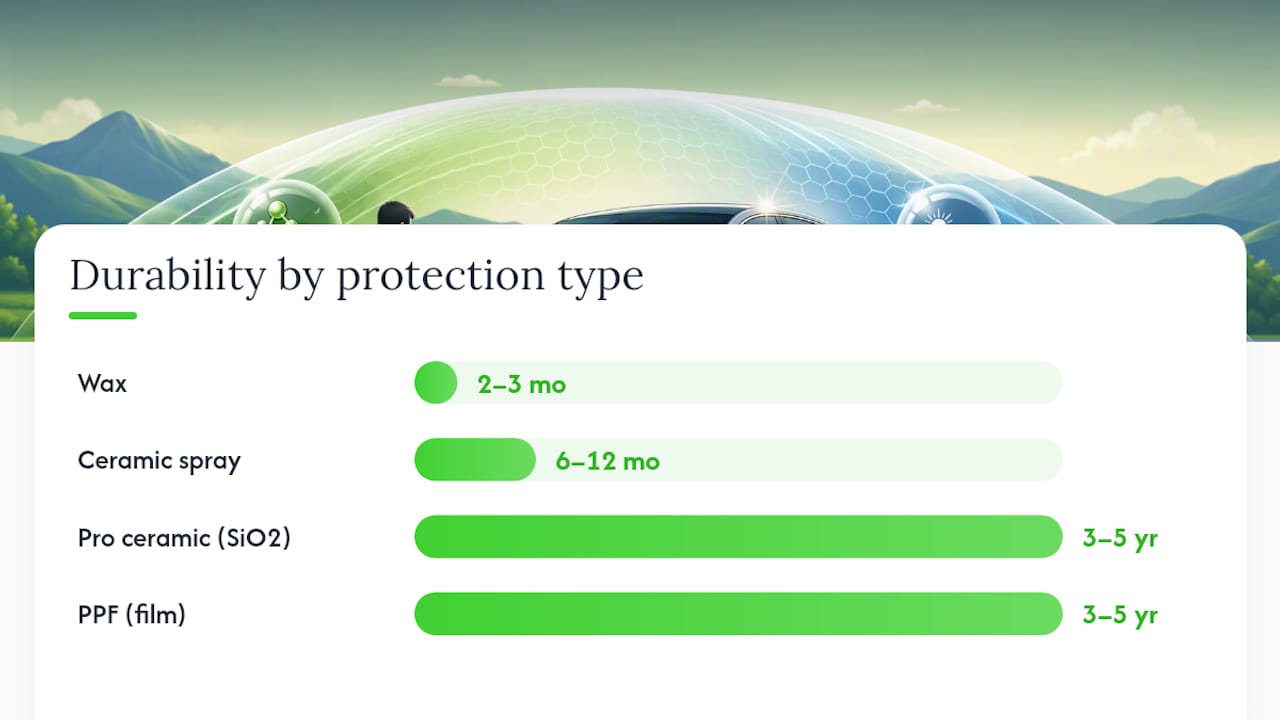
| Protection Type | Cost | Durability | Best For | Protection Level |
|---|---|---|---|---|
| Carnauba or synthetic wax | $100–$200 (DIY) | 2–3 months | Budget maintenance, older cars | UV and light chemical resistance only |
| Consumer ceramic spray | $50–$100 | 6–12 months | Easy maintenance boost | Moderate UV, hydrophobicity, light chemical resistance |
| Professional SiO2 ceramic coating | $1,000–$2,500 | 3–5 years | Long-term owners, outdoor parking, post-correction preservation | Strong UV, chemical, and contamination resistance |
| Professional PPF (paint protection film) | $1,500–$3,000 | 3–5 years | Rock chip zones, front-end protection, high-value vehicles | Physical impact, rock chips, deep scratches, UV |
The key distinction: ceramic coating is a chemical barrier; PPF is a physical one. Ceramic coatings offer no meaningful rock chip or deep scratch protection — that's PPF's job. For the front bumper, hood, and mirrors of a new car, PPF is the stronger choice. For the full vehicle's gloss, UV protection, and wash ease, ceramic coating delivers more value per dollar.
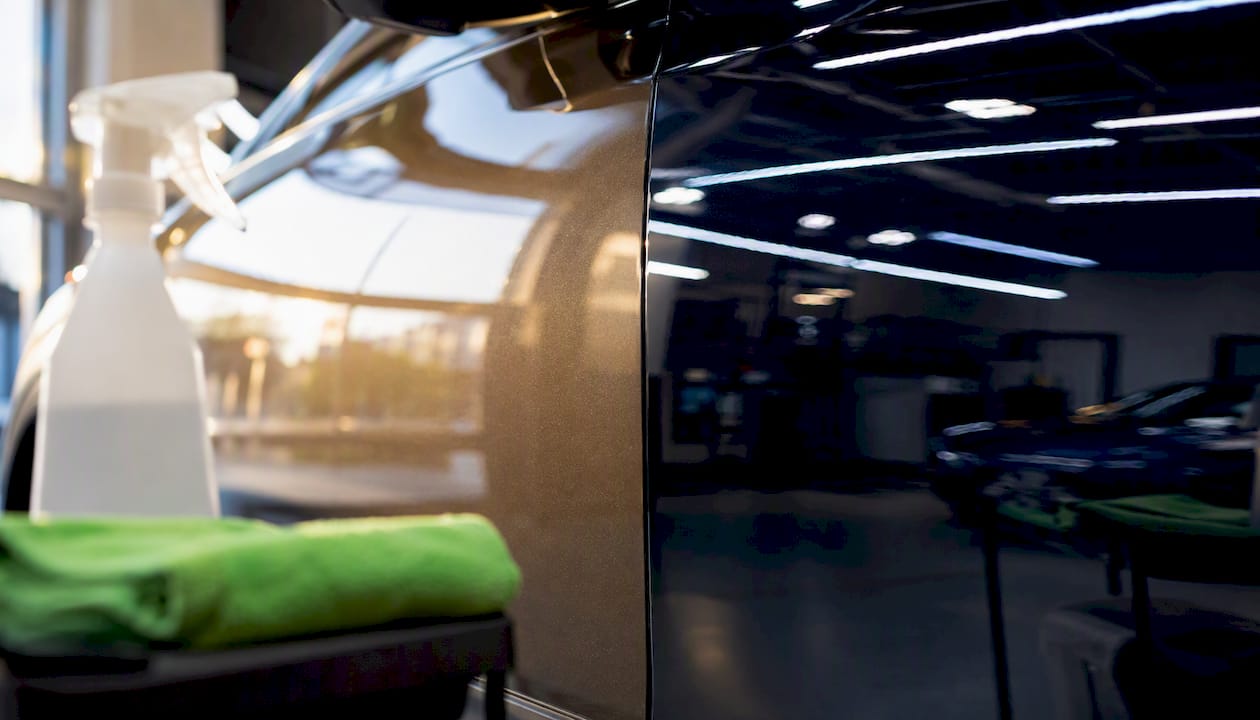
The best of both worlds: Many owners apply PPF to high-impact zones (front bumper, hood, mirrors, rocker panels) and then coat the entire car with ceramic over the top. The PPF handles chips; the ceramic handles everything else and makes the PPF easier to clean. For PPF options, the PPF vs. vinyl wrap comparison and XPEL vs. 3M PPF guide are useful starting points.
Pro Tip: Never apply ceramic coating directly over a vinyl wrap unless the wrap manufacturer explicitly approves it. Most wraps have textured surfaces that prevent proper coating adhesion, and the coating can make future wrap removal significantly harder.
Questions to ask before hiring a ceramic coating installer
A good installer will answer every one of these without hesitation. Vague or evasive answers are your signal to keep looking.
Ask these directly:
- What prep steps are included? (Wash, clay, iron decontamination, paint correction?)
- Which coating product do you use, and what is its SiO2 or graphene concentration?
- Is paint correction included, or is it an add-on?
- What does the warranty cover, and what voids it?
- What maintenance does the warranty require from me?
- Do you have a climate-controlled installation space?
- How long will the car be with you, and what is the cure time before I can drive it?
What a reputable shop provides:
- Written warranty documentation with specific coverage terms
- A maintenance schedule and recommended product list
- A prep checklist showing what was done before application
- Before-and-after photos of the paint correction stage
Red flags to walk away from:
- No mention of paint correction or prep
- Warranty paperwork that is vague or verbal only
- Rushed cure times ("you can pick it up in a few hours")
- No climate-controlled workspace
- Prices significantly below market without a clear explanation
Professional shops vary greatly; a higher price typically reflects more thorough paint correction, certified products, and a controlled environment — not just a fancier waiting room.
What a quality professional installation actually looks like
Understanding the process helps you evaluate whether a shop is doing the work or just charging for it.
What a reputable shop does, step by step:
- Initial paint inspection — assess clear coat condition, identify defects, and photograph the vehicle
- Full decontamination wash — two-stage wash, iron fallout treatment, clay bar
- Paint correction — one- to three-stage machine polish depending on defect severity
- Panel prep wipe — IPA wipe to strip polish oils and ensure a clean bonding surface
- Coating application — applied panel by panel in a climate-controlled, dust-free environment
- Initial cure — infrared lamp or controlled temperature to accelerate initial bonding
- Maintenance handoff — written care instructions, product recommendations, and warranty paperwork
Why environment and skill matter: Coating applied in a dusty garage or in direct sunlight will trap particles and cure unevenly. A climate-controlled space isn't a luxury — it's what separates a coating that lasts five years from one that starts failing in eighteen months.
Warranty reading tips:
- Look for specific coverage language, not just a duration ("covers delamination and loss of hydrophobicity" vs. "covers coating performance")
- Note any exclusions: environmental damage, improper washing, use of non-approved products
- Confirm whether annual inspections are required and whether they cost extra
- Check if the warranty is tied to the installer or the coating manufacturer
A shop that hands you a one-page warranty with no exclusions listed is either very confident or very vague. Ask them to walk through what is and isn't covered before you commit.
What we actually see from customers at the shop
The owners who get the most out of ceramic coating share one thing: they came in with realistic expectations and paint that was ready for it. The ones who leave disappointed almost always skipped the paint correction conversation or assumed the coating would fix existing problems.
The most common misunderstanding is treating ceramic coating as a repair. It is not. It is a preservation tool. A car that comes in with light swirls and a fresh single-stage polish, then gets a professional-grade SiO2 coating in a controlled environment, will look noticeably better and stay that way for years. A car that comes in with heavy oxidation and gets coated without correction will look slightly shinier for a few months and then reveal every flaw it had going in.
The second most common issue is wash habits. Owners who switch to a proper two-bucket hand wash or touchless automatic after coating see the full benefit. Owners who keep running through a brush tunnel every week are essentially sanding the coating off one pass at a time.
Professional ceramic coating in Van Nuys, CA
If the checklist points toward a professional install, the quality of the shop matters as much as the quality of the coating product.
Tintandwrapscustoms performs ceramic coating installations at its climate-controlled facility in Van Nuys, CA, with manufacturer-backed warranties and documented prep processes. Every install includes full decontamination, paint condition assessment, and a written maintenance schedule. The shop has protected over 1,000 vehicles across the San Fernando Valley and holds a 5-star customer rating. Tesla and EV owners get specific attention to panel gap geometry and factory paint characteristics that generic shops often overlook.
Services include standalone ceramic coating, PPF plus ceramic combinations, and full vehicle wraps for owners who want complete protection. Book a consultation or request a quote to get a realistic price based on your vehicle's actual paint condition.
Sources
- Best ceramic coatings tested
- Is Ceramic Coating: Is It Worth It?
- Is Ceramic Coating Worth It? Here's How It Holds Up In The Real World
- Ceramic Coating: Is It Worth It? | WheelPrice
- Is Ceramic Coating Worth It? What You Actually Get for the Money - AutoBodyLab