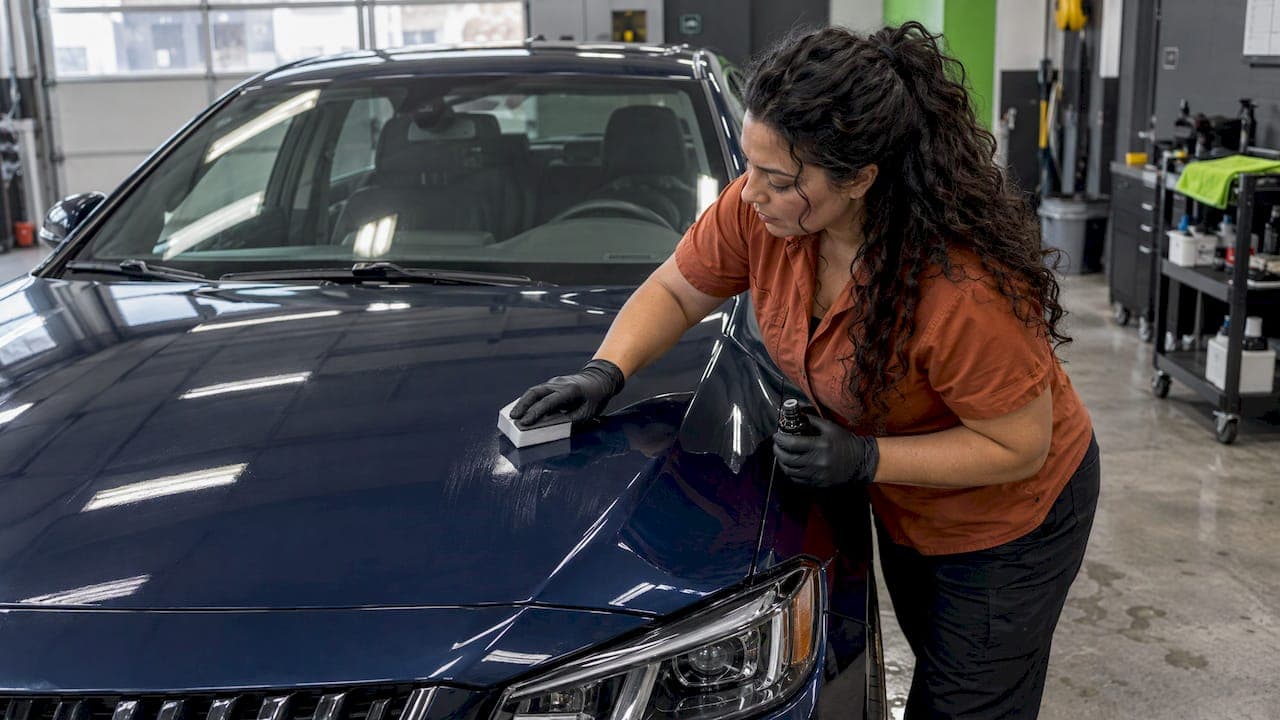
Ceramic coating gives your paint a deeper gloss, makes it easier to wash, and adds a durable layer that helps resist UV light, bird droppings, bugs and road grime. It works best when a professional prepares the paint properly and you wash the car gently afterward. Below is what each benefit means in daily driving, why a new car is the ideal candidate, how long coatings last, and what they will not do.
TL;DR
- A ceramic coating bonds to your paint and cures into a thin, glass-like layer that adds gloss and makes water bead and roll off.
- Washing gets faster because dirt, dust and bugs have a harder time sticking to the surface.
- Coatings add resistance to sun exposure and to contaminants like bird droppings, but they do not stop rock chips or deep scratches.
- With good care, most coatings last two to five years, and new cars need less prep work to get the best result.
- Professional application in a clean, controlled space is the safest route to a flawless finish.
Table of Contents
- What ceramic coating is and how it protects paint
- The main ceramic coating benefits
- Ceramic coating benefits for new cars
- How long ceramic coating lasts
- Keeping the benefits: simple care
- What ceramic coating does not do
- Pairing ceramic coating with PPF, tint and wraps
- Is ceramic coating worth it?
- Our perspective
- Book your ceramic coating in Van Nuys
- FAQ
- Sources
What ceramic coating is and how it protects paint
Ceramic coating is a liquid product that is applied to the paint and cures into a thin protective layer. Most modern coatings rely on silicon dioxide or related chemistry, and the cured layer makes the paint more resistant to environmental contamination. Its hydrophobic behavior is the part you notice first: water beads up and sheets away instead of sitting flat on the panel.
The difference from wax is how it holds on. Wax sits on top of the paint and wears away gradually. A properly applied ceramic coating chemically bonds to the paint, which is why it lasts so much longer between applications.
Think of it as a hard, slick skin over your clear coat. It is not a new coat of paint and it does not change color. It makes the finish you already have look richer and stay cleaner.
The main ceramic coating benefits
A deeper, glossier finish
Ceramic coating can enhance gloss and add richness to the color. On dark colors such as black, deep blue or Tesla's midnight shades, the effect is easy to see in sunlight: reflections look sharper and the paint looks wet. On lighter colors, you get a cleaner, more even shine.
The gloss comes partly from the preparation. Before coating, the paint is cleaned, decontaminated and polished, so the layer locks in a smooth surface. That is why the same product can look average on poorly prepped paint and excellent on well-prepped paint.
Easier, faster washing
This is the benefit most owners say they value after the first month. Because water beads and runs off, it carries dirt and dust with it. A routine wash takes less scrubbing and less time, and the car tends to stay cleaner between washes.

If you park outside in the San Fernando Valley, where dust and freeway grime build up quickly, that matters. You spend less effort on each wash and you touch the paint less, which also helps keep swirl marks down.
Protection from sun exposure
UV light slowly fades and oxidizes paint. Ceramic coating can provide some protection against the effects of prolonged sunlight. In Southern California, where cars sit under strong sun most of the year, that added layer is a sensible part of keeping the finish healthy.
Note the wording: some protection, not immunity. The coating is a barrier that helps. It works best alongside shade when you can get it and regular washing.
Resistance to bird droppings, bugs and other contaminants
Bird droppings, insects and tree sap are acidic and can etch unprotected paint if they sit. Coatings can offer some resistance to acidic or alkaline contaminants and make droppings and bugs easier to remove before they sit on the paint. The key phrase is "before they sit." A coated car buys you time, not an excuse to leave a mess for weeks.
A longer interval than wax
Wax is something you reapply often. A coating is a one-time application that stays on for years. If you would rather spend a weekend elsewhere than waxing, that trade is a real benefit.
Easier upkeep for long-term value
Paint that stays glossy and free of etching looks better at trade-in or sale time. We cannot promise a resale figure, but a car that has been kept clean and protected from the start shows its care.
Ceramic coating benefits for new cars
A new car is the best moment to coat. The paint is at its peak, so there is little to correct and the coating locks in that fresh condition instead of covering up wear.
For the coating to bond properly, the vehicle must be thoroughly cleaned, decontaminated and polished, and paint correction may also be needed. New cars often arrive with light marks from transport and dealer lot washing, so a gentle polish before coating is common. Starting with healthy paint means the least correction and the best final result.
For owners of newer cars, a professional install may be the better choice if you want the longest-lasting protection with a flawless finish. Mistakes, or contact before the coating has fully cured, can require wet sanding and reapplication. That is a hard way to learn on a car you just bought.
A few practical tips for a new car:
- Book the coating soon after delivery, before the paint collects contamination.
- Ask the shop how it prepares paint and what the cure period looks like. Our guide to ceramic coating cure times explains what to avoid in the first days.
- Keep the car out of rain and away from washing during the cure window your installer gives you.
- Decide early whether you also want paint protection film on high-impact areas. We cover that pairing below.
How long ceramic coating lasts
With proper maintenance, coatings typically last between two and five years, or roughly 30,000 to 50,000 miles. What moves a coating toward the long end of that range:
- Surface preparation. A clean, decontaminated, polished surface bonds better.
- Environment. Garage parking, mild weather and less road salt help. Constant sun and heavy road film wear a coating faster.
- Washing habits. Gentle, pH-neutral washing and the occasional maintenance booster spray keep the surface slick.
If you want to dig into how coatings hold up, our article on ceramic coating durability looks at lab testing and real-world wear.
Choosing a coating tier
We offer 1-year, 5-year and lifetime coatings, so you can match the product to how long you plan to keep the car and how much protection you want. A shorter term can suit a leased vehicle. A longer term suits a car you plan to keep. Our ceramic coating page lists each option, and our guide to what you are actually covered for under a coating warranty explains how warranties are typically structured. For budgeting, see what vehicle owners should expect to pay.

Keeping the benefits: simple care
A coating makes care easier, but it does not replace it. A few habits keep the slickness and gloss going:
- Wash by hand with a pH-neutral shampoo and clean microfiber mitts.
- Avoid abrasive brushes and harsh chemicals.
- Dry the car with a soft towel or blower to reduce water spotting.
- Use a maintenance spray now and then if your installer recommends one.
- Remove bird droppings and bugs promptly.
For a clear walkthrough, these ceramic coating maintenance steps cover what to do and when. We also keep a guide on maintenance that helps preserve warranty coverage.
What ceramic coating does not do
Knowing the boundaries helps you get full value from the coating.
- Impacts. A coating cannot absorb impacts from rocks, gravel or shopping carts. For that, paint protection film is the right layer.
- Existing defects. It will not automatically hide scratches or correct paint flaws, which is why paint correction comes first.
- Washing. It does not eliminate washing. It makes washing easier.
- Color change. It adds gloss but cannot change the color of your car. For that, look at a vinyl wrap.
It also helps to be careful with finish type. Matte and satin paint need a coating made for them so the sheen is not altered. Our page on ceramic coating for matte paint explains what to ask for.
Pairing ceramic coating with PPF, tint and wraps
Ceramic coating works well as one layer in a broader plan:
- Paint protection film takes rock chips and scuffs on the front end, mirrors and door edges. A coating on top adds slickness and easier cleaning. If you plan both, read about ceramic coating over PPF and the wait time before washing. Our paint protection film options include The Track Pack, Full Front and Full Body.
- Window tint blocks heat and UV from the inside, which protects the interior and the people in it. See our window tinting services.
- Wheels and calipers collect brake dust, and a coating helps with cleanup. We cover what to expect from wheel ceramic coating.
- Wraps change the look entirely, and a coating is not a substitute for one. For a new color or chrome delete, see our vinyl wraps.
Is ceramic coating worth it?
Whether it is worth the money depends on your expectations. It makes sense if you want a glossy car that is easier to clean and you plan to keep it a few years. It is not a substitute for proper care, and it does not stop rocks or scratches.
A simple way to decide:
| If you... | Ceramic coating fits when... |
|---|---|
| Just bought a new car | You want to lock in factory-fresh paint |
| Park outdoors in strong sun | You want a durable UV-resistant layer |
| Hate waxing | You want a long-interval alternative |
| Drive on highways a lot | You pair it with PPF on the front end |
| Keep a leased car | A shorter-term coating covers your lease |
For a deeper walk-through, see our practical owner's guide to whether ceramic coating is worth it.
Our perspective
We have coated enough cars to know the difference preparation makes. The same product can look ordinary on rushed paint and exceptional on paint that has been washed, decontaminated and polished in a clean space. That is why we do every install in our climate-controlled, dust-free facility in Van Nuys: dust landing in a curing coating is not something you can fix with a better product.
We work on a lot of Teslas and other EVs, and the details matter there. Clean edges around sensors and trim, and a careful, factory-quality fit, are part of how we approach every job.
Our advice to most owners is simple. If you are buying a new car, coat it early. If you drive freeways, add film to the front end and coat over it. Pick the coating term that matches how long you will keep the car, and wash it gently. Do that, and you get what a coating is designed to deliver: better gloss, easier washing and a finish that holds up to the sun.
Jake
Book your ceramic coating in Van Nuys
We offer 1-year, 5-year and lifetime ceramic coatings, applied in our climate-controlled facility, with manufacturer-backed warranties. Tell us your car, how you use it and how long you plan to keep it, and we will recommend the right option.
See the details on our ceramic coating page, or get in touch through Tint & Wraps Customs to schedule your install.
FAQ
Is ceramic coating worth it on a new car?
For most owners who plan to keep the car for years, yes. New paint needs the least correction, so the coating locks in a clean finish. It helps with gloss, easier washing and resistance to sun and contaminants.
How long does ceramic coating last?
With proper maintenance, most coatings last two to five years. Preparation, climate and how you wash the car all affect the result. Our coating tiers of 1 year, 5 years and lifetime let you match the product to your plans.
Does ceramic coating stop scratches and rock chips?
No. A coating helps with gloss and cleaning, but it will not absorb impacts from rocks or gravel. For chip protection, paint protection film is the right layer, and many owners add a coating over it.
Can I still wash my car normally after coating?
Yes, with gentle methods. Use a pH-neutral shampoo and soft mitts, and avoid abrasive brushes and harsh chemicals. Follow your installer's cure instructions for the first days.
Should I have ceramic coating professionally applied?
Professional application is recommended, because mistakes or early contact before curing can require wet sanding and reapplication. A controlled shop environment helps the coating cure clean and even.
Sources
- What Is Ceramic Coating, And Is It Worth It? (Motor1)
- How Long Does Ceramic Coating Last? (Autotrader)
- Considering Ceramic Coating for Your Car? (Autoblog)
- What is Ceramic Coating for Cars? (J.D. Power)
- Ceramic Coating Maintenance (MobileDetailing.io)