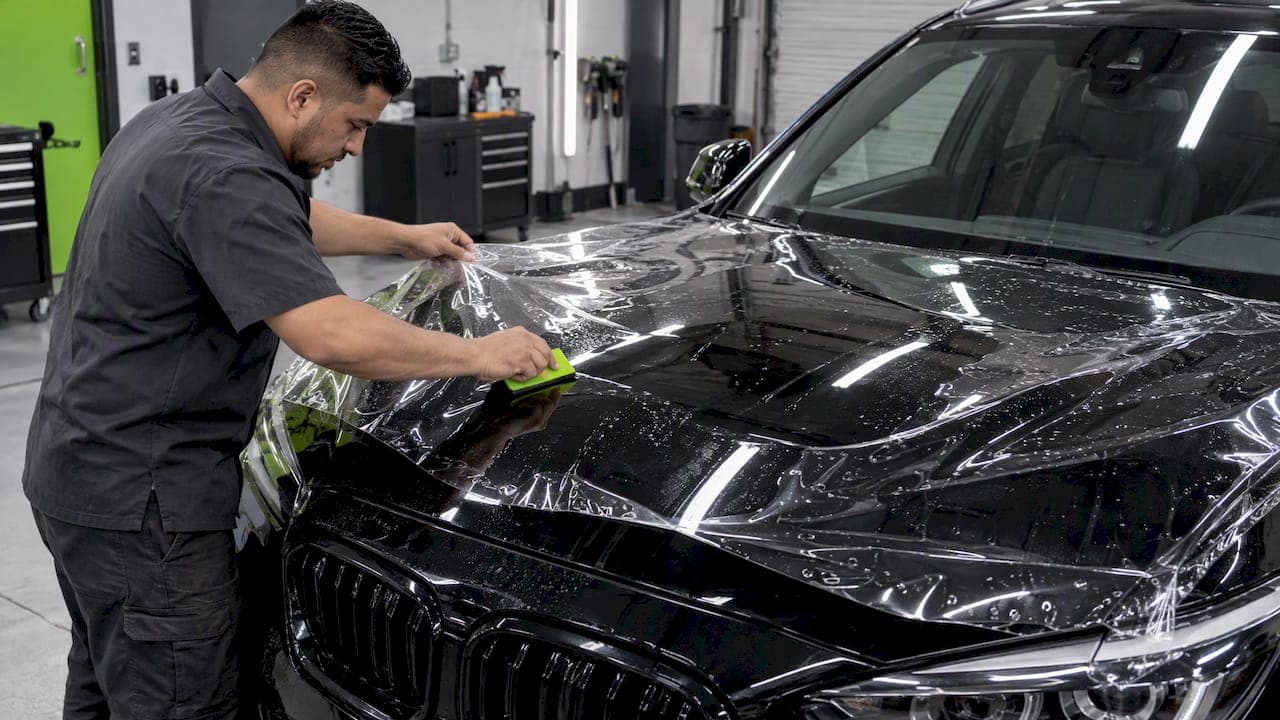
Paint protection film (PPF) is one of the few upgrades that suits black paint's two biggest problems: it shows every swirl, and it shows every chip. A clear, self-healing film absorbs the small scratches that make black paint look hazy and stops rock chips from reaching the paint. It will not make a black car wash-proof, but it makes the finish far easier to keep sharp. You can also buy PPF in black itself, in gloss, matte or stealth finishes, if the goal is a color change that protects.
TL;DR
- Clear PPF is the best match for black paint: it takes the scratches and chips, and its self-healing top coat clears light swirls over time.
- Black PPF exists in gloss and matte finishes. It changes the look of the car, so it is a different job from clear film.
- Typical U.S. pricing runs from about $900 to $1,500+ for partial front coverage, $1,800 to $3,000 for a full front and $5,000 to $8,000+ for full body. Shop, region and vehicle complexity move those numbers.
- Installer quality matters more on black than on any other color, because every dust nib, lifted edge or stretch mark shows in the reflection.
- Ask about the film brand, the warranty terms, what gets removed during install and where the car sits while the film cures.
Table of Contents
- Why black paint needs more protection than other colors
- What clear PPF actually does on black
- Black PPF: gloss, matte and stealth finishes
- How much does PPF cost on a black car?
- PPF, ceramic coating or vinyl wrap on black
- Perspective: what we see on black cars in the shop
- Tesla and other EV owners: fitment and sensors
- What to check before you choose an installer
- Get PPF done on your black car in Van Nuys
- FAQ
- Sources
Why black paint needs more protection than other colors
Black paint is not softer than white or silver. It simply hides nothing. A fine scratch that disappears on a light gray car shows as a bright white line on black. Automatic car washes, a dry towel or a dusty microfiber leave a web of swirl marks that you only see in direct sun. Dust, pollen and water spots sit on dark paint like frosting.
Here in Southern California the pressure is higher. Strong sun heats dark panels well past what lighter cars see, and freeway grit in the San Fernando Valley keeps hitting the front end. Many owners of black cars tell us the same thing: the car looks perfect for two weeks after a detail, then the swirls come back.
PPF attacks the cause. A thermoplastic urethane film sits between the world and your clear coat. Scratches land on the film instead of the paint.
What clear PPF actually does on black
Scratches and swirl marks
Modern films carry a top coat that heals itself. According to The CAR guide to paint protection film, the gel top coat self-heals minor scratches, scuffs and swirl marks over time, and heat from the sun or an engine speeds the process. On a black car that is the headline benefit. The light wash-induced marks that normally require a polish simply fade after a warm day or a rinse with warm water. Deep scratches that cut through the film do not heal, and the film panel is then replaced rather than the paint refinished.
Rock chips
The film is thick enough to take the hit of road debris. On black paint a chip exposes bright primer or metal and is obvious from ten feet away. Under film, the same stone leaves nothing, or a small mark in the film that is cheap to address compared with touch-up paint and its mismatched sheen.
Gloss and depth
A common worry on black is that film will look like plastic. Good films are optically clear and made to reduce the look of orange peel. STEK says its clear films are designed for optical clarity and smoothness, and that they can give an extremely smooth, glossy finish while still letting metallic flake show through. SunTek describes its clear PPF as an optically clear, glossy barrier over the paint. On a deep black, the result is usually a wetter, more even reflection, not a dull one.
A few honest caveats. Film will not fix swirls that are already in the paint, which is why a correction polish before install matters. Sunlight on a fresh install can show tiny moisture pockets for a few days while the film cures. And film will not make the car clean: it makes dust easier to wipe off, nothing more.
UV and fading
Black single-stage and clear coat finishes can oxidize and turn chalky with years of sun. Film adds a sacrificial layer, and quality films are formulated not to yellow. Warranty terms on yellowing are one of the cleaner ways to compare brands, which we cover below.
Black PPF: gloss, matte and stealth finishes
If your car is not black yet, or you want a different black, color PPF is an option. Avery Dennison's North American wet-apply PPF brochure separates clear, matte and color films, and lists Gloss Black, described as deep and mirror-like, and Matte Black, described as a smooth, non-reflective finish.
| Finish | Look | Best for | Watch out for |
|---|---|---|---|
| Clear gloss | Keeps factory black, adds gloss | Daily drivers, new cars | Needs good paint prep first |
| Black gloss film | Piano-black, uniform | Color change from another shade, accents, roofs, mirrors | Edges and seams are more visible; wraps around door edges need skill |
| Matte or stealth black | Satin or flat, non-reflective | Dramatic restyle, factory-matte cars | Cannot be polished; needs matte-safe care |
| Clear matte over gloss | Gloss paint turned satin | Owners who want a satin look and a reversible change | Fingerprints and oil show more |
SunTek notes that its matte PPF can blend with original matte paint or give gloss paint a smooth satin look. That is useful if you already own a factory matte black and want to protect it, since matte paint cannot be polished out if it gets marked. We cover that in detail in our guides on matte paint PPF and installer prep steps for matte paint.
How much does PPF cost on a black car?
Color does not set the price. Coverage, vehicle shape and installer skill do. According to RGBG Films' 2025 U.S. benchmark guide, U.S. prices commonly run:
| Coverage | Typical U.S. range |
|---|---|
| Partial front | $900 to $1,500+ |
| Full front | $1,800 to $3,000 |
| Full body | $5,000 to $8,000+ |
The same guide notes that pricing varies with shop positioning, regional labor markets and vehicle complexity. Expect the upper end for large trucks, cars with sharp creases and any job with color film, since more panel wraps and edge work take more hours. We do not publish fixed prices because the quote depends on the car, the film and the coverage you choose. Our longer breakdown, PPF cost in 2026, walks through what moves the number.
Which coverage makes sense on black
- Full front: bumper, full hood, fenders, mirrors and headlights. This is where chips and bug etching land. It is the usual choice for a daily driver, and we explain why in Full Front PPF.
- Track-style package: adds high-impact areas such as rocker panels and the lower doors to the front end, for cars that see highway miles or canyon runs.
- Full body: protects everything, including the roof, trunk and rear quarters, and is the right call for a new black car you plan to keep looking new, or one you may sell at a premium.
- High-touch areas only: door edges, door-cup handles, the rear bumper top and the trunk sill. These are the places black paint gets scratched by keys, rings and luggage. See our note on rear bumper protector film for when a professional film beats a DIY one.
PPF, ceramic coating or vinyl wrap on black
These get mixed up, but they solve different problems.
Ceramic coating is a liquid layer that adds gloss, water beading and easier washing. It resists light chemical staining but does little against rock chips and will not stop a scratch. On black it makes the paint look glassy and cuts wash time.
PPF is physical armor. It takes scratches and chips and heals light marring.
Vinyl wrap changes color or finish and gives some protection against light scuffs, but it is not built to absorb impacts. For a black-to-matte-black change the choice between wrap and color PPF comes down to protection versus cost. Our comparison of PPF vs vinyl wrap covers it.

The strongest setup for a black car is often film on the impact zones, with a ceramic coating over the film so washing is easy. Coating over PPF needs a cure window before the first wash, which we explain in ceramic coating over PPF.
Perspective: what we see on black cars in the shop
Black cars are the ones that teach owners about paint. The customer who brings in a three-month-old black car with swirls from a drive-through wash is common. The fix is a paint correction first, then film. Putting film over defects locks them in, so we treat prep as half the job.
We do every install in a climate-controlled, dust-free facility. On black this is not a luxury. A single piece of lint under the film reflects like a pebble, so keeping the bay clean is what separates a clean install from one you notice every time the sun hits.

We have protected more than 1,000 vehicles, and we see many Teslas. EV owners tend to ask the same question: will the film interfere with anything? Our answer is that fit is the issue, not the film itself. Sensors, cameras and radar sit behind specific panels, and a precise cut that respects those areas matters more than any marketing claim. If an installer wants to remove a bumper cover or any part that holds a sensor, ask why and what they plan to do about it before you book.
Our advice for most black cars: full front in clear film, with a good ceramic coating on top of the rest. If you want to change the color, tell us up front, because that affects how we handle the edges.
— Jake
Tesla and other EV owners: fitment and sensors
Film does not interfere with a car just because it is on the paint. Trouble comes from careless cutting around cameras, radar windows, ultrasonic sensor holes and charge-port areas, or from removing and re-fitting parts that contain sensors. Before you book:
- Ask where the installer cuts around sensors and cameras, and whether the pattern is built for your model and year.
- Ask whether the bumper cover comes off, and what happens if it does.
- Ask how the shop would handle a sensor warning after install, and how the warranty treats a re-do.
- Check your owner's manual or the manufacturer's service guidance for any limits on coatings near sensor faces.
This is where specialized EV experience helps. We work on Tesla installs regularly and fit film to avoid sensor interference.
What to check before you choose an installer
Film brand and warranty
Top brands publish their terms. STEK says its DYNOseries films carry a 10-year manufacturing warranty and its PROseries films a 5-year warranty, and that its films use hydrophobic, self-healing liquid topcoats. Terms differ by brand, product line and region, so read the exact document. Manufacturer warranties often require registration after install; see why you should register within 30 days.
Remember that a film warranty is separate from the car's own coverage. If you are weighing how long a car's mechanical coverage lasts as well, this explainer on powertrain warranty coverage shows what that kind of warranty includes, so you do not confuse it with a paint film warranty.
Shop environment
Visit the bay. Dust, open doors and wind are bad signs. Black paint will show every flaw in direct light, so ask to see a finished car under a bright lamp.
Prep and edges
A good install includes washing, decontamination, inspection of the paint under light and, where needed, correction. Look for wrapped edges, tight seams that sit in natural body lines and no visible stretch marks. Avoid shops that cut on the paint.
Aftercare
Expect a short window before the first wash and no automatic brush washes. Hand wash with a pH-neutral soap. Our guide to PPF maintenance covers the routine.
Get PPF done on your black car in Van Nuys
If you drive a black car in the San Fernando Valley, we can look at your paint in person, tell you what is worth protecting and quote coverage from a full front to full body. We install clear, matte and color options in a climate-controlled facility, with manufacturer-backed warranties.
See our PPF installation in Van Nuys page for packages including Full Front, Full Body and The Track Pack, or add ceramic coating for easier washing and extra gloss.
FAQ
Is PPF worth it on a black car?
For most owners, yes. Black shows swirls and chips more than any other color, and a self-healing film takes the light marks that would otherwise need polishing. It is most worth it on a new car, a car you keep for years or one you drive on freeways daily.
Is PPF available in black?
Yes. Gloss and matte black films exist, and major makers list them in their color lines, such as Avery Dennison's Gloss Black and Matte Black. They change the car's appearance, so choose them when you want a color change that also protects, and clear film when you want to keep your paint as it is.
What is the best coating for a black car?
There is no single answer, because coating and film do different jobs. Clear PPF protects against chips and scratches. A ceramic coating adds gloss and makes washing easier. Many black cars carry both: film on the front end and a coating over everything.
How much does it cost to PPF a car?
Common U.S. ranges are about $900 to $1,500+ for partial front, $1,800 to $3,000 for a full front and $5,000 to $8,000+ for full body, based on a 2025 pricing guide. The exact figure depends on your vehicle, the film and your area. Contact the shop for a quote on your car.
Sources
- The CAR guide to paint protection film (PPF)
- Clear Bra Paint Protection Film | STEK USA
- Paint Protection Film Clear and Matte | SunTek
- Wet-Apply Paint Protection Film brochure | Avery Dennison
- PPF Pricing Benchmarks 2025 (U.S.) | RGBG Films
- Powertrain Warranty: U.S. Used Car Buyers, Check What Transfers