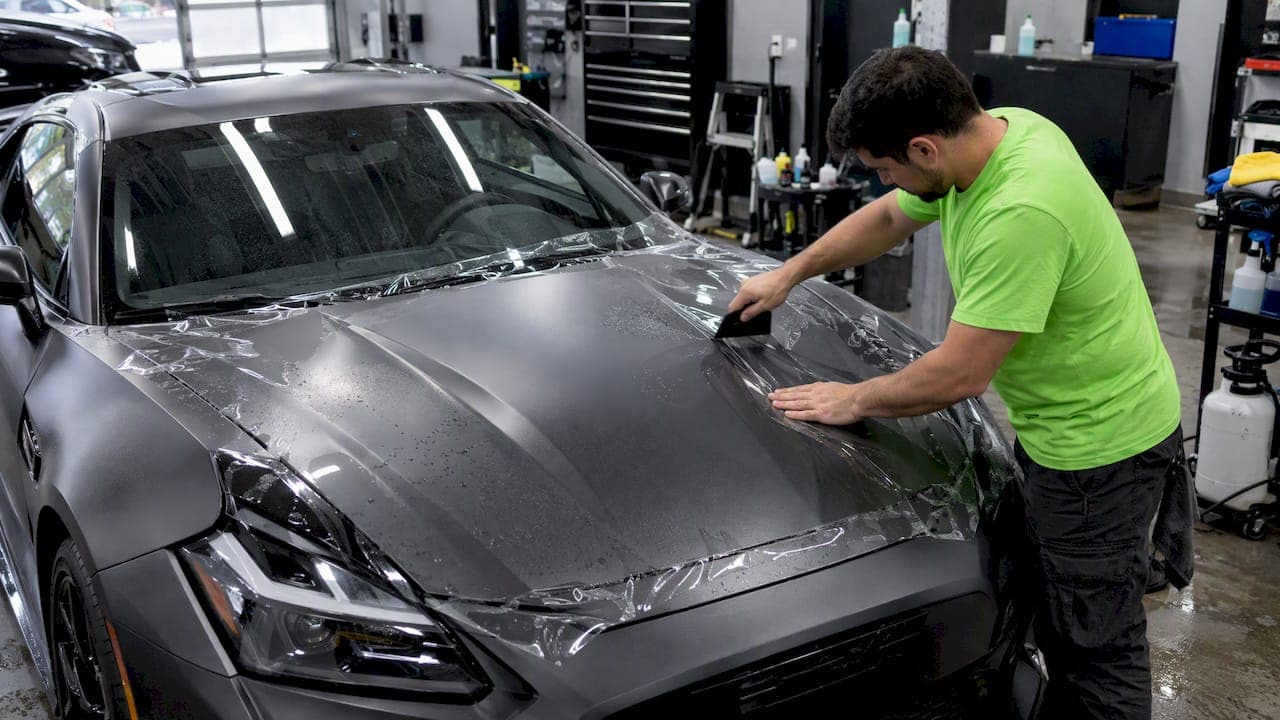
You can protect matte paint with paint protection film, and you can also turn gloss paint into a matte finish with matte PPF. They are two different jobs. Factory matte paint needs a film that keeps the flat look and can't be polished later. Gloss paint under satin or matte film gets rock-chip protection and a stealth finish, and it stays easy to remove or change. This guide covers which one fits your car, what it costs, and how to keep the finish looking even.
TL;DR
- Factory matte paint can't be polished out if it gets scratched, so film is the main way to protect it. Gloss paint under matte PPF gives you the same look with an undamaged finish underneath.
- Expect matte or satin PPF to run roughly 15 to 25% above the equivalent gloss tier, because the install is less forgiving and the topcoat is specialized.
- Matte care is strict: pH-neutral matte shampoo, no polish, no gloss wax, no circular scrubbing.
- A clean, climate-controlled install space matters more on matte than on gloss, since dust and flaws show in the surface texture.
Table of Contents
- Two jobs people mean by "matte paint PPF"
- Why matte surfaces are harder to protect
- What matte PPF costs
- How a good matte install works
- Caring for matte finishes and matte film
- Matching the rest of the car
- Our perspective
- Book a matte PPF install in Van Nuys
- FAQ
- Sources
Two jobs people mean by "matte paint PPF"
The phrase covers two situations, and the right answer differs.
1. Your car already has matte paint. This is factory matte or a matte clear coat, common on performance and luxury trims. Scratches can't be buffed away the way they can on gloss. Owners in forums describe the same thing: a scratch on matte paint often means repainting the panel, which is the expensive outcome film is meant to prevent. A matte or satin-finish film goes over the paint and takes the chips and abrasion instead.
2. You want the matte look without matte paint. You have gloss paint and want a flat or satin finish. Matte PPF does this and protects at the same time. A vinyl wrap changes color but offers little impact protection. We compare the two in PPF vs vinyl wrap. The big advantage of film over gloss paint is reversibility: the original finish stays intact underneath.

If you are not sure which applies, check your window sticker or build sheet for the paint code and finish name. Satin, frozen, and matte are all low-gloss finishes, and all need the same careful handling.
Why matte surfaces are harder to protect
A gloss clear coat hides small defects because you can polish them away. A matte surface gets its look from a microtexture that scatters light. Polishing flattens that texture and leaves shiny patches that don't go back.
That has three practical consequences:
- Damage is permanent. The paint maker's own matte finish care guide says matte needs special care to keep its look, and names mechanical polishers, abrasive compounds and gloss-enhancing waxes as things to avoid.
- Contamination shows more. Matte PPF tends to hide micro-scratches and dust better than gloss, but installers note that the surface shows road grime and fingerprints more readily and rewards strict matte-only products.
- Installation is less forgiving. Any speck trapped under the film, any stretch mark or misaligned seam, reads clearly on a flat surface.
The film is the same protective urethane idea as gloss, with a different topcoat. That is why the work is in the preparation and the hands, not just the roll.
What matte PPF costs
We don't publish fixed prices because they depend on the car, the coverage and the film. We won't quote you a number we can't stand behind, but here is the market picture so you can sanity-check any quote.
One published 2025 pricing guide puts professional full-front installs at roughly $2,300 to $4,350, and full-vehicle coverage at $4,500 to $10,000 or more, with matte and satin running about 15 to 25% above gloss for the same coverage. Those are industry ranges, not our prices.
What moves the number:
| Factor | Effect on price |
|---|---|
| Coverage level (track pack, full front, full body) | The largest driver, since film area and labor scale together |
| Matte or satin vs gloss | Higher: specialty topcoat and more careful seam work |
| Body complexity | Aggressive bumpers, deep recesses and sensors add labor |
| Wrapped edges vs trimmed edges | Wrapping edges takes longer but hides film lines |
| Warranty and film grade | Manufacturer-backed films cost more than unbranded rolls |
For a broader view, see our PPF cost guide. If you only want to protect the most-hit areas on a daily driver, full front PPF is usually the best value tier.
Choosing coverage on a matte car
Partial coverage on matte paint has one catch: panel-to-panel consistency. Matte film next to unprotected matte paint can look slightly different in certain light. Many owners of matte cars choose full-front or full-body coverage so the finish reads as one continuous surface. If budget forces a partial job, ask the installer to show you how the film edge will look in sunlight before you commit.

How a good matte install works
We've written a detailed checklist on installer prep steps for PPF on matte paint. The short version:
- Inspect the paint. Matte paint can't be corrected like gloss, so any existing marks are documented first.
- Decontaminate gently. Use matte-safe products only. No clay and no polish that would burnish the surface.
- Control the environment. Dust is the main enemy. Our installs happen in a climate-controlled, dust-free facility in Van Nuys, so there is no wind, pollen or heat swing while the film cures.
- Fit the film panel by panel. Seam placement and edge wrapping are planned before cutting, since texture makes misaligned lines obvious.
- Cure and inspect. The finish is checked under different lighting before the car leaves.
On cars loaded with sensors, such as a Tesla, fit matters as much as finish. Our matte PPF guide for Tesla Model Y and Model 3 covers cameras, radar areas and panel gaps in detail.
Caring for matte finishes and matte film
The care rules are the same whether it's factory matte paint or satin film over gloss.
- Wash with pH-neutral, matte-specific shampoo. Wipe forward and back, not in circles, since circular motions can cause swirls or localized burnishing that alters the non-reflective finish.
- Skip anything that adds gloss. That includes regular wax, polishing compounds and most spray detailers. Matte-specific sealants are designed to protect without filling the texture; one care brand lays out a wash, decontaminate, seal and maintain routine for matte paint, matte PPF and wraps.
- Remove bird droppings, bugs and fuel quickly. Soak them, then lift them away without rubbing.
- Avoid automatic brush washes. Brushes drag grit across the surface.
- Don't put a gloss ceramic coat over it. If you want a coating, it must be a matte-safe product, applied by someone who has done it before. Our note on ceramic coating over PPF covers the cure and wash timing, and general film upkeep is in PPF maintenance.
Matching the rest of the car
Once the paint goes matte, trim starts to stand out. Some owners tie it together with matte-finish accessories, such as a matte carbon fiber mirror cap set for the BMW M2 (F87) as an example of how far the look can go on a performance car. Closer to home, chrome delete wrap, smoked lights and painted calipers are the usual companions to a matte exterior. Check how each part will be cleaned, because every matte surface follows the same no-polish rule.
Our perspective
Most matte questions we get come down to one worry: "What if I ruin it?" That worry is fair. On gloss paint, a mistake can be polished out. On matte, it usually can't. So we treat matte jobs as preparation work first and film work second.
Here's what we tell owners:
- If you love your factory matte paint, film is the cheapest insurance you can buy. One repainted panel costs more than most front-end packages.
- If you like the look but not the commitment, put satin film on gloss paint. If you tire of it, the film comes off and the paint underneath is untouched.
- Pick coverage once. Doing it in pieces means more seams and more risk of visible differences.
- Be honest with yourself about washing. If you will use a drive-through brush wash, matte isn't the right finish for you.
We've protected more than 1,000 vehicles, with Tesla and other EVs a specialty, and the same habit applies to every job: a controlled space, careful fitting and manufacturer-backed warranty support.
— Jake
Book a matte PPF install in Van Nuys
If you're in the San Fernando Valley and want a quote for matte or satin film, see our paint protection film page. It covers the Track Pack, Full Front and Full Body options. Tell us the make, model, paint finish and how you use the car, and we'll recommend a coverage level. If you want color or branding rather than protection, our vinyl wraps page explains that route.
FAQ
How much does it cost to matte PPF a car?
Industry guides put matte and satin film about 15 to 25% above gloss for the same coverage. The same guide lists full-front installs from about $2,300 to $4,350 and full-vehicle jobs from $4,500 to $10,000 or more. The final figure depends on your car and the coverage, so ask for a quote tied to your exact vehicle.
Can you put PPF on matte paint?
Yes, but use a film made for matte or satin finishes, not standard gloss film, which would change the look. The surface must be prepped without polishing. Because matte paint can't be corrected afterward, the installer's process matters more than usual.
Can you polish matte PPF or matte paint?
No. Polishers, abrasive compounds and gloss waxes can leave permanent shiny spots by flattening the matte texture. Wash with matte-specific shampoo and use a matte-safe sealant instead.
Is matte PPF better than a matte wrap?
They do different jobs. Matte PPF is a thick protective urethane that guards against chips and scratches. A wrap mainly changes color or appearance. If protection is your goal, choose film. If you want a color change, read our PPF vs vinyl wrap comparison.
Sources
- How much does PPF cost in 2025? (SalesThumb)
- Matte Finish Care Guide (PPG Refinish)
- Matte vs. Gloss PPF for Model Y Juniper (DIY Wrap Club)
- Matte Paint Care (Swissvax US)
- Matte paint protection discussion (r/AMG)