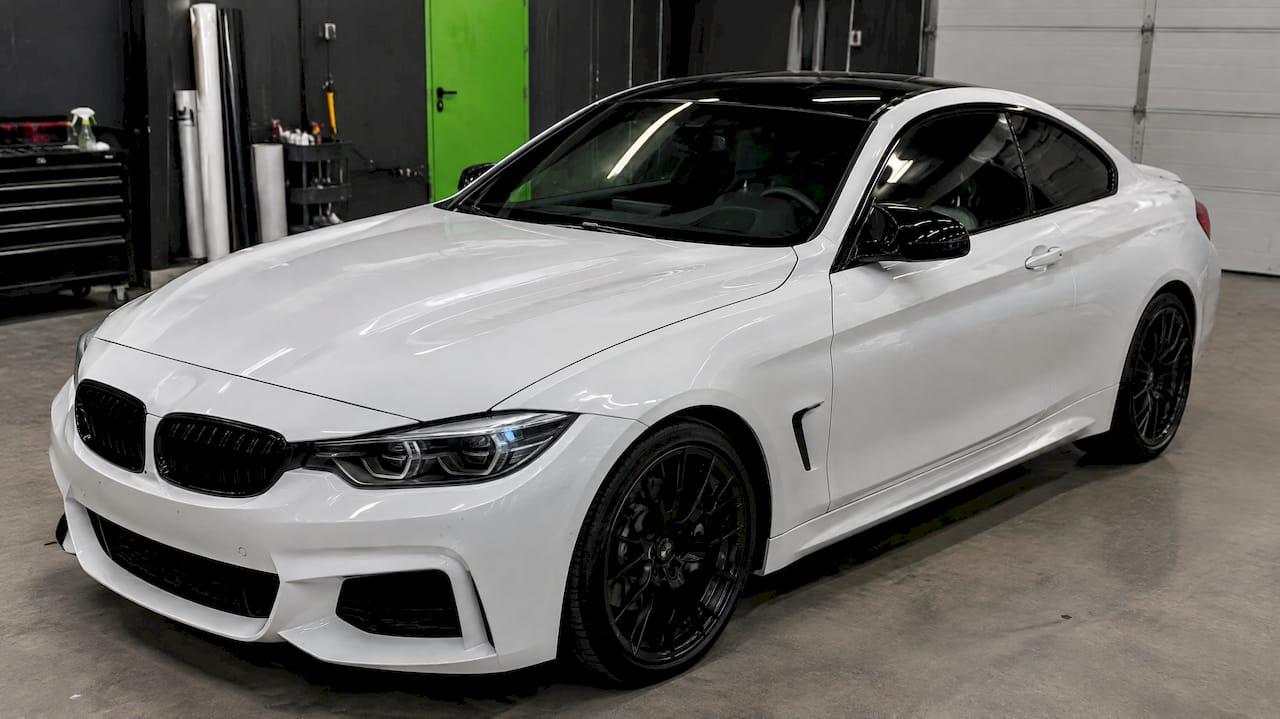
The best roof wrap idea for most cars is a gloss black roof, because it gives a panoramic-glass look on almost any color and is easy to coordinate with mirror caps and window trim. If your car is already black, skip plain gloss and choose a texture, such as satin, carbon fiber or a dark metallic. Below you will find the main designs, how to match them to your paint, what to know about glass roofs and Teslas, and how to keep a roof wrap looking sharp in Southern California sun.
TL;DR
- Gloss black is the most popular roof wrap and suits white, silver, gray, red and blue cars best.
- On a black car, pick satin, carbon fiber, dark metallic or a restrained color-shift film so the roof actually reads as different.
- Stripes, badges and printed patterns work when the whole design is planned around them, not added as an afterthought.
- Roofs take the most sun of any panel, so film choice, parking habits and washing routine decide how long the wrap looks new.
- Tesla and glass roofs need an installer who knows the sensors, cameras and trim. We handle them in our climate-controlled Van Nuys shop.
Table of Contents
- Why the roof is the smartest place to start
- Ten roof wrap designs worth considering
- Matching roof color to your paint
- Gloss black roof wrap: what to expect
- Glass roofs, sunroofs and Teslas
- How long a roof wrap lasts
- Perspective: why we install roof wraps the way we do
- Ready to wrap your roof?
- How to choose your roof wrap in five steps
- FAQ
- Sources
Why the roof is the smartest place to start
A roof is one flat, highly visible panel. It changes how the whole car looks from the side, from the front and from above, and it costs far less than wrapping everything. That makes it the usual first step for owners who want a custom look without repainting or committing to a full color change.
A roof wrap also solves a practical problem. Roof paint is the surface that sees the most direct sun, and on older cars the clear coat there is often the first thing to dull. Putting film over it gives you a fresh look now and a layer between the paint and the weather. If you are weighing film for looks against film for protection, our guide to PPF vs vinyl wrap explains where each one fits.
Ten roof wrap designs worth considering
Most roof wraps fall into a handful of families. Here is how we describe them to customers in the shop.
1. Gloss black panoramic look
This is the classic. The roof turns into a continuous dark surface that visually joins the windshield, side glass and rear glass, so the car looks as if it has a panoramic roof. Installers across the US describe it as the most popular partial wrap by far, and it is also the idea behind most searches for a gloss black roof wrap. Our advice: pair it with black mirror caps for the two-tone look many factory models use.
2. Satin or matte black
Satin has a soft sheen and shows less of the sky and the trees above you. It makes a deliberate contrast against a glossy body, which is why it suits owners who want the roof to look like a design choice rather than a glass extension. If you cannot decide between the two, read our comparison of matte vs satin wraps.
3. Carbon fiber texture
A woven carbon pattern adds depth and a sporty edge. It is a strong option for dark cars, because the texture creates contrast even when the color does not. It also works as a quiet accent on a white or silver car if you do not want a pure black block.
4. Roof-length racing stripes
One or two stripes running from the windshield to the trunk give a performance look. Stripes need careful alignment with the center line of the car, the antenna and the roof rails, so this is a job for precise measuring and a steady hand. Stripe width, spacing and color matter more than the film brand.

5. Custom printed pattern
Printed film lets you use almost any graphic: camouflage, geometric patterns, a subtle logo repeat or a texture like brushed metal or leather. It is a good fit for show builds and for business vehicles that want branding visible from above and from taller neighbors on the freeway.
6. Color-matched brand accent
For a business car or van, a roof panel in the brand color, with a small logo or tagline, ties the vehicle into a consistent identity. If you run several vehicles, our fleet wrap service can carry the same look across all of them.
7. Metallic or color-shift film
Metallic charcoal, gunmetal or a restrained chameleon film changes with the light without shouting. These suit owners who want something custom that still looks tasteful in a parking lot at noon and at sunset.
8. Reflective roof elements
Some owners add reflective strips or panels, mostly on work vehicles, trucks and off-road builds. They are a functional choice more than a style one, and they work best when kept small and symmetrical.
9. Pillar-to-roof combination (the tuxedo look)
Here the black extends past the roof onto the A, B and C pillars and sometimes the mirror caps. The result is a floating-roof effect that looks closer to a factory two-tone. It takes more installation time than a roof alone, and the pillar seams are where an installer's skill shows.
10. Partial graphic or roof badge
A centered emblem, a split design, or a diagonal fade over part of the roof is the lightest touch. It suits owners who like their car mostly stock but want one personal detail.
Matching roof color to your paint
The question we hear most is which roof color goes with which body color. The rule of thumb used by installers is simple: contrast works, and tone-on-tone works, but a half-contrast does not.
| Body color | Roof ideas that work | Roof ideas to avoid |
|---|---|---|
| White | Gloss black, satin black, carbon fiber | Pale gray (looks like a mistake) |
| Silver or gray | Gloss black, dark metallic, carbon fiber | Another light metallic |
| Red | Gloss black, satin black | Orange or bright accent colors |
| Blue | Gloss black, satin black, carbon fiber | Green or teal |
| Black | Satin black, carbon fiber, metallic charcoal, subtle color shift | Plain gloss black |
| Yellow, orange, green | Gloss black, satin black | Second bright color |
This follows what roof-wrap specialists report: white, silver, gray, red and blue cars usually look best with a gloss or satin black roof, while darker cars need texture or a change in reflection to show any contrast. We have taken the idea and applied it in the table above to the colors we see most in the San Fernando Valley.
A second body color on the roof, such as a red roof on a white car, rarely looks intentional unless the whole car is designed around it. If you want that look, plan the hood, mirrors or stripes to echo it. For broader color thinking, our color change wrap ideas article walks through shades and finishes in more detail.
Gloss black roof wrap: what to expect
Gloss black deserves its own section because so many owners choose it.
Appearance. It creates a deep, mirror-like surface. On a bright day it reflects clouds and treetops, which is what makes the panoramic effect convincing from the side.
Maintenance. Gloss black shows dust, pollen and fine swirl marks more than satin does. That does not make it a poor choice. It means you should wash by hand with a clean mitt, dry with a soft towel and avoid dragging dirt across the surface. Our vinyl wrap maintenance guide covers the routine step by step.
Vinyl or gloss black paint protection film. Some owners choose a gloss black film with a self-healing top coat instead of regular vinyl. One manufacturer's technical data sheet describes a 165-micron polyurethane film with a self-healing top coat, designed to guard against stone chips, road debris, insect stains and small to medium scratches. Roofs rarely see stone chips, but they do collect tree sap, bird droppings and constant UV, which is why a protective gloss black film is a sensible roof option. We install paint protection film on our PPF page services and can talk through which film suits your car.

Glass roofs, sunroofs and Teslas
A roof wrap on a car with a panoramic glass roof, a sunroof or a cluster of sensors is not the same job as a wrap on a solid metal roof. Before you book, work through this list.
- Is the glass being covered, or only the metal around it? Many owners wrap just the roof panel and leave glass alone. Covering glass is a different decision that involves visibility, local rules and the film chosen. Ask the installer to explain exactly what will be covered.
- Where are the antennas, cameras and sensors? Roof-mounted antennas, rain sensors and cameras sit under or near the roof line on many cars. The film has to be trimmed around them cleanly and must not sit over a lens.
- Which film is going on? Metallic and very thick films can interfere with GPS, cellular and keyless entry signals on some vehicles, a concern raised in Tesla tint guidance. That is a reason to choose a non-metallic film for a Tesla roof unless you have confirmed otherwise.
- What is the paint condition? Photograph the roof before the work starts. Chips, deep scratches and failing clear coat should be dealt with first, and our article on how pros prevent paint damage before wrapping explains the prep timeline.
- Can the installer handle the car's electronics? Teslas and other EVs need to be powered down properly during the work, and trim pieces should come off and go back on without breaking clips.
This is where we put the most effort. We specialize in Tesla and EV installations, and our process is designed to keep sensors and cameras clear and the fit factory-clean. If you drive a Model 3, Model Y, Model S or Model X, our Tesla wrap colors guide shows finishes that look good with each factory paint.
On warranty: a wrap does not automatically cancel a car's whole warranty, but a wrap can change how a manufacturer treats paint-related claims. Before you wrap a new vehicle, ask your dealer or the manufacturer how they handle aftermarket film, and keep your photos and installation paperwork.
How long a roof wrap lasts
The roof is the hardest surface on the car for any film. It faces the sky all day, so it receives more UV and heat than a door or a bumper. Manufacturers reflect that in their ratings. The same Avery Dennison data sheet lists 10 years vertical and 7 years horizontal in its mildest climate zone for its gloss black protection film, with shorter horizontal figures in harsher zones. A roof is a horizontal surface, so expect the lower number to be the relevant one, and treat any rating as a ceiling rather than a promise.
What shortens life in practice:
- Parking outside all day in direct sun
- Automatic brush washes
- Harsh solvents, abrasive polish and pressure-washing close to the edges
- Poor prep, such as installing over a dirty or failing surface
What extends it:
- Parking in a garage, in shade or under a cover
- Hand washing or touchless washes
- Waiting before the first wash
- Good installation with clean edges and sealed corners
On that last point, 3M's care guide for its paint protection film recommends hand washing whenever possible, touchless over brush washes, and no washing for the first 72 hours. It also advises storing the vehicle indoors, in shade or under a cover to protect the film from heat and UV. That is good practice for any roof film, and we give every customer a care sheet when they pick up their car. For a fuller view of expectations, read our car wrap lifespan guide, and if you park in hot weather, see what temperatures a wrap can take.
Perspective: why we install roof wraps the way we do
Most roof wraps that disappoint did not fail because of the film. They failed because of what happened around the film: dust in the room, a rushed trim job, or a color picked from a tiny swatch.
That is why our installs happen in a climate-controlled, dust-free facility. A roof is a big, flat, very visible surface, and a single speck under gloss black shows from across the street. Controlling the air, the temperature and the surface makes a real difference to the finish.
We also tell customers to think about the whole car before choosing. A roof wrap is easiest to love when it works with the mirrors, the pillars and the window trim. If you are on a Tesla or another EV, we plan the work around sensors and cameras first, then the look. Our goal is a roof that looks like it left the factory that way.
If you are unsure between gloss, satin and carbon, bring the car. Seeing film samples on your own paint in daylight settles it faster than any gallery.
Jake
Ready to wrap your roof?
If you have chosen a look, or you are still deciding between two, we can help you pick the film and finish for your exact car. We install vinyl wraps, gloss black and other protective film, and partial wraps like roofs, mirror caps and pillars at our Van Nuys shop, backed by manufacturer-authorized warranties. See our vinyl wrap services or get in touch through our main site to book a consultation.
Want to know what a roof wrap costs before you commit? Our roof wrap cost guide explains how vehicle size and roof complexity change the price.
How to choose your roof wrap in five steps
- Start with body color. Use the table above to narrow to two or three finishes.
- Decide how bold you want to be. Gloss black is the boldest and most popular. Satin and carbon are quieter. Stripes and prints are statement pieces.
- Look at the rest of the car. Chrome trim, window surrounds and mirror caps should work with the roof. Our chrome delete service is a common companion, since black roof and blacked-out trim look best together.
- Consider where you park. If the car lives outside in the sun, prefer a film with strong UV ratings and plan to cover or shade it when you can.
- Choose the installer last, and carefully. Ask where the work is done, how glass and sensors are handled, and what warranty applies.
FAQ
What is the most popular roof wrap?
Gloss black. It gives a panoramic-roof look on most body colors and pairs well with black mirror caps. On a black car, satin black, carbon fiber or a dark metallic usually looks better because plain gloss will blend in.
Can I wrap a panoramic or glass roof?
It depends on the car and the film. Many owners wrap only the painted roof around the glass, and that is the safest approach. If you want film over glass, talk to the installer about visibility, local rules and the film type before you book.
Will a roof wrap damage my paint?
A wrap applied to healthy, factory paint and removed properly generally leaves the paint underneath in good condition. Problems come from poor prep, damaged clear coat or old repaint jobs. We inspect the roof before we start, and our guide on wraps and paint damage explains the process.
How should I wash a wrapped roof?
Hand wash with a soft mitt and mild soap, or use a touchless wash. Avoid brush washes, and do not wash during the first 72 hours after installation. Park in shade or a garage when you can, because sun is the biggest factor in how long the film lasts.
Can I wrap just the roof, or should I do mirrors and pillars too?
You can wrap only the roof. Many owners add mirror caps for a cleaner two-tone look, and some extend the black onto the pillars for a floating-roof effect. The extras add time, but they make the design look more deliberate.
Sources
- Partial Car Wrap: Cost, Ideas, and What to Wrap
- Black Car Roof Wrap Ideas and Roof Wrap Colors
- SPF Gloss Black Technical Data Sheet, Avery Dennison
- How to Tint a Tesla
- Product Care Guide for 3M Paint Protection Film