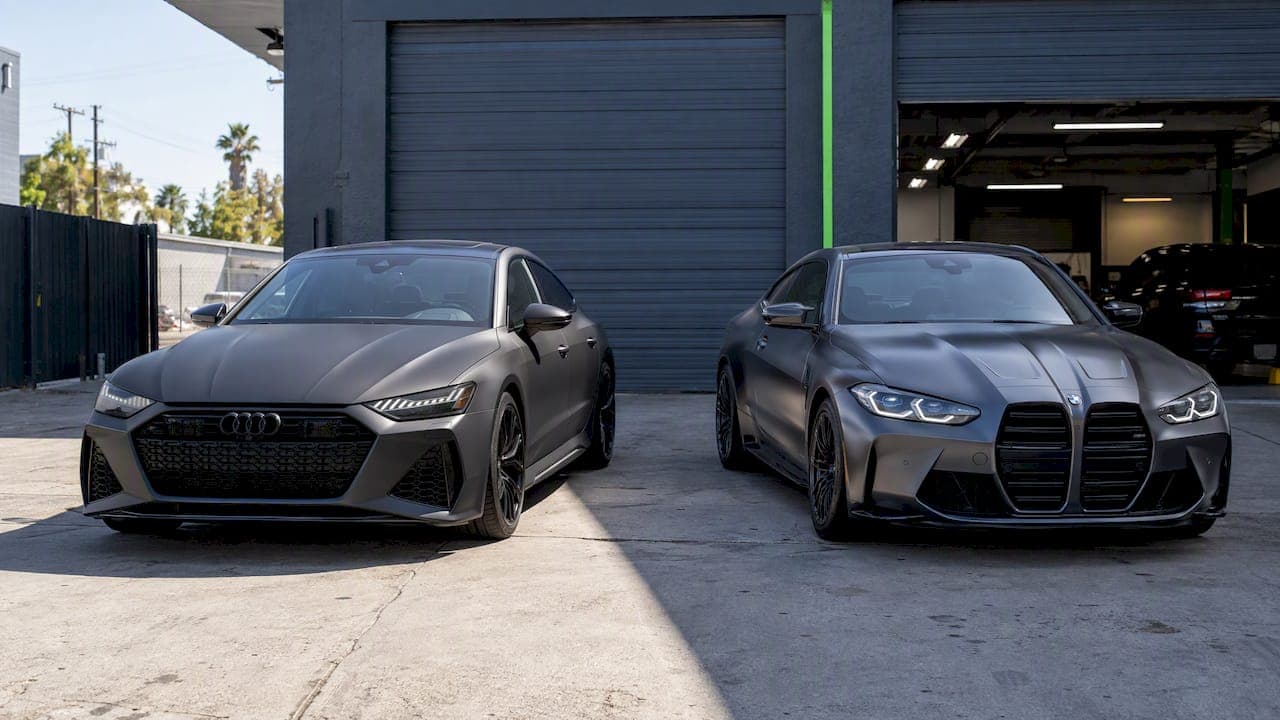
The difference comes down to light. A satin wrap reflects a little of it and gives you a soft, silky glow along the body lines. A matte wrap reflects almost none, so the car looks flat, deep and stealthy. Both are non-gloss, but they differ in how they look on your car and in how much work they ask of you after you drive away.
This guide covers how each finish looks on different vehicles, how each handles dirt, water spots and scratches, what the car wash rules are, and which one suits your driving. If you're in the San Fernando Valley and already know what you want, our vinyl wrap service in Van Nuys is the place to start.
TL;DR
- Satin has a low-to-medium sheen that shows off curves and creases. It is the easier finish for a daily driver, because it resists dirt, fingerprints and water spotting better than matte.
- Matte is non-reflective and aggressive. It hides fine micro-scratches well, but it shows water spots and contamination faster.
- Neither finish likes wax, automatic brush washes or a rushed first week. Hand washing with a wrap-safe soap is the standard for both.
- Choose matte for sharp, performance-styled cars that you will keep clean. Choose satin for a daily driver, a family car or anything parked outside.
- Your body shape matters as much as your taste. Always look at a large sample on a curved surface before you commit.
Table of Contents
- What actually separates matte from satin
- How each finish looks on real cars
- Upkeep: where the two finishes really diverge
- Car washes and the first week
- A word from our shop
- Which finish fits you
- Budget and what affects the quote
- Before you book: a short checklist
- Ready for a matte or satin wrap in the Valley
- FAQ
- Sources
What actually separates matte from satin
Both finishes are made by giving the vinyl surface a texture that scatters light instead of mirroring it. The degree of scatter is the whole story.
Matte vinyl reflects very little light, which creates a flat, muted surface. Highlights disappear, and the car reads as a single solid shape. On a car with strong angles, that can look menacing in the best way.
Satin vinyl reflects a small amount of light, which creates a soft glow and gentle highlights. Think of the sheen on an eggshell or brushed metal. The light rolls across a fender instead of bouncing off it, so you still see where the surface curves.
A quick side-by-side:
| Matte | Satin | |
|---|---|---|
| Sheen | None to very low | Low to medium, silky |
| Body lines | Flattened, one solid shape | Defined by soft highlights |
| Look | Stealthy, aggressive | Refined, understated |
| Fingerprints and smudges | Can show oils and smears | Generally more forgiving |
| Water spots and contamination | Show up faster | Show up more slowly |
| Fine micro-scratches | Easier to hide | Slightly more visible |
| Care routine | Most product-specific | Closer to standard, still wax-free |
The care rows come from manufacturer maintenance guidance and installer experience, which we cover below.
How each finish looks on real cars
Color changes everything. Black, dark gray and army green all behave differently from white, silver or a bold color.
Dark colors
Matte black is the classic stealth look. It absorbs light so completely that the car can look like a silhouette at dusk. Satin black keeps a soft sheen that helps define the vehicle's body lines, which many owners find looks more expensive and less like a primer coat.
If you want people to notice the shape of the car first and the finish second, go satin. If you want the finish itself to be the statement, go matte.
Light colors
On white, silver and pastel colors, the gap between the finishes narrows. Matte white can look chalky. Satin white looks closer to a pearl or ceramic glaze. Dirt also shows differently on light colors, which can work in your favor.
Body shape
Industry professionals tend to match the finish to the car's design language. Performance vehicles with sharp, aggressive lines suit the tactical feel of matte. Luxury daily drivers are often better served by the refined look of satin, which stays sophisticated while still being clearly custom and non-gloss. Large, smooth surfaces, like the sides of a Tesla or a full-size SUV, often look better with satin, because the soft highlight keeps the panel from looking like a flat sheet.
The practical test: ask to see a sample draped over a curved surface and look at it outdoors, in both direct sun and shade. Showroom lighting flatters everything.

Upkeep: where the two finishes really diverge
This is where most owners get surprised. Matte is not harder to live with because it is fragile. It is harder because it shows certain problems very clearly and punishes certain habits permanently.
Dirt, fingerprints and water spots
Matte finishes are good at hiding minor micro-scratches because there is no reflection to catch them. The trade-off is that they are more prone to visible water spots and contamination, so the car can look dirty sooner than a satin one, especially where the water is hard or rain is frequent.

Satin is widely cited as the better choice for daily drivers because of its higher resilience to dirt, fingerprints and water spotting.
If you park outside in the Valley, sprinklers and hard water are a real consideration. Dry the car right after a wash instead of letting it air dry in the sun.
Bird droppings, tree sap and bugs
These are the stains to treat fast. The texture of a dead-matte film is porous at a microscopic level, and organic contaminants can etch into it much faster than they do on gloss paint. Left alone, bird droppings and sap can leave permanent marks. Avery Dennison sells a dedicated wrap care range with a cleaner, power cleaner and sealant built for matte, satin and gloss wraps, which gives you a sense of how product-specific this gets.
Satin is effectively a bridge between gloss and matte. You can use more standard cleaning techniques, though still wax-free. Dead-matte finishes need a more meticulous routine.
Wax is the enemy of both
Many owners assume regular wax will protect a stealth finish. It does the opposite. Standard paste waxes contain fillers and petroleum distillates that can clog the fine texture of matte and satin films and leave uneven shiny patches that do not come out. Avery Dennison's care instructions for its Supreme Wrapping Film point owners toward dedicated products and a waterless wash for light dirt. Use only matte-safe detailers or approved sealants.
Scratches and heat
Because matte hides fine scratches, it often looks better for longer in daily use. Some surface marks on these films can be improved with controlled heat by a professional installer, but the margin is thin. According to 3M's maintenance guidance, going above about 225°F (107°C) on the surface risks burning the film, which cannot be undone and means replacing the panel. Never try this yourself with a hair dryer or heat gun. Bring the car to the installer.
Car washes and the first week
The wash rules are the same for both finishes.
- Wait at least 48 to 72 hours after installation. The adhesive needs time to cure to the paint. Washing or exposing the wrap to harsh conditions too early can cause edge lifting, particularly on complex bumpers and sensor areas where the film is under high tension.
- Skip brush washes. Automatic brush washes can dull the surface, scratch it and lift edges. According to 3M's guidance, touchless is the only automated option, and hand washing is still better for long-term results.
- Hand wash with a pH-balanced, wrap-safe soap and dry with clean microfiber.
- Wipe fuel spills immediately. Fuel can degrade the vinyl and the adhesive.
- Spot-treat bugs, sap and droppings early with a product approved for your film.
We go further on routines in our guide to vinyl wrap maintenance.
A word from our shop
We install wraps in a climate-controlled, dust-free facility in Van Nuys, and finish choice is one of the most common conversations we have at the counter. Here is how we see it.
Matte photographs well and turns heads, but it asks the most from the owner. We tell people to be honest about their habits. Do you hand wash? Do you have a garage or covered parking? Will you deal with a bird dropping the same day? If the answer is yes, matte is a great choice. If the answer is "I want a cool car I don't have to think about," we usually steer toward satin.
On Teslas and other EVs, we pay extra attention to how the film wraps around bumpers, sensor areas and door edges, because that is where tension in the film shows up. Satin tends to look especially good on the long, smooth panels of these cars. Whatever finish you choose, we work with film from established manufacturers, and warranties are manufacturer-backed.
One more thing we say often: the wrap is only as good as the surface under it. If your paint has failing clear coat or deep damage, read our shop-tested scenarios on wrapping over bad paint before you pick a color.
— Jake
Which finish fits you
Choose matte if
- You want the most dramatic, stealthy look and you're happy to maintain it.
- Your car has sharp, angular body lines that read well as a flat, dark shape.
- You have covered parking or a garage.
- You are willing to use dedicated matte-safe care products.
Choose satin if
- This is your daily driver and it sits outside.
- You want the body lines to stay visible.
- You'd like a routine that is simpler and more forgiving.
- You have kids, pets or a commute that will leave fingerprints and dust on the car.
Consider something else if
- You want protection from rock chips, not only a new look. A wrap changes appearance. Paint protection film is the layer made to guard against impact. Our comparison of PPF vs vinyl wrap explains when each makes sense.
- Your car already has factory matte paint. That needs its own approach, covered in our notes on PPF for matte paint and ceramic coating for matte paint.
Budget and what affects the quote
Finish type is rarely the biggest driver of cost. Vehicle size, the complexity of the bumpers and mirrors, door jambs, the condition of the paint and the film brand all matter more. We don't publish fixed prices because each vehicle is quoted individually. For a realistic overview of what shapes a quote, see our car wrap cost guide and the Los Angeles price guide.
The cheaper wrap is often the one that fails early at the edges. Ask any shop how it preps, where it installs and who stands behind the warranty.
Before you book: a short checklist
- See a large sample of both finishes in your color, outdoors.
- Decide where the car will be parked and how you'll wash it.
- Ask which film the shop uses and what the manufacturer warranty covers.
- Ask about the installation environment. Dust is the enemy of a clean finish.
- Confirm the cure time and when you can wash.
- Ask what to do about contaminants such as sap and droppings.
- If you worry about your paint, read how pros prepare in the weeks before wrapping.
Ready for a matte or satin wrap in the Valley
We wrap cars, Teslas and fleets from our climate-controlled shop in Van Nuys, and we'll help you compare matte and satin samples on your own car's shape. Take a look at our vinyl wrap options, or if you want a black-out look without a full wrap, see our chrome delete service. Businesses can ask about fleet wraps too.
FAQ
What are the downsides of matte car wraps?
Matte shows water spots and contamination faster than satin, and it can't be waxed or polished. Bird droppings and tree sap can etch into the porous texture if left on, and it needs product-specific care. On the plus side, it hides fine micro-scratches well.
Which is better, matte or satin?
It depends on your habits. Satin is the safer pick for a daily driver because it handles dirt, fingerprints and water spots better and keeps your body lines visible. Matte is better if you want the flattest, most aggressive look and will keep up with the washing.
Can you go through a car wash with a matte wrap?
Not a brush wash. Manufacturer guidance says automatic brush washes can dull, scratch and lift edges, and touchless is the only automated option. Hand washing is better, and you should wait 48 to 72 hours after installation before any wash.
Can I wax a matte or satin wrap?
No. Paste waxes can clog the surface texture and leave permanent shiny patches. Use a detailer or sealant made for matte and satin films instead.
Sources
- Satin vs Matte Vinyl Wrap: Differences, Pros, and Cons
- 3M Wrap Film Series 2080 Frequently Asked Questions
- Caring for your Avery Dennison Supreme Wrapping Film
- Avery Dennison Supreme Wrap Care Product Overview