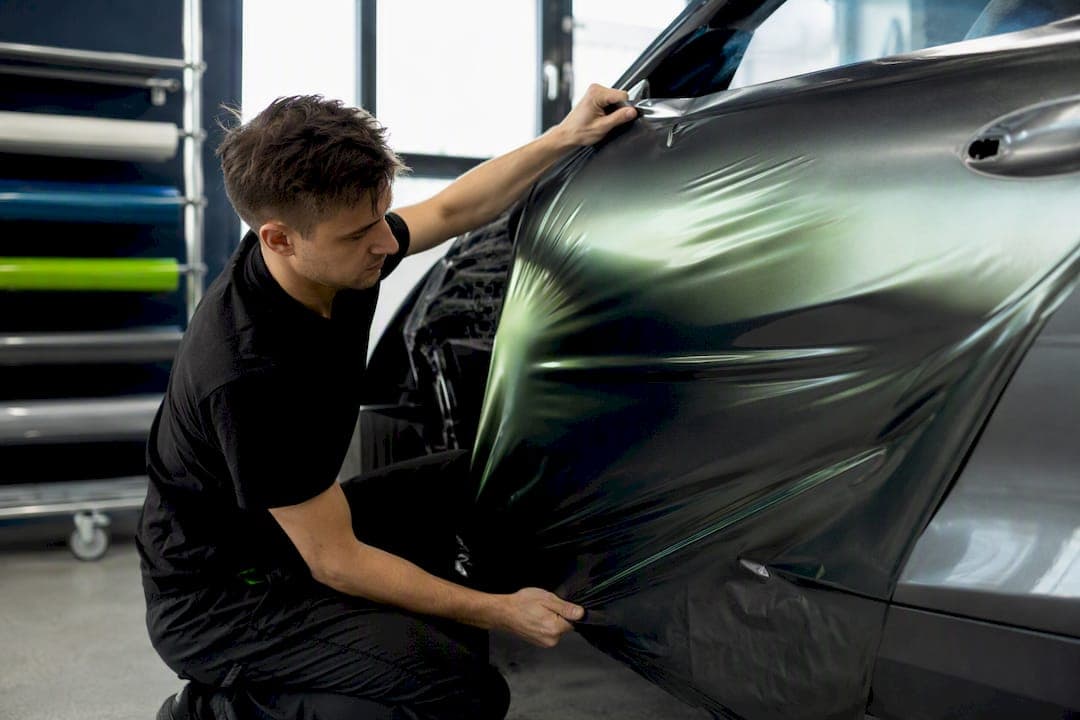
A professionally installed vinyl wrap lasts 5 to 7 years under decent conditions, with premium cast film and diligent care sometimes stretching that to 8 or 10. Budget installations with calendered vinyl can start failing in as little as 1 to 3 years. Four things move that number more than anything else: film construction, installation quality, climate and surface orientation, and how you maintain it afterward.
- Premium cast vinyl (solid color): 5 to 7 years, up to 8 to 10 in mild climates
- Printed and laminated cast graphics: 5 to 8 years
- Calendered/economy vinyl: 1 to 5 years
- Chrome and metallic finishes: 2 to 4 years
Most quality car wraps last several years when installed correctly and maintained on a regular schedule, according to industry-wide guidance compiled by TheHowMuch.
Key Takeaways
Car wrap lifespan depends less on brand names and more on film construction, installation quality, climate, panel orientation, and how consistently you maintain it afterward.
| Point | Details |
|---|---|
| Expect 5 to 7 years | Cast vinyl with proper care typically lasts 5 to 7 years, with premium setups reaching 8 to 10 in mild climates. |
| Horizontal panels fail first | Hoods, roofs, and trunks often see roughly half the vertical-rated lifespan due to direct UV exposure. |
| Cast beats calendered | Cast vinyl resists shrinking and cracking; calendered film is cheaper but fails sooner, often within 1 to 5 years. |
| Hot climates cut lifespan | Installers in sunny, hot regions commonly see real-world lifespans drop to 3 to 5 years. |
| Professional install matters | Tintandwrapscustoms installs wraps in a climate-controlled Van Nuys facility with manufacturer-backed warranties. |
Where to check the technical numbers yourself
- ORAFOL's service-life and warranty tables for climate-zone durability ratings.
- Flywheel Brands' material comparison breaking down cast versus calendered specs.
- Cars on real-world wrap lifespan.
- Hexis Americas' finish-specific durability notes for maintenance guidance by film type.
Roughly 5 to 7 years is the realistic middle ground most quality wraps land on once climate and care are factored in.
Table of Contents
- How Long Do Car Wraps Last, According to Manufacturer Data?
- What Factors Actually Shorten or Extend Wrap Life?
- Which Vinyl Types and Finishes Hold Up Best?
- How Do You Extend a Car Wrap's Life?
- When Should You Repair Versus Replace a Wrap?
- What Does a Wrap Cost Versus How Long It Lasts?
- What Should You Expect From Wraps in Different Climates?
- Frequently Asked Questions
- Sources
How Long Do Car Wraps Last, According to Manufacturer Data?
Manufacturer service-life numbers and real-world results rarely match, and that gap trips up a lot of first-time wrap buyers. A datasheet figure is a lab-conditions ceiling, not a promise.
ORAFOL's own technical literature frames its published service-life tables as the "maximum expected" durability for vertical outdoor exposure in Climate Zone 1, the mildest UV category on their charts. Warmer zones and horizontal panels get discounted from there, and the company's warranty documentation is explicit that these figures exclude gradual aging effects like plasticizer migration and general weathering. That single fact explains most of the confusion around "how long do car wraps last" as a search question: the number on the box assumes ideal geometry and a mild climate, and most cars don't get either.
Cast vinyl under a UV-stable overlaminate holds up longest in the real world, with spec comparisons citing roughly 8 years for printed-and-laminated constructions, while polymeric calendered film lands closer to 5 to 7 and monomeric or entry-level films can fail in under a year in demanding applications.
Homeowners and daily drivers alike tend to assume the highest number on the spec sheet applies to their car. It usually doesn't, especially once you factor in a hood or roof panel baking in direct sun every afternoon.
What Factors Actually Shorten or Extend Wrap Life?
Film quality sets the ceiling, but everything else determines whether you actually reach it. Here's what moves the needle most:
- Film construction: Cast vinyl conforms to curves without stress and resists shrinking; calendered vinyl is cheaper but prone to cracking and edge lift within a few years.
- Installation quality: Trapped dirt, rushed seams, and sloppy edge treatment cause early lifting no matter how good the film is.
- Climate and UV exposure: Intense sun, heat cycling, and coastal salt air all accelerate fading and adhesive breakdown.
- Surface orientation: Horizontal panels like hoods, roofs, and trunks take direct UV hits and often see failure at roughly half the vertical-rated life, a reduction manufacturers routinely apply for anything more than 10 degrees off vertical.
- Usage patterns: Garage-kept cars driven occasionally will always outlast daily-driven fleet vehicles parked outside.
- Wash habits: Harsh chemicals and high-pressure jets aimed at edges peel film faster than sun ever will.
Installer experience backs this up directly. Shops working in hot, sunny climates commonly see real-world lifespans drop to three to five years, even on film rated for longer, and horizontal panels are almost always the first place that shows up.
Pro Tip: Ask your installer to photograph every panel edge and seam right after installation. That baseline photo set makes it far easier to spot early lifting at a 3 or 6 month checkup, before it turns into a full panel failure.
Which Vinyl Types and Finishes Hold Up Best?
Cast vinyl beats calendered vinyl on almost every durability metric that matters. Cast film is made by pouring liquid vinyl onto a casting sheet, which lets it conform to curves and body lines without internal stress, so it resists shrinking and cracking over time. Calendered vinyl is manufactured by rolling out sheets under heat and pressure, which bakes in stress that slowly relaxes and shows up as shrinkage, edge curl, and premature cracking.
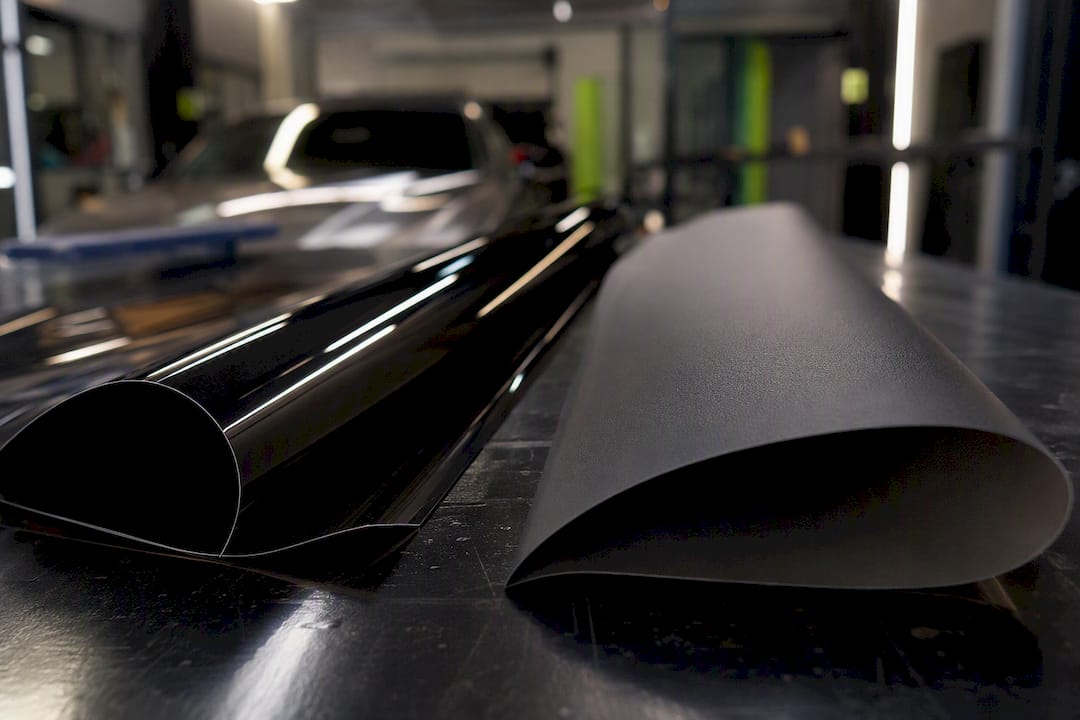
Printed-and-laminated graphics behave differently than solid-color cast film. The printing process and inks introduce a weak point, and a laminate can't fully compensate for a cheap base film or fugitive ink, since the whole system's lifespan follows its weakest layer.
Finish matters too:
- Gloss and satin: Generally the most durable and easiest to maintain.
- Matte: Slightly more sensitive to fingerprints and requires gentler cleaning agents.
- Chrome and mirror finishes: Look dramatic but are the least UV-stable and tend to degrade faster.
- Textured carbon fiber: Holds up well but traps grime in the texture, demanding more frequent washing.
| Material/finish | Realistic lifespan | Common use case |
|---|---|---|
| Solid cast color-change | 5 to 7 years | Full vehicle wraps |
| Printed + laminated cast | 5 to 8 years | Business branding, fleet graphics |
| Calendered/economy | 1 to 5 years | Budget or short-term promotional wraps |
| Chrome/metallic | 2 to 4 years | Accent panels, show cars |
Manufacturers like 3M, Avery Dennison, and ORAFOL (ORACAL) each publish their own durability guidance for these categories, and while the exact numbers vary by product line, the cast-versus-calendered gap holds across all three brands.
How Do You Extend a Car Wrap's Life?
The single biggest lever you control is the install itself. Pick a cast film with a UV-stable overlaminate if longevity matters more than upfront cost, and insist on full surface decontamination before any vinyl goes down. A climate-controlled bay matters here because dust and temperature swings during application are a leading cause of adhesion failure down the road.
Once it's on the car, a few habits make an outsized difference:
- Hand wash weekly to biweekly using a pH-neutral car shampoo and a microfiber mitt.
- Skip automatic touchless car washes with aggressive brushes or high-pressure edge jets.
- Avoid solvent-based cleaners, bug and tar removers, and anything with alcohol near seams.
- Park in a garage or under a breathable cover whenever possible.
- Rotate parking orientation for fleet vehicles so the same panel isn't always facing direct sun.
Ceramic coating applied over vinyl adds a sacrificial layer that resists UV degradation and makes washing easier, though it won't rescue a wrap installed with poor seam work or trapped contaminants. Our guide on ceramic coating warranty coverage breaks down exactly what that added protection does and doesn't guarantee.
Pro Tip: Run a fingernail test along seams and edges every few months. If the edge lifts even slightly under light pressure, that's the earliest visible sign of adhesive failure, months before you'd notice fading or cracking.
When Should You Repair Versus Replace a Wrap?
Fading, chalking, and cracking on horizontal panels almost always show up first, since those surfaces take the most direct UV exposure. Edge lift, bubbling, and adhesive bleed usually follow as the film ages further.
- Repair or partial rewrap when damage is localized to one panel, like a faded hood or a scraped bumper corner.
- Full replacement makes more sense when adhesion is failing across multiple panels or color has shifted unevenly across the car.
- Check removal risk before waiting too long: old adhesive can bond to clear coat, making clean removal harder the longer a failing wrap stays on.
- Ask about paint condition underneath before committing to a rewrap versus a fresh PPF or vinyl install.
What Does a Wrap Cost Versus How Long It Lasts?
A full wrap typically runs from budget calendered options up to premium cast installations, with the price gap reflecting real differences in expected years of service. Repairs like edge fixes or a single-panel rewrap cost far less than starting over, which is why catching problems early saves money twice over.
- Economy calendered wraps cost less upfront but often need replacing within 1 to 5 years.
- Mid-tier cast vinyl balances price and durability for most daily drivers.
- Premium cast with lamination costs more but can outlast two economy wraps combined.
Cost-per-year is the number that actually matters, not the sticker price. A wrap that costs more upfront but lasts 7 years beats one that's cheaper but needs replacing after 2.
Manufacturer warranties typically cover material defects and delamination, but they almost always exclude UV fade on horizontal panels, environmental contaminants, and damage from improper cleaning. Read that fine print before assuming your warranty covers fading.
What Should You Expect From Wraps in Different Climates?
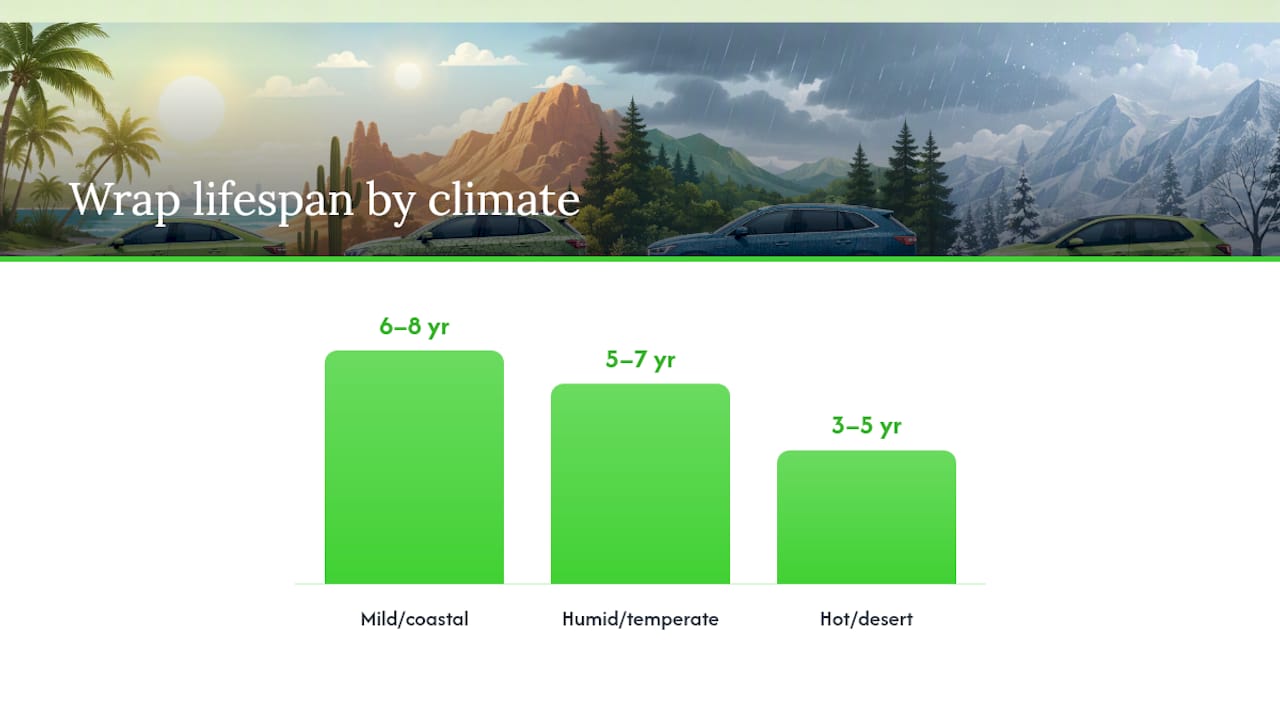
Installers working in hot, sunny regions routinely see vinyl wraps age faster than the datasheet suggests, with real-world lifespans landing closer to three to five years rather than the seven-plus figure on the box, largely because horizontal panels bear the brunt of direct sun exposure.
That field observation lines up with how manufacturers structure their own durability tables. A vertical-rated service life gets cut by roughly half for horizontal or steeply angled panels, per guidance widely cited across material comparisons.
| Climate type | Realistic expectation |
|---|---|
| Mild/coastal | 6 to 8 years |
| Humid/temperate | 5 to 7 years |
| Hot/desert | 3 to 5 years |
How we talk to customers about wrap longevity
We tell every customer the same thing: your climate and how you park matter as much as the film you pick. That's part of why our installs happen in a climate-controlled facility, and why our warranty-backed work covers Tesla and other EV owners who want a clean, factory-level finish that holds up over time.
[JAKE_EEAT_PLACEHOLDER: insert Jake-specific proof points, shop capability details, and warranty statement here]
Get a realistic lifespan estimate for your vehicle
If you're weighing a full color-change wrap, chrome delete, or fleet branding job, the material and climate factors above only tell part of the story, your specific vehicle, parking situation, and driving habits shape the rest. Tintandwrapscustoms installs every wrap in a climate-controlled facility in Van Nuys, using manufacturer-backed warranties and the same attention to detail behind our Tesla and EV specialty work.
Whether you want a durable cast vinyl color change or a ceramic coating layered over an existing wrap for extra protection, our team can walk you through which combination fits your budget and how long you drive between garage stays. Book an inspection or get a quote and we'll give you a straight answer on what to expect from your specific setup, not just a generic datasheet number.
Frequently Asked Questions
Does a car wrap protect the paint underneath? Yes. A wrap acts as a sacrificial layer over factory paint, shielding it from minor scratches and UV exposure for as long as the film stays adhered, though it's not a substitute for paint protection film if scratch resistance is the priority.
Can you wash a wrapped car at a regular car wash? Hand washing is safer than automatic touchless washes, which often use aggressive brushes or high-pressure jets that can lift edges and seams over time.
Does ceramic coating make a wrap last longer? Ceramic coating adds a UV-resistant layer that eases cleaning and slows fading, but it can't compensate for a poor installation or low-grade base film underneath it.
How do you know if a wrap needs to come off before it damages paint? If adhesive has started bonding aggressively to clear coat, usually after several years past the film's rated life, removal risk goes up. Getting it evaluated sooner rather than later keeps removal clean.
Is a printed wrap less durable than a solid color wrap? Generally yes. Printed graphics introduce ink and lamination as additional weak points, so even with a UV-stable overlaminate, printed wraps average slightly less than solid cast color-change films.
Sources
- ORAFOL general warranty and expected service life tables — ORAFOL
- What decal material lasts longest outdoors? — Flywheel Brands
- Cars
- How long does a car wrap last? Lifespan, Maintenance & Replacement Cost — TheHowMuch
- How Long Does a Vinyl Wrap Last? — Hexis Americas