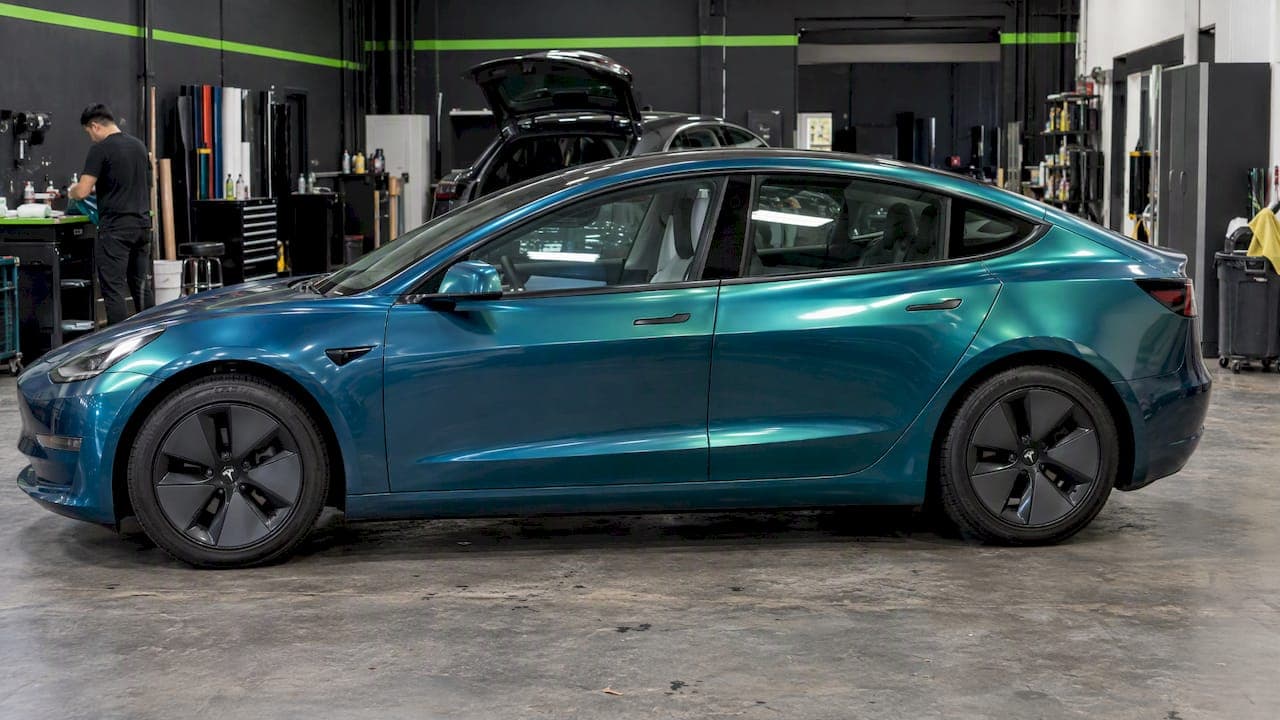
The best Tesla wrap color is the one that still looks right on your specific model, in your light, in three years. In practice that usually means a satin or gloss version of a restrained shade: nardo-style gray, deep green, midnight blue, satin black or pearl white. Bold colors work too, but they depend more on installation quality. Below we cover how color behaves on each Tesla, how finish changes the result, and what to settle before you pay for film.
TL;DR
- Finish matters as much as hue. Gloss reads as paint, satin hides fingerprints better than gloss and looks premium, and matte is the most dramatic and the most demanding to keep clean.
- Never choose from a screen. Use a visualizer to narrow the field, then look at a physical sample outdoors on a curved panel.
- Wrap color cannot hide poor paint. Dents, nicks and scratches can telegraph through vinyl, so prep decides the result.
- Vinyl is for color and light surface protection. If stone chips are your worry, look at clear or colored paint protection film instead.
- Ask for the film brand, finish, coverage, edges, jambs and warranty issuer in writing before you book.
Table of Contents
- Which colors people actually wrap Teslas in
- Match the color to your model
- Gloss, satin or matte: choosing the finish
- How to test a color before you commit
- Why prep matters more than the color
- Vinyl wrap or paint protection film
- What a Tesla wrap costs, and why we do not quote a number here
- Perspective: what we tell Tesla owners at the shop
- Questions to ask any installer before you pay
- Caring for a wrapped Tesla
- Wrap a Tesla at Tint & Wraps Customs in Van Nuys
- FAQ
- Sources
Which colors people actually wrap Teslas in
Tesla's factory palette is narrow. Most cars on the road are white, gray, black, silver, blue or red, so a wrap is the quickest way to look different without touching the paint. Over the years we have seen requests fall into a few families.
Grays and "cement" tones. A flat, mid-to-dark gray is the most requested color on the Model Y and Model 3. It suits the black trim, black glass roof and dark wheels, and it makes body lines look sharp rather than glossy. It also forgives a little road film.
Black, in three versions. Gloss black looks like deep paint and shows every swirl. Satin black is the safer daily choice. Matte black looks aggressive and is the hardest to live with, because oils from hands and bird droppings need prompt, careful cleaning.
Deep greens and blues. Dark forest, British racing-style green, midnight and deep metallic blues look nearly black in shade and reveal color in direct sun. They are a good fit if you want something distinct that does not shout.
Whites and pearls. Pearl white or satin white keeps a clean, modern look. If your car is already white, a wrap is mostly about refreshing it or changing the finish.
Reds, oranges and bright colors. Gloss red, orange and teal photograph well and turn heads. They also make panel gaps, seams and wrapped edges more visible, so they reward an installer who works carefully.
Color-shift and specialty films. Color-flow films, satin chromes and textured finishes move between shades depending on angle. The Avery Dennison wrap visualizer for Tesla models groups films into gloss, matte, satin, textured, ColorFlow, specialty and diamond-style categories across Model S, 3, X, Y and Cybertruck, which gives you a feel for how broad the choice is.
Match the color to your model
Tesla bodies are not alike, and the same film reads differently on each.
Model Y
The Model Y has a tall, rounded body with large flat door and tailgate surfaces. Satin grays, deep greens and pearl whites look balanced on it. Very dark gloss colors can show reflections that make the large flat areas look wavy, which is a good reason to inspect the panels in daylight before you commit.
Model 3
The lower, sleeker Model 3 handles bold colors well because the body has less visual mass. Gloss red, midnight blue and satin dark green all suit it. The newer Highland-style front and rear lighting also takes tinted treatments neatly if you want a coordinated look.
Model S and Model X
The larger sedan and SUV suit understated, luxury-leaning colors: satin gray, dark blue, champagne tones and deep black. Long panels make color-shift films look especially good, but they also expose any stretch or tension marks, so installer skill counts.
Cybertruck
The Cybertruck is a different problem. Its large, flat stainless panels are unlike painted steel, and the surfaces are unforgiving: seams and straight edges are very visible. Color choices here tend toward satin and matte colors that suit the angular design, and a careful installer matters more than any shade.
Gloss, satin or matte: choosing the finish
People spend weeks on hue and minutes on finish, when finish often changes more about how the car looks and how it lives.
| Finish | Look | Daily upkeep | Best for |
|---|---|---|---|
| Gloss | Close to fresh paint | Shows swirls and fine scratches | Owners who want the car to read as factory color |
| Satin | Soft sheen, between gloss and matte | Moderate, hides fingerprints better than gloss | The most popular all-round choice |
| Matte | Flat, non-reflective | Needs gentle, prompt cleaning; oils and bird droppings stand out | Statement builds and show cars |
| Textured, chrome, color-shift | Highly distinctive | Varies by film; ask your installer | Enthusiasts who want a one-of-a-kind look |
If you are torn between the two middle finishes, our guide to matte vs satin wrap finishes walks through the trade-offs in more detail.
How to test a color before you commit
A screen cannot tell you how a wrap will look on your car. Calibration, sunlight, panel curvature and film direction all change the finished appearance. Use this order instead.
- Narrow the field online. Use a visualizer to compare overall contrast against your model's body shape, trim and wheels. Pick three colors, not twelve.
- Ask for physical samples. Hold them against the car, not against a table.
- View them outdoors. Check in direct sun, in shade and at dusk. Metallic and color-shift films can look like different colors in each.
- Look at a curve. A sample laid flat tells you little. A fender or mirror shows how the film breaks light.
- Consider your trim. Black window trim and a black roof suit most colors, but dark wheels with a dark wrap can look heavy. Plan wheel and caliper color alongside the body.
- Live with it for a day. Photograph the samples on your driveway and look again the next morning.
The manufacturer's own wrap program follows the same logic: color selection happens in person during an initial visit rather than from a fixed public palette, and installation follows in a second visit. A good independent shop should offer the same physical review.
Why prep matters more than the color
The most expensive film on the market will not rescue a car with unrepaired paint. The manufacturer says that dents, nicks, scratches and other irregularities can telegraph through vinyl and become more noticeable, so inspection and paint correction may be needed before a single panel is wrapped.

That is also the reason a dust-controlled workspace matters. Debris trapped under film shows up as a bump forever. If you want the full prep timeline, we explain it in how pros prevent paint damage before wrapping.
One more point owners miss: the manufacturer warns that residue from pre-existing third-party ceramic coatings can affect adhesion and may fall outside its wrap warranty. If your car has a coating, tell the installer before you get a quote.
Vinyl wrap or paint protection film
These are different products with different jobs.
- Vinyl wrap changes color and gives light surface protection. It can be removed, which makes it a good way to try a bold color without a permanent decision.
- Paint protection film (PPF) is a clear or tinted urethane layer built to resist rock chips and scratches. The manufacturer describes its own clear urethane film as self-healing and about twice as thick as vinyl.
If you mostly drive freeway miles and want to protect the nose and hood, PPF is the better tool. If color is the goal, vinyl is. Some owners combine them: PPF on high-impact areas, vinyl elsewhere. Our comparison of PPF vs vinyl wrap helps you decide, and our page on Tesla paint protection for Model 3 and Y covers the soft-paint question specifically.
What a Tesla wrap costs, and why we do not quote a number here
No official source publishes a universal price for a Model Y color-change wrap. Tesla's separately listed clear film for Model 3 and Y is shown at $5,000, but that is a different product from a full-color vinyl wrap and is not a market price for one.
A fair quote depends on these factors:
- Model and generation (a Model Y Juniper is not a first-generation Model Y)
- Full or partial coverage
- Film brand and finish, since specialty films cost more and are harder to install
- Paint correction needed before wrapping
- Trim removal and edge wrapping
- Door jamb coverage
- Warranty terms
Beware of any price that arrives before someone has looked at the car.
Perspective: what we tell Tesla owners at the shop
Most people arrive with a color in mind and leave with a different finish. We have wrapped and protected over 1,000 vehicles in the San Fernando Valley, and the pattern is consistent: owners fall for hue, then live with finish.
Our honest advice is this. Pick a shade you would still like if it were the only color you saw for three years. Choose satin if you are unsure. Spend your attention on the installer, not the roll. Film from respected makers is a baseline, but the work happens in a clean, climate-controlled bay, where temperature and dust do not interfere with adhesive and edges.

Teslas also need specific care. Cameras, radar-era sensor areas, charge port and door handles all need precise cuts and clean fitment so nothing blocks a sensor. We build every Tesla job around that.
And if what worries you is rock chips rather than color, we will say so and point you toward PPF. A wrap that does not fit the reason you want it is not a good sale.
— Jake
Questions to ask any installer before you pay
Use the same list at every shop, including ours. The answers should be in writing.
- Which film brand and exact color code? Names like "gray" mean nothing across brands.
- Which finish? Gloss, satin, matte or specialty.
- Is paint correction included? If not, what happens to visible defects?
- What is covered? Edges, mirrors, spoilers, inner door areas and jambs. The manufacturer states that its own wrap does not include door jambs, and jamb coverage varies elsewhere.
- Who issues the warranty, and for how long? Ask for the warranty document, not a verbal promise. The manufacturer's program carries a 12-month warranty for installation issues, subject to terms.
- How is the install kept sensor-safe? Cameras and sensor areas should be left interference-free.
- How long will the car be here, and where is it worked on? Dust and temperature control matter.
- What are the care instructions? You should leave with them.
Caring for a wrapped Tesla
Care keeps the color you chose. The manufacturer recommends hand washing only after a wrap is installed. The technical bulletin for a widely used cast vinyl, 3M 2080, advises non-abrasive, solvent-free cleaners in the pH 3 to 11 range and warns against brush car washes. The same bulletin lists an expected performance life of 8 years on a flat vertical outdoor surface, under its stated Northern European test conditions. Southern California sun is harder on film than that, so treat it as a ceiling rather than a promise.
Practical habits:
- Wash by hand with a soft mitt and keep pressure-washer nozzles at a distance from edges.
- Remove bird droppings and bug residue quickly, especially on matte and satin.
- Park in shade or a garage when you can.
- Skip wax and abrasive polishes on matte and satin finishes.
Owners who charge at home and think about running the car on rooftop power may find a primer on solar EV charging for homeowners useful when they plan a covered parking spot. For everything about the wrap itself, our vinyl wrap maintenance guide covers products and schedules.
Wrap a Tesla at Tint & Wraps Customs in Van Nuys
If you have a shortlist of colors, bring it. We work with vinyl wraps from brands including 3M, Avery, Inozetek and KPMF, and our installs happen in a climate-controlled, dust-free facility. We cover Tesla and other EV installations with manufacturer-backed warranties. Pair a wrap with chrome delete for a blacked-out trim package, or add window tinting for UV and heat protection. For a vehicle-specific quote, start at tintandwrapscustoms.com.
FAQ
What colors can I get on a Tesla wrap?
Almost any color a film maker produces: gloss, satin, matte, textured, color-shift and specialty finishes. The manufacturer's own program does not list a fixed public palette, and colors are discussed at the initial service visit. Independent shops carry broader ranges, so ask to see physical samples.
What is the best color to wrap a Model Y?
Satin gray, deep green, midnight blue and pearl white are safe, flattering choices on the Model Y. Black trim and a glass roof pair well with them. The best pick is whichever one still looks right to you on a sample outdoors.
How much does it cost to wrap a Tesla Model Y?
There is no official universal price. It depends on coverage, film, paint condition, trim removal, jambs and warranty. Request a written, vehicle-specific quote after the shop has inspected the car.
Does a wrap protect Tesla paint?
Vinyl offers light surface protection and can be removed later, but it is mainly a color product. For serious stone-chip protection, PPF is the better fit. Hide-nothing prep still applies, since flaws under the film can show through.
Can I wrap over ceramic coating?
It is risky. Pre-existing coating residue can affect adhesion and can fall outside warranty terms, according to the manufacturer's wrap guidance. Tell the installer about any coating up front.
Sources
- Tesla Vinyl Wraps, Tesla Support
- Model 3/Y clear wrap, Tesla Shop
- Tesla wrap visualizer featuring Avery Dennison film
- 3M 2080 product bulletin