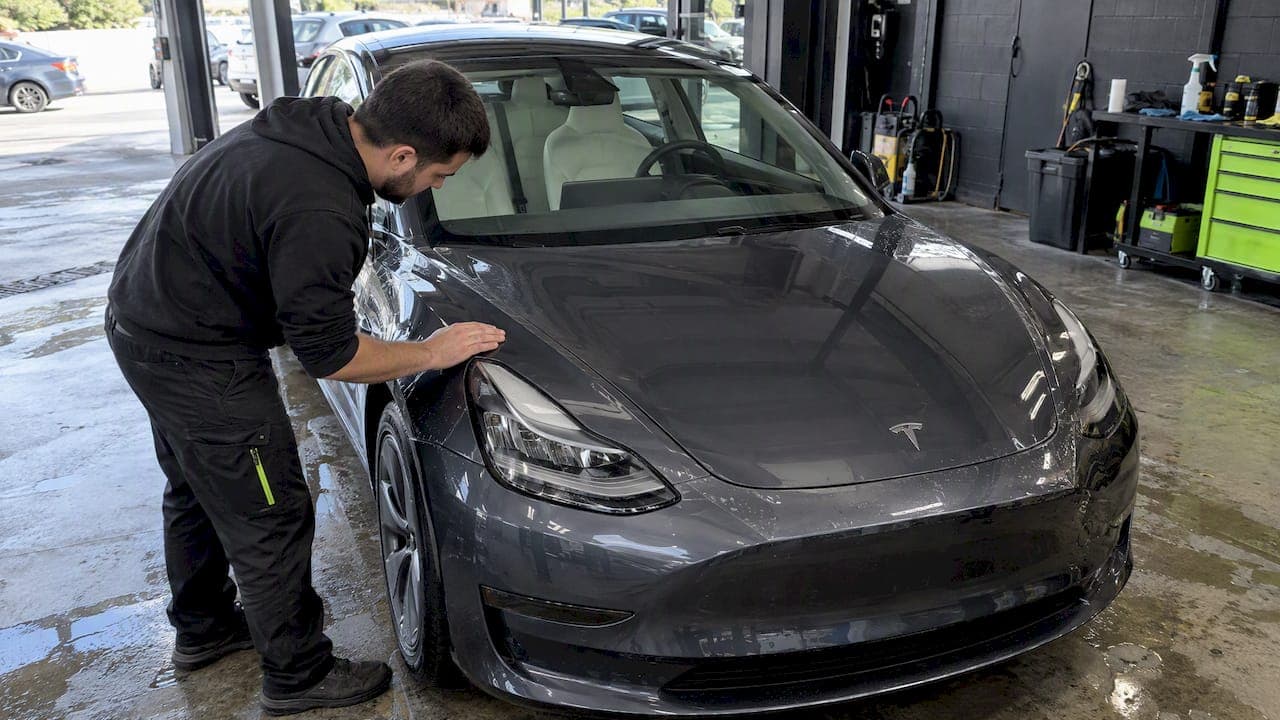
Tesla's factory finish uses modern waterborne paint chemistry, which can lead to visible swirls and chips unless the finish gets protected. This is less about a defective product and more about how thin, environmentally compliant clear coats react to polishing, road debris, and careless washing. The immediate next step for most owners is professional paint protection film or careful, low-contact detailing until that protection is in place.
TL;DR:
- Waterborne basecoats in Tesla's paint are softer and more sensitive to heat and abrasion compared to older solvent-based paints, increasing risk of swirl marks and chips.
- Proper protection involves installing paint protection film on high-impact areas first, followed by ceramic coating for easier cleaning and UV resistance, especially in extreme climates.
- Surface imperfections under 1.5 millimeters are usually safe to correct with light polishing, but larger defects or deep chips require professional repair or panel refinishing.
- Tesla's paint warranty typically covers factory defects for 12 months or 12,500 miles, but normal wear and environmental damage are excluded from coverage.
- Careful washing techniques, avoiding automatic brushes and aggressive polishing, are essential to maintain the finish and prevent swirl marks on this modern waterborne paint.
Table of Contents
- What "soft paint" actually means on a Tesla
- Why owners report swirls, chips, and other damage
- Spotting swirls, holograms, and chips before they get worse
- PPF, ceramic coating, and wraps: what each one actually does
- What Tesla's paint warranty covers, and what it doesn't
- How Tesla's service manual guides safe paint correction
- A practical checklist for new and current owners
- How Tesla's paint hardness compares with other automakers
- How Tesla's finish ages across different climates
- How to clean Tesla's finish without creating new damage
- Has Tesla's paint quality changed across model years?
- Why "soft paint" is the wrong fight to pick
- Getting your Tesla's finish protected the right way
- FAQ
- Sources
What "soft paint" actually means on a Tesla
The "soft paint" label is really a description of modern waterborne basecoats, not a flaw unique to Tesla. Waterborne basecoats emit far fewer volatile organic compounds than the solvent-borne systems automakers used decades ago, a shift driven by air quality regulation. Typical waterborne basecoats emit roughly 50 to 150 grams per liter of VOCs, compared with 450 to 500 grams per liter for older solvent-borne paints, according to the same EPA guidance. That regulatory push changed how the whole industry builds a finish, not just how Tesla does it.
A factory finish is built in layers: a waterborne basecoat for color, then a clear coat, usually a two-component polyurethane, that provides gloss and the physical barrier against the outside world. The basecoat dries softer than older solvent-borne formulas, and the clear coat on top has to bond to it without the thicker buffer of older systems.
- Waterborne basecoats cut VOC output dramatically compared with older solvent-borne paint.
- The clear coat, not the basecoat, takes most of the daily abuse from washing and road debris.
- Perceived "softness" usually comes from how these two layers interact under polishing or abrasion, not from a single bad batch of paint.
Why owners report swirls, chips, and other damage
Thinner, more sensitive clear coats mean the margin for error during cleaning or correction work is smaller than it used to be. A wash mitt, a brush, or a buffer that worked fine on an older solvent-borne finish can leave marks on a modern waterborne system if it is used the same way.
Aggressive polishing or high-heat buffing is one of the most common causes of long-term damage, since it physically removes clear coat material with every pass. Tesla's own service documentation calls for slower buffer speeds and shorter cutting passes specifically to avoid thinning the clear coat during correction work, a point covered in more detail later in this guide.
- Thinner modern clear coats are more sensitive to heat and abrasive pads than older, thicker systems.
- Automatic car washes with brushes, along with tree sap and road salt, add constant low-grade abrasion.
- Rock chips and road debris strike a finish that has less clear coat thickness to absorb the impact.
Spotting swirls, holograms, and chips before they get worse
Most visible paint complaints fall into a handful of categories, and knowing which one you are looking at determines whether a microfiber towel or a professional fixes it.
- Swirl marks show up as fine circular scratches, usually from washing in sunlight or with a dirty mitt.
- Holograms appear as a web-like pattern under bright light, typically left by a rotary buffer run too aggressively.
- Buffer trails are straight-line scratches from a dual-action polisher used with the wrong pad or compound.
- Rock chips are small, isolated paint losses on the front bumper, hood, and mirrors from road debris.
For sizing, Tesla's own service documentation treats small imperfections, generally under about 1.5 millimeters on a flat panel, as lower risk, while anything larger than 2.0 millimeters is flagged for more involved repair. If a mark wipes away with a clay bar or a gentle detailing spray, it is surface-level. If it catches a fingernail or sits inside the clear coat, it is a job for a trained detailer.
PPF, ceramic coating, and wraps: what each one actually does
Owners generally have three protection options, and they solve different problems rather than competing head to head.
Paint protection film is a sacrificial clear layer applied over factory paint, and it is the strongest defense against rock chips, abrasion, and the kind of road debris that causes most visible front-end damage. Quality film is self-healing against light swirls and typically carries a long-term warranty; Tesla itself backs its own Clear Protection Film for 10 years under its vehicle warranty, which signals how seriously the industry treats PPF as a durability product rather than a cosmetic add-on.
Ceramic coating adds a hydrophobic layer that makes washing easier and helps resist light staining and UV fading, but it does not add meaningful thickness or chip resistance. It is a maintenance upgrade, not a shield.
Vinyl wraps change the exterior appearance and add a layer of coverage, but they are generally chosen for color change or branding rather than pure protection, and they do not match PPF's abrasion resistance on high-impact zones like the front bumper.
- PPF: best for rock chips, abrasion, and high-impact zones like the front bumper and leading edges.
- Ceramic coating: best for easier washing, light UV protection, and maintaining gloss.
- Vinyl wraps: best for a design or branding change, with some added surface coverage.
Pro Tip: Install PPF on the front end first, then apply ceramic coating over the film and any remaining painted panels for easier long-term cleaning.
The sequencing that tends to hold up best over years of ownership is quality PPF installed in a climate-controlled facility, followed by ceramic coating over both the film and the remaining paint.
What Tesla's paint warranty covers, and what it doesn't
Tesla's Parts, Body & Paint Repair Limited Warranty covers most parts for 12 months or 12,500 miles, whichever comes first, with separate terms for protective film: 10 years for Clear Protection Film and 5 years for Color Paint Film. Factory paint defects fall under that general coverage window, but normal wear, like swirl marks from improper washing or chips from road debris, is treated as owner responsibility rather than a warranty claim.
- Factory paint defects are covered under the standard parts and body warranty window.
- Clear Protection Film and Color Paint Film carry their own, much longer warranty terms.
- Environmental damage and wear from washing methods are typically excluded from coverage.
If you spot a defect, photograph it with a date stamp and raise it with service promptly, since warranty review depends on establishing that the issue existed from delivery rather than developing from later use.
How Tesla's service manual guides safe paint correction
Correction work on a modern waterborne finish needs a lighter touch than older paint systems tolerated, and Tesla's own documentation reflects that. The Model Y service manual's paint defect rectification guidance calls for reducing buffer speed by roughly 40 to 50% and shortening cutting passes significantly to avoid heat buildup that can thin the clear coat.
Tesla's service documentation recommends cutting typical buffing intervals from around 15 seconds down to about 5 seconds on sensitive areas, according to the Model Y paint repair procedure. That shorter window reflects how little margin modern clear coats leave for error.
- Reduce buffer speed substantially and use shorter, cooler passes near character lines.
- Treat small defects, generally under about 1.5 millimeters, as low risk suited to light correction.
- Treat larger defects as candidates for spot repair, a PPF patch, or a full panel refinish rather than aggressive polishing.
A practical checklist for new and current owners
Protecting a Tesla's finish is mostly about sequencing and discipline rather than any single product.
- Inspect the car in good light right after delivery and note any existing chips or marks.
- Avoid automatic washes with rotating brushes from day one; they are a leading cause of swirl marks.
- Install PPF on the front bumper, hood edge, and mirrors before daily driving begins.
- Wash with pH-neutral shampoo and a clean microfiber mitt, and decontaminate with a clay bar a few times a year.
- Schedule a professional inspection if you notice holograms, buffer trails, or chips larger than a few millimeters.
Pro Tip: When choosing an installer, confirm they work in a climate-controlled, dust-free bay and offer a manufacturer-backed film warranty, since dust contamination during install is one of the most common causes of visible defects in PPF work.
Our PPF maintenance guide covers the washing cadence and products that keep film clear once it is installed.
How Tesla's paint hardness compares with other automakers
Owner forums frame Tesla's finish as uniquely soft, but the underlying chemistry is shared across the industry. Waterborne basecoats are now standard at most major automakers because of the same regulatory pressure that pushed Tesla toward them, and the resulting clear coat sensitivity is an industry-wide characteristic rather than a Tesla-specific defect. Coverage of the waterborne transition from SEMA notes that the shift reshaped maintenance expectations across manufacturers, not just for electric vehicle brands.
What differs between automakers is less the paint chemistry itself and more the application process, panel prep, and clear coat thickness tolerances at each factory. A brand with decades of refinement in its paint line may have tighter, more consistent clear coat application than a newer production run, which can make defects or thin spots more or less common depending on the model year and plant. Owner complaints about any brand's paint tend to track more closely with build consistency at a given factory than with a fundamental difference in the paint itself. That makes a blanket claim that Tesla's paint is softer than every competitor's hard to support with the available evidence, and it is more accurate to say Tesla shares the same basic vulnerability as most modern vehicles built under current VOC rules.
How Tesla's finish ages across different climates
Waterborne basecoats and modern clear coats respond differently to heat, UV exposure, humidity, and road salt than the thicker solvent-borne systems many owners grew up with. In hot, high-UV climates, clear coat can show earlier signs of oxidation and gloss loss without consistent protection, since UV exposure breaks down the clear coat's surface over time. In colder climates, road salt and grit during winter months accelerate chip formation and edge wear on the front bumper and rocker panels.

Humid coastal environments bring their own challenge: salt air and frequent moisture can accelerate corrosion at chip sites if they are not addressed quickly, since a rock chip that exposes bare metal becomes a rust starting point far faster near the ocean than in a dry inland climate. None of these climate effects are unique to Tesla, but they matter more on a finish with less clear coat margin to begin with.
The practical takeaway is that owners in extreme climates, whether hot and sunny or cold and salty, benefit most from early protection. A finish that has PPF on its leading edges and a ceramic coating sealing the rest tends to show noticeably less fading, staining, and chip-related corrosion after several years than an unprotected factory finish exposed to the same conditions.
How to clean Tesla's finish without creating new damage
Washing technique matters more on a modern waterborne finish than it did on older cars, since there is less clear coat to sacrifice to a mistake. The safest routine starts with a thorough rinse to remove loose grit before any contact washing begins, since dragging a mitt over dry dirt is one of the fastest ways to create swirl marks.

Use a pH-neutral car shampoo and a clean, high-quality microfiber wash mitt, working in straight lines rather than circular scrubbing motions. Circular motions make swirl marks easier to see later under direct light, while straight-line passes are easier to inspect and correct if a mark does appear. Two-bucket washing, one for soapy water and one for rinsing the mitt, keeps grit from transferring back onto the paint during the wash.
Dry with a clean microfiber towel or a filtered leaf blower rather than wringing a towel over the surface, which can reintroduce the grit you just rinsed away. Decontaminate with a clay bar or a clay mitt a few times a year to remove embedded contaminants that washing alone will not lift, and follow with a quick detailing spray to restore slickness between full washes. Avoid automatic car washes with spinning brushes entirely. They are convenient, but the brushes are shared across every vehicle that passes through and are one of the most consistent sources of swirl marks reported by owners.
Has Tesla's paint quality changed across model years?
Tesla's production process has evolved substantially since the Model S launched, and paint application is part of that evolution. Early production runs, particularly in the first few years of Model 3 output, drew frequent owner complaints about panel gaps, orange peel texture, and inconsistent clear coat thickness, issues tied to a manufacturer scaling production quickly rather than to the paint chemistry itself.
Later model years have generally seen more consistent application as Tesla's factories matured and production processes stabilized, though owner reports on forums still vary by plant and model year. Because paint application quality depends heavily on robotic calibration, booth conditions, and curing consistency at a given factory, a car built during a production ramp-up is statistically more likely to show application inconsistencies than one built on a mature, stable line.
For current and prospective owners, the practical implication is the same regardless of model year: inspect the car carefully at delivery, document anything unusual, and treat professional protection as standard practice rather than an upgrade reserved for cars with visible factory flaws.
Why "soft paint" is the wrong fight to pick
The loudest complaints about Tesla's paint miss the real issue. Waterborne basecoats and thinner clear coats are not a Tesla problem; they are where the entire industry has landed under current emissions rules, and every modern vehicle shares some version of this sensitivity. What actually separates a Tesla that looks factory-fresh at five years from one covered in swirls is maintenance discipline in the first few months of ownership, not the paint batch it rolled off the line with.
The owners who get this wrong usually blame the car for damage caused by an automatic car wash, a rushed detail shop, or a buffer run too hot and too fast. The fix isn't outrage about Tesla's paint supplier. It's treating a modern waterborne finish the way its chemistry actually demands: gentle washing, a sacrificial layer up front, and correction work done at the speeds the service manual actually calls for.
— Jake
Getting your Tesla's finish protected the right way
We install paint protection film and ceramic coatings for Tesla owners in a climate-controlled, dust-free facility, which matters most on a finish with this little margin for installation error.
- Paint Protection Film, including the Track Pack, Full Front, and Full Body packages for rock-chip and abrasion protection.
- Ceramic Coating options, from 1-Year to Lifetime Coating, for easier washing and added gloss retention.
- A climate-controlled inspection and estimate before any work begins, so you know exactly what your panels need.
If you want a straightforward look at what your Tesla's finish needs, our PPF installation page covers packages and booking details for the Van Nuys shop.
FAQ
What is the rarest Tesla color?
Tesla has periodically retired and reintroduced paint colors, which makes certain limited-run colors harder to find on the used market at any given time. Availability shifts by model year and region, so the "rarest" color changes over time rather than being fixed.
What are the common paint issues Tesla owners report?
Owners most often report swirl marks, holograms, buffer trails, and rock chips on the front bumper and leading edges. Most of these trace back to washing technique, automatic car washes, or aggressive polishing rather than a defect in the paint itself.
Which Tesla paint color holds up best over time?
Durability depends more on clear coat thickness and application consistency than on the color pigment underneath it. Darker colors tend to show swirl marks more visibly under light, while lighter colors can show chips and stone damage more obviously, but neither is inherently more durable without protection.
Has Tesla's paint quality improved over the years?
Owner reports suggest paint application has generally become more consistent as production processes matured beyond the early Model 3 ramp-up period. Build quality still varies by plant and model year, so inspecting a car carefully at delivery remains worthwhile regardless of when it was built.