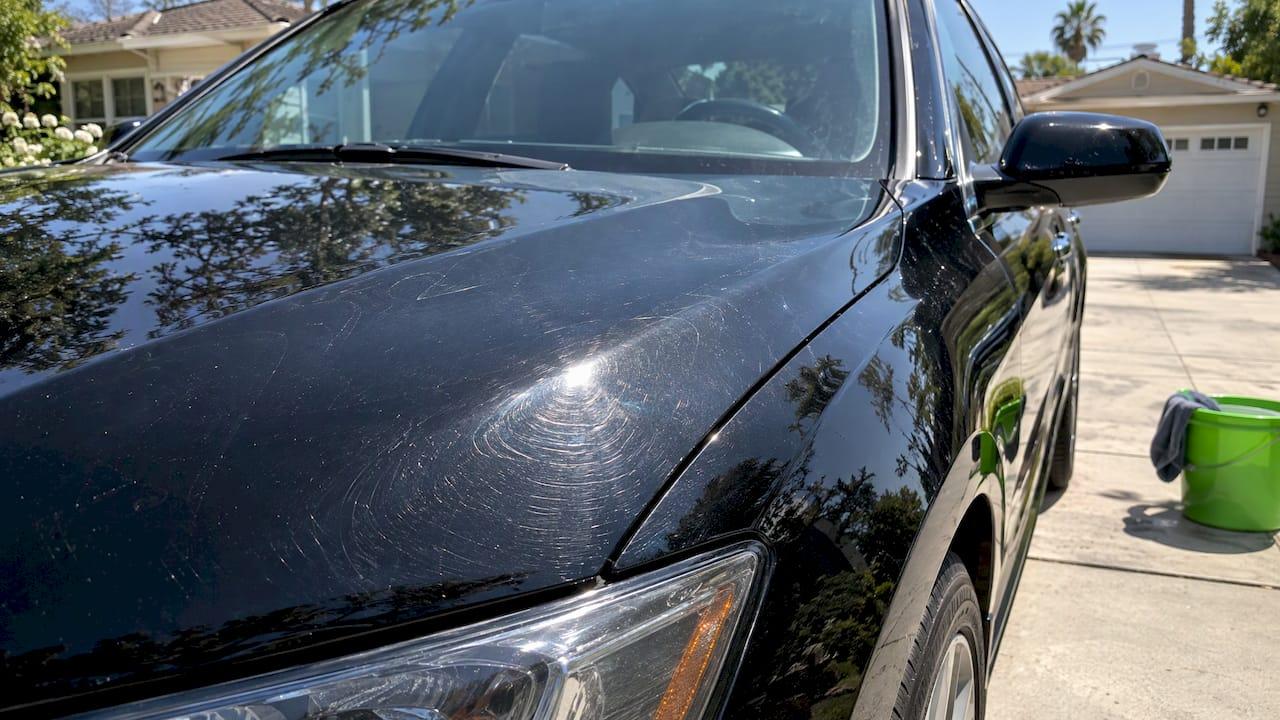
The most reliable swirl protection for a black car is a two-part plan: a wash routine that never drags grit across the paint, and a protective layer on the paint so everyday contact lands on that layer instead of your clear coat. Paint protection film (PPF) is the layer that works hardest here, with a ceramic coating as the option that makes washing easiest. At Tint & Wraps Customs in Van Nuys, CA, we install both, so the plan below ends with a path you can book.
TL;DR
- Swirls are fine scratches in the clear coat, mostly made by dirt ground in during washing and drying. Black paint shows every one of them.
- Safer washing means rinsing first, two buckets, straight-line strokes, a cool shaded car and touch-free or blotted drying.
- Self-healing PPF can erase light swirls with heat, and it takes the scratches that would otherwise land on your paint.
- A ceramic coating adds a slick, hard-wearing surface that makes washing easier and safer.
- Protect the paint while it is in good shape. Existing swirls are a separate job from preventing new ones.
Table of Contents
- Why black paint shows every swirl
- Prevention versus removal
- A swirl-safe wash routine
- Why a protective layer beats washing technique alone
- Where the installation happens matters on black
- Caring for film and coating so swirls stay away
- Warm water and fingernail checks on self-healing film
- What we do about black cars
- Book swirl protection for your black car in Van Nuys
- FAQ
- Sources
Why black paint shows every swirl
Swirl marks are hairline scratches in the clear coat, the transparent top layer of your paint. Cars.com reports that dirt ground into the paint during washing is the core cause of swirls. A mitt, sponge or towel picks up grit, and every pass turns that grit into a tiny scratch. Scratches made in circular motions form the circular patterns that give swirls their name.
On white or silver paint, those scratches scatter light and blend in. On black, the dark base gives the eye nothing to hide behind, so each scratch catches the sun or a garage light and shows up as a web of lines. Mike Phillips, training director at Autogeek.net, told Cars.com that for a black car you want the softest, highest-quality materials you can find, because every scratch will show.
The usual sources of swirls are the same few habits:
- washing with a dirty sponge, mitt or brush
- drying with a rough or dirty towel
- skipping the pre-rinse, so loose dirt gets rubbed in
- running the car through an automatic wash with brushes
- dusting a dry car with a cloth or duster
None of these is dramatic. Swirls build up slowly, which is why many owners notice them only after a year or two, when the car comes out of the shade.
Prevention versus removal
There are two different jobs here, and mixing them up is the most common mistake.
Prevention keeps new scratches from forming. It is about your wash routine and a protective layer over the clear coat.
Removal deals with swirls that already exist. That usually means machine polishing, which levels the clear coat to take out the scratches. It is a correction step, not protection, and it does nothing to stop new swirls the next time the car is washed badly.
A quick way to tell old swirls from new ones: look at the car in direct sun or under a strong flashlight. A dense, even web of fine circles across the whole panel is old and built up over many washes. A few sharp, isolated lines are fresh and usually come from one incident, such as a towel with grit in it. Deeper marks you can feel with a fingernail are damage, not swirls.
The order matters. If your paint already has swirls, you want it corrected before film or coating goes on, because the layer sits on top of whatever is underneath. We cover that sequence in our guide to paint correction before PPF.
A swirl-safe wash routine
Even with PPF or a coating, how you wash matters. Consumer Reports advises not washing a hot car, using lengthwise strokes rather than circles, rinsing first and working one section at a time from the top down. Here is that advice as a routine for black paint.

1. Start cool and in the shade
Hot panels dry soap and water before you can rinse it, which leaves residue you then have to rub off. Wash in the shade or early or late in the day, once the panels are cool to the touch.
2. Rinse before you touch anything
A thorough rinse takes off the loose grit that does the most damage. If you have a foam cannon, a thick layer of soap foam loosens more dirt before contact.
3. Use two buckets
Cars.com describes the two-bucket method: one bucket of wash solution and one of plain water, with the mitt rinsed in the clean bucket first. That keeps the dirt you just removed out of your soap. Carwash.com also recommends grit guards in the buckets, which trap grit at the bottom.
4. Wash in straight lines, top to bottom
Use a clean microfiber mitt and long, overlapping strokes in the direction of airflow. Do the roof and upper panels first and the lower, dirtiest panels last. Swap or rinse the mitt often. If you drop it, it is done until it is washed.
5. Dry without dragging
Drying is where many swirls start. Consumer Reports' chief mechanic John Ibbotson suggests a leaf blower on a low setting to push water off before blotting, preferably a light-duty battery-powered one to avoid electrical issues around water. Blot what remains with a clean, high-quality microfiber towel instead of wiping. Cars.com notes that such a towel absorbs about seven times its weight in water without scratching. Touch-free drying with filtered air is the lowest-risk method, since it avoids dragging trapped grit across the clear coat.

The simplest version of the rule: the less your wash media touches the paint, and the cleaner it is when it does, the fewer swirls you make.
Why a protective layer beats washing technique alone
A perfect routine still leaves you exposed. A dusty wipe, a branch, a zipper, a gas-station squeegee or a friend's towel can mark black paint in seconds. A protective layer takes that wear in your place. The two main choices work differently.
| Paint protection film (PPF) | Ceramic coating | |
|---|---|---|
| What it is | A clear urethane film applied over the paint | A silica-based liquid layer bonded to the clear coat |
| Swirl benefit | Takes the scratches itself, and the self-healing topcoat can erase light swirls with heat | Slick, hard surface that makes washing safer and easier |
| Rock chips and deeper marks | Built to absorb them | Not its role |
| Gloss on black | Clear and glossy | Deep, water-beading gloss |
The Porsche Club of America explains that a nano-ceramic coating hardens into a glass-like, water-repelling shield, and that for rock chips and deeper scratches, PPF, with its urethane base and self-healing clear coat, is the better option.
How PPF handles swirls on black paint
Motor1 reports that PPF's self-healing feature lets heat from sunlight or warm water erase minor scratches and swirls in the film. That is the key advantage on black: the light marks that would otherwise sit permanently in your clear coat close up in the film instead. Quality film is also optically clear, so it keeps the depth that makes black paint worth owning.
You can read more in our explainers on self-healing PPF, PPF benefits and what PPF fixes and costs on black cars.
What coverage you choose depends on how you use the car:
- Full front (hood, fenders, bumper, mirrors) covers the area that takes the most road debris.
- Full body covers every painted panel, which is the most complete swirl protection for a black car.
- The Track Pack is a coverage level we offer for drivers who put the most miles and heat on the front end.
We list all of these on our paint protection film page.
How a ceramic coating helps
A ceramic coating is a thin, silica-based layer bonded to the clear coat. It makes the surface slick, so dirt releases easily and a wash takes less contact. That matters because less rubbing means fewer swirls. Carwash.com advises coated cars to use coating-specific shampoos, wash in cool shade and dry touch-free where possible. Our ceramic coatings come in 1-year, 5-year and lifetime options, so you can match the coating to how long you plan to keep the car. The details are on our ceramic coating page and in what a ceramic coating does for your car.
Using both together
Many owners who want maximum protection and the easiest upkeep put a ceramic coating over their film. The film does the physical protecting and the coating makes the surface slick and easy to clean. The sequence and curing time matter, and we walk through them in ceramic coating over PPF.
Where the installation happens matters on black
Black paint also shows dust trapped under film or coating. A bubble or a speck beneath the film looks far worse on black than on a lighter color. That is why we do every installation in a climate-controlled, dust-free facility in Van Nuys. For black cars, it is one of the biggest factors in how the finished car looks in direct sun.
If your car is a Tesla, the other factor is fit. Tesla paint is known for being soft and easy to mark, and our Tesla and EV experience is built around precise, factory-quality fits with zero sensor interference. Our guide to protecting soft Tesla paint with 10 years of PPF backing goes into that.
Caring for film and coating so swirls stay away
Protection lasts longest with careful care. The manufacturer guidance for film is specific. 3M's PPF FAQ says to not wash the car for 72 hours after installation, wash by hand or touchless only, and wait one week before waxing. It also says brush washes can dull and scratch the film and lift its edges.
Carwash.com adds a few rules for film:
- Keep high-pressure water away from film edges.
- Avoid petroleum-distillate waxes and aggressive degreasers.
- Do not wash in direct sunlight.
- Use the two-bucket method, straight-line strokes and dedicated drying towels.
The full list is in the Carwash.com guide to washing film, coated and tinted cars. Our own PPF maintenance guide turns this into a weekly routine.
Warm water and fingernail checks on self-healing film
If you have film, a simple check will tell you whether a mark is a light swirl or something deeper. Run a fingernail across it. If your nail glides over the mark, warmth from sun or a warm-water rinse will usually close it. If the nail catches, the mark has gone deeper than the film's self-healing layer can fix. Self-healing is for light swirls and fine marks, not for deep cuts or punctures.
What we do about black cars
Black paint is the color where owners feel every flaw, and it is also the color that looks best when it is protected properly. We have protected over 1,000 vehicles for drivers across the San Fernando Valley, and the pattern is consistent: the owners who are happiest are the ones who protected the paint while it was still in good shape.
Our view is simple. Washing technique reduces swirls, but a film or coating stops relying on technique alone. For a black car that sees daily use, we recommend paint protection film, because it takes the hits and its self-healing topcoat closes up light swirls. A ceramic coating then makes the surface easy to wash. We do both in a climate-controlled, dust-free facility, and our work comes with manufacturer-backed warranties.
If you are choosing between full front and full body, think about how the car is parked and driven. Street-parked and highway-driven cars benefit from full coverage. Weekend cars often do well with full front.
Jake
Book swirl protection for your black car in Van Nuys
If you want the paint protected rather than managed, we install paint protection film (full front, full body or the Track Pack) and ceramic coatings (1-year, 5-year or lifetime) at our Van Nuys shop. Our work is backed by manufacturer warranties, and our customers rate us five stars for attention to detail.
See the options on our PPF installation page, or start from the Tint & Wraps Customs home page to request a quote for your car.
FAQ
Can you completely prevent swirl marks on a black car?
You can cut them dramatically, not eliminate every possible contact. A routine of rinsing first, two buckets, straight-line strokes and touch-free or blotted drying prevents most swirls. Adding PPF means everyday contact marks the film, whose self-healing topcoat closes light swirls with heat.
Does PPF change how black paint looks?
No, quality film is optically clear and glossy, so it keeps the color and shine of the paint underneath. On black it adds a layer of protection while the finish keeps its depth. A clean, dust-free installation keeps the surface looking smooth.
Is ceramic coating or PPF better for swirls?
They do different things. A ceramic coating makes washing easier and the surface slicker, so you create fewer swirls. PPF physically takes the scratches, and its self-healing layer can erase light ones. Many black-car owners choose film for the protection and add a coating for easy upkeep.
Are automatic car washes safe for black paint?
Touchless washes are far gentler than brush washes. 3M's guidance for film says brush washes can dull and scratch the film and lift its edges. For black paint, hand washing with a clean mitt or a touchless wash is the safer routine.
Can I remove swirls before protecting the paint?
Yes. Existing swirls are removed by machine polishing, which is a correction step before film or coating goes on. Doing it first means the protective layer covers paint in its best condition. Our guide to paint correction before PPF explains when it makes sense.
Sources
- How to Wash Your Car Like a Pro, Consumer Reports
- How to Prevent Scratches, Swirls on a Black Car, Cars.com
- How to wash a vehicle with paint protection film, ceramic coating and window tint, Carwash.com
- Chasing Perfection and Protection: The Science Behind Paint Protection, Porsche Club of America
- Paint Protection Film (PPF): Cost, Benefits, And Is It Worth It, Motor1
- 3M Paint Protection Film Frequently Asked Questions
- 6 Best Detailing Air Blowers for Drying Cars, Panoz Auto