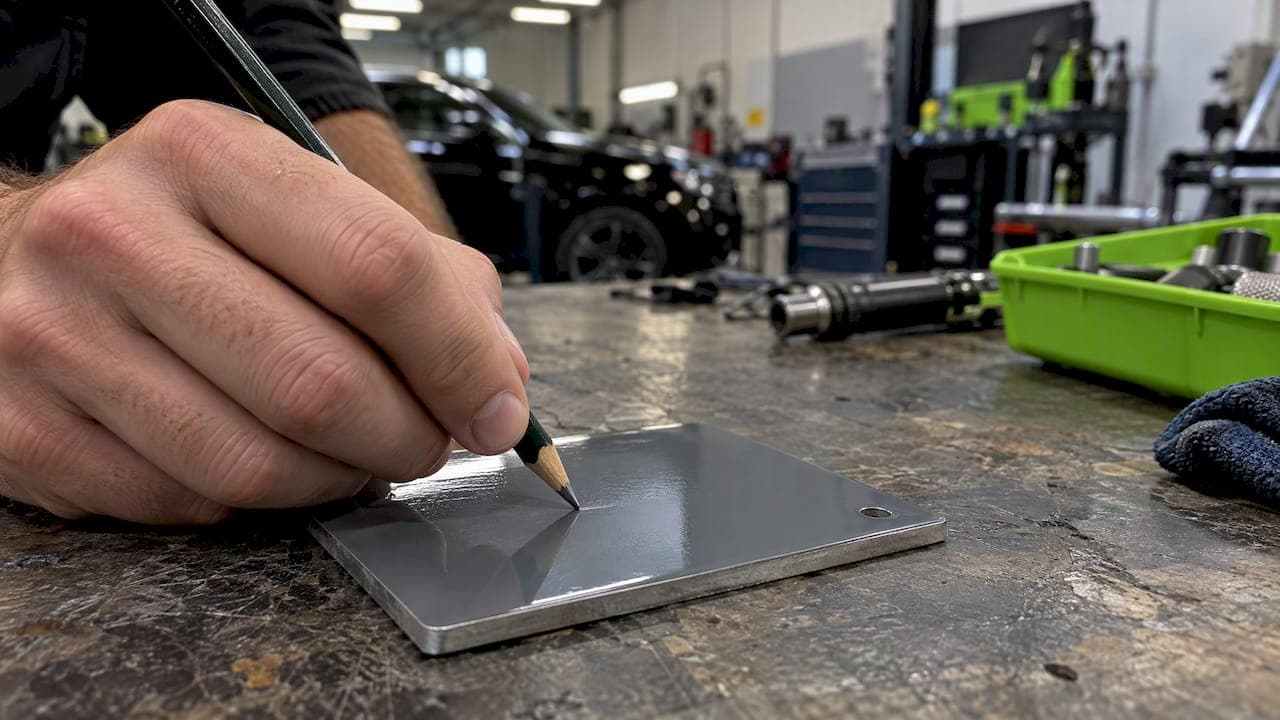
"9H" on a ceramic coating label refers to a pencil hardness test. A coating rated 9H resisted the hardest pencil lead on that scale without being cut or marred under test conditions. It does not mean your paint is scratch-proof, chip-proof or wash-proof, and it says little about how the coating behaves on a real car.
That gap between the number and the driveway is where most buyers get misled. Below, we explain where the scale comes from, how the test works, why 10H and 12H are marketing more than standards, and what to ask a shop instead.
TL;DR
- 9H is the top grade on a pencil hardness scale that runs from 6B (softest) to 9H (hardest). It is a lab test of a cured film, not a rating of a finished car.
- It does not make paint scratch-proof. Rock chips, dirty wash towels and automatic car wash brushes are different stresses than a pencil.
- 10H and 12H are not grades on the standard scale, so you cannot compare them directly with 9H.
- Judge a coating by the installer's prep, the written warranty, and the care rules, not the H number.
- For impact protection, paint protection film is the tool built for it. Ceramic coating is for gloss, slickness and easier cleaning.
Table of Contents
- Where the "H" comes from
- How the 9H pencil test works
- What 9H does not mean
- 9H vs 10H vs 12H: are they comparable?
- What a ceramic coating actually does for your car
- Perspective: what we tell customers about 9H
- How to judge a coating without relying on the H number
- Care matters more than hardness
- Ceramic coating at Tint & Wraps Customs
- FAQ
- Sources
Where the "H" comes from
The H stands for hardness, borrowed from graphite drawing pencils. Pencil grades run from soft and dark (B for blackness) to hard and light (H). In coatings work, the grading scale runs from 6B, the softest, to 9H, the hardest. So 9H is the end of the scale, not a midpoint you can climb past.
The test itself is a standard one. ASTM D3363 defines pencil hardness as a rapid, inexpensive way to test an organic coating on metal or a similarly hard substrate. Notice what that sentence describes: a coating film on a rigid test panel. It is not a mineral hardness scale like Mohs, and it is not a test written for automotive clear coat.
How the 9H pencil test works
The procedure is simple, which is both its strength and its weakness.
- A technician takes calibrated pencil leads, flattened at the tip.
- The lead is held at 45 degrees and pushed across the coating for a stroke of about 6.5 mm, or a quarter inch.
- The tester works through harder or softer pencils, depending on the standard, and reports the hardest pencil that does not create the specified defect. Depending on the method, that defect is a cut, a gouge or a scratch mark. Some methods start with the hardest pencil and work down, others start soft and work up.
So "9H" means the hardest pencil on the scale did not damage the film in that setup. That is all it means.
Why the number is softer than it sounds
Pencil hardness is a rough tool. ASTM notes that results can vary with the pencil maker, the pencil batch, the substrate and the laboratory, and recommends using the same manufacturer and batch for repeatable results. The American Coatings Association describes the test the same way and cautions that results differing by more than one pencil unit are suspect. Under the ISO 15184 procedure, as summarized in an instrument maker's manual, the test is repeated and results that differ by more than one pencil unit are discarded and retested.
Translation: a lab can get a 9H on a glass or metal panel under ideal conditions, and a different lab or a different pencil batch could land one step away. A claim like "9H" only carries meaning when you also know what it was applied to, how it was cured and what counted as a pass. Marketing copy rarely includes any of that.
What 9H does not mean
It does not mean scratch-proof
A pencil pressed straight across a film is one kind of stress. Your paint faces others:
- Grit dragged by a wash mitt or a dry towel
- Brushes and cloth at an automatic wash
- Sand and gravel kicked up at highway speed
- A belt buckle, a zipper, a key or a shopping cart
None of those behave like a flattened pencil lead at 45 degrees. A coating can pass the pencil test and still pick up fine swirls from careless washing. Treat the 9H label as no permission to dry-wipe dust off the hood.
It does not mean chip-proof
Motor1's guide to automotive coatings is blunt on this: ceramic coating does not make paint immune to damage, road debris can still chip it, and the coating is not designed to absorb impacts. A ceramic layer is very thin. A rock traveling at highway speed carries far more energy than the layer can absorb, and the damage goes into the paint beneath.
It does not mean the coating lasts a set number of years
Hardness and longevity are separate questions. How long a coating lasts depends on the chemistry, the prep, the cure, the climate, the parking situation and how the car is washed. If you want the detail, our piece on what lab tests reveal about real-life ceramic coating durability goes deeper.
9H vs 10H vs 12H: are they comparable?
This is where the numbers get slippery. On the standard pencil scale, 9H is the hardest grade, so "10H" or "12H" is not a recognized step on that ladder. Some brands use higher numbers as a product name, others point to a different test or a specialty pencil, and some give no test method at all.
That means you cannot treat 10H as "one better than 9H" the way you would compare two horsepower figures. Before a bigger number means anything, you would need to know:
- The test method used (and whether it is a published standard)
- The panel or substrate it was tested on
- How the coating was prepared and cured
- The pass or fail criterion
- Who ran the test, and whether a third party can verify it
If a shop or brand cannot answer those, the number is a slogan. A brand that can answer them is telling you something useful, but even then the result describes a lab panel, not your fender.
| Claim | What it usually means | What it does not tell you |
|---|---|---|
| 9H | Hardest grade on the pencil scale, on a test panel | Real-world scratch, chip or swirl resistance |
| 10H, 12H | A brand's own number or a non-standard test | Whether it is comparable to 9H at all |
| "Scratch-proof" | Marketing language | Nothing measurable; no coating makes paint immune |
| Multi-year warranty | The seller's written coverage terms | Coverage details until you read the document |
What a ceramic coating actually does for your car
Strip away the hardness myth and a good coating is still worthwhile. Motor1 describes automotive ceramic coating as a liquid product that bonds to the paint and cures into a thin protective layer. In practice, owners can reasonably expect:
- Deeper gloss and a slick surface
- Water beading and sheeting
- Dirt, bugs and road film that rinse off more easily
- Some resistance to UV and chemical exposure
- Washing that takes less effort
They should also expect limits. Bird droppings and strong chemicals can still affect coated paint, rocks can still chip it, and the finish still needs to be washed correctly, because abrasive cleaning methods can take a toll. If you are weighing whether it pays off for your situation, our practical owner's guide to whether ceramic coating is worth it walks through the trade-offs.
Ceramic coating or PPF?
People searching for 9H often really want to know whether hardness will stop rock chips. It will not. Paint protection film is built for that job: Motor1 separates the two, noting that ceramic coating is mainly for surface protection, chemical resistance, hydrophobic behavior and easier maintenance, while PPF is meant to absorb physical impacts like rocks and gravel.

For a daily driver on the 405 or 101, the strongest setup is often both: film on the high-impact areas such as the front bumper, hood, fenders and mirrors, and coating over the rest. You can even coat over the film; see our note on ceramic coating over PPF and the 72-hour wash wait.
Perspective: what we tell customers about 9H
We get the 9H question at the shop all the time, usually from someone who has read that a coating is "harder than a clear coat." Our answer is that the number is not the thing to shop on.
Here is how we think about it at Tint & Wraps Customs. A coating is only as good as the surface it goes on and the room it is installed in. Dust landing in a curing coating shows up as a defect for the life of the job, which is why we do our installs in a climate-controlled, dust-free facility. Paint correction before coating, and a clean, correct cure, matter more than whether the bottle says 9H or 10H.

We also steer people toward the right product for the right threat. If your worry is rock chips on a new Tesla or a track-day car, that is a film conversation, and we offer paint protection film for it. If your worry is keeping the paint glossy and easy to wash, coating is the answer. Being straight about which is which is how we have protected more than 1,000 vehicles for drivers across the San Fernando Valley.
One last point: ask for the warranty in writing and read the care requirements. A coating that is washed the wrong way can lose coverage, and we would rather you know that on day one. Our guides on what a ceramic coating warranty actually covers and maintenance that keeps warranty coverage valid lay it out.
— Jake
How to judge a coating without relying on the H number
When you are comparing quotes, ask these questions instead.
- What is the prep process? Look for a full wash, decontamination and paint correction appropriate to the paint's condition. Coating locks in whatever is under it, flaws included.
- Where is it installed? Dust, humidity and temperature swings affect application and cure.
- What does the warranty say? Length matters less than terms: what is covered, what voids it, and who honors it.
- What are the care rules? Wash method, cure period and maintenance visits should be spelled out. Our guide to 4 to 72 hour ceramic coating cure rules explains why the first days matter.
- What does it cover? Paint is the obvious one, but wheels, trim and glass behave differently. See what to expect from wheel ceramic coating and coating on plastic trim. Matte finishes need extra care too, as covered in ceramic coating for matte paint.
- If a hardness number is quoted, what is behind it? A real answer names the method, substrate and criterion. A vague answer tells you how much weight to give the claim.
A quick example
Say two shops quote you for the same SUV. Shop A advertises "12H, scratch-proof." Shop B says its coating has a multi-year written warranty, explains the paint correction step, tells you to wait before the first wash and recommends film on the front end. Shop B is giving you information you can act on. Shop A is giving you a number nobody can check against a standard.
Care matters more than hardness
Any coating, 9H or otherwise, loses its edge if it is treated badly. The basics are the same everywhere:
- Wash with clean mitts and plenty of lubrication, using the two-bucket method or a good rinseless process.
- Avoid dry-wiping dust and dragging a towel across gritty paint.
- Be cautious with automatic washes that use brushes or cloth strips; touchless is gentler.
- Remove bird droppings and bug residue promptly.
- Follow the installer's cure and maintenance instructions.
A coating makes the car easier to wash, but it does not remove the need to wash it correctly.
Ceramic coating at Tint & Wraps Customs
If you are in the San Fernando Valley and want coating done in a controlled environment, our ceramic coating page lists the 1-year, 5-year and lifetime coating options with manufacturer-backed warranties. We handle Teslas and other EVs regularly, and if rock chips are your main worry, we can pair coating with paint protection film. Contact us through the site for a quote based on your vehicle and paint condition.
FAQ
What does 9H mean on a ceramic coating?
It refers to the top grade on the pencil hardness scale, which runs from 6B to 9H. A coating labeled 9H resisted the hardest pencil in a standardized lab test on a test panel. It is not a guarantee of scratch resistance on a car.
Is 10H better than 9H?
Not in any way you can verify from the label. 9H is the hardest grade on the standard pencil scale, so 10H is not an official step above it. Ask the brand which test method, substrate and pass criterion produced the number before you give it any weight.
Does a 9H coating make my paint scratch-proof?
No. Coating can add some resistance to light marring, but swirls from improper washing and chips from road debris still happen. For rock and gravel impacts, paint protection film is the product designed to absorb them.
Can I take a ceramic-coated car through a car wash?
You can, but how you wash matters. Abrasive methods can wear on the finish, and brush-style automatic washes are the riskiest. Touchless washes or careful hand washing are the safer routes, and your installer's care sheet should say what keeps the warranty intact.
Sources
- Pencil Hardness Conundrum, American Coatings Association
- ASTM D3363 Standard Test Method for Film Hardness by Pencil Test
- DeFelsko Pencil Hardness Test instructions
- Wolff Wilborn pencil hardness test script, Elcometer
- Pencil Hardness Test tech tip, Tekra
- What Is Ceramic Coating, And Is It Worth It? Motor1