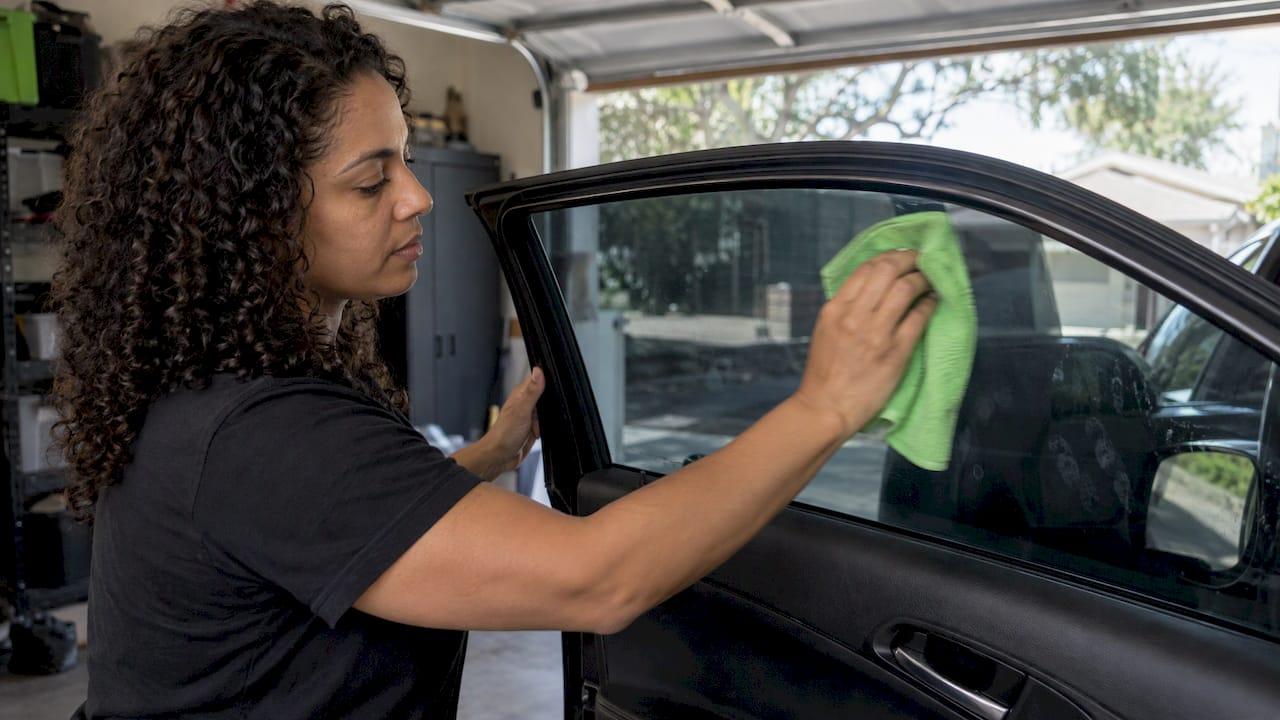
To clean tinted car windows, use clean water or an ammonia-free glass cleaner, two soft microfiber towels, and light pressure. Skip ammonia, abrasive pads and paper towels. Wait at least 48 hours after a new install before you touch the glass. Do that and your film stays clear, flat and evenly dark for years.
Below you will find the exact supplies, a step-by-step method, the mistakes that cause purple film and edge lift, and what to do in the first days after installation.
TL;DR
- Use an ammonia-free glass cleaner or a mild soap and water mix, applied with a soft cloth or microfiber, never a brush.
- Do not clean new tint for at least 48 hours, and skip rolling the windows down during that time.
- Ammonia, abrasive pads and paper towels are what damage film most often. Windex Original contains ammonia.
- Use two towels: one to wash, one to buff dry. Stop when a thin, even film of moisture is left and let it evaporate.
- Clean the inside of the glass most often, since that is where the film sits.
Table of Contents
- Why tinted glass needs a different cleaning routine
- What to use: the safe supply list
- How to clean tinted car windows, step by step
- What to avoid on tinted windows
- Cleaning new tint: the first 48 hours and the first weeks
- Fixing streaks, haze and spots
- How often should you clean tinted windows?
- Tesla and EV glass: extra care
- Our perspective on tint care
- Ready for tint that is easy to keep clean?
- FAQ
- Sources
Why tinted glass needs a different cleaning routine
Aftermarket window tint is a thin film bonded to the inside of your glass with an adhesive layer. You are not cleaning glass alone. You are cleaning a film that has an adhesive, a dye or ceramic layer, and a protective surface. Harsh chemicals reach those layers at the edges and through repeated wiping, and the damage shows up months later.
The usual failure signs are purple discoloration, cloudy patches near the edges, and bubbles. If you already see any of these, read our guide on window tint fading and warranty-backed fixes before you try more cleaning products.
Film type matters a little. Dyed polyester films are the most sensitive to cleaning chemistry, while carbon and ceramic films have a scratch-resistant hardcoat that tolerates mild cleaners better. Even so, the safe routine is the same for every film, so you never have to guess. If you are still choosing a film, our comparison of ceramic vs carbon tint explains the differences.
What to use: the safe supply list
You need very little. Most of it is already in your garage.
Cleaners that are safe for tint
- Clean water alone. The film manufacturer 3M's product care guide says to use clean water, a soft sponge or cloth with no brush, and a soft microfiber towel for drying. It also notes that sand and dust from dirty water can scratch the tint.
- A commercial pH-neutral cleaner without abrasives. The same 3M guide says regular pH-neutral cleaners are fine as long as they contain no abrasives.
- An ammonia-free glass cleaner. Read the label. "Ammonia-free" is usually printed on the front.
- Mild dish soap in water. Solar Gard's care instructions give a mix of 1/2 ounce of liquid dish soap in 1 quart of fresh water. Use a clean synthetic sponge or soft cloth to wash.
- A film maker's own glass cleaner. XPEL's care and maintenance guide lists its own glass cleaner or a mild dishwashing detergent and water mix in a spray bottle for window film.
A note on vinegar: some cleaning guides allow a heavily diluted solution, while others warn against it for car film. On a car, where heat and sun are constant, we simply leave it out. Plain water or an ammonia-free cleaner does the job.
Cloths and tools
- Two low-pile microfiber towels. One for washing, one for drying and buffing.
- A soft rubber or silicone squeegee for side windows only, if you like using one. XPEL's guide notes that a squeegee helps prevent water spotting on exterior film.
- A foam applicator or soft detail swab for corners and edges.
- Distilled or filtered water if your tap water is hard and leaves mineral spots.
Skip paper towels. Solar Gard points out that some paper towels are coarse enough to scratch film, and a scratch in tint cannot be safely polished out.
How to clean tinted car windows, step by step
- Park in the shade. Direct sun dries the cleaner before you can wipe it, and that leaves streaks. The glass should be cool to the touch.
- Shake out your towels. Make sure no grit is trapped in them. A single particle dragged across film can leave a fine scratch.
- Dust the glass first. Lightly wipe the interior glass with a dry microfiber to lift loose dust before any liquid touches it.
- Apply cleaner to the towel, not the glass. Spray your ammonia-free cleaner onto the first towel until it is damp. This keeps liquid from running into the door seals and along the edges of the film, where it can work under the adhesive.
- Wipe in light, even strokes. Work from the top of the window down. Use the same direction on each pass so you can see what you have covered. Do not scrub. The cleaner should do the work.
- Get the corners with a foam applicator. Corners and the strip near the window gasket collect the most haze.
- Buff with the second, dry towel. Use gentle strokes. If you see a streak, buff it with a dry microfiber and nothing else.
- Stop at a thin, even film. E&R Cleaning Solutions advises stopping when a uniform thin film of moisture remains and letting it evaporate naturally, because chasing every last drop is what causes swirls.
- Check the glass in angled light. The same guide suggests looking at the glass when the sun hits from the side, because that is when streaks and residue show.
Rear windows with defroster lines
On the rear glass, wipe along the defroster lines, not across them, and keep the squeegee off that glass. The lines sit close to the film, and cross-wiping with pressure is the quickest way to catch an edge.
Exterior glass
Film is installed on the inside of the glass, so the outside can be washed like any car window. Use a normal car wash routine, and keep the cleaning tools clean to protect the glass itself.
What to avoid on tinted windows
Most damaged tint we hear about traces back to one of four habits.
Ammonia-based cleaners
The most common mistake is grabbing the blue bottle under the sink. CarCareTruth's review confirms Windex Original contains ammonia and states that ammonia degrades the adhesive layer in aftermarket adhesive-backed film over time. It lists edge lift, bubbling and hazy separation as failure modes after repeated use. The same review notes that factory-embedded tint with no adhesive layer is not affected, which is why a dealer-installed or factory tint may behave differently from aftermarket film.
So, is Windex okay on tinted car windows? Not the original formula. Choose a glass cleaner that says ammonia-free.
Abrasive tools
Simple Green advises avoiding ammonia-based cleaners, which can dry out and fade tint, and abrasive tools such as paper towels, scouring pads or newspaper, which can scratch the film. Treat the film's surface like a phone screen protector.
Alcohol and solvents
Rubbing alcohol and citrus solvents can weaken the adhesive. One exception is worth knowing: some installers include a small amount of isopropyl alcohol in their own aftercare mix for PPF and tint. If your installer gives you a specific recipe, follow it for your film. Without one, stay with water, mild soap or an ammonia-free cleaner.
Scented or dyed cleaners
Fragrance and dye can leave residue that clouds the glass. A plain, unscented product is a better fit for film.
Razor blades and scrapers
Never scrape the inside of tinted glass to remove a sticker or stuck-on spot. Soak it with soapy water on a soft cloth and let it release. If a spot will not move, bring the car in and we will look at it.
Cleaning new tint: the first 48 hours and the first weeks
New tint is not finished the day you drive home. 3M says you should wait at least 48 hours before opening, closing or cleaning the windows after installation.
During that time, the mounting solution used during installation is still drying. Solar Gard explains that cold or cloudy weather lengthens the process, and warm weather with direct sun shortens it. Small water beads and a slightly cloudy or hazy look during dry-out are normal, and the film dries out without any action from you.
The best thing you can do is leave it alone. Do not press on small bubbles or pick at edges. Our full guide to window tint curing time covers what is normal and when your car is ready for daily use.

Fixing streaks, haze and spots
Streaks
Buff with a dry, clean microfiber. Do not add more cleaner. Extra product usually creates the next streak.
Haze on the inside of the windshield
A hazy film inside the glass is usually off-gassing from interior plastics and vinyl, plus the oils from hands and breath. It builds on the inside of the glass whether or not the car is tinted. Clean it with an ammonia-free glass cleaner on a microfiber, then buff dry. Windshield haze is on the glass, not the film, unless you have a windshield strip or clear film installed there.
Water spots
Use an ammonia-free cleaner and a soft cloth. If your tap water is hard, switch to filtered or distilled water for the final wipe.
Tint residue and stickers
For residue from old film, the safe path is a professional removal. Peeling film and chasing glue with solvents is how glass and defroster lines get damaged. We offer tint removal and new window tinting in Van Nuys if you are replacing an old, damaged set.
New bubbles
If small bubbles appear in a new install, leave them alone while the film dries out. If bubbles persist after the curing window, or you see edges lifting, contact your installer. A warranty may apply, and our overview of what window tint warranty coverage means explains what to ask.
Scratches
Fine scratches in the film cannot be safely polished out. Prevention matters more than repair: clean towels, no abrasives, and no seat belt buckles or jewelry dragging across the glass.
How often should you clean tinted windows?
There is no strict schedule. A practical rhythm:
| Situation | Suggested routine |
|---|---|
| Daily driver, light use | Interior glass every 2 to 4 weeks with ammonia-free cleaner |
| Kids, pets, or a lot of fingerprints | Quick dry-microfiber wipe weekly, full clean as needed |
| Dusty or pollen-heavy weeks | Dry dust first, then clean with a damp towel |
| After a new install | Nothing for at least 48 hours, then plain water and a soft cloth |
If you keep a spare microfiber in the glove box, a quick dry buff handles most fingerprints without any product at all.
Tesla and EV glass: extra care
Tesla glass roofs and large windows show every fingerprint and streak, and the film inside them is a premium product. The method is the same: ammonia-free cleaner on a soft towel, light strokes, and no pressure around the edges. Keep cleaners off sensor and camera areas by spraying the towel, not the glass. For film choices and what to expect, see our Tesla window tint guide.
Our perspective on tint care
Most of the tint damage that walks into our shop was not a bad film. It was a good film cleaned with the wrong bottle. Ammonia, rough towels and early scrubbing do the harm, and they are all avoidable.
That is why we install in a climate-controlled, dust-free facility. A clean install gives you a film that is bonded flat from edge to edge, and that is the base for easy cleaning. Our work comes with manufacturer-backed warranties, and we stand behind the finish.
Our advice is simple. Wait out the first 48 hours. Use two clean microfiber towels. Spray the towel, not the glass. If you ever see something that does not look right, bring it to us in Van Nuys and we will take a look. Caring for tint takes five minutes, and the film we install is built for years of daily driving.
Jake
Ready for tint that is easy to keep clean?
If your current film is purple, bubbling or peeling, cleaning will not bring it back. We remove old film and install new carbon or ceramic tint in our climate-controlled Van Nuys facility, with manufacturer-backed warranties and Tesla and EV experience. Customers across the San Fernando Valley trust us with their cars, and we have protected over 1,000 vehicles.

See our window tinting services or visit Tint & Wraps Customs to book. If you want UV protection without a dark look, our guide to clear ceramic tint is a good place to start.
FAQ
Is it okay to use Windex on tinted car windows?
Not the original formula. It contains ammonia, which can degrade the adhesive layer in aftermarket window film over time and lead to edge lift, bubbling and haze. Use a glass cleaner labeled ammonia-free, or mild soap and water, applied with a soft microfiber towel.
What should you not do after window tint?
Do not roll the windows down or clean them for at least 48 hours. Do not press on bubbles or pick at edges while the film dries. Small water beads and a hazy look are normal in that period, and they clear on their own.
How do you clean tinted windows without streaks?
Work in the shade on cool glass. Spray the cleaner on a towel, wipe lightly from top to bottom, and buff with a second dry microfiber. Stop when a thin, even film of moisture is left and let it evaporate. Check the glass in angled light.
What can I use to remove tint residue?
Soapy water on a soft cloth will lift light residue. Do not scrape or use solvents on the glass. For leftover adhesive from old film, a professional tint removal is the safe route, since glass and defroster lines are easy to damage.
Can I use dish soap to clean window tint?
Yes, a mild one. Solar Gard's instructions call for 1/2 ounce of liquid dish soap in 1 quart of fresh water. Wipe with a soft cloth or clean synthetic sponge, then dry with a second soft cloth or rubber squeegee.
Sources
- 3M: How to protect your vehicle after tinting, PPF or wrapping
- Solar Gard: How to clean tinted windows, care instructions
- XPEL: Commercial care and maintenance for window film
- CarCareTruth: Windex Original Glass Cleaner review
- Simple Green: How to clean tinted windows
- E&R Cleaning Solutions: Tinted window cleaning, safe cleaners, tools and steps
- Teckwrap: How to clean car window tint without ruining it