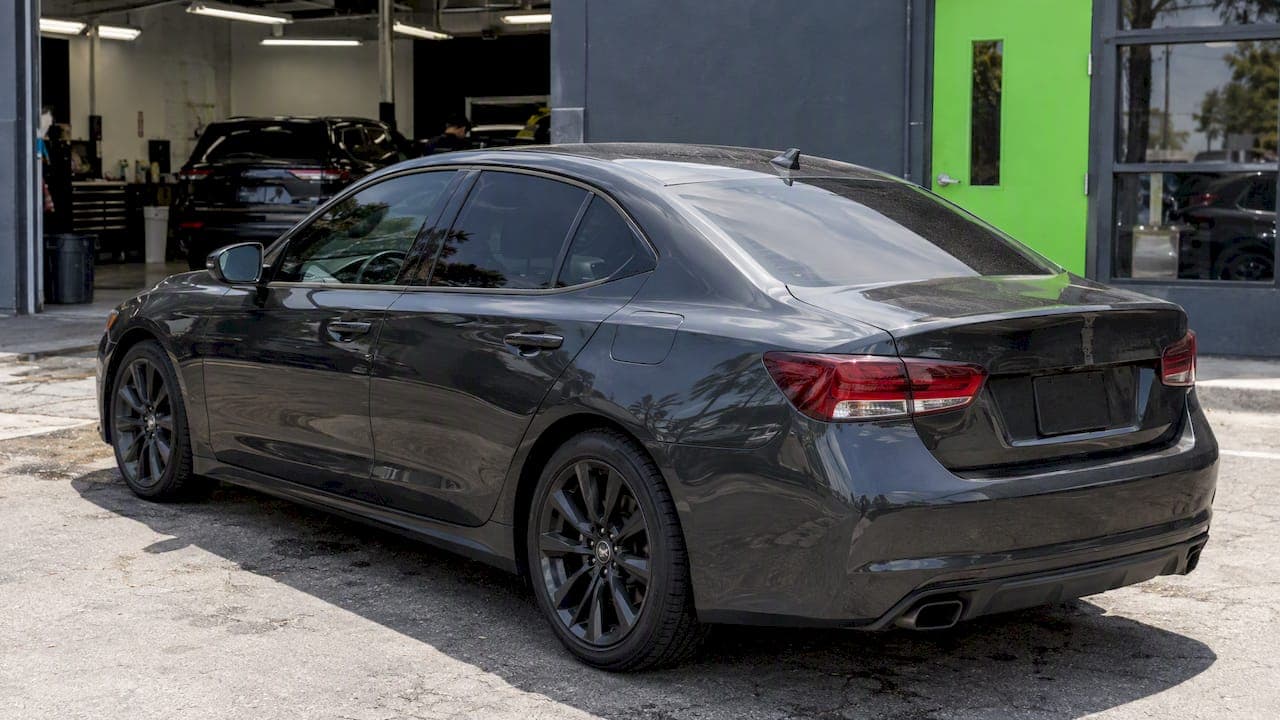
Quality window tint cuts the solar heat that comes through your glass, blocks most UV rays, tames glare, adds privacy and can help hold glass together in a crash. It also protects your dashboard and seats from fading. How much you gain depends on the film you choose, the glass on your car and the quality of the install. Below is what each benefit means in daily driving, where the limits are, and how to decide if tint is worth it for your car.
TL;DR
- Tint reduces solar heat, blocks up to 99% of UV rays and cuts glare, so the cabin is more comfortable and easier on your eyes.
- It helps protect your dashboard, upholstery and carpet from sun fading, and adds privacy.
- Window film may help hold glass together in an impact, which reduces flying fragments.
- Film type matters: ceramic and other non-metallic films are built for heat rejection without signal interference, and California law limits how dark you can go.
- Professional installation in a clean, controlled space is what separates a tint that lasts from one that bubbles.
Table of Contents
- Heat: the benefit you feel first
- UV protection for you and your interior
- Glare reduction and less eye strain
- Safety: film can help hold glass together
- Privacy, looks and theft deterrence
- Why some people tint only the back windows
- Which film type fits your car
- Is window tint worth it?
- How long installation takes and what to expect
- Legal limits to know before you choose a shade
- Our perspective
- Get tint done right in Van Nuys
- FAQ
- Sources
Heat: the benefit you feel first
Glass is the main way the sun gets into your car. One academic review of vehicle thermal comfort found that as much as 70% of a vehicle's total solar heat load enters through the glass areas. That is why a parked car feels like an oven and why the steering wheel can be too hot to touch.
Window film attacks that heat before it settles into the cabin. The International Window Film Association (IWFA) notes that window films can reject up to 55% of heat buildup, which lets the air conditioning work more efficiently. In practice that means the cabin cools down faster after you start the car and the AC does not have to run as hard to keep it there.
Not all films do this equally. The IWFA's education guide explains that heat rejection depends on whether a film is designed to absorb or to reflect solar energy, and reflective products often perform more efficiently. Dye-only films look dark but mostly absorb heat into the glass. Modern ceramic films are engineered to reject heat without needing a very dark shade. If you want the deeper breakdown, we cover it in our guide to heat rejection tint.

One honest point: shade percentage and heat rejection are different things. A light ceramic film can reject more heat than a dark basic film. Ask for the film's heat and UV specifications, not just the darkness.
A note on fuel economy and EV range
Less solar gain means less work for the air conditioner. Car and Driver's tint guide points out that tint serves a functional role in reducing solar gain, which can incrementally improve fuel economy by easing the load on the AC. For gas cars the effect is small. For electric vehicles, where cabin cooling draws from the same battery that moves the car, owners often care more, and we explain our approach in our piece on nano-ceramic tint and EV range.
UV protection for you and your interior
UV is the invisible part of sunlight, and it affects both skin and materials. The IWFA states that quality window films block up to 99 percent of the sun's damaging UV rays, which helps protect the skin of everyone in the car.
This matters more than most drivers think, because factory glass is not a complete answer. Researchers reviewing photoprotection by window glass found that laminated windshields give excellent UVA protection, but side and rear windows are typically not laminated and generally let through more. If you spend long hours commuting on the 405 or the 101 with your arm near the driver's window, that side exposure adds up.
The same UV and heat that reach your skin also work on the car itself. Car and Driver notes that good-quality tint can help preserve upholstery, carpeting and the dashboard, which fade and crack over time under sunlight. A cracked dash or sun-bleached leather is a visible hit to resale value, and tint is a far cheaper defense than replacing trim.

Families often ask about this for the back seat. Kids and babies sit beside large windows for the whole trip, and we wrote about what film can and cannot do in our guide to car tint for rear-seat babies. For a broader look at why factory glass alone is not enough, see our article on car window UV protection.
Glare reduction and less eye strain
Bright sun low on the horizon, headlights in the mirror and reflections off hoods all create glare. Tint lowers the amount of visible light entering the cabin, so you squint less and your eyes tire more slowly on long drives. The effect is most noticeable on sunrise and sunset commutes, when the sun sits right in your line of sight.
The tradeoff is real and worth stating plainly: darker film also reduces how much you see out, especially at night. Car and Driver notes that tint darkness affects how well you can see out. The smart move is to pick a shade that fits how you drive. If you often drive on dark, unlit roads, a lighter film is the better choice, and a high-quality ceramic film can still deliver strong UV and heat performance at that lighter level. We compare the options in our 70% vs 50% tint guide.
Safety: film can help hold glass together
This benefit rarely gets mentioned until someone needs it. The IWFA says that in an accident, window film may help hold glass together, reduce flying glass fragments that can cause lacerations and eye injuries, and may even help keep passengers from being ejected. The wording is "may," and it should be: film is not a substitute for seat belts or a laminated safety rating. But it adds a layer that most drivers never think about, and it also makes a smash-and-grab harder, since the glass tends to stay in one piece for longer.
Privacy, looks and theft deterrence
Darker windows make it harder for passers-by to see what is in your car. Car and Driver, citing the IWFA, notes that tint provides privacy and may help obscure valuables inside a vehicle, which can deter a potential thief. That is useful for anyone who parks on the street, at work or at a trailhead.
There is a style side too. The IWFA's guide lists a more balanced exterior look and the masking of interior parts such as seat tops and headrests among the aesthetic benefits. Many owners simply like how a car looks with uniform glass. If you want the look without a dark finish, clear ceramic tint gives you UV protection without the dark appearance.
Why some people tint only the back windows
A common question is why so many cars have dark rear glass and a lighter front. The answer is mostly about law and visibility. In California, the front side windows must let through at least 70% of visible light, and the windshield may only carry a strip at the top, while rear side windows and the back glass have much more freedom. California's window tint rules are the first thing to check before you choose a shade, and our page on what the law allows for windshields covers that glass in detail.
The cost of tinting only the back is that the front cabin gets less benefit. The driver and front passenger sit next to the glass with the most sun on their arms and face, and that is where a clear or light ceramic film on the front doors earns its place. It can add UV and heat protection while staying within the legal limit. Because factory glass is often slightly tinted already, the film itself has to be lighter than the number you are aiming for. A professional installer measures with a meter so you do not guess.
Which film type fits your car
There are a few common categories, and the right one depends on what you want from it.
| Film type | What it is designed to do | Good fit for |
|---|---|---|
| Carbon | Dark, matte look with solid heat control and no metallic content | Drivers who want a classic finish at a moderate level |
| Ceramic / nano-ceramic | Strong heat and UV rejection at lighter shades, with no signal interference | Daily drivers, EVs, families, anyone who wants performance without a dark look |
| Clear ceramic | UV and heat protection with a nearly clear appearance | Front doors, windshields where legal, owners who dislike dark glass |
The IWFA also points out something many shoppers miss: performance figures are based on testing 1/4-inch clear monolithic annealed glass, so results on your vehicle can vary with factory tint and glass type. Treat a spec sheet as a comparison tool between films, not a promise of an exact number in your car.
Signal interference is another worry. Older metallic films gave tint a bad name for disrupting radios and phones. The IWFA says today's window films may not interfere with GPS, cell phone or radio signals. For a deeper look at film that avoids metal entirely, read our guide to non-metallic car tint, and for how indoor installation helps, see our article on indoor tinting benefits.
Is window tint worth it?
For most drivers in a sunny, hot place like the San Fernando Valley, yes. The reasoning is simple. You gain a cooler cabin, protection for your skin, a longer life for your dashboard and seats, less glare and a layer of glass safety. The cost is a one-time install on glass you already own.
Here is a quick test. Tint is likely worth it if:
- You park outside for hours, at work, at home or on the street.
- You drive during sunrise or sunset, or on long highway stretches.
- You carry kids, pets or passengers who sit beside big windows.
- You plan to keep the car for years, or care about resale condition.
- You own an EV and want to ease the load on the battery from cabin cooling.
There are two caveats worth knowing so you buy the right thing. The thermal review mentioned earlier found limited statistical analysis and no subjective comfort measures in the studies it examined, so lab numbers do not translate perfectly to how hot you feel. And the IWFA notes that early architectural films used on cars were often too dark and too reflective, which is why manufacturers developed films made for automotive glass. Choose automotive film, installed by someone who does cars every day, and both concerns largely fall away.
How long installation takes and what to expect
Car and Driver says applying tint can take between one and four hours, sometimes more, and that professional work often comes with a guarantee or warranty. Here is what a good job looks like from your side:
- Choose the film and shade. Pick based on heat, UV and the legal limit for each window.
- Prep the glass. Windows should be cleaned thoroughly, because dust trapped under film shows as specks.
- Cut and fit. Film is cut to each window's shape and shrunk to fit curved glass.
- Apply and cure. The film needs time to cure, and you should avoid rolling the windows down for a few days, as your installer will tell you.
- Check the finish. Look for clean edges, no bubbles that remain after curing and no lifting.
The clean-room part matters more than it sounds. Dust is the main enemy of a flawless film job, which is why we install in a climate-controlled, dust-free facility.
Legal limits to know before you choose a shade
Tint laws vary by state, and Car and Driver advises that professional installation can help ensure the tint is legal and avoid a citation. In California, front side windows must allow at least 70% of light through, and the windshield is limited to a strip near the top. Medical exemptions exist for some drivers, and they carry their own rules. Our California window tint law guide walks through each window.
A related point: adding film to a windshield can push visible light transmission below the 70% level set by U.S. and European standards, so windshield film calls for care and a proper reading from a professional.
Our perspective
We have tinted and protected over 1,000 vehicles, and the question we hear most is whether tint is just a cosmetic upgrade. It is not. The real value is what it does every day: a cooler cabin, less squinting, and a dashboard that is not baking.
Our view is that film choice and installation matter as much as the shade. We recommend nano-ceramic and other non-metallic films because they are designed to reject heat and UV without disrupting signals, and that matters most on Teslas and other EVs full of sensors and antennas. Our work on those cars is built around a precise, interference-free fit.
We also believe the room matters. Our climate-controlled, dust-free facility is there so the film goes on clean, and manufacturer-backed warranties give you something real behind the work. If you are weighing tint, start with how you use the car, then choose the film to match.
Jake
Get tint done right in Van Nuys
If you are ready to put these benefits to work, we install carbon and ceramic window tint for cars and EVs at our Van Nuys shop, and we can also remove old, faded film before we apply new. Tell us how you drive and we will help you match a film and shade to your needs and to California's limits.
See the options on our window tinting page, or if you want to protect the paint as well as the glass, look at paint protection film and ceramic coating from the same shop.
FAQ
Does 70% windshield tint make a difference?
A 70% film is nearly clear, so it adds modest heat reduction, but it can still add UV protection. Windshields are already laminated, which gives strong UVA protection, as photoprotection research notes. In California, windshield rules are strict, so check what the law allows before you add anything.
What are the downsides of window tint?
Darker film reduces how much you can see out, especially at night, and each state sets its own limits. Choosing a film shade that fits your driving and having a professional install it solves most problems. A well-made ceramic film gives you performance without needing a very dark shade.
How often should you replace window tint?
There is no fixed interval. Good film that is installed cleanly and backed by a warranty can stay in place for years, and you replace it when it fades, bubbles or peels. If old film is failing, it should be removed professionally before new film goes on. Ask your installer about the specific warranty on your film.
Will tint interfere with my phone, GPS or radio?
The IWFA says today's films may not interfere with those signals. Non-metallic ceramic and carbon films are the safest picks, particularly for EVs with many antennas and sensors.
Why do people tint only the back windows?
Mostly because of legal limits and visibility. Rear windows can usually go darker than the fronts, so owners get privacy there and leave the fronts lighter. A clear ceramic film on the front doors can still add UV and heat protection within the limit.
Sources
- IWFA, Facts About Automotive Window Film
- IWFA, Automotive Education Guide 2026
- Car and Driver, Car Window Tinting: Benefits, How-Tos, and the Law
- University of Michigan, Thermal Comfort in Vehicles: A Review
- Current status of photoprotection by window glass