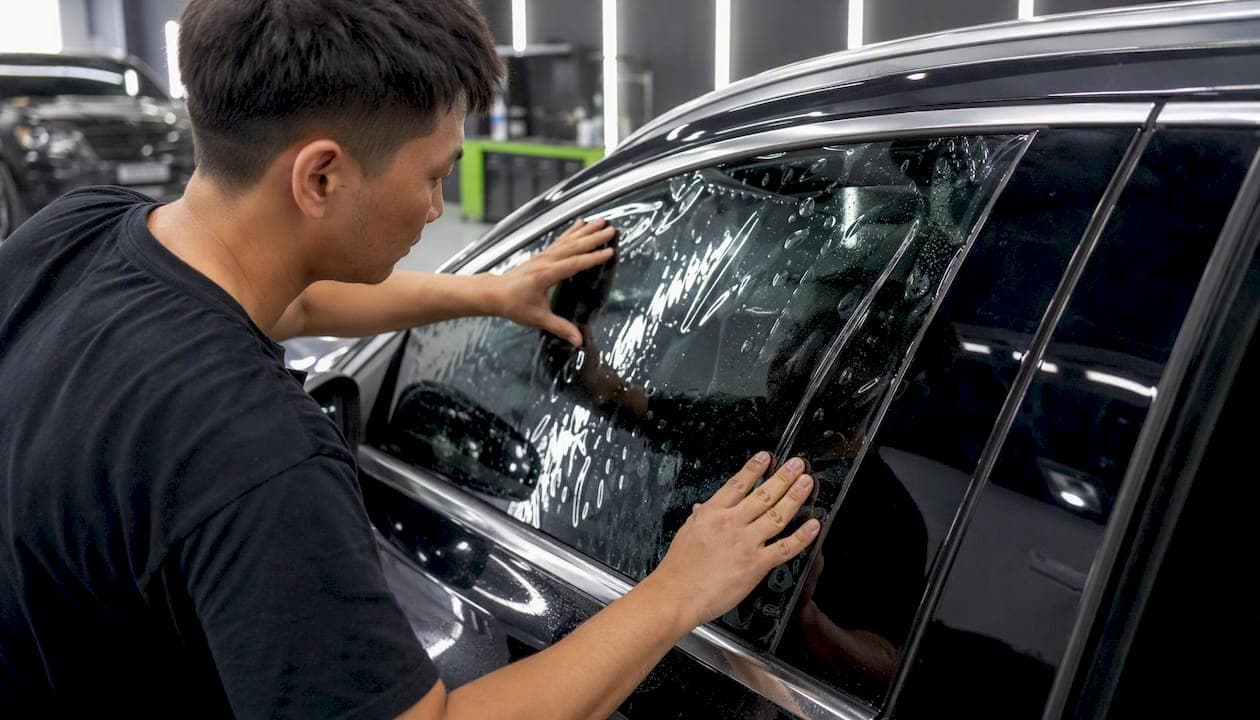
Dark aftermarket tint on your windshield or front side windows is essentially illegal in California, full stop, with only a couple of narrow exceptions. Rear side windows and the back windshield have no darkness limit at all, but only if your car has two working side mirrors once that glass goes dark. The whole system runs on Vehicle Code §26708 and the federal FMVSS No. 205 glazing standard, which sets a 70% light transmission floor that state law can't undercut.
Key Takeaways
| Point | Details |
|---|---|
| Front windows stay near-clear | Film must hit 88% VLT alone and 70% combined with glass, per Vehicle Code §26708. |
| Rear glass has no limit | Any darkness is legal on rear side and rear windshield if both side mirrors work. |
| Windshield strip is narrow | Top strip must sit at or above the AS-1 line and cannot be red, amber, or reflective. |
| First tickets are correctable | Fix-it tickets run about $25 to process; repeat violations cost far more. |
| Certificate must stay in the car | Tintandwrapscustoms issues the required legal certificate with every compliant ceramic install. |
Table of Contents
- What are the California window tint limits by window?
- How high can the windshield tint strip sit, and what color is legal?
- What film qualifies for front side windows in California?
- What are the rules for rear windows and mirrors?
- Who qualifies for a medical tint exemption in California?
- What are the fines for illegal window tint in California?
- Compliance checklist before you tint
- Which tint technology holds up best under California's rules?
- Get compliant tint installed the right way
- Frequently Asked Questions
- Sources
What are the California window tint limits by window?
Each pane of glass on your car plays by a different rule, and mixing them up is how most drivers end up with a fix-it ticket.
- Windshield: No film allowed except a non-reflective strip at the very top.
- Front side windows (driver and passenger): Only clear, colorless, UV-blocking film qualifies, and it has to meet a two-part test: the film itself must transmit at least 88% of visible light, and the combined glass-plus-film reading must stay at or above 70%.
- Rear side windows: No tint-percentage limit whatsoever.
- Rear windshield: Also unrestricted, as long as the car keeps two functioning outside mirrors.
Visible Light Transmission (VLT) is simply the percentage of light that passes through the glass. A 70% VLT reading means 70% of light gets through and 30% is blocked. Add a film rated at even 50% VLT to glass that starts at 78%, and you'll land well under the legal 70% combined floor.
How high can the windshield tint strip sit, and what color is legal?
California measures the top strip by statute rather than a flat inch count, with a measurement method that typically results in a strip roughly at the height of the AS-1 line etched on most passenger vehicles' windshields. The easiest visual marker is the AS-1 line etched into the glass by the manufacturer; anything above that line is generally safe territory for the strip.
- The strip cannot be red or amber.
- It cannot carry opaque lettering or graphics.
- It cannot reflect more light than the bare glass beneath it would.
Pro Tip: Ask your installer to line up the strip's bottom edge with the AS-1 marking, not a ruler measurement from the dash. Cars vary enough in windshield rake that a flat four-inch rule can put you above or below the legal line depending on the vehicle.
What film qualifies for front side windows in California?
Front-side film has to clear two separate thresholds at once, and missing either one makes the whole install illegal regardless of what the box says. 205](https://www.ecfr.gov/current/title-49/subtitle-B/chapter-V/part-571/subpart-B/section-571.205). The film also has to be manufactured for UV protection, not visible darkening, which is why legitimate front-window film always looks close to clear glass.
Installers and manufacturers are required to hand over a certificate naming the company and street address, and Vehicle Code §26708(d) requires drivers to keep that document in the vehicle. Before any front-window install, run through this:
- Ask for the film's official spec sheet showing VLT at 88% or higher.
- Confirm the combined VLT reading with your glass, not just the film's rating alone.
- Get the signed certificate and keep it in the glove box, not at home.
- Walk away from any shop that can't produce either document on request.
What are the rules for rear windows and mirrors?
Rear side windows and the rear windshield carry no VLT restriction in California, meaning you can go as dark as you want back there. There's one catch:
- The car needs functioning outside mirrors on both the left and right sides.
- Those mirrors must give the driver at least 200 feet of rear visibility.
Pro Tip: Officers checking rear tint almost always glance at the side mirrors first. If either one is cracked, missing, or folded in, that's the detail that turns a dark rear windshield into a citation.
Who qualifies for a medical tint exemption in California?
A licensed physician, surgeon, or optometrist can sign off on a medical exemption for light-sensitive conditions, but the exemption is narrower than most drivers assume.
- The signed certificate must stay in the vehicle at all times.
- The film still has to be clear, colorless, and UV-blocking, meeting the same 88% film VLT and 70% combined VLT thresholds as standard front-window film.
- It does not authorize dark or privacy-style tint on front glass under any circumstance.
- Film in poor condition, peeling, bubbled, or otherwise obstructing the view, can void the practical benefit of the exemption even with valid paperwork.
The exemption exists to protect drivers from UV exposure and light sensitivity, not to get around the darkness rules. An officer checking your paperwork is looking for the physician's certificate, not a reason to wave through 20% tint.
What are the fines for illegal window tint in California?
A first tint violation usually shows up as a correctable "fix-it" ticket rather than a straight fine. Correct the problem, get sign-off from a shop or inspection station, and the processing fee typically runs around $25.
- Ignore the citation or get cited again, and the cost climbs into the hundreds once court fees and assessments stack on top of the base fine.
- Registration can be affected if a fix-it ticket goes uncorrected past its deadline.
- Driving into California with out-of-state plates doesn't create an exemption. State law applies to whoever is on the road, not wherever the car is registered.
The practical fix after a citation is straightforward: remove or replace the noncompliant film, get a certified inspection or shop verification, and bring proof back to the court or agency listed on the ticket.
Compliance checklist before you tint
Run through this before any film touches your glass:
- Confirm the film's rated VLT is 88% or higher for front-side windows.
- Verify the combined glass-plus-film VLT lands at or above 70%.
- Collect the installer or manufacturer certificate and keep it in the car.
- If you're darkening rear glass, check that both side mirrors work properly first.
- Pick non-reflective, uncolored film for the windshield strip and confirm it sits at or above the AS-1 line.
Pro Tip: Bubbling, peeling, or heavy discoloration on old tint isn't just cosmetic. It can drop your effective VLT below legal limits even if the film was compliant when it was installed.
Which tint technology holds up best under California's rules?
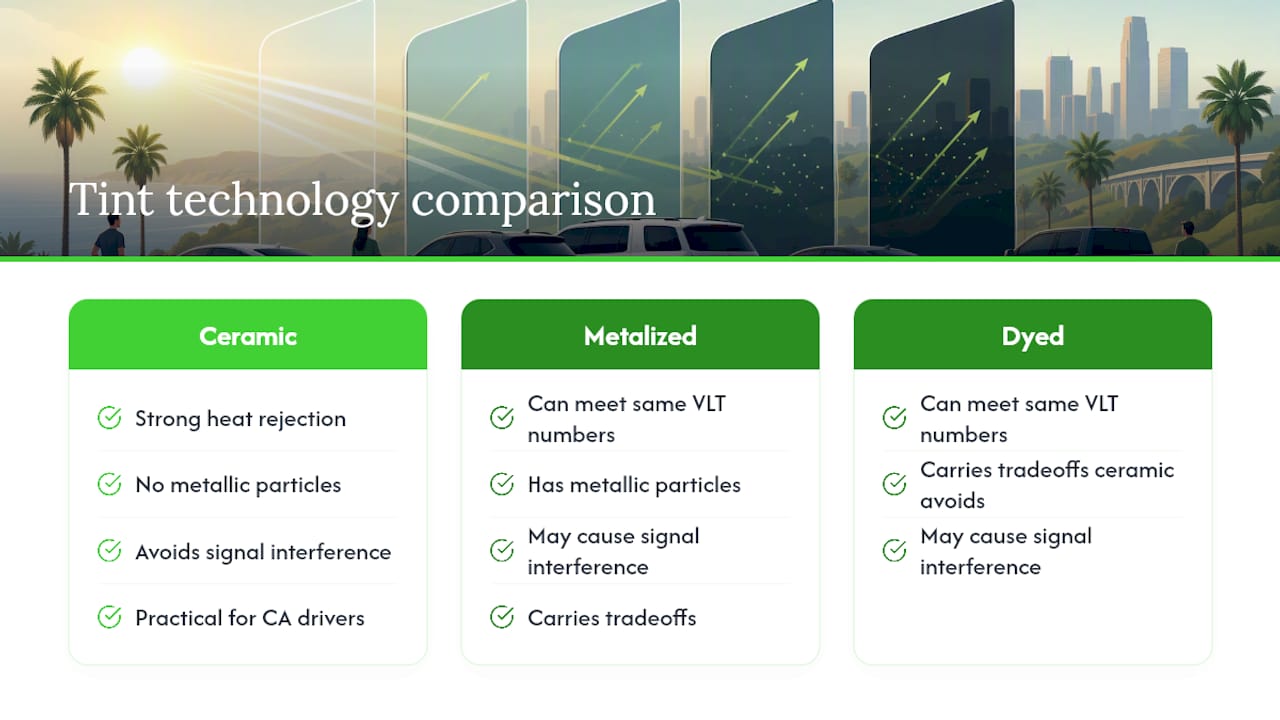
Ceramic film is the practical answer for most California drivers because it delivers strong heat rejection without the metallic particles that can interfere with Bluetooth, GPS, and EV telemetry systems. Metallic and dyed films can technically meet the same VLT numbers, but they carry tradeoffs ceramic avoids entirely, including signal interference on newer vehicles.
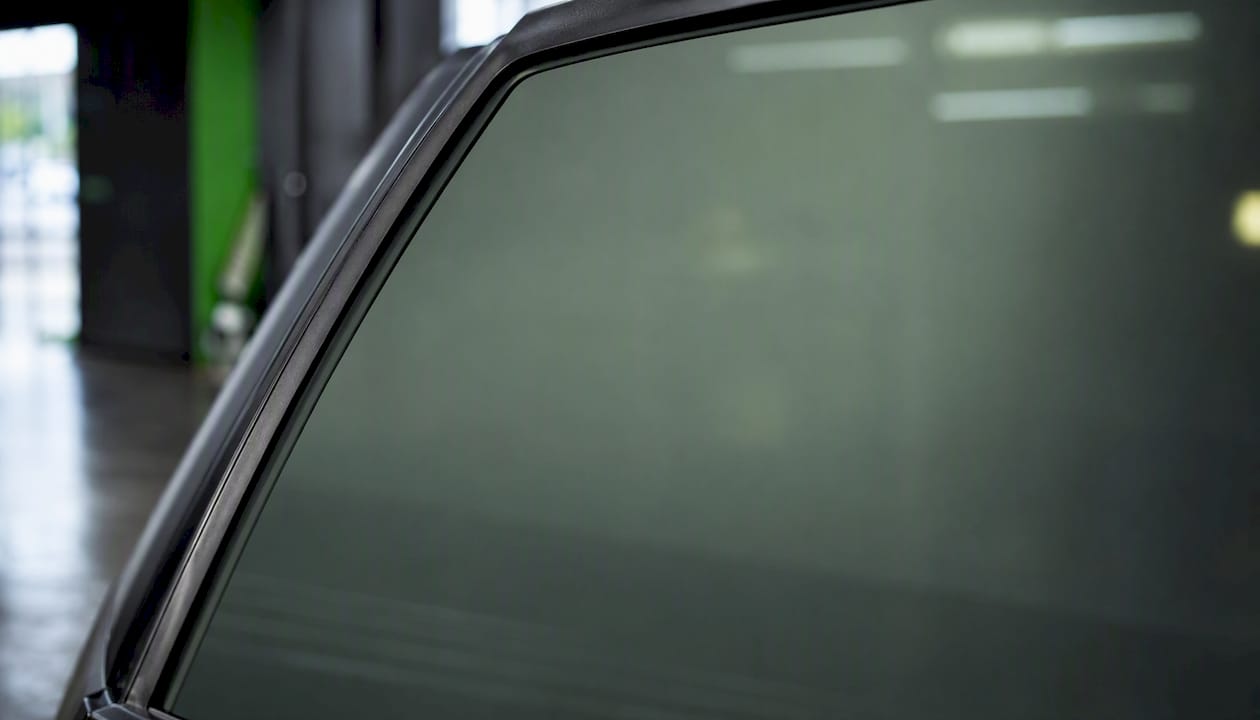
Pro Tip: Ask any shop for three things before booking: the manufacturer's VLT spec sheet, the written warranty terms, and the legal certificate you're required to keep in the car. If a shop hesitates on any of the three, keep looking.
A note from the shop floor
We install legal, high-performance ceramic film on California vehicles every week, and the certificate paperwork matters just as much as the film itself.
Get compliant tint installed the right way
There's no shortage of shops willing to sell you film that "looks about right," but a wrong VLT reading turns a cosmetic upgrade into a ticket. Tintandwrapscustoms installs nano-ceramic film in a climate-controlled facility, issues the required legal certificate on the spot, and backs every install with manufacturer warranties, so you drive away with paperwork that matches the glass.
Whether you're tinting a daily driver or a Tesla that needs signal-safe film, our team can walk you through what's legal for your specific windows before any film gets cut. Book a consultation at our Van Nuys shop and get a compliant, warrantied install without the guesswork.
Frequently Asked Questions
No.
Can I get pulled over just for tint in California? Yes, illegal front-window tint is enforceable on its own, and officers commonly issue a correctable fix-it ticket rather than an immediate fine.
Does a medical exemption let me use dark tint? No.
How dark can I go on rear windows? As dark as you want, with no VLT restriction, as long as both outside side mirrors are present and functioning.
What's the difference between metalized and ceramic window tint for legal compliance? Both can meet the same VLT numbers, but metalized film risks interfering with GPS, Bluetooth, and EV systems, while ceramic film avoids that issue entirely.
This article is general information, not a substitute for advice from a qualified lawyer. Consult a qualified legal professional about your own circumstances before acting on anything here.
Sources
- California Legislative Information — Vehicle Code §26708
- Electronic Code of Federal Regulations — FMVSS No. 205 (glazing)
- The Desert Sun — California's window tint laws: A quick guide