Nano-ceramic window tint delivers stronger heat rejection, near-total UV blocking, sharper optical clarity, and no GPS or phone interference, outperforming dyed and metallic films in every measurable way that matters day to day. It earns its price premium fastest on luxury vehicles, panoramic roofs, curved rear glass, and EVs where cabin heat load affects range. If you drive a basic sedan and plan to go very dark anyway, standard ceramic often closes most of the gap.
TL;DR:
- Nano-ceramic tint blocks up to 99% of UV rays and rejects high levels of infrared heat, significantly reducing cabin temperature and protecting interior materials and electronics.
- Its high particle density and uniform size improve optical clarity, especially on curved or large glass surfaces, with minimal distortion under night driving conditions.
- The technology offers long-lasting durability and resistance to fading, bubbling, and discoloration, supported by manufacturer warranties and proper installation in climate-controlled environments.
- The premium price mainly reflects the better heat rejection, clarity, and longevity, making it especially worthwhile for luxury vehicles, panoramic roofs, and EVs where heat load impacts range.
- Manufacturer spec sheets for TSER and IR rejection are crucial for assessing actual performance, as VLT and marketing claims alone do not reliably indicate effectiveness.
Table of Contents
- What Are the Benefits of Nano Ceramic Tint?
- How Does Nano Ceramic Window Film Actually Work?
- How Much Heat and UV Does Nano Ceramic Tint Block?
- Does Nano Ceramic Tint Affect Visibility or Night Driving?
- How Long Does Nano Ceramic Tint Actually Last?
- What Are the Downsides of Nano Ceramic Tint?
- Is Nano Ceramic Tint Worth It for Your Vehicle?
- What Should You Look for in a Window Tint Installer?
- Is Nano Ceramic Tint Environmentally Friendly?
- Nano Ceramic vs. Dyed and Metallic Tint: What's Actually Different?
- Is Nano Ceramic Worth the Upgrade Over Standard Ceramic?
- What the Data Actually Supports
- Ready to Upgrade? Here's What a Nano-Ceramic Install Looks Like
- Sources
- FAQ
What Are the Benefits of Nano Ceramic Tint?
The short list looks simple, but each item solves a specific, real problem rather than just sounding good on a spec sheet.
- Heat rejection. Nano-ceramic film blocks a large share of infrared energy before it hits your dashboard, seats, and skin, keeping the cabin noticeably cooler than glass alone.
- UV protection. Premium ceramic films can block up to 99% of UV rays, according to Madico, which matters as much for your skin as it does for your leather and dash trim.
- Optical clarity. The film stays clear and distortion-free even on curved glass, so your view out the windshield or rear window doesn't get a hazy tint.
- Durability. Quality nano-ceramic film resists fading and bubbling far longer than dyed film, often backed by a manufacturer warranty.
- No signal interference. Because it's non-metallic, it won't degrade your GPS, phone signal, or toll transponder.
- Glare and privacy. Cuts sun glare on the road and adds a layer of privacy without turning your windows into mirrors.
Statistic to know: Industry guides report that premium ceramic films reject high levels of infrared while blocking up to 99% of UV rays without the signal interference that plagued older metalized films. That combination, strong heat and UV performance with zero electronics interference, is the core reason nano-ceramic replaced metallic film as the go-to premium option.
The trade-off is cost. Nano-ceramic typically runs a premium over standard dyed or carbon film, so it makes the most sense when you actually value the extra clarity and longevity, not just a darker window.
How Does Nano Ceramic Window Film Actually Work?
"Nano" refers to the size of the ceramic particles suspended in the film, not a separate technology. Standard ceramic tint uses larger ceramic particles; nano-ceramic grinds those particles down to a much smaller, more uniform size, which lets manufacturers pack more of them into the same thin layer of film. TintGrade notes that this higher particle density and uniformity is what improves clarity, especially on curved glass, and it's also why nano-ceramic usually costs more than conventional ceramic.
Two numbers matter here, and they measure different things. Total solar energy rejected (TSER) tells you how much overall solar heat energy the film blocks, combining infrared, UV, and visible light. Visible light transmission (VLT) tells you how dark the film looks, meaning how much visible light passes through. A film can have a low VLT (very dark) but mediocre heat rejection, or a high VLT (fairly light, legal-friendly) with excellent heat rejection, because the two specs aren't tied together. This is exactly why some drivers who want maximum brightness still get strong heat rejection performance from a lighter nano-ceramic film.
Because ceramic particles are non-conductive, they don't interfere with radio-frequency signals the way metal flakes in older films could, per Window Film Depot. That's also why manufacturing quality matters so much: a film marketed as "nano-ceramic" with poor particle distribution or filler additives won't deliver the same performance, no matter what the label says.
How Much Heat and UV Does Nano Ceramic Tint Block?
TSER and IR rejection numbers vary by brand, shade, and film thickness, but the pattern across manufacturer data is consistent: nano-ceramic sits at the top of the performance range compared with dyed and even standard ceramic films. Madico's own material describes ceramic tint as delivering strong heat rejection and near-complete UV blocking compared with dyed alternatives, and TintFinder's product overview backs that up, citing high infrared rejection alongside long-term durability in its nano-ceramic breakdown.
The number that matters more than VLT: prioritize TSER and infrared rejection specs over how dark a film looks. Two films with an identical 35% VLT can perform very differently once you're sitting in traffic in July, because one might reject twice as much infrared as the other.
What does that translate to in your actual car? A parked vehicle with quality nano-ceramic film on all windows typically stays noticeably cooler at the dash and steering wheel than one with factory glass alone, which means less time blasting the AC before you're comfortable, and less strain on the system over the life of the vehicle. For interiors, that lower heat load slows the fading and cracking that UV and infrared exposure cause in leather, vinyl, and dashboard plastics over years of sun exposure.
For EV owners specifically, cabin heat load isn't just a comfort issue, it's an efficiency one. Air conditioning is one of the bigger parasitic draws on battery range in hot weather, so a film that meaningfully cuts solar heat gain reduces how hard the climate system has to work on a summer drive. Keep in mind that exact numbers depend on the specific product and how well it's installed. A film with excellent lab specs installed poorly won't deliver those numbers in the real world.
Does Nano Ceramic Tint Affect Visibility or Night Driving?
Clarity problems with tint mostly show up on large, curved surfaces, panoramic roofs, rear windshields, and deeply curved side glass, where lower-quality films can show a faint haze or distortion, especially under headlights or streetlights at night. TintGrade's material points to this exact scenario: nano-ceramic's finer, more evenly distributed particles reduce the refraction that causes that haze, which is why the clarity advantage is most visible on panoramic sunroofs and expansive rear glass rather than a flat front side window.
The difference between light and dark VLT choices matters too. At higher VLTs (lighter film), any haze or distortion is easier to spot because more light is passing through the imperfection. At very dark VLTs, minor clarity flaws get masked simply because so little light gets through in the first place, which is part of why some drivers assume a cheaper film "looks fine" when it's really just dark enough to hide its flaws.
For night driving, quality nano-ceramic reduces glare from oncoming headlights without introducing double vision or starbursting. If you drive a lot after dark, lean toward the lighter end of the legal VLT range for your state rather than maxing out darkness, and check your local tint laws before choosing a shade.
How Long Does Nano Ceramic Tint Actually Last?
Quality nano-ceramic film is built to outlast the vehicle in most cases, with fading, bubbling, and adhesive failure being far less common than with dyed film. Real-world lifespan depends on climate exposure, how the vehicle is parked, and installation quality, and TintFinder's overview attributes long service life to both film quality and proper installation working together.
Warranties generally come in two forms: manufacturer warranties that cover the film itself against defects like bubbling or discoloration, and installer warranties that cover workmanship, meaning bad edges, lifting, or improper curing. Ask which one you're getting and what voids it, since driving through an automatic car wash too early or rolling windows down before the recommended curing window is up is a common way people accidentally void coverage.
Curing time matters more than most new tint owners expect. The adhesive needs time to fully bond to the glass, and rolling windows down or blasting the defroster too soon can trap moisture and cause the exact bubbling or peeling that looks like a product defect but is actually a curing issue, a distinction covered in TintFinder's installation notes. A climate-controlled shop helps here too, since consistent temperature and a dust-free environment during application reduce the odds of trapped debris or uneven adhesion that shortens film life.
What Are the Downsides of Nano Ceramic Tint?
Nano-ceramic isn't the right call for every driver, and pretending otherwise does you no favors.
- Price premium. Nano-ceramic typically costs more than standard ceramic or dyed film, largely due to the finer particle manufacturing process.
- Diminishing returns at very dark shades. If you're going as dark as your state legally allows, the visible clarity advantage over standard ceramic shrinks, since less light is passing through either way.
- Marketing confusion. Some films are labeled "ceramic" or even "nano-ceramic" without disclosing particle size or TSER numbers, so the name alone guarantees nothing.
- Legal limits vary by state. Always confirm your local VLT limits before choosing a shade; laws differ significantly across the country.
Pro Tip: Ask any installer for the manufacturer's actual TSER and IR rejection numbers, not just a marketing sheet. If they can't produce a spec sheet, treat the "nano-ceramic" label with skepticism.
Is Nano Ceramic Tint Worth It for Your Vehicle?
Run through this before committing to a shade or a shop:
- Check your glass profile. Panoramic roofs, deeply curved rear windshields, and large glass areas benefit most from nano-ceramic's clarity advantage.
- Factor in ownership timeline. If you're keeping the vehicle five-plus years, the longer lifespan and stronger warranty coverage tend to pay off relative to cheaper film.
- Match VLT to your use case. Daily commuters who drive at night often do better with a lighter, legal VLT paired with strong TSER rather than maximum darkness.
- Request the spec sheet. Get actual TSER, IR rejection, and UV block numbers in writing before you compare price across shops.
- Confirm the warranty type. Know whether you're covered by a manufacturer warranty, an installer warranty, or both, and what voids each.
- Ask about the install environment. A climate-controlled facility reduces contamination and curing issues that cause early failure.
If you check most of these boxes, nano-ceramic is the stronger long-term buy.
What Should You Look for in a Window Tint Installer?
Film quality only gets you halfway there. Installation environment and technician skill account for the rest, which is why TintGrade's guidance on climate-controlled shops keeps surfacing across the industry: dust and temperature swings during application are a leading cause of premature bubbling and edge lifting, regardless of how good the film itself is.
When you're vetting a shop, ask three things: what curing time they recommend before you can roll windows down, whether they can show a demo panel so you can see clarity on curved glass firsthand, and exactly what their warranty covers versus what the manufacturer covers separately. A shop that installs in a climate-controlled, dust-free bay and backs its work with manufacturer-authorized warranty coverage, particularly for EV and Tesla installations where sensor placement around the glass requires extra care, is solving the two biggest risks in this purchase: bad adhesion and voided coverage.
Is Nano Ceramic Tint Environmentally Friendly?
Nano-ceramic film's biggest environmental contribution happens after installation, not during manufacturing. By blocking a large share of solar heat before it enters the cabin, the film reduces how much your air conditioning compressor has to run, which lowers fuel consumption in gas vehicles and eases the battery draw that shortens range in EVs during hot weather.
The film itself is a thin polyester base layer with a ceramic particle coating, and most professional installers can recycle backing liners and scrap trim material rather than sending it to a landfill. Compared with dyed film, which uses dye layers that degrade and need replacement more often, nano-ceramic's longer service life means fewer removal-and-reinstall cycles over a vehicle's ownership, less waste generated per year of protection. That durability advantage is arguably the most concrete sustainability case for nano-ceramic: a film that lasts the life of the vehicle simply generates less material waste than one you're replacing every few years.
Nano Ceramic vs. Dyed and Metallic Tint: What's Actually Different?
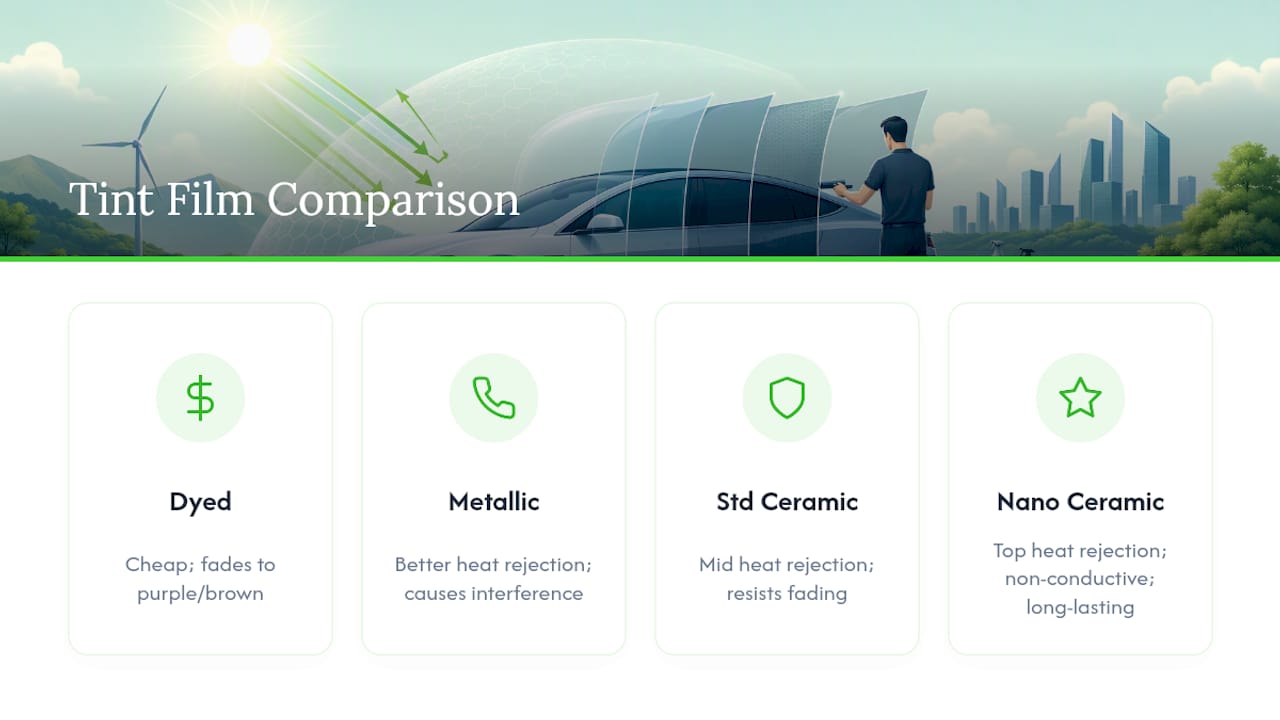
Dyed film is the budget option. It uses dye layers to darken glass and block some visible light, but it does little for heat rejection and tends to fade to purple or brown within a few years under sun exposure. It's cheap, and that's really its whole pitch.
Metallic (metalized) film improves on dyed film's heat rejection by embedding tiny metal flakes in the film, but those flakes are conductive, which is exactly what causes the GPS, phone, and radio interference that made metallic film unpopular as cars became more electronics-dependent. It can also give windows a reflective, mirror-like look some drivers don't want.
Nano-ceramic solves both problems at once. It matches or beats metallic film's heat rejection using non-conductive ceramic particles instead of metal, which is why it causes no signal interference while still delivering strong TSER numbers. It also holds its optical clarity and color far longer than dyed film, since ceramic particles don't fade the way dye molecules do. The trade-off is cost. Nano-ceramic sits at the top of the price range, with standard ceramic as a middle ground and dyed film as the entry point. For a full side-by-side on where carbon film fits into that spectrum, see this ceramic vs. carbon comparison.
Is Nano Ceramic Worth the Upgrade Over Standard Ceramic?
Standard ceramic already solves the biggest problems with older film technology. It blocks strong UV, rejects a good amount of heat, and doesn't interfere with electronics. So the real question isn't "ceramic versus nano-ceramic," it's whether the extra clarity and heat performance nano-ceramic adds is worth roughly 15% to 30% more, a premium range TintGrade attributes to the finer particle manufacturing process.
The upgrade earns its cost fastest on vehicles with large curved glass, panoramic roofs, wraparound rear windshields, where standard ceramic's larger particles are more likely to show faint haze under direct light. It also earns its cost for EV owners chasing every bit of range efficiency in hot climates, and for anyone planning to own the vehicle long enough that the longer lifespan offsets the higher upfront price.
Where the upgrade adds little: if you're tinting a vehicle with mostly flat glass, going to a very dark legal-limit VLT anyway, and planning to sell within a couple of years, standard ceramic likely delivers nearly the same real-world experience for less money. Save nano-ceramic for the situations where its specific advantages, clarity on curves and maximum heat performance at lighter shades, actually show up in daily use.
What the Data Actually Supports
Most tint marketing leans on the word "ceramic" as if it's a single guaranteed performance tier, and that's the biggest gap between what's advertised and what buyers actually get. Two products both labeled nano-ceramic can have meaningfully different TSER numbers because particle size, distribution, and film thickness vary by manufacturer, not just by category name.
The conventional advice, "go ceramic, you'll be fine," undersells how much installation quality and spec verification matter. A great film badly installed in a dusty garage with no curing guidance will bubble and lift regardless of what the particles are made of. That's not a knock on the technology. It's a reason to treat the installer's process, climate control, curing time, warranty terms, as seriously as the film brand itself.
If you take one thing from this guide, make it this: ask for the TSER and IR rejection numbers in writing before you compare price. Darkness is the easiest thing to eyeball and the least useful number for judging real performance. The buyers who end up disappointed are almost always the ones who shopped on VLT and price alone.
— Jake
Ready to Upgrade? Here's What a Nano-Ceramic Install Looks Like
Nano-ceramic and standard ceramic films are often installed in climate-controlled, dust-free facilities designed to avoid contamination and curing issues that cause premature bubbling. Expertise in installing films on Tesla and EV models can help ensure sensor placement around cameras and radar is handled correctly, often backed by manufacturer-authorized warranty coverage rather than a generic installer guarantee.
A quote starts with a quick inspection of your glass, curves, sunroof, rear windshield, so you get an honest read on where nano-ceramic's clarity advantage actually applies to your vehicle rather than a one-size-fits-all pitch. From there, you'll get real spec numbers, an estimated timeline, and a clear warranty breakdown before any film gets cut. If you're ready to see what your options look like, visit the window tinting page to request a quote, or browse the full range of services at Tintandwrapscustoms to see how tint pairs with paint protection film or ceramic coating for full vehicle protection.
Sources
- Ceramic Window Tint: Benefits & How It Compares | Madico, Inc.
- What Is Nano Ceramic Window Tint? (And Is It Better?) — TintGrade
- Understanding Ceramic Window Tint: Benefits and Features Explained
- Nano Ceramic Window Tint — TintFinder
FAQ
What Are the Disadvantages of Nano Ceramic Tint?
The main downside is cost. Nano-ceramic typically runs higher than standard ceramic or dyed film because of its finer particle manufacturing process. Its clarity advantage also shrinks at very dark VLTs, and buyers need to verify actual spec sheets since "nano-ceramic" labeling isn't standardized across manufacturers.
Are Nano Ceramic Tints Good?
Yes, nano-ceramic tints deliver strong heat rejection, near-total UV blocking, and better optical clarity than dyed or metallic film, without the signal interference older metalized films caused. They're especially worth it on curved glass, panoramic roofs, and vehicles you plan to keep long term.
How Long Does Nano Ceramic Tint Last?
Quality nano-ceramic film is built to last the life of most vehicles when properly installed, with far less fading or bubbling than dyed film over time. Actual lifespan depends on climate exposure and installation quality, which is why warranty terms and a climate-controlled install matter.
Can You See at Night With Nano Ceramic Tint?
Yes, quality nano-ceramic film maintains strong night visibility and reduces glare from oncoming headlights without introducing distortion. Clarity issues are more likely on cheaper films or very dark shades, so choosing a lighter legal VLT helps if you drive frequently after dark.