Either way, confirm the film quality (ceramic beats dyed film for heat control) and check your state's tint law before booking an install.
TL;DR:
- At 70% VLT, ceramic film can block over 99% of UV rays while keeping the glass visually close to its factory appearance.
- Nighttime detection distances decline as tint darkens, particularly through rear windows, and the effect is greater for older drivers and people who wear glasses.
- Factory glass changes final VLT, so have the installer measure every window and document the result instead of relying on the film label.
- State limits can differ for front, rear, and windshield glass; check each pane’s rule and any medical exemption before booking installation.
- Ceramic film can provide high infrared rejection at either shade, so compare the film’s heat performance rather than assuming darker tint keeps the cabin cooler.
Table of Contents
- What 70% and 50% tint actually look and feel like
- How tint level affects night and low-light visibility
- Thermal comfort and UV protection: why film tech matters more than darkness
- Legal basics and a practical checklist for compliance
- Decision checklist: matching tint level to your needs
- Installation quality and maintenance that change your outcome
- An installer's view on picking between 70% and 50%
- How Tint & Wraps Customs helps you get this right
- FAQ
- Sources
What 70% and 50% tint actually look and feel like
VLT, or visible light transmission, measures the percentage of light that passes through a window. The gap sounds small on paper, but it changes how a car looks and how it feels to drive after dark.
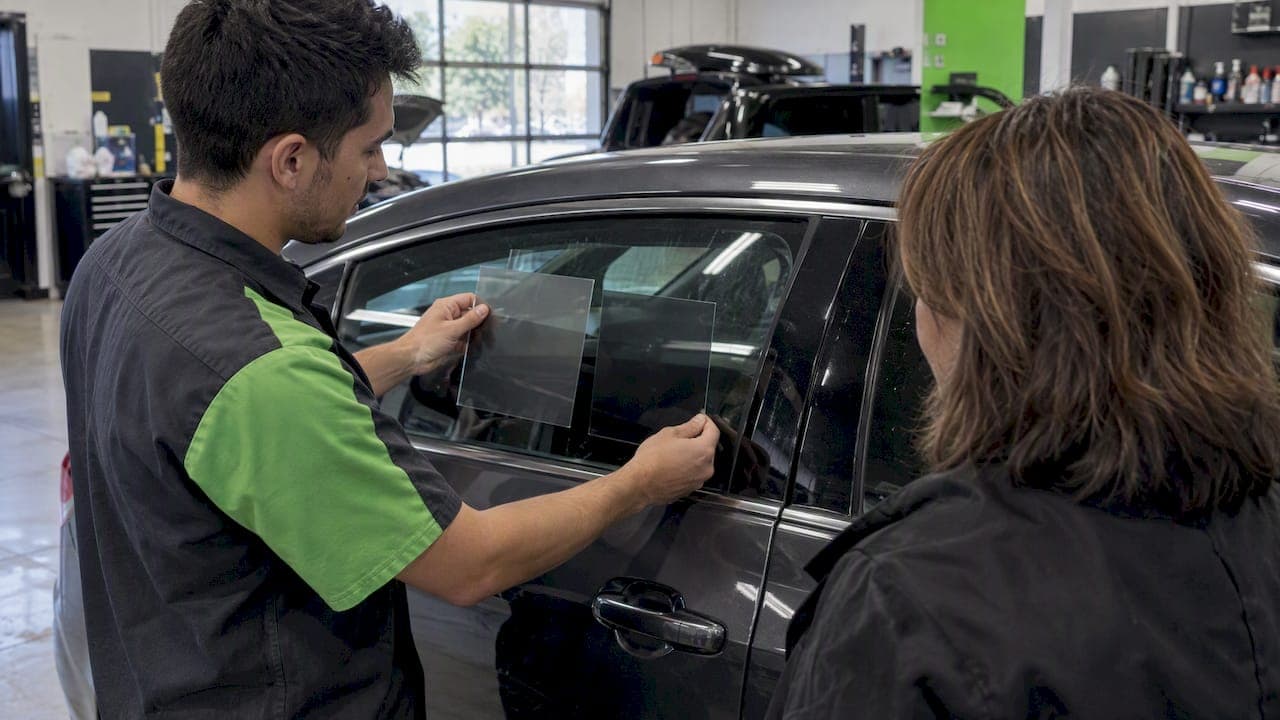
At 50%, the dimming becomes clearly visible, giving the cabin a noticeably darker, more private look, especially on side and rear windows.
- 70% VLT: A light haze that mostly reads as "factory glass," common on windshields and front side windows.
- 50% VLT: A visible shade shift that cuts glare and adds privacy, popular on rear doors and back glass.
- Factory glass interaction: Many vehicles already carry light factory tinting, so layering aftermarket film changes the math on total transmittance.
Modern ceramic films at 70% VLT can block over 99% of UV rays according to manufacturer performance data from Ceramic Pro, which means the lighter film still does the protective job most buyers actually want.
How tint level affects night and low-light visibility
Night driving is where the 70 versus 50 debate gets practical instead of cosmetic. Research summarized in a DOT report to Congress on motor vehicle window tinting found that increasing tint density reduces detection distances, meaning drivers spot pedestrians, signs, and other vehicles later as windows get darker. The effect is more pronounced on rear and rear-side windows than on the windshield, and it grows for spectacle wearers and older drivers whose eyes already need more light to resolve detail at night.
A related concern is how tint stacks with existing factory glass. Add a 50% film instead and the real-world number drops further, which is exactly the kind of surprise VTRC research into tinting and detection performance flags as a factor in reduced nighttime target detection.
Transmittance reductions below roughly 70% show increasingly detrimental effects on certain visual tasks, with spectacle wearers and older drivers more affected than average.
The measurable visibility penalty shows up for people who commute at night, drive rural roads without streetlights, or already wear glasses that scatter light.
If your driving is almost entirely daytime and well-lit, 50% is unlikely to create a real safety gap.

Thermal comfort and UV protection: why film tech matters more than darkness
Darker is not automatically cooler.
Manufacturer data sheets make this concrete. Ceramic Pro's performance tables list UV blocking and total solar energy rejection separately from VLT, and premium nano-ceramic lines often target high infrared rejection regardless of how light or dark the visible tint reads.
| Film attribute | Typical 70% ceramic | Typical 50% ceramic |
|---|---|---|
| Visible light transmission | 70% | 50% |
| UV rejection | Over 99% | Over 99% |
| Infrared/heat rejection | High, film-dependent | High, film-dependent |
Premium ceramic films commonly block over 99% of UV radiation regardless of VLT level, according to manufacturer specifications, so the darkness number tells you little about sun protection on its own.
For dashboard fade, upholstery protection, and EV cabin cooling, the film chemistry matters more than the shade. A nano-ceramic film built for heat rejection can reduce the air conditioning load enough to matter for EV range, and it does that job at 70% VLT just as well as at 50%. The practical takeaway: pick the film series for its infrared performance first, then decide how dark you want to go.

Legal basics and a practical checklist for compliance
Federal rule sets a floor, not a ceiling, and states build their own limits on top of it. NHTSA's Standard No. 205 requires at least 70% light transmittance on glazing areas requisite for driving visibility, which generally means the windshield and front side windows on the vehicle as manufactured. That federal standard mainly restricts manufacturers and installers from making a vehicle "inoperative" relative to that baseline; it does not give vehicle owners a blanket federal permission to tint however they like, since states layer their own aftermarket rules on top.
That state-level variation is where most confusion starts. Some states allow darker film on rear and back windows than on the front, some ban any windshield tint below the top few inches, and a few recognize medical exemptions for photosensitivity. A California-specific breakdown of window tint law is a useful example of how specific these rules get, and it is worth checking your own state's text or DMV page before committing to a percentage.
Windshield cracks and chips add another legal wrinkle, since tinting over damaged glass can complicate both inspection and insurance claims; a guide to windshield law and repair covers what drivers need to know there.
Before booking an install, work through a short checklist:
- Confirm your state's VLT minimum for front, rear, and windshield glass separately.
- Ask for measured VLT, not just the label on the roll, since factory glass changes the final number.
- Get documentation showing the measured percentage in case of a traffic stop.
- Ask about installer liability and whether any medical exemption paperwork applies to you.
- Avoid windshield tint entirely in states that restrict it below the manufacturer's line.
Decision checklist: matching tint level to your needs
Picking between 70% and 50% comes down to a short list of honest questions about how and where you actually drive.
- Assess your driving profile. Night commuter, rural driver, or anyone wearing corrective lenses should lean toward 70%; daytime-only drivers in sunny climates have more room for 50%.
- Choose the film technology before the shade. A ceramic or nano-ceramic line delivers UV and heat rejection at either VLT, so pick the film series on performance, not darkness.
- Confirm measured VLT and warranty in writing. Ask the installer to state the final measured percentage on each window and provide manufacturer-backed warranty paperwork.
Vehicle color, cabin privacy preferences, and how much glare bothers you on a sunny commute all factor in too, but driving conditions and vision needs should carry the most weight in the decision.
Pro Tip: If you want strong UV and heat protection without any night-driving penalty, ask for a premium ceramic film at 70% VLT rather than assuming you need to go darker to get the protection.
Installation quality and maintenance that change your outcome
The film you choose only performs as advertised if the install is clean. A climate-controlled, dust-free bay keeps debris out from under the film, which prevents the bubbles and specks that ruin an otherwise good tint job, and experienced techs know how to cut around sensors and cameras tied to driver-assist systems without triggering interference.
- Ask whether the facility is climate-controlled, since dust contamination is the most common cause of a poor finish.
- Follow the curing window before rolling down windows, typically several days, to avoid lifting edges.
- Clean with ammonia-free products only, since ammonia breaks down film adhesive over time.
- Request post-install measured VLT readings and keep the paperwork with your vehicle documents.
- Confirm warranty terms in writing, including what voids coverage.
An installer's view on picking between 70% and 50%
Working daily with ceramic film and Tesla installs in a climate-controlled shop makes one pattern obvious: the shade people pick on a mood board rarely matches what they need on the road.
— Jake
How Tint & Wraps Customs helps you get this right
We install nano-ceramic and carbon films at various VLT levels, keeping the shade decision separate from the film-quality choice, and measure every window before handing back the keys.
- Clear ceramic tint options for drivers who want UV protection without a visible darkening.
- Ceramic window tint lines built around nano-ceramic and 3M Crystalline film for strong heat rejection at any VLT.
- Climate-controlled installation with manufacturer-backed warranties and Tesla and EV installation experience.
Every job runs through a climate-controlled facility, and we document measured VLT on request so you have proof on hand if you're ever asked. Book a window tinting appointment and tell us your driving habits so we can recommend the right film and percentage for your car.
FAQ
Is 70% tint even noticeable?
It still cuts glare and blocks the large majority of UV rays while staying visually subtle.
Is 50% tint too dark at night?
Research summarized by the VTRC shows detection distances drop more noticeably below roughly 70% transmittance, so drivers who commute at night, drive unlit roads, or wear glasses see the biggest impact.
Is 70% tint legal in all states?
NHTSA's Standard No. 205 sets a 70% transmittance floor for glazing requisite for driving visibility as a federal baseline, but individual states set their own aftermarket rules on top of it. Always check your specific state's law, since front, rear, and windshield limits often differ.
Will cops notice 50% windshield tint?
Many states also restrict windshield tint more tightly than side or rear glass, so it's worth confirming the measured VLT before installing anything on that pane.
Sources
- Interpretation ID: 17440.drn — NHTSA
- Report to Congress on Tinting of Motor Vehicle Windows (DOT repository)
- VTRC report: Window tinting and detection performance
- KAVACA IR & IR+ Window Film — Ceramic Pro