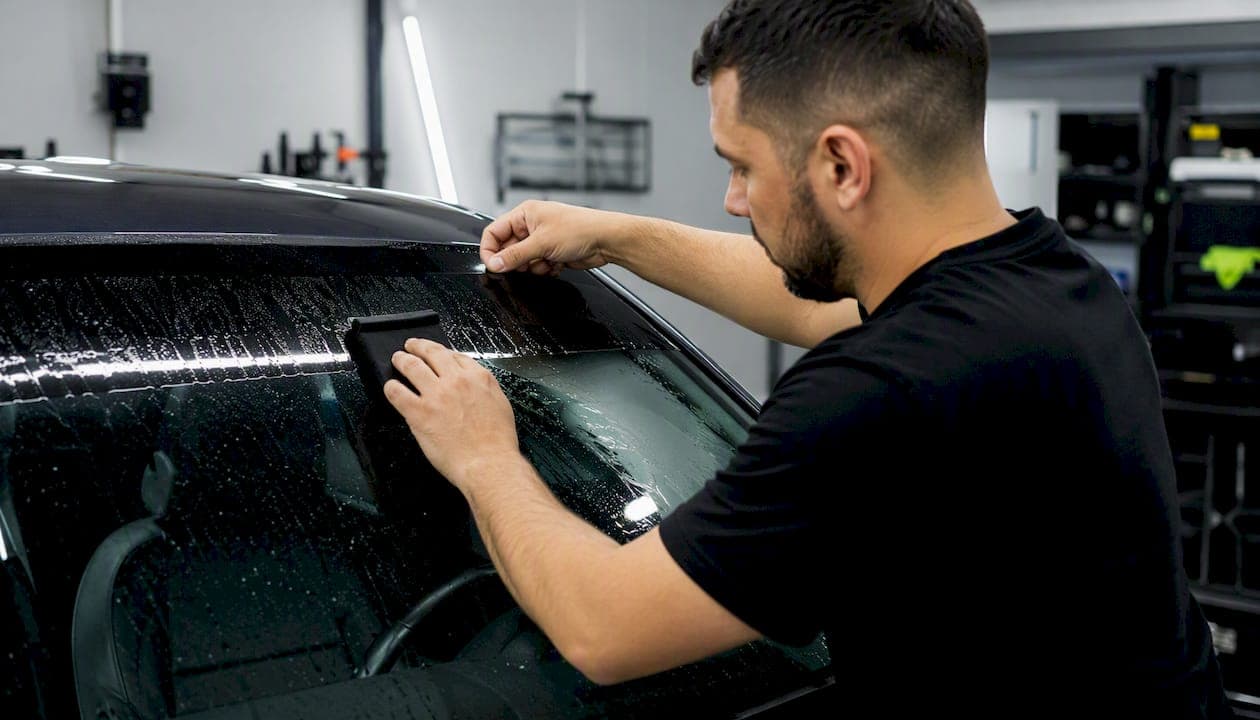
A windshield tint strip, also called a visor strip or eyebrow tint, is the fastest and most affordable way to cut high-angle glare from the sun without touching the rest of your glass. For most commuters dealing with sunrise or sunset glare, a precut ceramic strip installed above the AS-1 line is the right call. If your problem is broader cabin heat, full-windshield privacy, or a curved EV windshield with embedded sensors, skip the strip and book a professional install instead.
When a visor strip makes sense:
- You face direct sun glare at the top of your windshield during morning or evening commutes
- Your budget is tight and you want a quick, reversible upgrade
- You want to preserve full nighttime visibility across most of your glass
- You drive in a hot, sunny climate and want UV protection for your dash
When to skip the strip and go bigger:
- Glare or heat affects your whole windshield, not just the top few inches
- You want cabin-wide heat rejection or interior privacy
- Your windshield has significant curvature or embedded cameras (common on Teslas and newer EVs)
- State regulations in your area restrict strip placement or VLT
Pro Tip: Before buying anything, locate the AS-1 line etched into your windshield's edge. Every state that allows a visor strip ties its legality to that line. If you can't find it, measure 5 inches down from the top of the glass — that's the common fallback most installers use.
Key Takeaways
| Point | Details |
|---|---|
| Strip vs. full tint | A visor strip targets top-of-windshield glare; full tint handles cabin-wide heat and privacy. |
| Legal placement | Always install above the AS-1 line; check your state DMV for height and reflectivity rules. |
| Best VLT range | 35%–50% VLT balances daytime glare reduction with safe nighttime visibility. |
| Ceramic over PET | Ceramic film offers stronger UV and IR rejection with no signal interference for cameras or GPS. |
| Tintandwrapscustoms | Professional installation with a manufacturer-backed warranty, climate-controlled facility, and Tesla/EV expertise in Van Nuys, CA. |
Table of Contents
- What is a windshield tint strip, and what types are available?
- What are the real benefits and limitations of a visor strip?
- Visor strip vs. full windshield tint: which one solves your problem?
- How do you choose the right windshield tint strip?
- How to install a windshield tint strip yourself
- What VLT, size, and material should you choose?
- Is a windshield tint strip legal in your state?
- How long does a windshield tint strip last, and how do you maintain it?
- When does a visor strip fall short and full tint makes more sense?
- When should you hire a professional installer?
- An editorial perspective on strips vs. professional installs
- Get a professional windshield tint strip installed at Tintandwrapscustoms
- Sources
What is a windshield tint strip, and what types are available?
A windshield tint strip is a narrow band of window film applied across the top portion of a windshield to reduce glare and UV exposure from high-angle sunlight. You'll hear it called a visor strip, eyebrow tint, sun strip, or windshield banner depending on the shop or product listing. The function is the same regardless of the name: it acts like a built-in sun visor, blocking the slice of sky that your flip-down visor often misses.
Material types
The film itself comes in four main materials, and the difference matters more than most buyers realize:
- PET (polyester): The most common base for static-cling and wet-apply kits. Affordable, widely available, and easy to remove. Heat and UV rejection are modest compared to premium films.
- Ceramic: The top-tier choice. Ceramic particles embedded in the film reject infrared heat and block UV without metallic content, so there's no signal interference with GPS, radar, or dash cameras. Ceramic vs carbon tint is worth reading if you want the full material breakdown.
- Dyed/carbon: Mid-range pricing with better heat rejection than plain PET. Carbon films resist fading longer than dyed-only films. Neither matches ceramic for raw UV and IR performance.
- Metallic: Strong heat rejection but causes radio, GPS, and toll-transponder interference. Most shops and EV owners avoid these.
Installation styles
- Adhesive: Permanent bond, cleaner look, requires careful alignment before contact.
- Static-cling/wet-install: Applied with a soapy water solution that lets you reposition the film before it sets. Easier for DIYers, but adhesion is lighter long-term.
- Precut kits: Sized to common windshield widths and shipped ready to apply. Rvinyl's precut visor strips come in multiple VLT shades and multi-height kits, which reduces waste and improves fit across different windshield profiles.
- Custom shop-cut: A professional measures and cuts film to your exact glass dimensions. Best fit, especially for curved or unusually wide windshields.
Inside application is the standard. Film applied to the interior surface is protected from weather, road debris, and UV degradation, and it stays cleaner longer.
VLT shade labels
VLT (Visible Light Transmission) tells you how much light passes through the film. Lower numbers mean darker film:
- 5% VLT: Very dark, sometimes called "limo tint." Severely limits visibility, especially at night.
- 20% VLT: Dark but manageable in daylight. Risky for nighttime driving.
- 35% VLT: A popular middle ground. Noticeable glare reduction without dramatically cutting night visibility.
- 50% VLT: Light tint. Subtle glare reduction, minimal visibility impact.
What are the real benefits and limitations of a visor strip?
The pitch for a windshield tint strip is straightforward: it blocks the band of sunlight that hits you at eye level during low-sun hours, and it does it cheaply. The limitations are just as real, and ignoring them leads to buyer's remorse.
Benefits
- Glare reduction at high sun angles: The strip targets exactly the zone where morning and evening sun enters your line of sight. A flip-down visor blocks your view of the road; the strip doesn't.
- UV protection: Quality ceramic strips block a significant portion of UV radiation, which protects your eyes, your dash, and any exposed interior surfaces. MotoShield Pro's nano-ceramic precut sunstrips advertise up to 99% UV rejection — that's a manufacturer claim, but ceramic films consistently outperform dyed and PET alternatives on UV blocking.
- Lower top-of-windshield heat: Even a narrow strip reduces the solar load entering through the top of the glass, which can make a difference on a parked car in direct sun.
- Low cost and quick install: A precut kit from a retailer like Gila costs a fraction of a full tint job. The Gila Windshield Glare Strip Kit is a 10 in. × 6.5 ft. roll that includes cutting tools and application spray, making it genuinely DIY-friendly.
- Styling: The eyebrow effect gives the front of a car a more aggressive, finished look. Shops in sunny regions often position it as a fast, high-value visual upgrade.
Limitations
- Narrow coverage: A 6–8 inch strip covers maybe 10–15% of your total windshield area. If heat or glare is a cabin-wide problem, a strip won't fix it.
- Night visibility: Darker VLT choices (5%–20%) reduce how much light reaches your eyes at night. This is a real safety concern, not just a legal one.
- Legal risk if placed incorrectly: A strip installed below the AS-1 line in a state that prohibits it can fail inspection or earn a fix-it ticket.
- Common mistakes that make things worse: Film that's too tall creeps into your primary sightline. Reflective or colored films violate most state rules. A strip installed on the outside of the glass degrades faster and is more likely to peel.
Pro Tip: Tesla and EV owners should pay extra attention to VLT and material choice. Cameras and sensors mounted near the top of the windshield can be affected by film placement. A ceramic, non-metallic strip installed by a shop with Tesla-specific experience is the safest route.
Visor strip vs. full windshield tint: which one solves your problem?
| Feature | Visor/Eyebrow Strip | Full Windshield Tint |
|---|---|---|
| Glare at high sun angles | Excellent | Good |
| Cabin-wide heat rejection | Minimal | Strong |
| Night visibility impact | Low (if 35%–50% VLT) | Moderate (depends on VLT) |
| Coverage area | Top 6–10 inches only | Entire windshield |
| Installation complexity | Low (DIY-friendly) | Moderate to high |
| Legal risk | Low if above AS-1 line | Higher; many states restrict full tint |
| Typical cost range | $15–$50 DIY; $50–$150 pro | $50–$150 pro install |
| Removal/replacement | Easy | More involved |
The strip wins on simplicity, cost, and legal safety. Full windshield tint wins on heat rejection and uniform coverage. Neither is universally better.
Who should pick a strip:
- Commuters with a predictable glare window (sunrise eastbound, sunset westbound)
- Drivers who want a quick, reversible upgrade without touching the rest of their glass
- Anyone on a tight budget who still wants UV protection at the top of the windshield
Who should pick full tint:
- Drivers in extreme heat climates where the whole cabin bakes
- Anyone who wants privacy or a uniform exterior look
- EV owners who want comprehensive dash and sensor protection handled by a professional
How do you choose the right windshield tint strip?
Getting this right comes down to five decisions made before you buy anything.
- Decide your VLT target. For balanced daytime glare reduction without hurting nighttime visibility, 35%–50% VLT is the practical range. Go darker only if you rarely drive at night and your state allows it above the AS-1 line.
- Choose your material. Ceramic is worth the extra cost if you want real UV and IR rejection. Dyed or carbon films work for pure glare reduction on a budget. Avoid metallic films if you have a GPS, toll transponder, or dash cameras.
- Measure before you order. Measure the width of your windshield across the A-pillars. Check the height from the top of the glass to the AS-1 line. Most precut kits are designed for common widths, but height varies by vehicle.
- Precut vs. trim-to-fit. Precut kits save time and reduce cutting errors. Trim-to-fit rolls give you more flexibility for unusual windshield shapes. If you're not confident with a razor blade and a straight edge, buy precut.
- Inside vs. outside application. Inside is standard. Outside application degrades faster and is more vulnerable to damage. If a product listing only shows outside application, look elsewhere.
Red flags when shopping:
- No VLT percentage listed anywhere on the product page
- Film described as "reflective" or sold in bright colors (red, blue, gold)
- No installation instructions or warranty information
- Seller actively discourages checking the AS-1 line
Questions to ask an installer before booking:
- What exact VLT will you use, and can I see a sample?
- Is the installation done in a climate-controlled environment?
- What does your warranty cover, and for how long?
- Have you installed strips on Teslas or vehicles with top-mounted cameras?
- What's your removal policy if I'm not satisfied?
When the windshield has significant curvature, embedded heating elements, or cameras near the top edge, professional installation isn't optional — it's the only way to guarantee a clean result and a valid warranty.
How to install a windshield tint strip yourself
Inside application, clean glass, careful positioning, wet-apply or adhesive bond, squeegee, trim, cure. That's the sequence. If any step sounds uncertain, book a shop.
What you'll need
- Application spray (soapy water or a dedicated tint solution)
- Squeegee or hard card
- Microfiber towels
- Razor blade or trimming tool
- Heat gun (only if the film needs shrinking to conform to a curved surface)
- Tape measure and marker
Step-by-step installation
- Clean the glass thoroughly. Any dust, oil, or debris trapped under the film will create bubbles that don't go away. Use a lint-free microfiber cloth and a glass cleaner that leaves no residue. Work in shade or indoors.
- Locate and mark the AS-1 line. Find the etched line on your windshield's edge. Mark its position lightly with a dry-erase marker so you know your upper boundary.
- Measure and cut the film. Measure the width across your windshield at the point where the strip will sit. Cut the film to width, leaving a small margin you'll trim after application.
- Wet the glass. Spray the interior glass surface generously with your application solution. This gives you time to reposition the film before it bonds.
- Peel and position the film. Peel the liner from the film, wet the adhesive side lightly, and lay the film against the wet glass starting from the center and working outward. Keep the top edge flush with the top of the glass or the AS-1 line, depending on your state's rules.
- Squeegee out the water. Work from the center toward the edges using firm, overlapping strokes. Remove all water and air pockets. Take your time here — this step determines whether you get bubbles.
- Trim the edges. Use a sharp razor blade to trim any overhang along the sides and bottom edge. A dull blade drags and tears the film.
- Wipe and inspect. Dry the edges with a microfiber cloth and check for lifted corners or remaining bubbles. Small water bubbles under the film often disappear during curing.
- Allow to cure. Don't roll down windows or clean the glass aggressively for at least 48–72 hours. Window tint curing time varies by film type, climate, and whether the car sits in sun or shade during the cure period.
The Instructables windshield tint brow guide documents the wet-apply method in detail, including common trimming mistakes that cause lifting at the edges.
Common mistakes to avoid:
- Installing on a dirty or cold windshield (bubbles and poor adhesion)
- Cutting the strip too tall so it drops below the AS-1 line
- Using reflective or colored film that violates state rules
- Skipping the squeegee step and hoping bubbles self-resolve (they don't)
- Rushing the cure and cleaning the glass within 24 hours
Pro Tip: Small hazy water bubbles right after installation are normal. They disappear as the film cures and moisture evaporates. Large air bubbles with a defined edge are a different problem — those need to be lifted and re-applied before the adhesive fully sets.
Safety note: If the film shifts during installation and covers any part of your primary sightline, stop. Peel it off and start over or take the car to a shop. A misaligned strip is a visibility hazard, not just a cosmetic issue.
What VLT, size, and material should you choose?
How to measure your windshield
Measure the full width of the glass at the point where the strip will sit, typically just below the top edge. Then measure the distance from the top of the glass down to the AS-1 line. That second measurement is your maximum safe height. Most visor strips run 4–8 inches tall; staying at or below 6 inches keeps you safely above the AS-1 line on most vehicles.
Precut dimensions and trim-to-fit
Gila's Windshield Glare Strip Kit is sold as a 10 in. × 6.5 ft. roll with cutting tools included, designed for trim-to-fit application. Precut kits from vendors like Rvinyl ship sized to common windshield widths and offer multi-height options so you can match the strip to your specific glass profile without guesswork.
VLT guide
| VLT | Visible Effect | Best Use Case |
|---|---|---|
| 5% | Very dark, near-opaque | Not recommended for driving |
| 20% | Dark, noticeable tint | Daytime-only, check state rules |
| 35% | Medium tint, clear at night | Best balance for most drivers |
| 50% | Light tint, subtle effect | Mild glare, maximum visibility |
Material performance
Ceramic film is the clear leader for heat and UV rejection. MotoShield Pro's nano-ceramic precut sunstrips claim up to 99% UV rejection (manufacturer claim), and ceramic films consistently outperform dyed and carbon alternatives in independent heat-rejection comparisons. Critically, ceramic is non-metallic, so it won't interfere with GPS signals, radar detectors, or the cameras common on modern EVs. For a deeper look at how ceramic compares to carbon on heat rejection performance, the difference in real-world cabin temperature is meaningful.
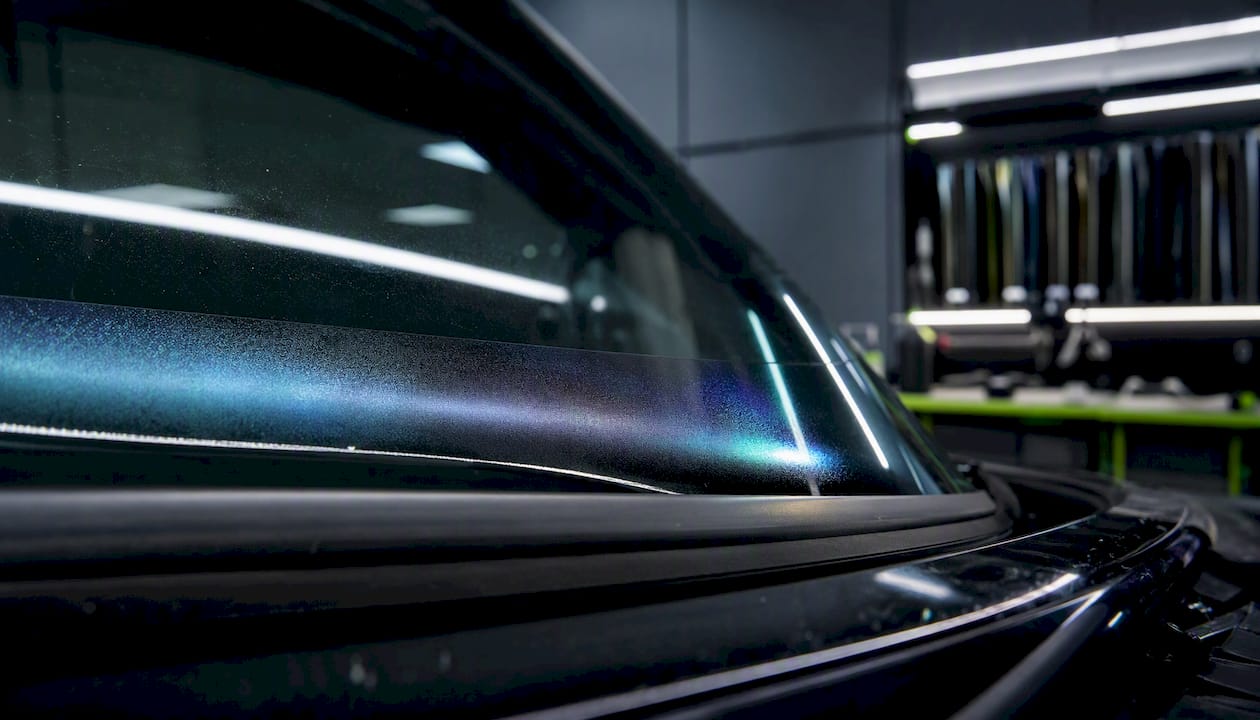
Dyed and carbon films cost less and still reduce glare effectively. They're a reasonable choice if UV and IR rejection aren't your primary goals. PET static-cling films are the most DIY-friendly but offer the least performance and the shortest lifespan.
Is a windshield tint strip legal in your state?
The short answer: it depends on your state, and you need to check before you buy. RealTruck's state-by-state guide confirms that many states allow a non-reflective strip above the AS-1 line, but maximum height, permitted colors, and reflectivity limits vary widely.
What the AS-1 line means
The AS-1 line is an etched marking on the edge of your windshield, placed by the manufacturer to indicate the boundary above which tinting is generally permitted. Film installed below this line enters your primary driving sightline, which is why most states prohibit it. If your windshield doesn't have a visible AS-1 marking, the common fallback is 5 inches from the top of the glass — but confirm this with your state DMV before relying on it.
Common state restrictions to know
- Maximum strip height: Many states cap the strip at the AS-1 line or a fixed measurement (often 5–6 inches from the top). Texas, for example, requires eyebrow film to stay above the AS-1 line and prohibits reflective films and certain tint colors.
- Reflective and colored films: Most states ban metallic, mirrored, or brightly colored films on any part of the windshield, including the visor strip.
- Medical exemptions: Some states allow darker tint for medical reasons, but these exemptions typically apply to side and rear windows, not windshield placement rules. Don't assume a medical exemption lets you install a strip below the AS-1 line.
How to verify your state's rules:
- Search your state's DMV website for "window tint laws" or "windshield tint regulations"
- Look for the specific windshield section, not just the side-window VLT table
- Ask your installer to confirm placement before they cut the film
- Keep any medical exemption documentation in the vehicle if applicable
Pro Tip: Enforcement varies by jurisdiction. A strip that passes inspection in one county may draw a citation in another. When in doubt, keep the strip above the AS-1 line and use a non-reflective film — that combination is legal in the vast majority of states.
How long does a windshield tint strip last, and how do you maintain it?
Cleaning do's and don'ts
- Do wait the full curing period before cleaning the glass. Most films need 48–72 hours minimum; ceramic films in cold climates may need longer.
- Do use a soft microfiber cloth and an ammonia-free glass cleaner. Ammonia degrades the adhesive on many film types over time.
- Don't use abrasive pads, paper towels, or any cleaner with alcohol as the primary solvent.
- Don't use automatic car washes with stiff brushes during the first two weeks after installation.
Expected lifespan by material
Ceramic films typically last 10 years or more when properly installed and maintained. Carbon and dyed films generally run 5–7 years before fading or adhesive failure becomes noticeable. PET static-cling films have the shortest lifespan, often 2–4 years, particularly in high-UV climates like Southern California, Arizona, or Texas. Frequent car washes, improper cleaning chemicals, and installation in non-climate-controlled environments all shorten lifespan regardless of material.
What warranties cover
Manufacturer-backed warranties typically cover bubbling, delamination, and color fading for a defined period. Installer warranties cover workmanship issues like lifting edges or misalignment. The two are different, and you want both. A window tint warranty from a reputable shop will spell out exactly what's covered, for how long, and what the removal and replacement process looks like.
Pro Tip: Keep your warranty paperwork in the glove box. If you sell the vehicle, a transferable warranty is a genuine selling point — and some manufacturer-backed warranties are transferable to the next owner.
When does a visor strip fall short and full tint makes more sense?
A strip is a targeted fix. When the problem is bigger than the top of your windshield, the strip won't keep up.
Situations where full windshield tinting is the better call:
- Heat enters through the whole windshield and makes the cabin uncomfortable regardless of the sun's angle
- You want privacy or a uniform tinted appearance across the front of the vehicle
- Your entire dash, seats, or interior surfaces are fading from UV exposure
- Glare reflects off the whole glass surface, not just the top band
- You want a single professional solution that covers everything in one appointment
Decision factors:
- Climate: Extreme heat climates (Phoenix, Las Vegas, the San Fernando Valley in summer) push toward full tint for meaningful cabin temperature control.
- Budget: Full windshield tint costs significantly more than a strip. If budget is the constraint, a ceramic strip now and full tint later is a reasonable sequence.
- Legal environment: Full windshield tint faces stricter restrictions in most states. A strip above the AS-1 line is almost always the legally safer choice.
- Windshield complexity: Heavily curved glass or windshields with embedded heating elements, antennas, or cameras require professional handling regardless of how much of the glass you're covering.
Alternatives worth considering: A quality windshield sunshade handles parked-car heat better than any film. Polarized driving glasses cut glare without touching the glass at all. For many drivers, the best solution is a ceramic visor strip plus a sunshade for parking — covering both the driving and parked scenarios without the legal complexity of full windshield tint.
When should you hire a professional installer?
Hire a pro when the margin for error is low. Complex windshield curves, AS-1 line uncertainty, embedded sensors, or a desire for a manufacturer-backed warranty all tip the decision toward a shop.
What a reputable shop provides that a DIY kit can't:
- Precise AS-1 line placement confirmed before cutting
- Climate-controlled installation that eliminates dust contamination and adhesion problems caused by temperature swings
- Manufacturer-backed warranties that cover bubbling, delamination, and fading
- Trained handling of Tesla and EV windshields, where camera placement and sensor zones require exact film positioning
- Documented experience across hundreds or thousands of vehicles
Before you book, ask:
- How many vehicles have you installed tint on? (Over 1,000 is a meaningful benchmark.)
- Do you offer a manufacturer-backed warranty, and what does it cover?
- Is your installation space climate-controlled?
- What's your process for windshields with embedded cameras or sensors?
- What's your curing guidance and aftercare policy?
Pro Tip: A shop that can't answer the warranty and camera questions clearly isn't the right shop for a modern vehicle. Those aren't edge-case questions — they're standard for any car built after 2018.
An editorial perspective on strips vs. professional installs
The conventional wisdom says a visor strip is "just a DIY product" and professional installation is for serious tinting jobs. That framing misses something.
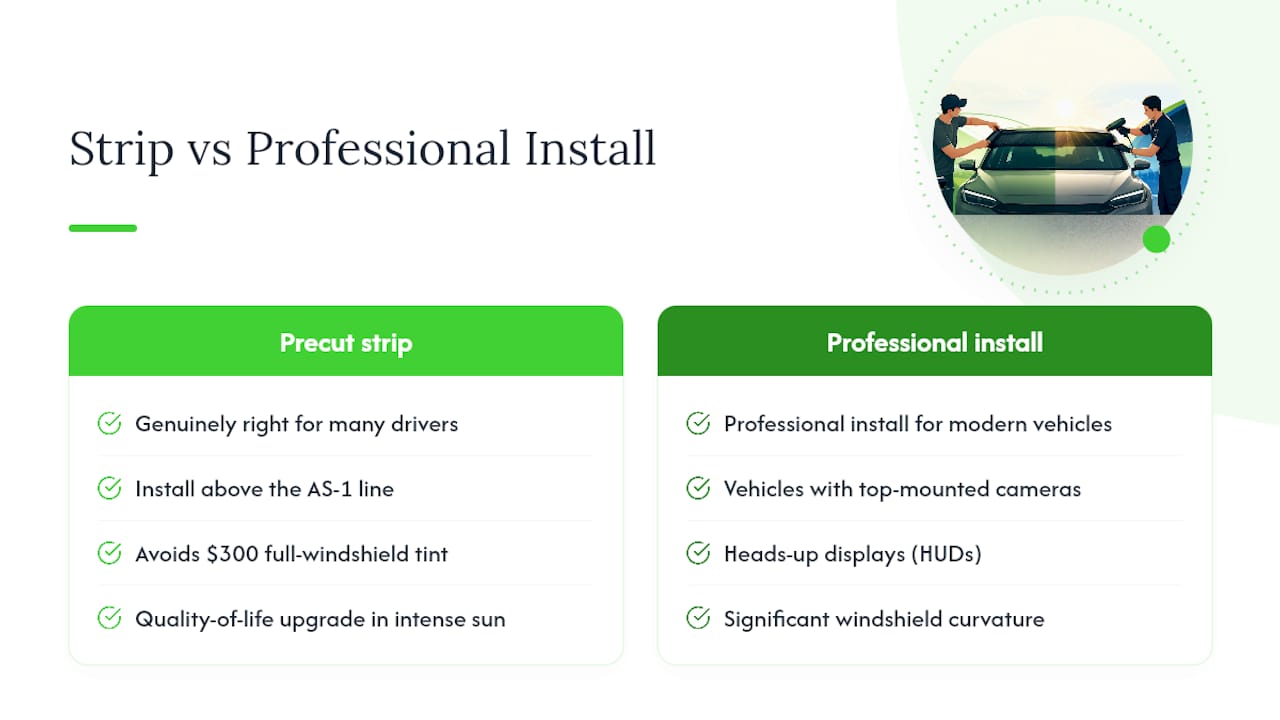
A precut ceramic strip installed correctly above the AS-1 line is genuinely the right answer for a large share of drivers. A commuter who faces sunrise glare on an eastbound highway every morning doesn't need a $300 full-windshield tint job.
Where the DIY-first instinct goes wrong is on modern vehicles. A 2022 Tesla Model 3, a Ford F-150 with a heads-up display, a Subaru with EyeSight cameras mounted at the top of the windshield — these aren't the same as a 2008 Civic. The film placement tolerance is tighter, the consequences of a misaligned cut are higher, and the warranty question matters more. For those vehicles, the strip is still often the right product, but the installation should be professional.
The other underrated factor is climate. A driver in Minneapolis who faces glare three months a year has a different calculus than someone in the San Fernando Valley who deals with intense sun year-round. For the latter, a ceramic strip is a genuine quality-of-life upgrade, not just a cosmetic choice. The UV load in Southern California is high enough that even a narrow strip makes a measurable difference in how quickly a dash fades.
My recommendation pattern: precut ceramic strip for most commuters with a defined glare problem; professional install for any vehicle with top-mounted cameras, significant windshield curvature, or an owner who wants a warranty they can actually use.
Get a professional windshield tint strip installed at Tintandwrapscustoms
Drivers in the San Fernando Valley who want a visor strip done right the first time have a clear option in Van Nuys.
Tintandwrapscustoms installs windshield tint strips and full window tint packages in a climate-controlled facility, which means no dust contamination, no adhesion failures from temperature swings, and a finish that holds up. Every installation comes with a manufacturer-backed warranty covering bubbling, delamination, and fading. The shop has protected over 1,000 vehicles and holds a 5-star customer rating, with specific expertise in Tesla and EV installations where camera and sensor placement requires precision that a DIY kit simply can't guarantee.
To book your appointment or ask about VLT options and pricing, visit Tint & Wraps Customs and schedule directly. Bring your vehicle's make, model, and year, and the team will confirm the right strip height, VLT, and material for your windshield before any film is cut.
Sources
Use these to verify state rules, compare product specs, and follow DIY steps before buying or booking.
This article is general information, not a substitute for advice from a qualified lawyer. Consult a qualified legal professional about your own circumstances before acting on anything here.