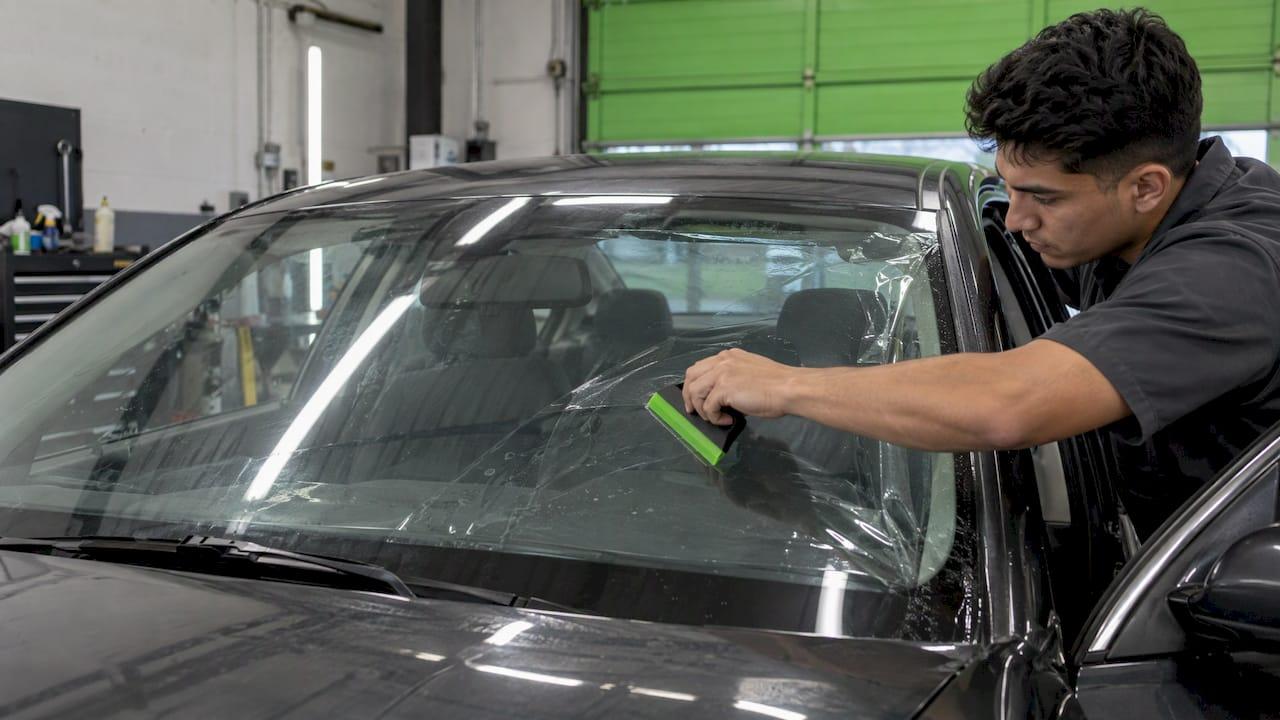
Windshield glare film can take the edge off harsh daytime sun, but it will not erase glare, and it is not a fix for oncoming headlights at night. The legal way to do it is a clear, light-colored film that keeps the windshield bright, plus proper tint on the side and rear windows. Anything dark across the driver's view is both unsafe and, in most states, illegal.
This guide covers what "anti-glare" really means, what federal and state rules allow, how night driving changes the picture, and what to ask before anyone puts film on your glass.
TL;DR
- No film eliminates glare. Good film controls visible light and heat, and works best on bright sun, not on headlights at night.
- Federal safety rules require at least 70% light transmittance in the glass areas needed for driving visibility, so a windshield film has to be clear and light.
- States differ on how much of the windshield you can tint. Most allow a strip across the top, and some allow clear UV film over the whole glass.
- Dark or tinted films hurt night vision. For night glare, clean glass, correct headlight aim and good driving habits matter more than film.
- On a Tesla or any car with sensors and antennas, use non-metallic film from an installer who knows where the cameras sit.
Table of Contents
- What "anti-glare" film actually means
- What the law allows on a windshield
- Will it help at night?
- What actually reduces headlight glare
- Where film does help: sun, heat and UV
- Tesla and EV owners: sensors and signals
- Questions to ask before you buy any glare film
- Perspective
- Get it done right in Van Nuys
- FAQ
- Sources
What "anti-glare" film actually means
Shoppers type "anti glare tint," "glare reduction window film" and "anti-glare windshield film" as if they were one product. They are not. Three different optical problems get lumped under the one label:
- Glare: bright light, usually low sun or reflections off other cars and wet roads, that makes seeing uncomfortable or hard.
- Haze: a cloudy look caused by light scattering as it passes through the film. Low-quality film can have it. It makes the view worse, not better.
- Internal reflection: your dashboard or screen reflecting on the inside of the glass. This is a different issue from sun glare, and a film that fixes one does not automatically fix the other.
So when a product says "anti-glare," ask which of these it addresses. A film can look clear and still show reflections of a light-colored dash.
The International Window Film Association (IWFA) says automotive window film brings several benefits: improved appearance, solar heat reduction, UV protection, glare control and safety. It describes glare control as possibly the most beneficial property. It also explains that glare control is almost exclusively a function of visible light. In plain terms: the less visible light a film lets through, the less glare you get. That is exactly why the windshield is a special case. You cannot cut visible light there the way you can on a rear window.
Glare film versus windshield protection film
The two get confused in search results. Windshield protection film is a clear, thick layer applied to the outside of the glass to absorb rock chips and road debris. Its job is impact resistance. Glare film is applied to the glass to manage light, and it is thinner and optically tuned. A product built for one is not a substitute for the other, so be clear about which problem you are solving before you book anything.
What the law allows on a windshield
This is the part that decides what you can actually do, so start here.
The federal baseline
The National Highway Traffic Safety Administration (NHTSA) explains that Federal Motor Vehicle Safety Standard 205 requires at least 70 percent light transmittance in the glazing areas needed for driving visibility. In passenger cars that covers all windows. In trucks and buses it covers the windshield and the immediate side windows. NHTSA also says no manufacturer or dealer may install film on new-vehicle glazing unless the vehicle still meets that 70% minimum.
The practical meaning: whatever goes on a windshield must be very light. A dark "sun strip" over the driver's view is not a glare solution. It is a ticket.
The AS-1 line and the top strip
Look closely at the upper corners of your windshield. You may see small markings and the letters AS-1. The IWFA notes the AS-1 area of the windshield has the highest visibility standard under FMVSS 205, while the top few inches and all windows behind the driver and front passenger are classed AS-3, with much looser limits.
Most states build their windshield rules on that idea: tint is allowed in a band at the top, above the AS-1 line or within a set number of inches from the roof edge, and nothing darker across the main field of view.
How states differ
Rules vary, so check your own state's agency before you buy. Texas is a useful example of how specific they get. The Texas Department of Public Safety says windshield sunscreening must sit above the AS-1 line (or stop five inches below the top if there is no line), cannot be red, amber or blue, and must meet set transmittance and reflectance limits. It also allows a clear UV film anywhere on the front windshield without a medical exemption.
Other states follow different numbers. Two points hold nearly everywhere:
- Reflective or mirror-like film is restricted on the windshield.
- Colored film in red, amber or blue tones is a common no-go.
The IWFA also points out that most state laws judge the net VLT, meaning film plus the glass, because the film alone is almost impossible to measure after installation. Tolerances average about 5% but can run from 3% to 7%. Factory glass is not perfectly clear, so a film that sounds legal on paper can fail on your car. Our guide to tinting over privacy glass and net VLT walks through the math.
If you live in California, we cover the details in Windshield Tint in California and California Window Tint Laws. Our shop is in Van Nuys, so those are the rules we work with every day.
Will it help at night?
Here is the honest answer: probably not, and the wrong film will make it worse.
The American Academy of Ophthalmology warns that lenses made to limit the light reaching your eye make it harder to see at night, not easier, because your eyes need to adapt to darker conditions along with fast-changing light. The same logic applies to anything darkening your windshield. Less light in means less information about the road, pedestrians and dark objects.
That is why 70% is the line for driving glass. It is also why we steer people toward lighter choices on the front half of the car. If you are comparing shades for the side windows, our breakdown of 70% vs 50% tint and night visibility shows how the numbers change what you see after dark.
A few signs a film is a bad fit for night driving:
- A visible color cast, especially strong blue or green.
- Uneven tone, streaks or distortion when you look through it.
- A cloudy or hazy look around streetlights, which usually means scatter.
- Halos or double images around oncoming lights.
If any of those show up, the film is working against you.
What actually reduces headlight glare
Most complaints about glare at night come from bright headlights, particularly high, bluish LED lamps on trucks and SUVs. Film is the wrong tool for that. AAA recommends habits and basics instead: don't stare into oncoming headlights, keep your eyes on the right shoulder, and keep the windshield clean. AAA adds that adaptive driving beam headlights, which reduce glare for other drivers, are not yet widely available in the US despite a 2022 NHTSA ruling allowing them.
A short checklist that costs almost nothing:
- Clean the inside of the windshield. Interior haze from plastics and vapor scatters oncoming light into starbursts. It is the most overlooked cause.
- Replace worn wipers so the outside stays streak-free in rain.
- Set the rearview mirror to night mode to knock down lights from behind.
- Get your own headlights aimed properly, so you are not the glare for someone else.
- Have your eyes checked if night glare has suddenly gotten worse. Cataracts and dry eyes can both cause it, and an eye doctor is the right person to sort that out.
Where film does help: sun, heat and UV
Daytime is where good window film earns its keep. Low sun on a commute, bright reflections off hoods and a hot dashboard are all easier with film on the windows that are allowed to carry it. The IWFA says UV control matters because UV effects on skin and eyes are cumulative, and because interior fabrics and panels fade.
A practical setup for most drivers:
- Windshield: a clear, legal film or, where your state restricts it, just the allowed top strip.
- Front side windows: a light ceramic film that stays inside your state's VLT limit.
- Rear side and back glass: darker film, where your state permits, for privacy, heat and glare from behind.
If you want UV protection without a dark look, read our piece on clear ceramic tint. For the bigger picture of what film does for a car, see Window Tint Benefits.
Tesla and EV owners: sensors and signals
Modern cars pack cameras, rain sensors, antennas and driver-assistance hardware around the windshield. Film near those areas needs care. The IWFA notes that many vehicles have the antenna built into the glass, and that films with high electrical conductivity can interfere with radio or mobile signals. In those cases it advises a non-metallic film, and it warns that some dealers and manufacturers may void the warranty on certain electronics if conductive film is installed.

For that reason we install non-metallic films on EVs, and we work around camera housings and sensor zones instead of covering them. Our post on non-metallic tint and signal safety explains the difference. Before any film goes near a windshield, tell your installer which driver-assistance features your car has, and where its cameras and sensors sit.
Questions to ask before you buy any glare film
Whoever installs it, run through these:
- Is it legal in my state for this specific glass? Ask for the net VLT with your glass, not just the film's rating.
- What optical problem does it control? Glare, haze, or internal reflection? A good installer can answer in one sentence.
- Is it non-metallic? This matters for GPS, toll tags, cellular and radio, and for EV sensors.
- What does the warranty cover? Look for a manufacturer-backed warranty and for what it says about bubbling, peeling and discoloration.
- Where is it installed? Dust is the enemy of a clear film. A clean, controlled bay gives a cleaner result than a driveway or parking lot.
- Do I get paperwork? In some states you need to carry a certificate from the installer or film maker.
The question about haze is the one most buyers miss. A film can be low-haze and still show dash reflections, and cutting reflections does not automatically mean less haze. Ask to see the film on a sample of glass, in daylight, before you commit.
Perspective
Most people who call us about glare are really asking for one of two things: they want the sun to stop hurting their eyes on the drive, or they want to see better at night. Film can help with the first. It cannot honestly promise the second, and we would rather tell you that than sell you a shade that makes night driving worse.
Our approach is to put the right film on the right glass. We install carbon and ceramic window tint for the side and rear windows, where it cuts heat, UV and daytime glare. For the front, we keep things light, clear and inside the law, because that is where visibility matters most.
Quality of install matters as much as the film. Our facility is climate-controlled and dust-free, so there are no specks trapped under the film and no distorted edges. We also do a lot of Tesla and EV work, which means we plan around cameras, sensors and antennas from the first measurement.
If you are not sure what suits your car, bring it in. We will tell you what we would put on it, and what we would leave alone.
Jake
Get it done right in Van Nuys
If you drive in the San Fernando Valley, you know how hard the sun hits in the afternoon. Our window tinting service covers carbon and ceramic films, tint removal for old, purple or bubbling film, and installs backed by manufacturer warranties. We have protected more than 1,000 vehicles, and Tesla and EV installs are a specialty.
Tell us the car, the state it is registered in and what bothers you most about the glare, and we will recommend a setup. If the glare is coming from your own headlights or taillights, our headlight and taillight tinting is a separate service worth asking about.
FAQ
Is there a film that removes windshield glare completely?
No. Film can reduce visible light and some reflections, but glare comes from the sun, headlights, wet roads and other sources, and no product removes all of it. The best results come from the right film on the right windows, plus a clean windshield and good habits.
Is anti-glare tint legal on the windshield?
Only in limited forms. Federal safety rules call for at least 70% light transmittance in areas needed for driving visibility, and most states restrict windshield tint to a strip at the top. Some states allow clear UV film across the whole glass. Check your state agency's current rules, or ask us about California's.
Will glare film help me see better at night?
Generally no. Anything that reduces the light reaching your eyes makes night driving harder, and the American Academy of Ophthalmology says the same about darkened lenses. For night glare, clean the inside of the glass, check your wipers and mirror settings, and see an eye doctor if it has changed recently.
Can window film interfere with a Tesla's cameras or my phone signal?
Metallic or highly conductive films can interfere with signals passing through glass that contains antennas. A non-metallic film avoids that, and a careful installer will keep film clear of camera and sensor areas. Tell the shop which features your car has before the job starts.
Sources
- NHTSA Interpretation 2526y: FMVSS 205 light transmittance
- Texas DPS: Window Tinting Standards
- IWFA Automotive Education Guide (2026)
- IWFA Automotive Education Guide (2024)
- American Academy of Ophthalmology: Night Driving Glasses May Hurt, Not Help
- AAA: Why Headlights Seem So Bright and What Drivers Can Do