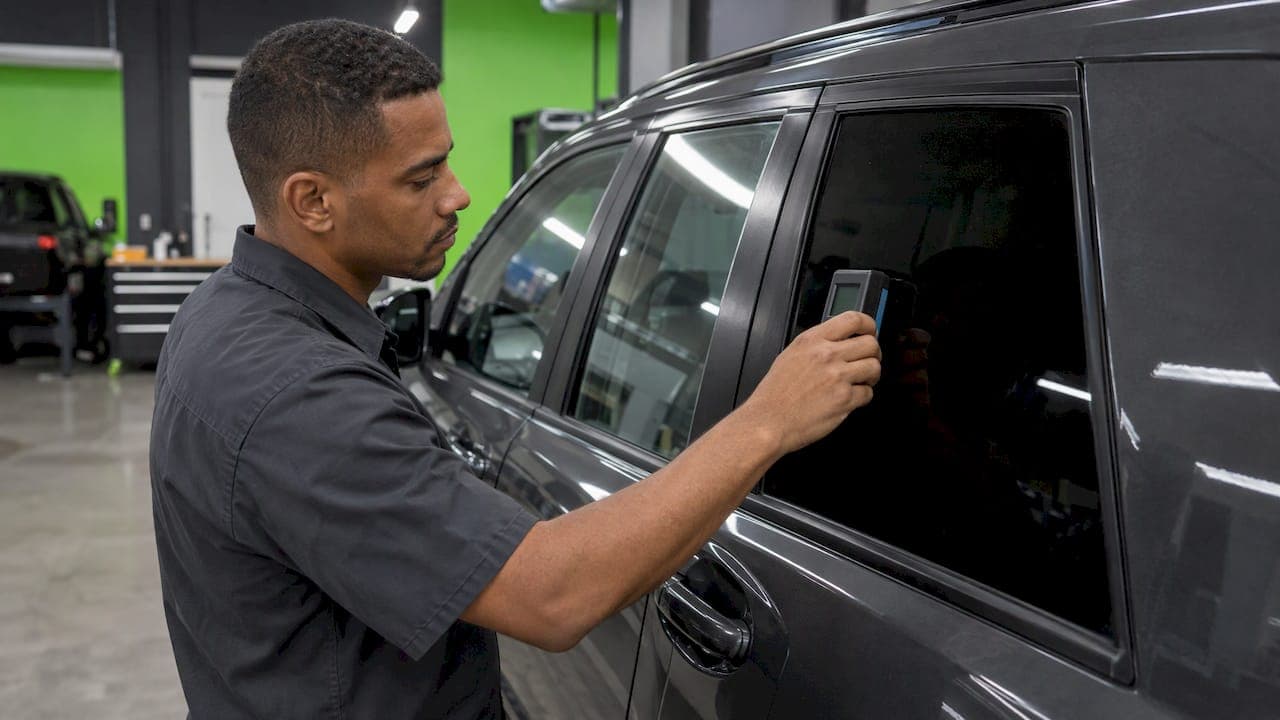
Yes, you can tint over factory privacy glass. A professionally installed film goes on the inside of the glass and works with the dark glass instead of replacing it. The catch is math: the two layers multiply, so the final window is always darker than the film's label. Pick the film by the number you want after both layers, not by the number on the box.
This guide explains what privacy glass is, how to calculate the finished darkness, which films make sense over it, what the law says, and what to ask for at the shop.
TL;DR
- Film can be applied over factory privacy glass. It adds UV and heat control that the dark glass alone does not give you, and it evens out the look between front and rear windows.
- Darkness multiplies. 20% privacy glass plus a 50% film measures about 10% net, and even a 70% film over it lands near 14%.
- Legal limits apply to the combined reading. Front side windows are the usual trouble spot, and rules differ by state.
- For most owners, a light ceramic or clear-style film on the rear glass keeps visibility and adds protection. Darker is rarely better over dark glass.
- Installation quality matters most on the rear window, where defroster lines make cutting and seaming a skilled job.
Table of Contents
- What privacy glass actually is
- What film adds over privacy glass
- How the math works: net VLT
- Choosing a shade over dark glass
- Is it legal? How states treat tint over privacy glass
- How to tell whether your glass is privacy glass or already filmed
- Installation: the rear window is where skill shows
- Perspective: why we put film over privacy glass
- What to ask before you book
- Tinting at Tint & Wraps Customs
- FAQ
- Sources
What privacy glass actually is
Privacy glass is the dark rear glass you see on many SUVs, trucks and minivans. It is not a film. Factory-tinted glass has dyes and pigments mixed into the glass during manufacturing, which darkens it and cuts some visible light. Because the color is inside the glass, you cannot peel it off, and it behaves differently from film.
Aftermarket window film is a different product. It is built from several layers of polyester film, including an adhesive layer, layers with metal particles, dyes and pigments, and a scratch-resistant top coat. That construction is why film can do things dyed glass cannot.
The key point for owners: dark does not mean protected. Privacy glass mainly reduces what people see into the cabin. The darkness of a window and its UV and heat performance are separate things. We cover the UV side in more depth in our post on why factory glass is not a UV shield.
What film adds over privacy glass
If the glass is already dark, why add anything? Three reasons come up again and again with our customers.
UV and fabric protection
The IWFA Automotive Education Guide notes that people spend many hours a day in their vehicles, that UV exposure is a concern for skin and eyes, and that interior fabrics and panels are prone to fading, which window film can help reduce. Rear passengers, including kids in car seats, sit behind that dark glass all day, so UV control there is not a cosmetic detail.
Film data shows how much is possible without going darker. One published spec sheet for a clear film made for factory privacy glass lists 77% visible light transmission, more than 99% UV protection across 300 to 380 nm, and 44 to 60% infrared energy rejection. A light ceramic film at 72% VLT is listed with 99% UV rejection, 68% IR rejection and 20% glare reduction, measured on 1/8 inch (3 mm) glass plates. Those are manufacturer figures for specific products, tested on clear glass, so real results on your vehicle will differ with the film and the glass.

Heat
Dyed glass absorbs some energy, but it is not built as a heat-rejection layer. Modern ceramic films are. If you want to understand how those numbers translate to a cooler cabin, our guide to heat rejection tint walks through TSER, IR rejection and what to look for.
A matched, finished look
Many trucks and SUVs ship with dark rear glass and very light front windows. The IWFA guide says film can remove that jarring side-view difference and make the vehicle look more balanced, with the roofline and body blending instead of splitting sharply. That is the main reason owners with dark rear glass still tint the fronts, and sometimes the rears too.
How the math works: net VLT
VLT means visible light transmission: the percentage of light that passes through. Film is rated on clear glass. Put it on tinted glass and you multiply the two numbers.
Here is the simple formula:
Net VLT = glass VLT × film VLT
Factory privacy glass on rear windows usually falls around 15 to 25% VLT, while clear automotive glass usually passes roughly 70 to 80%. Using 20% privacy glass as the example:
| Film over 20% glass | Calculation | Approx. net VLT |
|---|---|---|
| 70% | 0.20 × 0.70 | 14% |
| 50% | 0.20 × 0.50 | 10% |
| 35% | 0.20 × 0.35 | 7% |
| 20% | 0.20 × 0.20 | 4% |
The first two rows match the worked example in this explainer; the rest use the same arithmetic. Your glass may be 15% or 25%, so the real figure shifts. A shop with a meter can read your glass before you choose.
Two more details are worth knowing. Tint meters carry a tolerance of about two percentage points, so a 42% reading could be anywhere from 40 to 44%. And as that same page notes, the combined reading is always lower than the film's own rating.

Why a 5% result is rarely what people want
A net reading in single digits looks sleek in daylight. At night, backing up in a dim driveway or parking lot, it can make the rear glass nearly opaque from the inside. That is why the forum advice that ranks for this topic, like 50% over the factory rear glass, tends to land on light films. Our post on 70% vs 50% tint and night visibility explains the tradeoff in detail.
Choosing a shade over dark glass
Start with what you want the film to do.
You want protection and a clean look, without more darkness. Choose a light, high-performance film on the rear glass. A clear or near-clear ceramic keeps your rear visibility close to stock while adding UV and heat control. See our overview of clear ceramic tint for how it works.
You want the front and rear to match. Pick the front film first, based on what your state allows. Then choose a rear film that brings the back glass into the same family of color. Matching is about hue as much as darkness, which we explain in matching factory tint by hue, not VLT alone.
You drive a Tesla or other EV with sensors, antennas and a big glass roof. We recommend a non-metallic film so nothing interferes with signals. Our write-up on non-metallic car tint covers that, and our nano-ceramic tint post for EV owners goes into range and cabin heat.
You want maximum privacy. Your privacy glass already provides most of it. Adding a darker film gains little extra privacy for a large loss of visibility, and it may push you past legal limits on any window you tint at the front.
Is it legal? How states treat tint over privacy glass
The legal question is almost always about the net reading. The IWFA guide explains that most state laws set a net VLT requirement, combining the film and the glass, and that because film VLT is measured on clear glass, you need to know what the combination reads. Shops can check it with a hand-held meter.
The rules differ by window and by state. According to one state-by-state summary, most states require front side windows to allow at least 35% VLT, while some, including Georgia, Florida, Texas and New Mexico, allow darker front tint. New York, California and Pennsylvania require 70% on the front sides. That summary also reports that California, Texas, Arizona and about a dozen other states have no rear VLT minimum, as long as the vehicle has dual outside mirrors.
California example
We are based in Van Nuys, so California is the case we see every day. According to a California law firm's summary of Vehicle Code section 26708, aftermarket film on the front driver and passenger windows must allow at least 70% VLT, and windows behind the driver can be any darkness provided you have functioning side mirrors that show at least 200 feet to the rear. The windshield allows a non-reflective strip along the top four inches.
Over privacy glass, that means the rear glass can be tinted, while the front windows still need a light film. Privacy glass generally sits on the rear windows, not the front, so the fronts are measured on ordinary glass.
Other states
Nevada is an example of how specific statutes get. Nevada law allows non-reflective material on the windows immediately beside the driver only if it keeps at least 35% combined light transmission, with a 7% tolerance, and allows material on rear side and rear windows if the outside mirrors reflect the highway at least 200 feet behind the vehicle. If you live outside California, check your state's current statute or motor vehicle agency before you choose a shade. Laws change, and nothing here replaces the text of your state's code.
A note on federal rules
The IWFA guide says NHTSA has long held that its glazing regulations cover window film, while the industry considers film an aftermarket product outside NHTSA's jurisdiction. According to the guide, a court sided with the states and the film industry, and NHTSA has not pursued the matter in over 30 years. In practice, state law is what governs your tint.
How to tell whether your glass is privacy glass or already filmed
Before you plan anything, confirm what you have. Two quick checks, both described in this guide to factory privacy glass:
- Fingernail test. Run a nail along the top edge of a rear window. Factory glass feels smooth right to the edge. Film often leaves a slight lip or gap near the top where it stops short of the rubber seal.
- Check the bug. Look for the small permanent stamp in the corner of the glass. It shows the manufacturer's logo and an item code from the ANSI/SAE Z26.1 safety glazing standard. An AS-3 marking means the glass passes less than 70% of visible light and is approved only for positions not needed for driving visibility.
If your rear glass has aftermarket film from a previous owner, it is a different job. Old film should come off before new film goes on, which is why we offer tint removal alongside installation.
Installation: the rear window is where skill shows
Rear glass is the hard part of any tint job, and privacy glass does not change that. A few things we pay attention to:
- Defroster lines. Rear windows carry heating lines, and the film has to sit cleanly around them. The IWFA installation guidelines describe the defroster cut strip method: several pieces of film are overlapped and cut along the defroster lines so they look like one piece, with seams mostly hidden by the lines.
- Cutting pressure. The same guidelines caution that cutting on the inside defroster lines takes experience and a steady hand, because too much pressure or cutting over a line can leave the defroster line inoperable. That is a reason to choose an installer who does this daily.
- Dust and contamination. On dark glass, specks under the film show up as light dots. A clean, controlled space matters. Our work is done in a climate-controlled, dust-free facility for exactly this reason.
- Curved glass. Rear glass on SUVs and trucks curves, so film is heat-shaped to the glass before it is applied.
After installation, leave windows up for the cure time your installer gives you, since moisture needs to escape from under the film. Do not worry about haze or small water pockets in the first days; they usually clear as the film cures. If anything looks wrong after that, bring the vehicle back so the installer can look at it.
Perspective: why we put film over privacy glass
We hear the same line every week: "My back windows are already dark, so I don't need tint." We understand it. But dark and protected are different things, and we think the better question is what your glass is not doing yet.
Our approach is to start with a clear goal. If it is UV and heat control for the kids in the back seat, we reach for a light, high-performance ceramic film and keep the net darkness reasonable. If it is a matched look, we plan the front and rear together so the whole vehicle reads as one design. If it is a Tesla or another EV, we use non-metallic films to avoid any interference with sensors and signals.
The shop environment is part of the result. We install in a climate-controlled, dust-free facility, and we back our work with manufacturer-backed warranties. Over 1,000 vehicles protected has taught us that the shade on the box rarely tells the whole story, so we measure the glass and talk through the net number before any film is cut.
Jake
What to ask before you book
A short list keeps the appointment productive:
- What is the net VLT going to be on each window? A good installer can give you the combined figure, not just the film rating.
- What is the legal limit in my state for each window? Front, rear sides and rear glass often differ.
- Which film type fits my vehicle? Carbon and ceramic options behave differently. Ceramic is the pick when you want strong heat and UV control without much darkness; our page on ceramic window tint explains the options.
- How will the rear window be cut and seamed around the defroster?
- What does the warranty cover, and who backs it?
You can also read how the benefits stack up in our overview of what window tint really does for your car and why tinting indoors gives a cleaner result.
Tinting at Tint & Wraps Customs
We tint cars, trucks, SUVs and Teslas at our Van Nuys, CA shop, including vehicles with factory privacy glass. We offer carbon and ceramic film, tint removal for old or failing film, and headlight and taillight tinting if you want the lights to match.
Prices depend on the vehicle, the film and the windows involved, so we quote each job individually. Tell us what you drive and what you want to achieve, and we will recommend a shade and give you the net numbers before we start. See our window tinting services and request a quote.
If you also want to protect the paint, our paint protection film pairs well with a tint job done in the same visit.
FAQ
Can you put tint over factory privacy glass?
Yes. Film bonds to the inside surface of the glass whether it is clear or dyed. The finished window will be darker than the film's rating because the two layers multiply, so choose the shade with that in mind.
Will tint over privacy glass make my back windows too dark to see out of?
It can if you choose a dark film. A 50% film over 20% glass reads about 10% net, and a 35% film reads around 7%. A lighter ceramic film keeps visibility much closer to stock, especially at night.
Do I need to tint the rear windows if they are already dark?
Not for privacy. Film mainly adds UV and heat control, and it can make front and rear windows look matched. If you only want a matched look or better protection, a light film on the rear is usually enough.
Is tint over privacy glass legal?
It depends on your state and the window. Laws usually apply to the combined reading. In California, the Vehicle Code requires at least 70% VLT on front side windows, while windows behind the driver can be any darkness with proper side mirrors. Check your own state's statute for the current rules.
How can I tell if my windows are privacy glass or film?
Run a fingernail along the top edge of the glass: film often leaves a small lip, factory glass does not. You can also look for the stamped marking in the corner of the glass, which shows the manufacturer and the safety standard code.
Sources
- Factory vs. aftermarket tint: what's the difference (Madico)
- IWFA Automotive Education Guide
- AIR Series clear window film spec sheet
- Manta Ceramic 70 film data
- Factory privacy glass: what it is and what it doesn't do
- Utah legal tint limit explainer
- Window tint laws by state
- California window tint laws summary
- Nevada Revised Statutes 484D.440
- IWFA Automotive Installation Guidelines