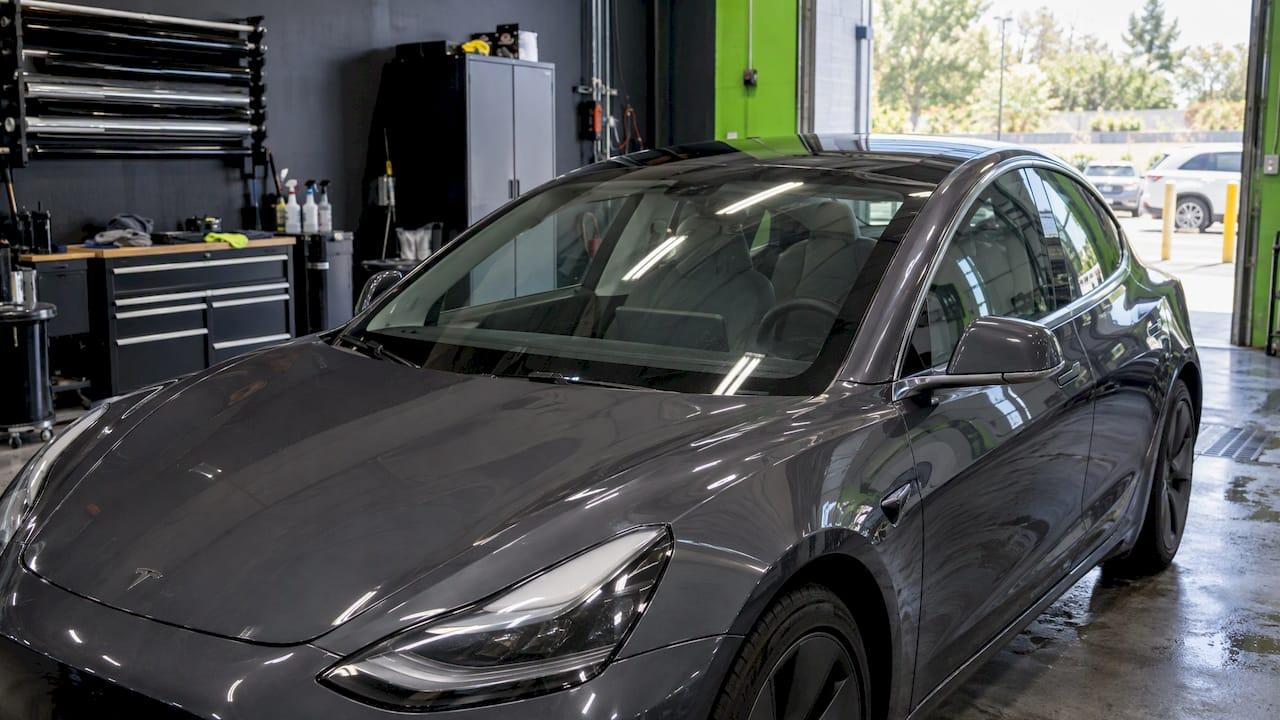
Tesla glass blocks most ultraviolet light in two places: the laminated windshield and the roof. The side windows are the weak spot. Tesla's own manual says the glass components score under 2 on the UV Index scale, but independent testing of side glass on cars shows far more UV-A getting through. If you drive in the San Fernando Valley sun every day, the window beside your left arm is the one to think about.
Below, we go window by window, show what tests have measured, and explain where a quality ceramic or carbon film fits.
TL;DR
- The laminated windshield on a Tesla blocks roughly 95% to 99% of UV-A and nearly all UV-B, thanks to a plastic layer between two sheets of glass.
- Tempered side windows are the gap: tests on cars show UV-A blockage on side glass that can fall far below the windshield's level.
- Roof glass on the Model 3 and Model Y is built to absorb about 99% of UV, according to Tesla engineers speaking at the company's design center.
- Tesla's manual still tells owners to take their own sun-protection precautions, and film is the straightforward way to add a layer at the side windows.
- Film rated up to 99% UV rejection is available in ceramic and carbon, and we install both in a climate-controlled bay in Van Nuys.
Table of Contents
- How car glass handles UV in the first place
- Window by window: what Tesla glass does
- What Tesla says about its own glass
- Why the left arm matters
- How film adds UV protection to Tesla glass
- Choosing a shade that stays legal and clear
- Does tint interfere with Tesla sensors?
- Perspective
- Book Tesla window film in Van Nuys
- FAQ
- Sources
How car glass handles UV in the first place
Ultraviolet light comes in two forms that matter inside a car. UV-B is the burning wavelength, and almost all automotive glass stops it. UV-A penetrates deeper into skin and is the part that varies by glass type.
Cancer Council Australia's fact sheet on tinted windows explains that all commercial and automobile glass blocks the majority of UV-B, while UV-A transmission depends on the glass. Laminated windscreens block about 98% of UV-A. Tempered glass, the kind normally used for side and rear windows, lets through much more, with estimates up to 79%. The same fact sheet notes that clear or tinted film can cut total UV radiation passing through tempered glass by more than 99%.
In the US, windshields must be laminated: two layers of glass with a stretchy plastic sheet between them. AP News reported that this layer helps a windshield absorb 100% of UV-B and around 98% of UV-A, an SPF of 50 or more, while tempered side glass usually absorbs only about 65% of UV, roughly SPF 16.
That is the baseline for every car. A Tesla follows the same pattern, with a few modern twists.
Window by window: what Tesla glass does
Tesla builds its cars with different glass in different positions. Here is how each piece behaves.
The windshield
The windshield is laminated, and it is the strongest UV filter on the car. In the 2016 JAMA Ophthalmology study of 29 vehicles in Los Angeles, front windshields averaged 96% UV-A blockage, with a range of 95% to 98%. The 2013 Tesla Model S in that study measured 95% through the windshield.
A more recent study is encouraging for current drivers. Researchers evaluating 34 vehicles from 2015 to 2025, including 10 electric ones, found an average front windshield UV-A attenuation of 99.25%, and every window blocked 100% of UV-B apart from one outlier.
The front side windows
This is where the picture changes. In the same JAMA study, side windows averaged only 71% UV-A blockage, with a range from 44% to 96%. Only 4 of the 29 cars blocked more than 90% through the side glass. The Tesla Model S measured 72% at the driver's window. The authors also found that factory tint on side windows did not track with higher UV-A blockage, because the protection comes down to the polymers in the glass, not how dark it looks.

The 2025 study reached a similar conclusion for EVs: they offered better UV-A attenuation at the front and back windshield, but not at any side window.
Owner-measured numbers for specific Teslas vary. A 2021 Model 3 measured in California by TeslaNorth showed front side windows at 82% to 83% visible light transmission with 100% UV-A blockage, while the rear side windows blocked only 60% to 62% of UV-A. That tells you two things: the glass differs by position, and it differs by model year. Tesla moved to laminated double-glass side windows across its lineup starting around 2021, with the Model 3 receiving them in its 2021 refresh, according to Tesla Oracle. So a 2018 Model 3 and a 2025 Model 3 may not behave the same at the doors.
Because readings differ by year, trim and measuring method, treat any single percentage you see online as a guide, not a guarantee for your car.
The panoramic glass roof
The roof is the best-protected piece of Tesla glass. Tesla's glass director described at the Hawthorne design center that the roof absorbs 99% of UV radiation, using a 2% tint film plus films that reflect solar radiation, all bonded with a PVB layer. CleanTechnica reported the same engineer statement.
UV is only half of the roof story, though. Heat is the other half, and we cover that in our guide to panoramic roof tint.
Rear side and rear glass
The rear side windows carry factory privacy tint. Privacy tint is a darkness measure, not a UV measure, so the dark look should not be read as UV rejection. The JAMA authors observed exactly this on side windows generally: tint level did not correlate with UV-A blockage.
| Glass | Construction | What the research shows |
|---|---|---|
| Windshield | Laminated with plastic interlayer | About 95% to 99% UV-A blocked, near-total UV-B |
| Front side windows | Tempered or laminated, depending on year | Side glass averaged 71% UV-A blockage in a 29-car study; varies widely |
| Rear side windows | Tempered or laminated, factory privacy tint | One 2021 Model 3 measurement: 60% to 62% UV-A blocked |
| Roof | Laminated, tinted, reflective films | Described by Tesla engineers as absorbing about 99% of UV |
What Tesla says about its own glass
The Model 3 owner's manual states that the roof, windshields and windows are excellent at protecting occupants from UV rays, with glass components scoring less than 2 on the UV Index scale. In the same passage, Tesla reminds owners that they remain responsible for taking necessary sun-protection precautions.
Both statements can be true at once. A UV Index score describes the glass in general terms. Cumulative exposure is about hours behind the wheel, the angle of the sun and which side of your body faces the window. The 2025 researchers pointed out that this is a known source of cumulative lifetime UV exposure and called for continued sun safety even while driving. The same study found that mileage, not model year, predicted driver's-side UV-A attenuation, which means the number on a spec sheet will not tell you how your particular car's door glass performs today.
Why the left arm matters
In the Valley, a commute along the 405 or the 101 puts the sun on the driver's side for long stretches. Your left arm, hand and the side of your face sit right behind the front side window. That is the glass with the widest range of measured UV-A blockage. It is also the glass your kids' faces sit next to in the back, where the rear side glass can let through a good share of UV-A.
The interior matters too. UV fades dashboards, door cards, leather and the soft-touch surfaces in a Tesla cabin. Film at the windows reduces what reaches those materials. We talk more about this in our piece on why factory glass shouldn't be your only UV plan.
How film adds UV protection to Tesla glass
Window film is a layer bonded to the inside of the glass. Quality films contain UV absorbers throughout the film. The AA notes that UV-protective windows with special films or coatings can block up to 99% of all UV rays, and Cancer Council Australia puts the reduction on tempered glass at over 99%.
What that means in practice for a Tesla:
- Front side windows: this is where film moves the needle most, taking the glass with the widest UV-A range and lifting it toward the 99% level.
- Rear side windows and rear glass: film adds a measured UV layer behind the factory privacy tint.
- Windshield: already strong on UV, so film here is mostly a comfort and heat decision. We cover the specifics in our Model Y windshield tint guide.
- Roof: already built to absorb most UV. Owners add film mainly to cut heat while keeping the sky view, as covered in our Model Y roof tint article.
Ceramic or carbon
We install two main film types. Ceramic window tint is our pick for most Tesla owners who want the strongest heat and UV performance without a dark look. Carbon window tint is a solid matte-finish option that also targets UV. Our nano-ceramic comparison explains why we lean ceramic for most drivers: nano-ceramic versus other film types.

When you compare films, UV rejection is the easy spec, because most quality films hit very high numbers. Heat is where they differ. Look at infrared rejection and total solar energy rejection, and see our walkthrough of the four specs to check on infrared tint.
Choosing a shade that stays legal and clear
Tesla's side glass is not all the same darkness, and film stacks on top of whatever is already there. Rear side windows have factory privacy tint, so adding a dark film over it makes them darker still, which can hurt night visibility. The front side windows ship lighter, so they have more room.
State law is where tint choices get decided, and it differs from state to state. In Texas, for example, the windows right beside the driver must pass 25% light transmission to pass inspection, and rear side windows are exempt. California has its own rules, and we set the VLT for each window with those rules in mind before the film goes on. If you drive between states, tell us at booking.
A clear, near-invisible UV film is an option for owners who want the protection but not the look of tint. It is a good fit if you like the stock appearance of your Tesla.
Does tint interfere with Tesla sensors?
Owners often ask this, and it is a reasonable question for a car packed with cameras. Our installs on Teslas are done with the car's sensors and camera housings in mind, and we describe our Tesla work as designed for a factory-quality fit with no sensor interference. If you want film near the windshield's camera cluster or the rear glass, ask us how we handle that on your model and year when you book.
Perspective
Every week we see Teslas where the owner assumed the glass was done protecting them. The windshield and roof really are impressive. But the side windows are different glass doing a different job, and the research shows that spread plainly.
Our approach is to treat each window on its own. Ceramic film on the front sides closes the UV gap where your arm and face actually sit. On the rear, film adds a measured layer behind the privacy tint. On the roof, we focus on heat and keep your view.
The part we care about most is the install. We work in a climate-controlled, dust-free bay in Van Nuys, because dust under a film is the difference between a clean finish and a flaw you see every day. We have protected more than 1,000 vehicles, and Teslas are a specialty. We back our work with manufacturer-backed warranties.
Jake
Book Tesla window film in Van Nuys
If you want the UV gap at your side windows handled properly, we can quote film for each window on your Tesla, matched to your model year and how you drive. Our window tinting page shows the carbon and ceramic options and tint removal if you have old film to take off first.
We also cover indoor installation benefits for EV owners, and a full breakdown of Tesla window tint options if you want to compare films before you call. Prices depend on the vehicle and the film, so we quote after we know your car.
FAQ
Does a Tesla windshield block UV rays?
Yes, mostly. The windshield is laminated glass with a plastic layer, and testing on vehicles has found front windshield UV-A blockage averaging 96% in a 2016 study and 99.25% in a 2025 study of 34 vehicles. UV-B is blocked almost completely.
Do Tesla side windows have UV protection?
Some, but it varies by window, model year and the glass type. Side windows in a 29-car study averaged 71% UV-A blockage, with a range of 44% to 96%. A Tesla Model S in that study measured 72%. Film is the way to bring side glass toward the 99% level.
Does the Tesla glass roof block UV?
Tesla engineers have said the roof absorbs about 99% of UV, using a tint film, reflective films and a PVB layer. The roof is the best-protected glass on the car, so most owners tint it for heat and glare rather than UV.
What tint comes on a Tesla from the factory?
The rear side windows and rear glass carry factory privacy tint, while front side windows are lighter. Privacy tint controls darkness, not UV, and the tint level on side glass has not tracked with UV blockage in published testing. Film choice should consider what is already on the glass.
Can I add film over Tesla's factory glass?
Yes. Film bonds to the inside of the factory glass, and the combined light transmission of glass and film is what counts against state limits. We pick the shade for each window so the result is clear to see through and within the rules for where you drive.
Sources
- Fact sheet: Tinted windows, Cancer Council Australia
- Evaluation of UV-A and UV-B transmission through vehicle windows, PubMed (2025)
- Can you get sunburn through a car window? The AA
- Car windows may not protect from sun, AP News
- Assessment of Levels of Ultraviolet A Light Protection in Automobile Windows, JAMA Ophthalmology (2016)
- 2021 Tesla Model 3 Glass Tint Transmittance Rates, TeslaNorth
- Tesla shares its glass technology, Tesla Oracle
- How Cool Are Tesla Glass Roofs? CleanTechnica
- Windows, Tesla Model 3 Owner's Manual
- Window Tinting Standards, Texas Department of Public Safety