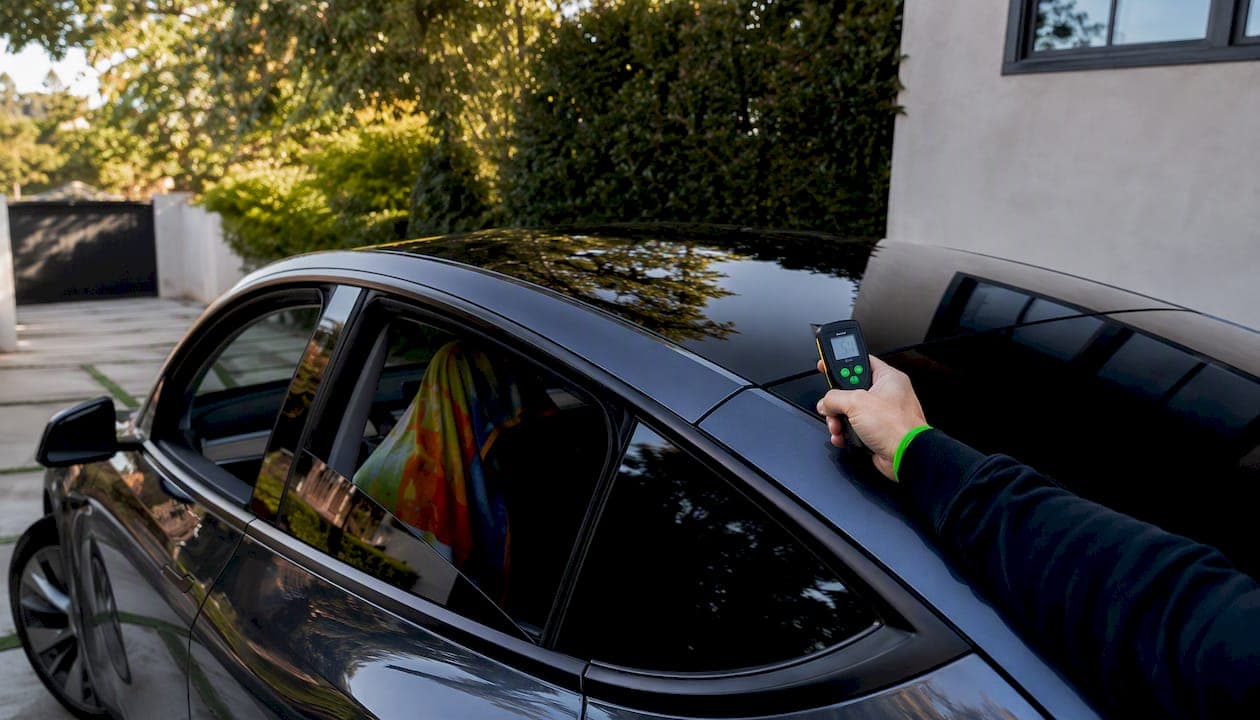
Yes, tinting your Model Y panoramic roof is worth it in most U.S. climates, especially if you park in the sun, drive in heat, or want UV protection for passengers. The three fastest reasons to do it: ceramic or TPU-based tinted PPF cuts infrared heat before it enters the cabin, blocks close to 99% of UV radiation, and, with exterior PPF, adds impact resistance the factory glass does not have.
Two situations where it pays off most:
- Hot-sun geographies (California, Texas, Arizona, Florida) where the panoramic roof turns the cabin into a greenhouse within minutes of parking
- Owners prioritizing UV protection or roof impact resistance, including families with children or anyone who regularly parks outdoors
Table of Contents
- What the factory Model Y panoramic roof already does
- Why tinting the panoramic roof actually changes the driving experience
- Risks and special considerations before tinting a panoramic roof
- Which film types actually perform best on a Model Y roof
- What VLT percentage should you choose for the roof?
- What does a professional Model Y roof tint job cost?
- How to pick a shop for your Model Y roof tint
- What to expect on install day and the first 30 days after
- How long does roof tint last, and what does removal involve?
- State laws and safety notes you need to check first
- Why Tintandwrapscustoms is built for Model Y roof tint jobs
- Key Takeaways
- The thing most owners get wrong when tinting a Model Y roof
- Get your Model Y roof tinted the right way at Tintandwrapscustoms
- Useful sources and further reading
What the factory Model Y panoramic roof already does
Tesla's panoramic roof glass is not bare. The factory coating provides meaningful UV and IR rejection out of the box, and the glass runs darker than the side windows, which is why it does not look completely clear from the outside.
What the stock roof typically delivers:
- UV blocking: Factory glass blocks a significant portion of UV-A and UV-B radiation, though not at the near-total levels a quality aftermarket film achieves
- IR rejection: Some infrared rejection is built in, but it is partial, and owners in hot climates still report noticeable cabin heating through the roof on sunny days
- Visible light transmission (VLT): The factory panoramic glass sits in a darker range than the side windows, giving some privacy and glare reduction by default
- Recent revisions: The refreshed Model Y Juniper updated several body components, but the fundamental glass coating approach remains similar
The limitation is real: factory glass lets enough infrared radiation through that the cabin heats up quickly when parked, and the HVAC system works harder to compensate. That translates directly to range loss on hot days.
The factory glass is a solid starting point, but it was not designed to maximize heat rejection. Aftermarket ceramic film or tinted PPF can meaningfully close that gap for owners in warm climates.
Why tinting the panoramic roof actually changes the driving experience
The most reliable gain is heat reduction. A quality ceramic film or tinted exterior PPF cuts the infrared load coming through the roof, which lowers cabin temperature when parked and reduces how hard the HVAC works once you are driving. That matters for range.
The full list of benefits:
- Heat and IR reduction: Nano-ceramic films and tinted TPU PPF can block a substantial portion of solar infrared energy, measurably reducing cabin temperature on sunny days and easing the load on climate control
- UV protection: Premium films block up to 99% of UV radiation, protecting both passengers and the interior (dashboard, seats, headliner) from long-term sun damage
- Glare reduction: A darker roof film cuts the overhead glare that bounces off the dashboard on bright days, which is more fatiguing than most owners realize until it is gone
- Privacy and aesthetics: A tinted roof gives the car a cleaner, more finished look and reduces visibility into the cabin from above
- PPF-specific impact resistance: TPU-based tinted PPF adds a layer of protection against small debris, chips, and hail that standard interior film cannot provide. The self-healing and hydrophobic properties of TPU PPF also make the roof easier to clean and maintain
- Interior preservation: Blocking UV and IR consistently slows the fading and cracking of the headliner and seat materials directly under the roof
For families with young children or anyone who parks outdoors daily, the UV and heat arguments alone justify the cost in most warm-weather states.
Pro Tip: If you are deciding between interior film and exterior PPF for the roof, the PPF option gives you heat rejection plus impact protection in one layer, and it avoids any risk of water near the overhead electronics during install.
Risks and special considerations before tinting a panoramic roof
The biggest risk is not the film itself. It is a bad installation. The Model Y panoramic roof is large, curved, and sits directly above interior electronics, and those three factors combine to punish inexperienced shops.
Key risks to know before you book:
- Fingering and bubbling: Shrinkage during cure on a curved surface can cause the film edges to lift or develop finger-like creases, especially when installed in uncontrolled temperature or humidity
- Adhesion failure: Large glass panels with compound curves are harder to wrap cleanly; poor surface prep or wrong film choice leads to peeling edges within months
- Water near overhead electronics: Interior film installation requires spraying slip solution inside the cabin, directly below the roof electronics. A shop without proper technique risks moisture damage to sensors or wiring
- Seal and edge interference: Film that overlaps the rubber seals around the panoramic roof can trap moisture or peel prematurely
- Optical distortion: Low-quality film or improper installation can introduce a slight visual warp that is most noticeable at night or in low-angle light
- Glass stress: A small number of owners have reported cracking anecdotes tied to improper install or thermal stress from dark films on already-stressed glass, though this is uncommon with quality film and proper technique
Shops that lack Tesla-specific experience or a climate-controlled facility are a higher risk for every one of these issues. The panoramic roof is not a forgiving surface for a shop learning on your car.
Pro Tip: Exterior tinted PPF eliminates the water-near-electronics risk entirely because it is applied from the outside. If your priority is heat rejection plus impact protection and you want the safest possible install, ask specifically about exterior TPU-based tinted PPF rather than interior film for the roof panel.
Which film types actually perform best on a Model Y roof
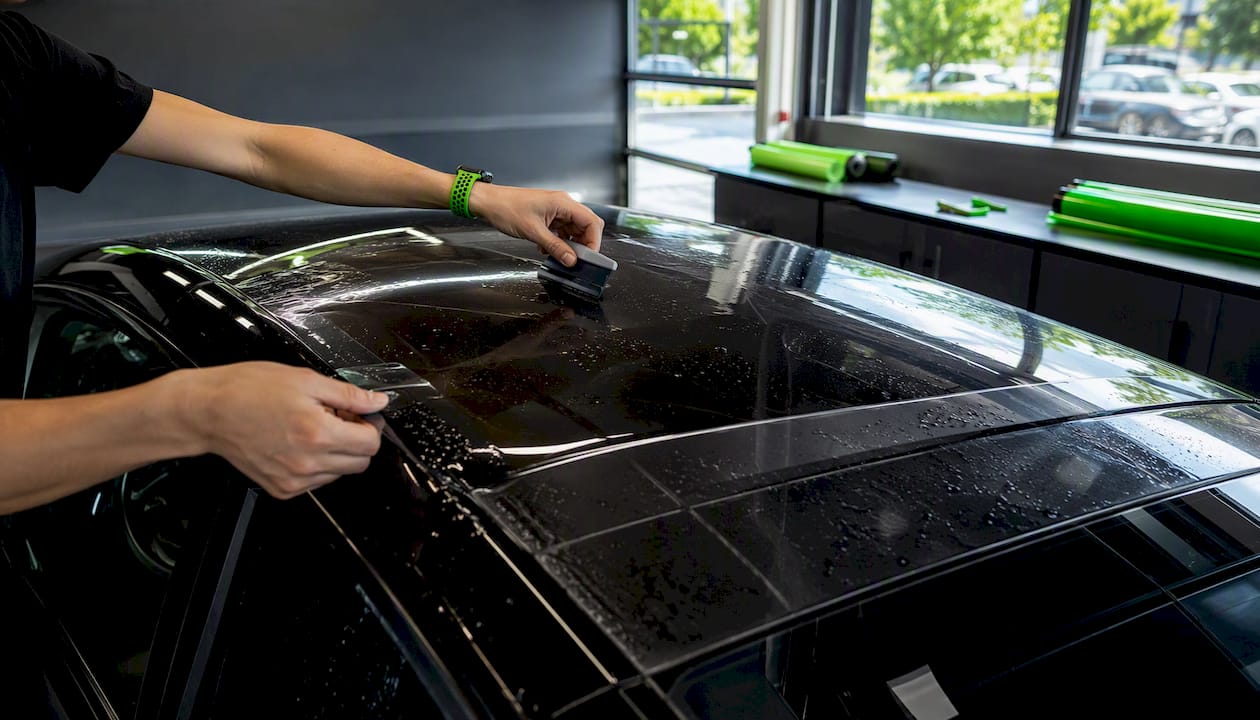
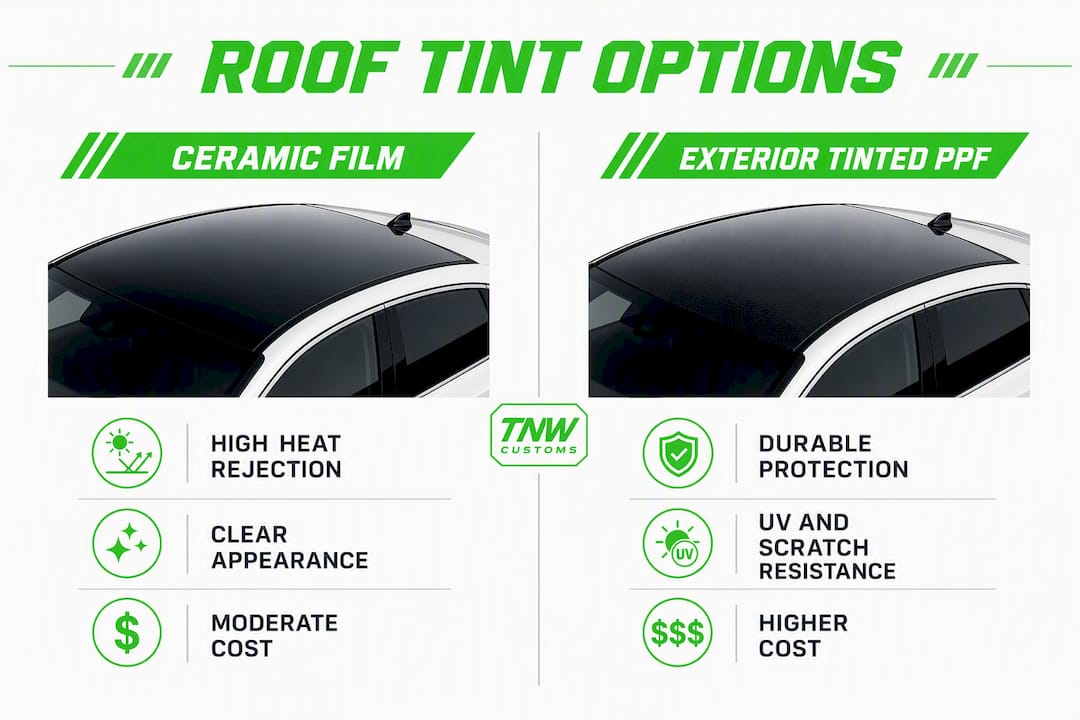
Ceramic film and exterior tinted PPF are the top choices for the panoramic roof. Both reject heat without metallic layers that can interfere with Tesla Vision cameras, and both hold up better on large curved glass than dyed or carbon films.
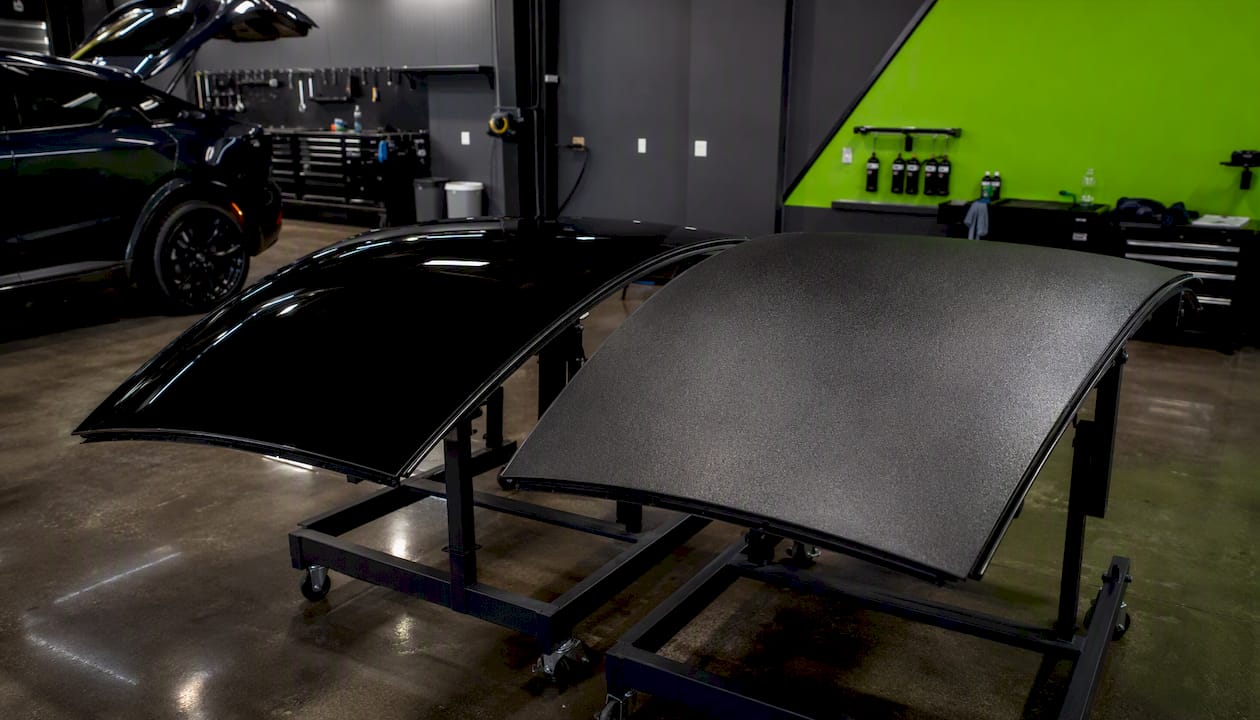
| Film Type | IR/Heat Rejection | UV Blocking | Camera Safety | Durability | Price Range |
|---|---|---|---|---|---|
| Nano-ceramic | High | Up to 99% | Safe (no metal) | 10+ years | Mid to premium |
| Carbon | Moderate | High | Generally safe | 5–10 years | Mid |
| Metalized | High | High | Risk to ADAS | 5–10 years | Mid |
| Dyed | Low | Moderate | Safe | 3–5 years | Budget |
| Tinted TPU PPF | High | Up to 99% | Safe (exterior) | 7–10 years | Premium |
A few things the table does not capture:
- Metalized films are the one type to avoid on a Tesla. The metallic particles can interfere with Tesla Vision cameras and other ADAS sensors. Camera and ADAS compatibility is a non-negotiable filter for any film going on a Tesla, and metalized films fail that test.
- Tinted TPU PPF is applied to the exterior, which means no water spray inside the cabin during install. It also adds impact resistance and self-healing properties that no interior film can match.
- Brand names to ask about: 3M Crystalline, Llumar, Huper Optik, and XPEL all offer ceramic or nano-ceramic options suitable for Tesla roofs. The right choice depends on your installer's authorization and warranty terms more than on small performance differences between brands. As the XPEL vs 3M comparison makes clear, installer certification and warranty support matter more than brand loyalty alone.
What VLT percentage should you choose for the roof?
A 50% VLT is a reasonable starting point for most owners. It reduces heat and glare noticeably without making the cabin feel dark, and it sits comfortably within legal limits in virtually every state for a roof panel.
VLT is the percentage of visible light a film allows through. Lower numbers mean darker film.
- 70% VLT: Barely perceptible change in appearance; minimal heat and glare reduction. Best for owners who want UV protection only and want to preserve the open-sky feel of the panoramic roof
- 50% VLT: The most popular choice. Noticeable heat and glare reduction, still feels bright inside, and works well for daily driving in moderate to warm climates
- 35% VLT: Meaningful heat rejection and strong privacy. The cabin feels slightly darker, which some owners prefer. Good for hot-sun climates like Southern California, Texas, or Arizona
- 17% VLT (deep tint / PPF): Maximum heat and privacy. Available in tinted PPF kits for the Model Y Juniper. Best for owners who park outdoors in intense sun and prioritize comfort over the panoramic feel
- Light tinted PPF (71% VLT): Nearly invisible change in appearance; primarily adds impact protection and UV blocking with minimal effect on light transmission
For heat rejection performance, VLT alone does not tell the whole story. A 50% ceramic film rejects far more infrared heat than a 50% dyed film at the same visible darkness. Always ask about the IR rejection percentage, not just the VLT.
State laws typically regulate front side windows most strictly. Roof panels are less commonly restricted, but you should verify your state's rules before booking. More on that in the state law section below.
What does a professional Model Y roof tint job cost?
Roof-only jobs typically run $150–$300 for interior film. Standard full-vehicle tint packages excluding the windshield (including the panoramic roof) land in the $350–$800 range, while premium installs with ceramic film typically run $700–$1,000. Packages with PPF or top-tier ceramic film can reach $900–$1,400 or more.
| Job Scope | Typical Price Range | What's Usually Included |
|---|---|---|
| Roof only (interior film) | $150–$300 | Film, basic install, standard warranty |
| Full vehicle (excl. windshield) | $350–$800 | All windows + roof, mid-range film |
| Full vehicle + premium roof | $700–$1,000 | Ceramic film, roof, installer warranty |
| Premium with PPF or high-end ceramic | $900–$1,400+ | Tinted PPF or top-tier ceramic, extended warranty |
These price ranges reflect real-world Tesla tinting costs and the factors that push a job toward the higher end:
- Roof size and curvature: The Model Y panoramic roof is one of the largest glass surfaces in the segment. More material and more labor time than a standard sunroof
- Climate-controlled install: Shops with temperature and humidity-controlled bays charge more, and they should. The controlled environment is what prevents bubbling and adhesion failure on a curved surface
- PPF vs interior film: Exterior tinted PPF costs more than interior film but adds impact resistance and eliminates the electronics risk
- Pre-cut kits vs custom trimming: Pre-cut templates for the Model Y reduce install time and error rate. Shops that use them often charge a small premium for the kit but save on labor
- Warranty level: A manufacturer-backed film warranty plus an installation warranty adds cost but protects you if the film fails
Install time for a roof-only job is typically 2–4 hours. A full-vehicle job with the roof runs 4–8 hours. Most shops recommend leaving the car for a full day. Cure time before normal use (including car washes) is typically 3–7 days for interior film and 24–48 hours for exterior PPF, though full cure can take up to 30 days.
How to pick a shop for your Model Y roof tint
The single most important attribute is Tesla-specific experience in a climate-controlled facility. A shop that has done dozens of Model Y roofs in a controlled environment will produce a better result than a general tint shop doing its first Tesla in an open bay.
Questions to ask every shop:
- How many Model Y roofs have you tinted, and can you show photos or references?
- Do you use pre-cut kits or templates for the Model Y Juniper geometry?
- Is your installation bay climate-controlled for temperature and humidity?
- What film brands do you carry, and are you an authorized installer for those brands?
- Do you offer a manufacturer-backed film warranty and a separate installation warranty?
- Is the film you recommend camera-safe and ADAS-compatible for Tesla Vision?
- Can you show before/after temperature or IR test results from previous Model Y jobs?
- How do you handle roof crack claims if one occurs during or after install?
Red flags:
- Avoids discussing ADAS or camera compatibility
- Recommends metalized film for the roof
- No climate-controlled bay for a curved-glass job
- Promises a same-day turnaround for a full roof install
- Cannot produce warranty documentation or manufacturer authorization
- Refuses to share customer references or before/after data
Trust signals to request:
- Manufacturer-backed film warranty (from 3M, Llumar, XPEL, Huper Optik, or equivalent)
- Separate installation warranty from the shop
- Documented count of Tesla installs completed
- 5-star customer reviews specific to Tesla jobs
- Before/after IR or temperature test results
Understanding what a window tint warranty actually covers before you sign is one of the most overlooked steps in the process. A warranty that only covers film defects but not installation errors leaves you exposed if the adhesion fails on a curved surface.
What to expect on install day and the first 30 days after
A professional roof tint install follows a predictable sequence: inspection, surface prep, film application, and a final quality check. Knowing what each step looks like helps you catch problems early.
The install-day sequence:
- Drop-off and inspection: The shop checks the glass for chips, cracks, or contamination that could affect adhesion. Any existing damage is documented before work starts
- Surface prep: The glass is cleaned thoroughly, often with isopropyl alcohol and a clay bar, to remove any contamination that would cause bubbling under the film
- Film application: For interior film, the technician works inside the cabin with slip solution. For exterior PPF, the film is applied from outside. Pre-cut kits are positioned and squeegeed into place
- Cure and QA: The shop inspects for bubbles, edge lift, or optical distortion before releasing the car. Some initial water bubbles are normal and will dissipate during cure
Aftercare for the first 7–30 days:
- Avoid high-pressure car washes for at least 7 days (30 days is safer for interior film)
- Do not roll down windows or disturb the roof film during the initial cure period
- Pat dry rather than wipe aggressively if the roof gets wet
- Small water bubbles under the film in the first week are normal. They disappear as the film cures
- If bubbles persist past 30 days or edges begin to lift, contact the shop under the installation warranty
If you notice edge lift or persistent bubbling after 30 days, that is an installation issue, not a film defect, and your installation warranty should cover it. Document it with photos before contacting the shop.
How long does roof tint last, and what does removal involve?
Nano-ceramic interior film on the Model Y roof typically lasts 7–10 years with proper care. TPU-based tinted PPF runs 7–10 years as well, with some manufacturers offering warranties up to 10 years. What shortens that lifespan is usually improper install, edge lift from moisture intrusion, or using harsh cleaning products.
Maintenance:
- Clean with a pH-neutral soap and a soft microfiber cloth
- Avoid ammonia-based cleaners (Windex and similar products degrade film adhesive over time)
- For PPF, the hydrophobic coating benefits from occasional application of a PPF-safe spray sealant
- Avoid abrasive pads or brushes on the roof surface
- Inspect edges annually for early lift, especially around the seal perimeter
Lifespan factors:
- Edge lift from improper install is the most common early failure mode
- UV breakdown accelerates in films without UV stabilizers, which is why quality ceramic films outlast dyed ones significantly
- Parking in direct sun daily without any shade shortens film life faster than the warranty assumes
Removal:
When the film reaches end of life or you want to re-tint, removal typically costs $50–$150 for the roof panel depending on adhesive condition. Old adhesive residue requires a solvent treatment. Attempting DIY removal on the panoramic glass risks scratching the surface or damaging the seals. A professional removal followed by a fresh install is almost always the better path. For PPF cost and replacement planning, factor in removal as a line item when budgeting a re-tint.
State laws and safety notes you need to check first
State tint laws vary, and you are responsible for knowing yours before the film goes on. Most states regulate front side windows most strictly, with rear windows and roof panels subject to looser or no specific limits. But "less regulated" does not mean unregulated.
What to do before booking:
- Check your state DMV website or contact your local law enforcement agency for current VLT limits by window position
- Ask your installer for a compliance certificate or window tint sticker if your state requires one
- Confirm that the film chosen for the roof does not affect the windshield or front side windows in any way (it should not, but verify)
- If you plan to tint side windows at the same time, confirm those VLT levels comply with your state's front and rear window rules
Safety note on ADAS:
Roof tint does not typically affect driver visibility laws, but it can affect Tesla Vision camera readings if the wrong film is used. Ceramic films without metallic layers are the safest choice for any Tesla application. Always confirm camera-safe film selection with your installer before the job starts.
Pro Tip: Your state's DMV website is the authoritative source for tint laws, not your installer's word or a generic online chart. Laws change, and a chart from three years ago may not reflect current rules in your state.
This article provides general information, not legal advice. Verify current tint regulations with your state DMV or a qualified professional before scheduling work.
Why Tintandwrapscustoms is built for Model Y roof tint jobs
Tintandwrapscustoms in Van Nuys, CA has the specific combination of credentials that the sections above tell you to require: a climate-controlled installation facility, manufacturer-backed warranties on both film and installation, and a documented track record with Tesla and EV installations across more than 1,000 vehicles protected.
What the shop offers for Model Y roof tint specifically:
- Nano-ceramic and carbon window tint with camera-safe film selection for Tesla Vision compatibility
- Exterior tinted PPF for the panoramic roof, eliminating the water-near-electronics risk and adding impact resistance
- Tesla-specific pre-cut templates for clean, precise fit on Model Y geometry including the Juniper refresh
- Manufacturer-backed film warranty plus a shop installation warranty, both available in writing before you commit
- Before/after IR testing on request, so you can see the actual heat rejection performance, not just a spec sheet claim
- 5-star customer rating from owners who have been through the process
Tintandwrapscustoms backs every Model Y roof tint job with manufacturer-supported film warranties and a climate-controlled install that gives the film the best possible conditions to cure correctly on a large, curved glass surface.
Ask for sample installs, warranty paperwork, and Tesla-specific references when you call. A shop confident in its work will have all three ready.
Key Takeaways
Nano-ceramic film or exterior tinted PPF is the right choice for most Model Y owners, and the installer's credentials matter as much as the film brand.
| Point | Details |
|---|---|
| Factory glass has limits | Tesla's panoramic roof blocks some UV and IR, but aftermarket ceramic film or tinted PPF meaningfully closes the heat gap. |
| Ceramic or tinted PPF for roofs | Nano-ceramic and TPU-based tinted PPF are the safest, highest-performing options; avoid metalized films on any Tesla. |
| VLT baseline: 50% | A 50% VLT is the most practical starting point; go to 35% for hot climates, 70% if you want UV protection with minimal visual change. |
| Cost and timeline | Full-vehicle jobs with the roof run $700–$1,000; premium PPF installs reach $900–$1,400+. Budget a full day for install and 7–30 days for cure. |
| Installer credentials matter | Require a climate-controlled bay, Tesla-specific experience, manufacturer-backed warranty, and camera-safe film confirmation before booking. |
| Tintandwrapscustoms | Offers climate-controlled Model Y roof tint installs with manufacturer-backed warranties and 1,000+ vehicles protected in Van Nuys, CA. |
The thing most owners get wrong when tinting a Model Y roof
The conventional wisdom says "just pick a good film brand." That is the wrong place to focus. In practice, the film brand is the last variable that determines whether your Model Y roof tint looks perfect in five years. The first variable is whether the shop has done this specific job enough times to know where the Model Y panoramic glass wants to lift, where the curvature fights the film, and how to manage the cure environment so none of that becomes your problem.
Owners who research film brands exhaustively and then hand the car to a shop with no Tesla experience are making a category error. A 3M Crystalline or XPEL film installed badly will fail faster than a mid-tier ceramic film installed correctly in a climate-controlled bay by a technician who has done fifty Model Y roofs.
The second thing owners underestimate is the exterior PPF option. Most people think of PPF as a paint protection product and never ask whether it applies to glass. For the Model Y roof specifically, tinted exterior TPU PPF solves three problems at once: heat rejection, UV blocking, and impact resistance, all without a single drop of water going near the overhead electronics. That is not a marginal upgrade over interior film. For anyone parking under trees, in hail-prone areas, or in the kind of intense sun that Southern California delivers year-round, it is the more complete solution.
The installer vetting checklist in this article is not a formality. It is the actual work that separates a roof tint that looks great for a decade from one that starts lifting at the edges before the first winter is over.
Get your Model Y roof tinted the right way at Tintandwrapscustoms
Tintandwrapscustoms offers Model Y roof tint and exterior tinted PPF installs from its climate-controlled Van Nuys facility, using nano-ceramic and carbon films selected specifically for Tesla Vision camera compatibility. Every job comes with a manufacturer-backed film warranty and a shop installation warranty, both in writing. The team has protected more than 1,000 vehicles and works with Tesla-specific pre-cut templates for a clean, precise fit on the panoramic roof.
If you want before/after IR test results, ask when you call. The shop can demonstrate actual heat rejection performance on your car, not just quote a spec sheet.
Book your Model Y roof tint appointment at Tintandwrapscustoms in Van Nuys and get a quote that covers film type, warranty terms, and install timeline before you commit.
Useful sources and further reading
- Tesla Window Tint: Best Films, Costs, and Install Guide
- Window Tint Warranty: What Your Coverage Actually Means
- XPEL vs 3M PPF: Which Film Wins in 2026?
- PPF Cost in 2026: What Every Vehicle Owner Should Know
- Heat Rejection Tint: What Actually Keeps Your Car Cool
- Tintandwrapscustoms service and booking page