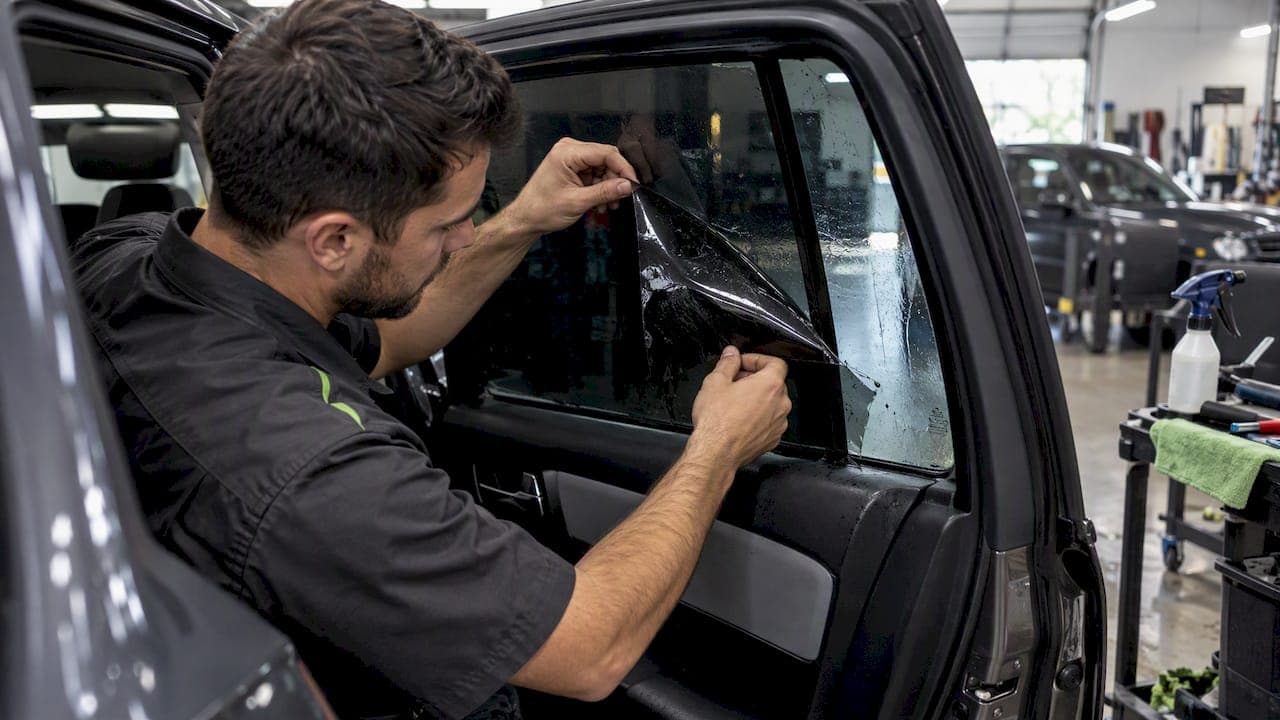
Double layer tint, meaning a second adhesive film stacked on top of an existing one, is rarely a good idea and almost never the safest path. Engineered multi-layer films, built as a single factory-bonded unit, consistently outperform stacked aftermarket layers in clarity and heat rejection. If you want darker or more effective tint, a professional consultation and a VLT meter test will tell you whether replacement or an engineered film is the better route.
TL;DR:
- California requires front side windows to allow at least 70% VLT through the finished glass; factory privacy glass and every film count.
- A film’s heat rejection depends on its construction, not darkness; lighter ceramic or nano film can block more infrared heat than darker dyed film.
- Stacked films can trap moisture, inhibit adhesive curing, distort night visibility, and void warranties; adhesives bond to clean glass, not aged film.
- Use replacement or factory engineered film; consider stacking only if a certified installer confirms compatibility and provides a finished glass VLT reading and written warranty terms.
Table of Contents
- What "double layer tint" actually means: stacking vs. engineered film
- Practical pros and cons of layering tint
- How stacking affects combined VLT and what to check legally
- Physical failure modes when you stack film
- Installer best practices, timing, and safer alternatives
- Why a warranty-backed, climate-controlled shop reduces layering risk
- My take: skip the stack, choose the right film instead
- Tint & Wraps Customs: request a VLT check or consultation
- FAQ
- Sources
What "double layer tint" actually means: stacking vs. engineered film
People often confuse two very different things when they talk about double layer tint. Stacking is the manual process of applying a second adhesive-backed film directly over an existing one, usually to deepen the shade or patch a fading layer. Engineered multi-layer film is something else entirely: a factory-bonded optical assembly built from the start as one unit. According to 3M's Crystalline brochure, these films can contain anywhere from a few layers to more than 200 micro-layers, all bonded under controlled manufacturing conditions to manage light and heat.
That distinction matters for three reasons:
- Clarity: factory-bonded layers are optically matched; two separately applied films rarely align the same way.
- Heat rejection: engineered stacks are tuned for infrared blocking during manufacturing, not added after the fact.
- Warranty: most manufacturer warranties cover a single, professionally installed film, not an aftermarket second layer applied over it.
Practical pros and cons of layering tint
Stacking film can seem like a cheap fix, but the tradeoffs are real and worth naming honestly.
Potential upsides:
- Added privacy from a darker combined appearance.
- Possible marginal UV or IR reduction, depending on the films involved.
- A short-term cosmetic patch over scratched or faded existing film.
Likely downsides:
- Adhesive mismatch between two separately applied layers, since adhesives are formulated to bond to clean glass, not to aged film.
- Bubbling, haze, or cloudy patches as trapped air and moisture work their way between layers.
- Voided manufacturer or installer warranties, since most coverage assumes a single approved application.
- A higher chance of landing outside your state's legal VLT limit once the two layers combine.
- Optical distortion and reduced night visibility, particularly through rear and side windows.
Darker does not automatically mean cooler. Heat rejection depends on the film's technology, not the depth of its shade: a lighter ceramic or ultra-nano film can block more infrared heat than a dark dyed film, a point confirmed by Avery Dennison's Encore series data sheets, which list VLT, IR rejection, and UV block figures that vary by construction, not just by tint depth. For more on how film type drives heat performance, see our breakdown of heat rejection tint.
Pro Tip: Ask any installer to show you the IR rejection percentage on the film's data sheet before assuming a darker shade will keep your car cooler.
How stacking affects combined VLT and what to check legally

Visible Light Transmission, or VLT, measures how much light passes through the final assembly, not just through one film. Enforcement in states like California looks at the combined result of factory glass plus every film applied to it. Under California Vehicle Code Section 26708, front side windows must allow at least 70% VLT through the finished glass, a figure that applies to the whole stack, not to a single film's label.
That creates a real problem for stacked tint. A film rated at 70% VLT on its own packaging can combine with factory glass and a second layer to fall well under that threshold, as practical tint-law guides point out. A label never guarantees legality once a second layer is involved.
Before you layer anything, run through this checklist:
- Confirm your state's VLT minimum for front, rear, and back windows.
- Get a meter test on the finished glass, not just a read of the film's rating.
- Factor in factory privacy glass, which already reduces VLT before any film goes on.
- Keep documentation of the test result in case of a traffic stop.
Noncompliance typically means a citation and a fine, plus the cost of removing the illegal film anyway. Responsibility for the final measured VLT sits with the vehicle owner, regardless of what any film's packaging claims.
Physical failure modes when you stack film
Layering film creates failure points that single-layer installations rarely see. Adhesives are engineered to bond to clean, bare glass, not to the surface of an existing film, so a second layer is working against a bond it was never designed for.
- Adhesion mismatch: increases the risk of delamination, where the new layer lifts or peels at the edges over time.
- Curing inhibition: many films need UV exposure to cure their adhesive fully, and a layer underneath that already blocks UV can prevent the top layer from curing properly.
- Trapped moisture: moisture sealed between two layers has nowhere to evaporate, which often shows up as permanent haze or cloudy patches.
- Optical scattering: uneven layers can scatter light in ways that reduce night visibility and, in some cases, interfere with camera-based driver assistance sensors mounted near the windshield or rear glass.
None of these problems are guaranteed, but they show up often enough that most reputable shops avoid stacking altogether.
Installer best practices, timing, and safer alternatives
Most professional installers remove old film before applying anything new, and for good reason: clean glass gives adhesive a reliable surface to bond to, and curing happens far more predictably without a second layer interfering. Layering over existing film is rare, usually reserved for narrow cases where an installer has verified the base layer is in excellent condition and compatible with the new product.
- Ask whether your installer removes old film as standard practice before quoting a new install.
- Confirm the facility controls dust and temperature during application, since airborne particles and inconsistent heat are common causes of bubbling and uneven cure.
- Request a documented VLT meter read after installation, not just a verbal estimate.
- Get warranty terms in writing before the film goes on, including what voids coverage.
Curing can take several days depending on temperature and humidity, and a climate-controlled curing environment reduces the odds of trapped moisture or incomplete adhesion.
Pro Tip: Always ask for the VLT meter reading in writing. A verbal "it's legal" from an installer isn't something you can show a police officer.

Why a warranty-backed, climate-controlled shop reduces layering risk
A controlled environment changes the odds considerably. Dust-free, temperature-stable conditions reduce the inclusions and cure defects that cause most layering failures, and manufacturer-backed warranties only hold up when the installation follows the film maker's specifications.
When layering decisions come up, a professional shop generally recommends one of three paths instead of stacking:
- Full tint removal followed by a fresh, single-layer install on clean glass.
- An engineered multi-layer film, like a ceramic or carbon option, that delivers deeper shade and stronger heat rejection without a second adhesive layer.
- A VLT check first, so you know your legal headroom before choosing a darker product.
Before committing to any shop, ask for an installer's certificate of experience, a documented meter result, and written warranty terms that specify what voids coverage.
My take: skip the stack, choose the right film instead
In most cases, I'd point you toward replacement or an engineered multi-layer film rather than stacking a second layer over existing tint. The failure modes, haze, bubbling, voided warranties, are common enough that the short-term savings rarely hold up.
I'd only consider layering if a certified installer inspected the base film, confirmed compatibility, and guaranteed a post-install VLT test. Outside of that narrow case, get your glass checked by a professional and verify the final VLT before you drive away.
— Jake
Tint & Wraps Customs: request a VLT check or consultation
We install window tint in a facility designed to maintain good conditions for installation. Our team has experience with various vehicles, and installations come with warranty coverage.
If you're weighing a second layer against a clean replacement, we can run a VLT check, walk you through carbon and ceramic tint options, or handle full tint removal before a fresh install.
- Carbon and ceramic window film options for deeper shade without stacking.
- Tint removal on clean glass before any new application.
- Documented VLT meter reads and warranty terms provided in writing.
| Service | What it addresses |
|---|---|
| Carbon Window Tint | Higher UV and IR rejection without added layers |
| Ceramic Window Tint | Heat rejection at lighter, legal-friendly shades |
| Tint Removal | Clean glass prep before any reinstall |
Ready to find out whether your current tint needs removal or an upgrade? Visit our window tinting page to request a consultation.
FAQ
Is it okay to double layer tint?
Generally, no. Stacking a second adhesive film over an existing one raises the risk of bubbling, haze, and voided warranties, and it can push your combined VLT below your state's legal minimum.
What do 2 layers of 20% tint equal?
There's no fixed formula, since combined VLT depends on the specific films and the factory glass underneath, not simple subtraction. The only reliable way to know the result is a meter test on the finished assembly, as California's compliance guidance recommends.
What does 2-ply window tint mean?
"2-ply" usually refers to an engineered film built with two bonded layers in one factory-made product, not two separately applied aftermarket films. Avery Dennison's product data lists VLT and IR rejection figures for these engineered constructions.
What is 2 layers of 35% tint?
As with any stacked combination, the resulting VLT isn't simply additive and must be measured on the installed glass. A professional meter test is the only way to confirm whether the result meets your state's minimum, such as the 70% front-window requirement under California Vehicle Code Section 26708.
Does window tint technology matter more than how dark it is?
Yes. Heat and UV protection depend on the film's construction, not its shade, which is why a lighter ceramic or nano film can outperform a darker dyed film on heat rejection, a point reinforced by third-party UV protection guidance.
Sources
- 3M Automotive Window Film Crystalline brochure
- California Vehicle Code Section 26708
- Avery Dennison Encore series product data sheets
- California window tint laws: VLT limits & fines (IsItStreetLegal)