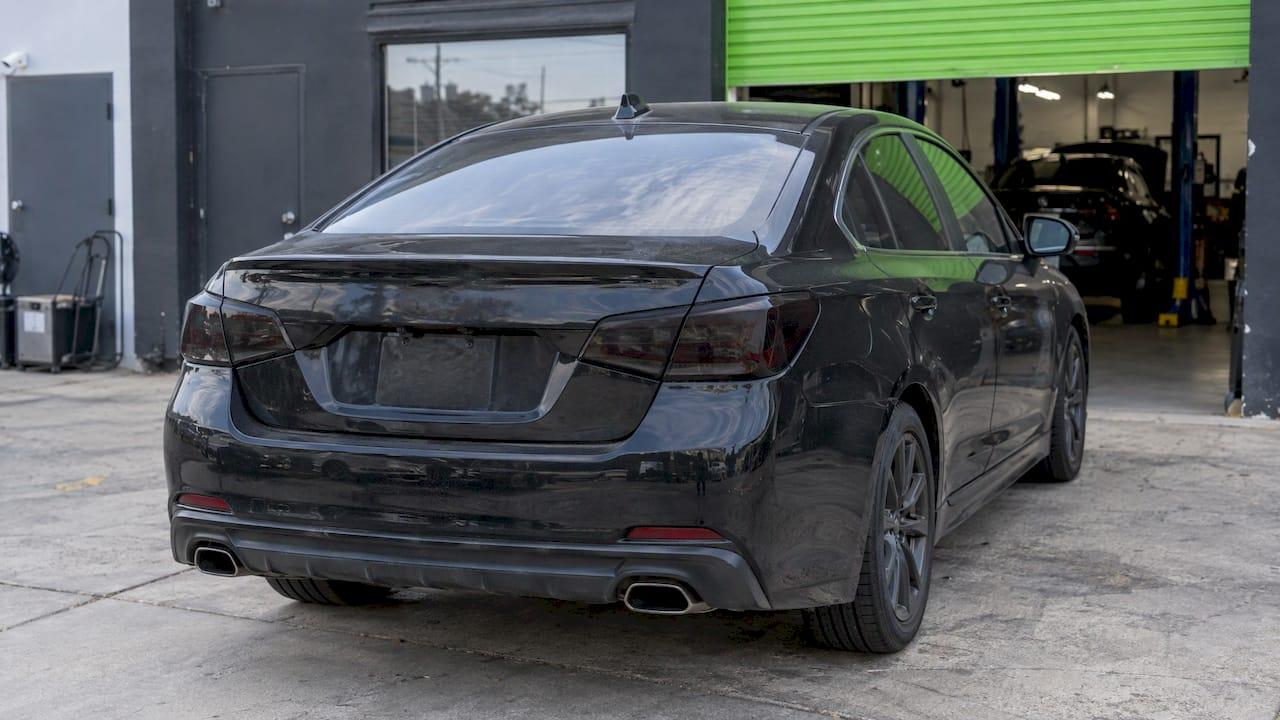
For a street-driven car, no. California requires the light that leaves your taillights to be red and bright enough to be seen from a long way back, and film, spray or smoked covers that darken or change that light put you on the wrong side of the rule. The usual outcome is a correctable "fix-it" ticket, not a big fine, but you still have to undo the tint. This guide explains the rule in plain terms, how different products are treated, what a ticket looks like and how to get a smoked look that keeps you legal.
TL;DR
- California taillights must emit red light and be visible from 500 feet, or 1,000 feet on vehicles made after January 1, 1969.
- The CHP treats any means of changing the emitted color or dimming a lamp as unlawful, and that includes film, sprays and translucent covers.
- A typical citation is a correctable violation: you get up to 30 days to restore the lights and pay a $25 dismissal fee, though that process has a sunset date of January 1, 2027.
- If your lights are already tinted, removal returns them to a compliant state. Window tint is the legal way to get a darker, sleeker look.
Table of Contents
- What California actually requires of a taillight
- How the CHP treats film, sprays and smoked covers
- What happens if you get cited
- Is the law changing?
- Already have tinted taillights? Restore them before a stop finds them
- Get the darker look legally
- Checklist before you buy any rear lighting product
- Our approach to lighting at Tint & Wraps Customs
- Our view on smoked lights
- FAQ
- Sources
What California actually requires of a taillight
The law does not use the word "tint" for taillights so much as it describes what the lamp must do. Under Vehicle Code section 24600, every vehicle needs at least one taillamp, and most cars first registered after January 1, 1958 need two, one on each side at the same level. Taillamps must be red and visible from 500 feet. For vehicles manufactured after January 1, 1969, the distance is 1,000 feet.
Two more details matter for anyone shopping for aftermarket lights:
- Color. CVC section 25950 says light emitted to the rear and reflected light visible from the rear must be red, with listed exceptions such as yellow turn signals and white backup lamps. A rear lamp whose unlit lens is not red must have a red inner lens covering the entire lit area, except for backup lamps. That is why clear-lens lights with red bulbs are not automatically fine: the red has to come from a proper inner lens.
- Mounting height. Section 24600(f) puts taillamps on vehicles made on or after January 1, 1969 between 15 and 72 inches off the ground. This is about where the lamp sits, not tint, but it is part of the same equipment standard.
So the legal test is about performance. Does the finished lamp still glow red, and is it still bright enough to see? Dirt, a cracked lens or a failing bulb can create the same compliance problem as tint, as Catalyst Legal's overview of California tail light rules points out. Dark tint, smoked covers and decorative films get extra scrutiny because they hit the color and brightness requirements directly.
How the CHP treats film, sprays and smoked covers
The California Highway Patrol sets out how officers apply these rules in General Order 100.5, revised December 2023. Three points from it matter to a driver.
Anything that changes the color is out. The order calls any means of altering the emitted light to a prohibited color unlawful, and names lenses, covers, color filters and pigments applied to taillamps. Red lamps must look red, not yellow or pink, when viewed from directly in front of the lamp.
Slotted covers are the one carve-out. A slotted cover can be acceptable if it leaves at least 7.75 square inches of visible lens, keeps the light red and keeps the 1,000-foot visibility. Translucent covers over all or most of the rear lens that cut brightness or alter color are unlawful unless the lamp clearly still meets the Vehicle Code.
Modifying devices need test data. The order cites CVC section 26101, which prohibits selling or using a device that changes the original design or performance of a lighting device unless it complies with the regulations and the manufacturer has laboratory test data showing compliance. LegalClarity's explanation of tail light tint rules adds that aftermarket tail light films and sprays almost never come with that proof. It also reports that a "light smoke" film typically absorbs 20 to 40 percent of the light output, which can push a lamp below federal minimums referenced in the Vehicle Code.
Here is how the common products line up:
| Product | How California treats it on a road-driven car |
|---|---|
| Smoke or tint film over the lens | Alters color and brightness; the lamp is generally treated as noncompliant |
| Spray-on tint | Same issue, and typically no manufacturer test data |
| Translucent smoked cover over the lens | Unlawful unless the lamp clearly still meets the Vehicle Code |
| Slotted cover keeping 7.75 sq in of visible lens | Can be acceptable if light stays red and visible from 1,000 feet |
| Clear lens with red inner lens covering the whole lit area | Permitted by the color rule in section 25950 |
| Red-tinted bulb or coating on the bulb | Listed as illegal equipment by the City of Claremont police department |
The Claremont list also flags taillights that are too dim, washed out, or show yellow, white or other colors. For brake lights it notes that those on vehicles newer than 1979 must be red.
What about the third brake light?
The center high-mounted brake light is a rear lamp too, and the same logic applies: it must keep its required color and visibility. Treat it exactly like the main taillights when you are deciding what is safe to put over it.
What happens if you get cited
Most darkened-taillight tickets are written as correctable violations. According to LegalClarity, the notice under CVC section 40610 gives you up to 30 days to restore the lighting to factory condition, then you submit proof of correction to the court with a $25 fee per violation under section 40611. Ignore it and it can escalate to full fines.
FindLaw's guide to unlawful vehicle modifications describes the mechanics. A fix-it ticket has "yes" checked next to correctable violation. After you fix the problem, an authorized person signs the Certificate of Correction. If the court accepts it, the case is dismissed. If you miss the deadline, you pay the fine and may be cited again, which can show on your driving record.

Figures for a first offense vary by source. LegalDiaries reports a $25 base fine on a first offense, up to $197 with court fees, and $197 or more for repeat offenses. Your actual total depends on the court and county, so treat the figures as a range and read the number on your own citation.
There is also a knock-on risk. FindLaw notes that smoked taillights can give an officer a reason to pull you over, and any other issue found during that stop can bring its own citation. For many drivers, that is the more expensive part of a "cool look."
The January 1, 2027 sunset
LegalClarity's fix-it ticket guide notes that section 40610 contains a sunset clause and is scheduled to be repealed on January 1, 2027. It says the dismissal fee is typically $25 per corrected violation and that a dismissed correctable violation does not go on your driving record. If the Legislature does not renew the provision, the familiar 30-day window and $25 process could change for equipment tickets like tinted taillights. If you receive a notice, read its instructions and check the court's current procedure before relying on the old timeline.
Is the law changing?
The core rule is stable. The most recent change to the color section is SB 480, effective January 1, 2026, which amended section 25950. It keeps the requirement that light visible from the rear be red, and its listed exceptions include pre-1979 stoplamps, yellow turn signals, white backup lamps, qualifying reflectors and marker lamps on autonomous vehicles. Nothing in it makes smoked or tinted taillights acceptable on a regular road car.
Already have tinted taillights? Restore them before a stop finds them
If you bought a car with smoked lights, or added film years ago, you do not need to wait for a ticket. Restoring the lamps to their factory condition removes the problem. A correctable violation is closed by exactly that step, so doing it early skips the stop, the notice and the paperwork.
What the job involves depends on what is on the lamp:
- Film has to come off without scratching the lens or leaving adhesive behind.
- Spray is harder, because it can bond to the lens surface and needs careful removal.
- Residue left by either one can cloud the lens and dim the lamp on its own, so it needs to be cleaned fully.
Our guide to taillight tint removal walks through film, spray and residue. Our tint removal service is available at the Van Nuys shop if you would rather hand it off.
Get the darker look legally
Most people who ask about smoked taillights want the same thing: a car that looks sleek and a bit darker, without changing the paint. California gives you room to do that on the glass.
Window tint is regulated by its own rules, and it is a legal place to add privacy, heat reduction and UV protection. Our guide to California window tint laws covers the limits, and tint percentages explained helps you choose a shade. For the front windows, read what proof to carry for front window tint and, if you are thinking about the windshield, what the law allows there.
A few other ways to change a car's look leave the lamps alone:
- Vinyl wraps change the color of the body without touching the paint.
- Chrome delete blacks out trim and badges for the blacked-out look.
- Wheel and caliper painting adds contrast without any lighting change.
If your main question is about the front of the car, we cover it separately in our headlight tint checklist for California.
Checklist before you buy any rear lighting product
Use these questions on any aftermarket taillight, cover or film:
- Is the lit color red? Check it from directly behind and from the front of the lamp, the way the CHP describes.
- Does a red inner lens cover the whole lit area if the outer lens is clear or smoked?
- Is the lamp still visible from 1,000 feet in daylight on a vehicle made after 1969?
- Does the product come with manufacturer lab test data showing it complies?
- Are the lamps between 15 and 72 inches off the ground?
- Are all bulbs, lenses and seals in good shape? Condensation, cracks and dead bulbs count as problems too.
If a product fails any one of these on a street-driven car, expect it to fail at a traffic stop as well.
Our approach to lighting at Tint & Wraps Customs
We do headlight and taillight work at our Van Nuys shop, and you can see what we offer on our headlight and taillight tinting page. Our installations take place in a climate-controlled, dust-free facility, and we have protected more than 1,000 vehicles for drivers across the San Fernando Valley. If you are not sure whether a particular lighting change fits the rules for your vehicle, ask us before you book. For restoring lights that already have tint on them, or for a legal blacked-out look elsewhere on the car, we can take it from there.
Tesla and other EV owners can book with us for precise installs that avoid sensor interference. Start with our window tinting options for carbon and ceramic film, or go to the main site to request a booking.
Our view on smoked lights
The question we hear most is not "is it legal?" but "what can I do to make my car look the way I want?" That is the right question.
Taillights are safety equipment. They tell the driver behind you that you are braking, and they have to do it in traffic, at dusk and in glare. California writes that down as red light, visible from 1,000 feet, and officers enforce it by looking at what the lamp actually does.
So we point people toward the changes that give a car presence without touching that job. Window tint in the right shade, a wrap, a chrome delete, painted calipers. Done well in a clean, climate-controlled bay, they change how a car looks from every angle. And if a car arrives with old film or spray on the lamps, getting it back to factory condition is a straightforward way to leave the ticket worry behind.
If you are unsure what suits your car, bring it by and we will talk through the options.
Jake
FAQ
Are smoked taillights legal in California?
On a road-driven car, generally not. Taillamps must emit red light and be visible from 500 feet, or 1,000 feet for vehicles made after January 1, 1969. Film, spray and translucent covers that change the color or dim the lamp are treated as unlawful by the CHP unless the lamp clearly still meets the Vehicle Code.
Can I get a ticket in California if my car is registered out of state?
The equipment rules apply to vehicles driven on California roads, so an officer can cite a car for darkened rear lamps while it is in the state. The ticket process and fees can differ, so read the notice carefully and follow its correction instructions.
What is the penalty for tinted taillights?
Usually a correctable violation. You restore the lights to factory condition, get the Certificate of Correction signed, and pay a $25 fee per violation when you show proof to the court, according to LegalClarity. Missing the deadline can mean paying the full fine. That 30-day process is scheduled to sunset on January 1, 2027, so check the current procedure.
Do I need a third brake light that works?
Yes, if your vehicle was built with one, it is part of the required rear lighting. Keep it red, bright and unobstructed, and do not cover it with film or a darkened shell.
Sources
- California Vehicle Code, Division 12, Chapter 2, Article 3 (section 24600)
- California Vehicle Code section 24600
- California Vehicle Code, Division 12, Chapter 2, Article 15 (section 25950)
- California Highway Patrol General Order 100.5, Regulated Devices
- City of Claremont, Illegal Car Equipment
- Catalyst Legal, California Tail Light Laws
- LegalClarity, Can You Tint Your Tail Lights in California
- LegalClarity, How to Resolve a Fix-It Ticket in California
- FindLaw, Guide to Unlawful Vehicle Modifications
- LegalDiaries, California Tint Law 2026