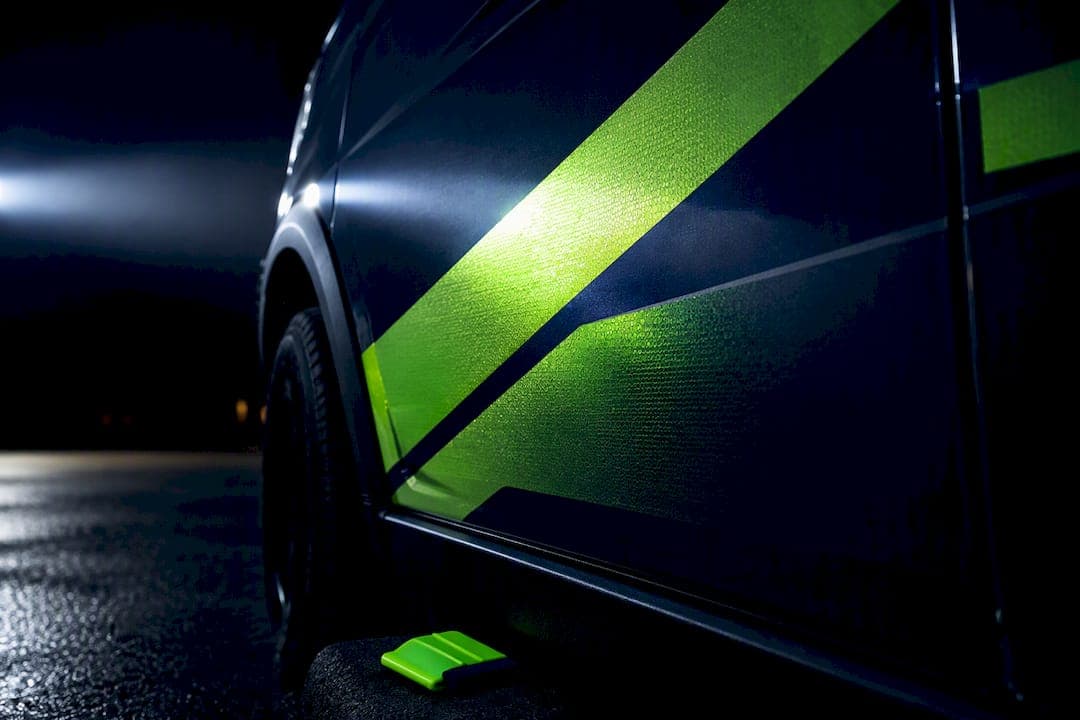
Reflective fleet graphics work: they cut nighttime detection distance for oncoming drivers and keep your logo visible around the clock, not just under daylight. The mechanism is retroreflection, and most commercial-grade films carry a service life of 3 to 9 years depending on construction. Specify the wrong material or skip the placement rules, though, and you lose both the safety benefit and the compliance cover.
TL;DR:
- Reflective fleet graphics can increase brand impressions by up to 40 percent and improve nighttime visibility, reducing crash risk.
- Microprismatic films offer better conformability around curved surfaces compared to beaded sheeting, which is brighter but stiffer.
- Installation quality depends heavily on climate-controlled environments, proper surface prep, and adherence to placement regulations for safety and compliance.
- Most reflective films last between 3 and 9 years outdoors, with shorter lifespans for high-UV or coastal routes requiring staging replacements.
- Proper design with high-contrast, large text and reflective backgrounds is essential to maintain legibility of graphics at night.
Table of Contents
- Why Reflective Fleet Graphics Matter for Safety and Branding
- How Does Retroreflection Actually Work?
- Which Reflective Materials Should You Choose?
- What Do Federal Rules Require for Placement?
- How Should You Install Reflective Graphics on Trucks and Vans?
- How Long Do Reflective Fleet Graphics Last?
- What Design Rules Keep Reflective Graphics Legible at Night?
- What Does a Reflective Graphics Project Cost, and What's the Return?
- What a Shop Owner Sees Across a Thousand Installs
- Ready to Spec Your Fleet's Reflective Graphics?
- Where to Verify These Standards
- Sources
- FAQ
Why Reflective Fleet Graphics Matter for Safety and Branding
A truck without reflective treatment is essentially invisible past your headlight throw at night, and that gap is where a lot of rear-end and merge collisions happen. Reflective materials return light straight back to an approaching driver's eyes, buying extra seconds of reaction time in rain, fog, or full dark. The NHTSA treats visibility as one of the cheapest, highest-leverage levers for reducing nighttime crash risk, and that's exactly what conspicuity tape and reflective decals are built to do.
The branding side isn't an afterthought bolted onto a safety product. Manufacturers behind reflective fleet films report impression uplifts of up to 40% because a lit-up logo at a gas station or intersection at night reads as more than daytime paint ever could. For fleet managers, that dual return shows up in a few concrete ways:
- Fewer nighttime near-misses and lower claims frequency for vehicles that stop, idle, or reverse in low light.
- Insurance underwriters increasingly ask about DOT conspicuity compliance during fleet policy reviews.
- Extra brand impressions at fuel stops, loading docks, and highway shoulders where a stopped vehicle sits for minutes, not seconds.
Statistic to know: reflective fleet films can lift brand impressions by up to 40%, a number worth citing when you're building the case for budget internally.
How Does Retroreflection Actually Work?
Retroreflection bends light back toward its source instead of scattering it, which is why a reflective decal glows under headlights while flat paint just sits there dark. Two technologies do this job. Glass-bead sheeting embeds thousands of tiny spheres that bounce light back within a wide but somewhat forgiving angle, and it's been the workhorse for decades. Microprismatic film, like the construction used in Avery Dennison's VisiFlex V-8000 series, uses molded prism structures that return light more efficiently and hold brightness at sharper viewing angles.
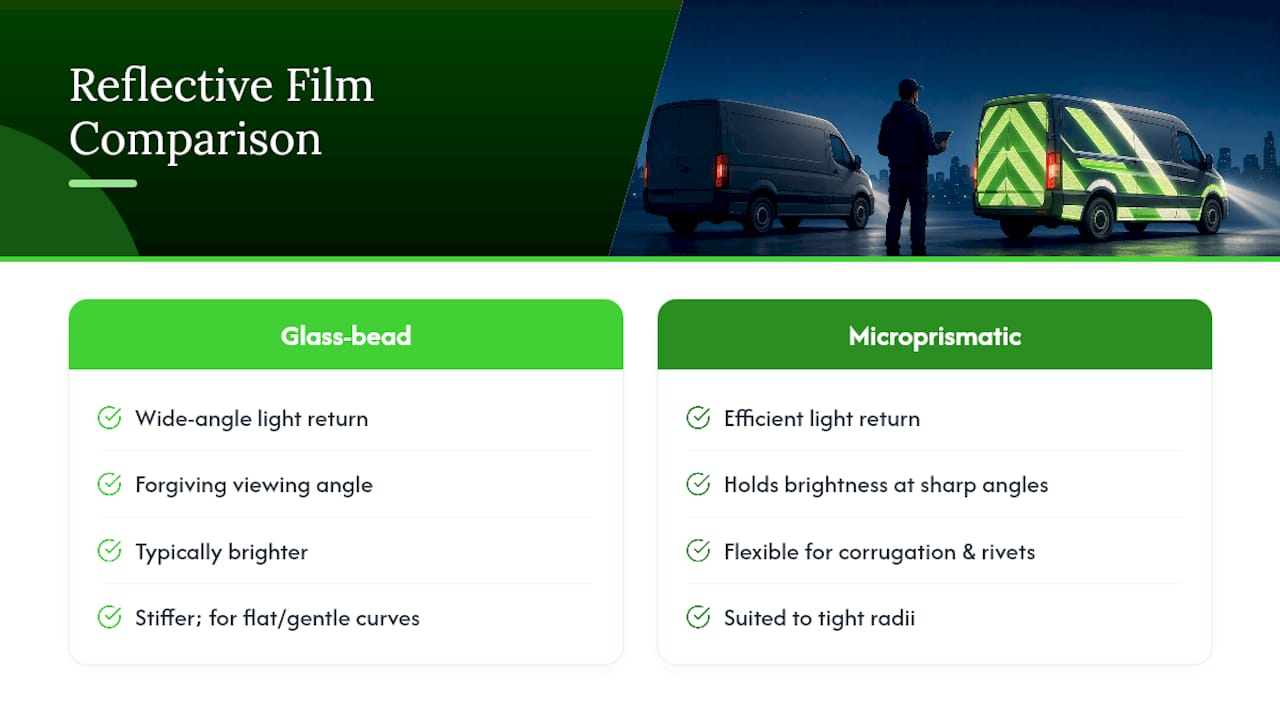
The practical difference is conformability. Beaded films are typically brighter but stiffer, so they suit flat panels and gentle curves. Microprismatic films flex around corrugation, rivets, and tight radii without cracking, which matters more than most buyers expect once a wrap has to wrap.
Which Reflective Materials Should You Choose?
Four material families cover almost every fleet job: printable reflective wrap film for full-color branding, engineer-grade beaded sheeting for high-brightness accents, DOT-C2 conspicuity tape for regulatory compliance, and cuttable reflective decals for logos and unit numbers. Each trades off print detail, brightness, and flexibility differently.
Run through this checklist before you commit to a spec:
- Coverage area. Full wraps need printable film; accent striping can use unprinted engineer-grade sheeting.
- Substrate. Corrugated box trucks and riveted trailers need conformable microprismatic film; flat panel vans have more options.
- Print method. Confirm the film accepts your shop's ink and laminate process before ordering rolls.
- Service-life target. ORALITE 5600 engineer-grade film lists roughly 6 to 7 years outdoors, while some single-layer microprismatic constructions push toward 9.
- Edge sealing. Multi-layer laminated systems generally need sealed edges to stop moisture creep; some single-layer microprismatic films skip that step entirely.
Pro Tip: Build a material matrix by vehicle class instead of ordering one film for the whole fleet. A rigid trailer, a box truck, and a service van each flex differently, and matching film family to surface complexity avoids the peeling and lifting that shows up first at rivets and door seams.
What Do Federal Rules Require for Placement?
Commercial vehicles fall under 49 CFR §393.11, which spells out reflex reflector counts, conspicuity system placement bands, and approved colors for trailers and trucks. FMVSS No. 108 governs the underlying lighting and reflective device standards that manufacturers and installers must meet. Before you sign off on a fleet graphics order, work through this short list:
- Confirm your conspicuity tape uses the required alternating red and white pattern along the sides and rear of trailers over a certain length.
- Check that reflectors sit within the height and spacing bands the regulation specifies, not wherever looks best on the mockup.
- Ask suppliers for datasheets showing ASTM D4956 certification, since that standard governs retroreflective sheeting classification.
- Keep documentation of certification markings in your procurement file in case of a roadside inspection or insurance audit.
How Should You Install Reflective Graphics on Trucks and Vans?
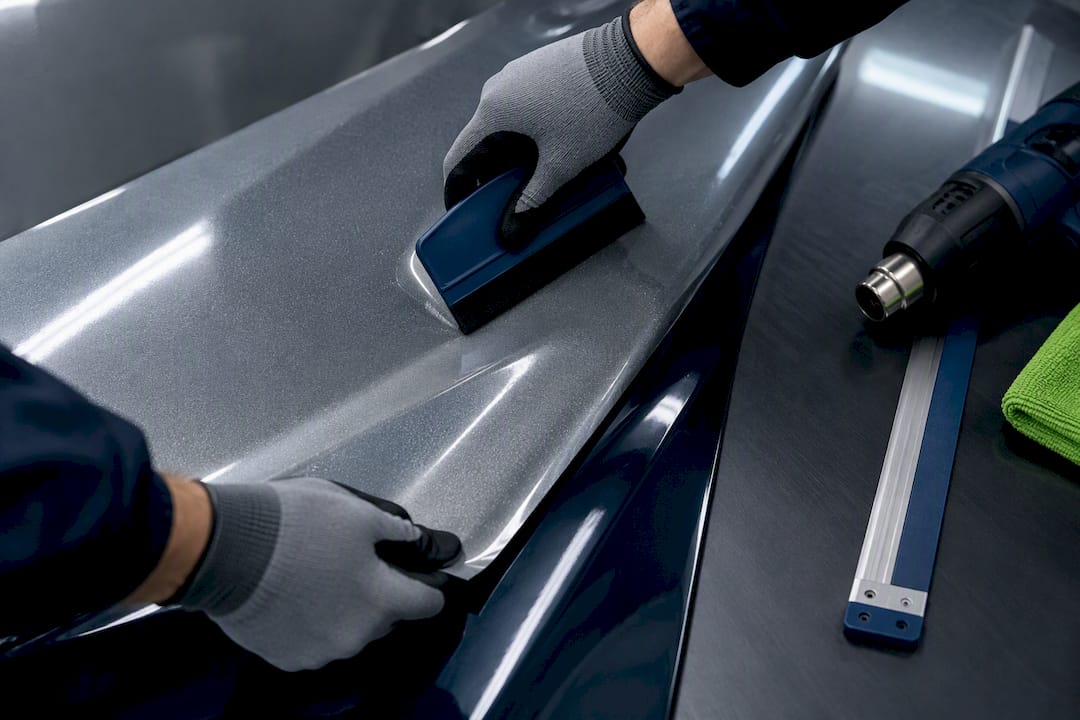
Surface prep and temperature control decide whether a reflective wrap lasts three years or nine. Film applied in a cold, dusty bay traps air and grit under the adhesive, and those bubbles turn into peeling edges within a season. That's the core reason manufacturers recommend climate-controlled installation with certified installers rather than an open-lot install.
Placement strategy also depends on vehicle class. Trailers get conspicuity tape along the lower side rails and rear, decals and branding above that band. Box trucks generally handle full rear-door wraps well since that panel is flat and highly visible to following traffic. Vans need extra care around wheel wells and door seams, where reflective film is most likely to lift first.
Before signing off on delivery, run a quick QA pass:
- Check every edge and seam for lift, bubbling, or visible adhesive residue.
- Verify reflective panels line up with the height and spacing bands your specification called for.
- Photograph the vehicle at night under headlights to confirm actual retroreflective performance, not just daytime appearance.
Pro Tip: Reject any installation with visible seams over rivet heads. That's the fastest failure point on a corrugated trailer, and it's almost always a sign the installer used a stiffer beaded film where a conformable microprismatic film belonged.
How Long Do Reflective Fleet Graphics Last?
Most reflective fleet films are rated for 3 to 9 years outdoors, with the wide range coming down to construction, color, and how much direct sun exposure a route sees. Fluorescent colors typically fade faster than white or silver microprismatic film. Vehicles that run coastal or high-altitude routes see more UV degradation than fleets parked in covered yards overnight.
Inspect graphics quarterly for chalking, edge lift, and reflectivity loss, and clean them with a non-abrasive wash to avoid scratching the prism or bead structure. Budget for staged replacement rather than a fleet-wide re-wrap: refresh the oldest 20 to 25 percent of units each year so no single budget cycle absorbs the full replacement cost at once.
What Design Rules Keep Reflective Graphics Legible at Night?
Reflective graphics that look sharp on a screen can turn into an unreadable blob under headlights if you ignore a few night-legibility rules. High-contrast type, generous letter spacing, and reflective backgrounds behind dark text tend to hold up best after dark. Photographic detail is the first casualty: fine gradients and small text simply don't retroreflect cleanly, so save that detail for non-reflective panels.
Production constraints follow from the film itself:
- Confirm your printer, ink set, and laminate are all rated for the specific reflective substrate, since not every combination bonds correctly.
- Keep minimum type sizes larger than you'd use on standard vinyl. What reads at 10 feet in daylight can vanish at 50 feet under headlights.
- Print a physical test panel and photograph it at night before committing to a full production run.
A short fleet branding style guide keeps every unit consistent as you roll graphics out across a mixed fleet over multiple years.
What Does a Reflective Graphics Project Cost, and What's the Return?
Cost scales with coverage: reflective decals and conspicuity tape run far cheaper per vehicle than a printed partial or full reflective wrap, and installation downtime follows the same curve, from a couple of hours for accent tape to a full day or more for a complete wrap. The biggest cost driver isn't the film itself but labor time on complex surfaces like corrugated trailers or vehicles with heavy rivet lines.
For a rough ROI case, pair the 40% impression uplift manufacturers cite against your existing marketing cost per impression, then weigh that against even one avoided nighttime incident. Most fleets pilot one or two sample vehicles before committing to a full rollout, which catches placement or color issues before they multiply across twenty trucks.
What a Shop Owner Sees Across a Thousand Installs
Running installs day after day teaches you where reflective graphics actually fail, and it's almost never the film. It's dust in the bay, a rushed cure time, or a beaded sheet forced onto a curve it was never meant to handle. Working in a climate-controlled facility and specializing in Tesla and EV installs, on top of manufacturer-backed warranties and a strong track record from numerous vehicle installations, means fewer comebacks and less guessing about whether a wrap will hold at rivet lines. An experienced local installer catches a wrong-film call at the mockup stage instead of six months into a fleet contract, and that's the difference between one clean rollout and a slow-motion recall.
— Jake
Ready to Spec Your Fleet's Reflective Graphics?
A specialist shop runs every fleet job through a climate-controlled facility used for Tesla and EV installs, which means no dust-trapped bubbles, no rushed cure times, and no rework six months down the road. That's the real advantage over a lot-based install: a flawless first pass backed by manufacturer warranties, not a redo.

If you're weighing reflective decals against a full wrap for a mixed fleet, start with a fleet audit and mockup rather than guessing at material specs. The shop can walk through vehicle classes, recommend film families per unit, and build a staged installation plan that spreads cost across budget cycles instead of hitting one quarter all at once. Check fleet wrap pricing and options to request an assessment for your fleet, or browse the full vehicle wrap services if you're still comparing accents against full coverage. Seasonal downtime planning matters here too. Coordinating install windows around slower fleet-usage periods, the kind fuel-efficiency scheduling guides recommend for winter operations, keeps trucks earning instead of sitting in a bay.
Where to Verify These Standards
Check placement rules directly against 49 CFR §393.11, pull service-life and application data from manufacturer datasheets like 3M's Scotchlite IJ680, and review night-driving safety context through NHTSA.
Sources
- Reflective Films and Wraps - Fleet Graphics and Signage | 3M US
- VisiFlex V-8000 Series product databook (Avery Dennison)
- 49 CFR § 393.11 — Lamps and reflective devices
- ORALITE® 5600 Fleet Engineer Grade (ORAFOL Americas)
FAQ
Are Reflective Car Decals Legal?
Yes, reflective decals are legal on commercial and personal vehicles as long as placement and colors follow 49 CFR §393.11 for commercial fleets. Passenger vehicles have more flexibility, but reflective material still can't obstruct required lamps or windows.
What Is a Fleet Graphic?
A fleet graphic is any branded decal, wrap, or reflective decal applied across a company's vehicles to create consistent visual identity. Reflective fleet graphics add retroreflective film to that branding so logos and unit markings stay visible at night, not just during the day.
Can I Print on Reflective Vinyl?
Yes, several reflective films are designed specifically for digital printing, including constructions like 3M's Scotchlite IJ680. Not every printer and ink combination is compatible, so confirm substrate specs with your installer before running full-color artwork.
What Are Reflective Decals?
Reflective decals are cut vinyl graphics made from retroreflective sheeting, either microprismatic or glass-bead construction, that bounce headlight beams back toward the driver who cast them. They're commonly used for unit numbers, safety striping, and logo accents on trucks, trailers, and vans.
How Long Do Reflective Fleet Graphics Typically Last?
Most reflective fleet films carry service-life ratings between 3 and 9 years, depending on construction, color, and route exposure. Fleets running high-UV routes should plan toward the shorter end of that range and budget for staged replacement.