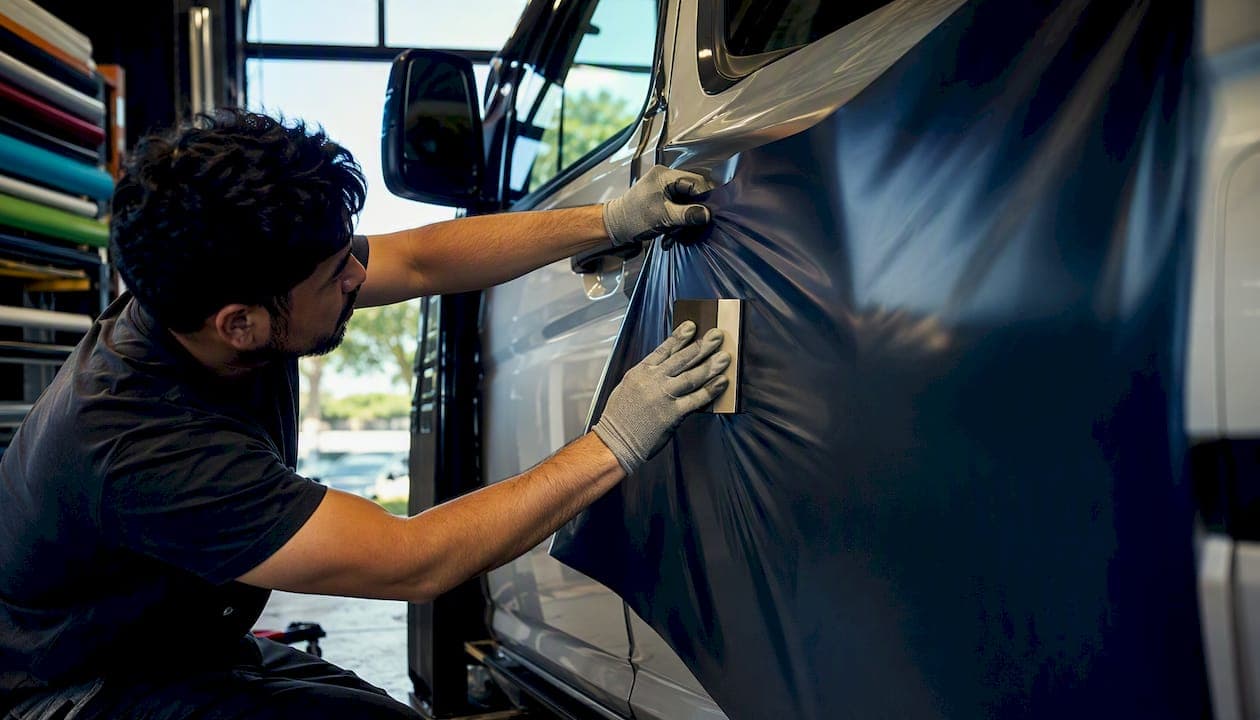
A full professional fleet wrap runs $2,500–$6,500 per vehicle in 2026, depending on vehicle size, vinyl grade, and your market. Partial wraps (25–50% coverage) typically land 40–60% lower than a full wrap on the same vehicle. At a $4,000 average amortized over five years, that works out to roughly a low cost-per-thousand-impressions figure — a cost that undercuts most radio and digital buys, according to OAAA benchmarks used industry-wide.
For a contractor averaging $2,500 per job, a single $4,000 van wrap breaks even after fewer than two jobs. That math holds even before you factor in the five-year lifespan.
Three variables move the number most:
- Vehicle size and shape. A compact sedan wraps for $1,800–$3,500 fully covered; a box truck runs $4,000–$7,500.
- Vinyl grade. Premium cast film from brands like 3M or Avery Dennison costs more upfront but lasts 5–7 years. Economy calendered vinyl often fails in 2–3 years.
- Regional market. Metro markets (Los Angeles, New York, Chicago) typically add a 15–35% labor premium over national averages.
Key Takeaways
Fleet wraps deliver CPMs under $0.50 when amortized over a five-year lifespan, making them one of the lowest-cost advertising channels available to contractors and small-business fleet operators.
| Point | Details |
|---|---|
| Per-vehicle budget range | Full wraps run $2,500–$6,500; partial wraps cost 40–60% less on the same vehicle. |
| Biggest vendor question | Ask for the vinyl brand name and part number — it separates premium cast film from cheap calendered vinyl. |
| CPM and break-even | At $4,000 amortized over five years, CPM runs roughly $0.48; a contractor averaging $2,500 per job breaks even in under two jobs. |
| Material grade matters most | Premium cast vinyl (3M, Avery Dennison) lasts 5–7 years; economy calendered vinyl often fails in 2–3 years. |
| Tintandwrapscustoms fleet service | Climate-controlled installs in Van Nuys with manufacturer-backed warranties and transparent fleet quote process. |
Table of Contents
- How much does fleet wrap cost by vehicle type and coverage?
- What drives the biggest price differences between quotes?
- Which vinyl brands and grades actually hold up?
- How do you calculate CPM and break-even jobs for a fleet wrap?
- How should you prepare and compare fleet wrap quotes?
- What a professional installer actually prioritizes on a fleet job
- Tintandwrapscustoms handles fleet wraps from quote to installation
- Sources
How much does fleet wrap cost by vehicle type and coverage?
The table below reflects 2026 national averages for professional installation.
A partial wrap on a cargo van runs roughly half the cost of a full wrap on the same vehicle. That ratio holds across most vehicle classes, which makes partials a practical starting point for contractors who want branded presence without the full-fleet budget commitment.
Box trucks and cargo vans are particularly cost-effective advertising platforms because of their large flat panels and high daily impression counts, though they require more prep and install hours, which pushes labor costs up relative to smaller vehicles.
Volume discounts change the math significantly. Most installers structure fleet pricing in tiers. Per vehicle wrap pricing data, typical discount ranges look like this:
- 5–9 vehicles: 10–15% off per-vehicle price
- 10–24 vehicles: 15–20% off
- 25+ vehicles: 20–25% off
Spreading design and setup fees across a larger fleet lowers per-vehicle cost faster than negotiating a marginal material discount. A 10-vehicle fleet that shares one master design file can save $200–$400 per vehicle in design fees alone.
What drives the biggest price differences between quotes?
Four factors explain most of the gap between a $2,800 quote and a $5,500 quote for the same vehicle. Material grade and coverage level are the two highest-impact variables; the others are real but secondary.
Coverage level is the most visible driver. Full wraps require more material, more labor hours, and more precise panel alignment. Every additional square foot of coverage adds both material and time cost.
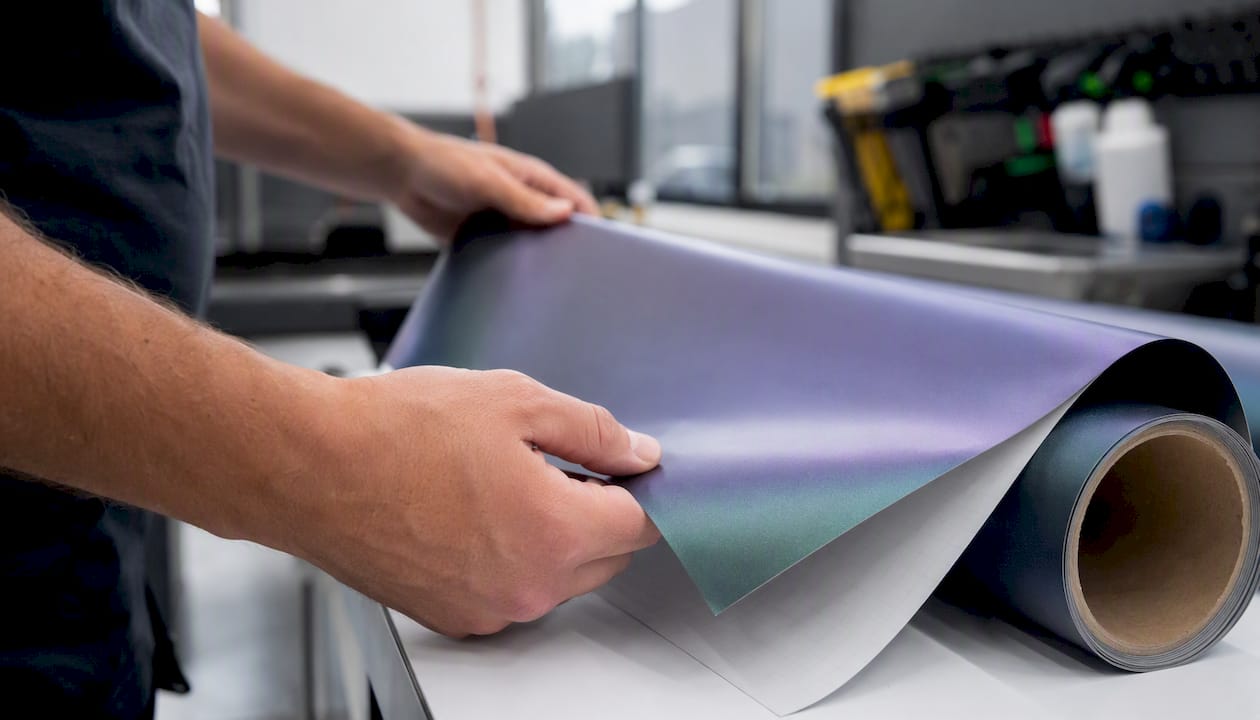
Vinyl material grade is the most consequential for long-term ROI. Cheap calendered vinyl can fail in 2–3 years and create adhesion problems at removal, sometimes damaging the paint surface.
Vehicle complexity matters more than most buyers expect. Deep door jambs, riveted panels, compound curves, and aftermarket accessories all add install time. A high-roof Sprinter with riveted panels takes meaningfully longer to wrap than a flat-sided box truck of similar square footage.
Design fees are usually a fixed cost, not a per-vehicle variable. A professional design file runs $300–$800 for a single vehicle; on a 10-vehicle fleet, that amortizes to $30–$80 per unit.
Other line items that move quotes:
- Surface prep and paint correction (often excluded from lowball quotes)
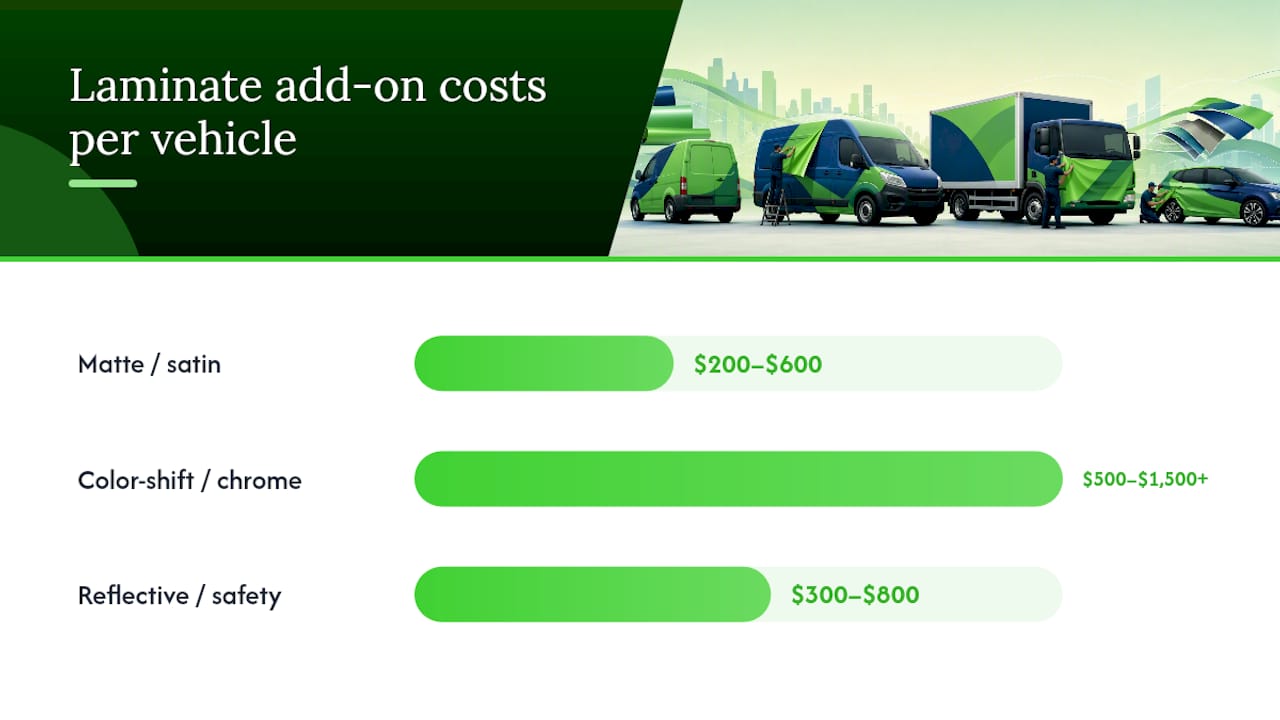
- Specialty finishes: matte, satin, color-shift, and reflective laminates
- Regional labor rates
- Warranty terms (installer vs. manufacturer coverage)
Red flags in a lowball quote:
- No mention of surface prep or paint correction
- Vinyl described only as "calendered" with no brand name or part number
- No written warranty or a warranty under one year
- Install timeline that seems unrealistically fast (a full cargo van should take 1–2 full days minimum)
- No sample photos of completed commercial jobs
Pro Tip: Ask every vendor for the vinyl brand name and part number before signing. A quote that names 3M IJ180Cv3 or Avery Dennison MPI 1005 is a fundamentally different product than one that says "premium vinyl" with no specifics.
Which vinyl brands and grades actually hold up?
The two dominant commercial-grade manufacturers are 3M and Avery Dennison, and both publish product warranties that cover print fade, edge lifting, and adhesion failure under normal use conditions. Asking for those warranty documents in writing is not optional on a fleet job.
Calendered (economy) vinyl is a flat-cast film that costs less per roll but tends to shrink over time, especially on curved surfaces. Expect 2–4 years of useful life in most U.S. climates, less in high-UV markets like Southern California, Arizona, or Florida. It works for short-term campaigns or low-exposure vehicles.
Cast vinyl is manufactured differently: the film is cast rather than extruded, which gives it dimensional stability on complex curves and a longer service life. Premium cast films from 3M and Avery Dennison typically last 5–7 years with proper laminate and maintenance, and they remove cleanly without damaging factory paint when installed correctly. That clean removal matters for fleet operators who rotate vehicles or plan to resell.
Specialty finishes add cost but serve specific purposes:
- Matte and satin laminates: Add $200–$600 per vehicle; lifespan comparable to gloss cast
- Color-shift / chrome films: Add $500–$1,500+ per vehicle; more fragile and harder to repair
- Reflective / safety laminates: Add $300–$800 per vehicle; required for some DOT-regulated vehicles
What to ask for in writing from any installer:
- Manufacturer name and product line for both the base film and laminate
- Number of years covered and what specifically is covered (fade, lifting, adhesion)
- Whether the warranty is from the installer, the manufacturer, or both
- What voids the warranty (improper washing, chemical exposure, parking conditions)
For context on how wrap warranties compare to paint protection film warranties, the PPF vs. vinyl wrap breakdown covers the key differences in coverage and longevity.
How do you calculate CPM and break-even jobs for a fleet wrap?
The math is simpler than it looks. Two formulas cover everything a contractor needs:
Amortized annual cost = Total wrap cost ÷ Lifespan in years
CPM = (Amortized annual cost ÷ Annual impressions) × 1,000
OAAA benchmarks are the industry standard for estimating vehicle impressions. A typical commercial van operating in a mid-size U.S. metro generates roughly 30,000–70,000 daily impressions depending on routing and market density.
Sample scenario 1: Contractor cargo van
- Full wrap cost: $4,000
- Lifespan: 5 years
- Amortized annual cost: $800
- Annual impressions (conservative): 10,950,000 (30,000/day × 365)
- CPM: ($800 ÷ 10,950,000) × 1,000 = $0.07
Sample scenario 2: Box truck, urban route
- Full wrap cost: $6,500
- Lifespan: 5 years
- Amortized annual cost: $1,300
- Annual impressions (moderate): 18,250,000 (50,000/day × 365)
- CPM: ($1,300 ÷ 18,250,000) × 1,000 = $0.07
Both scenarios produce CPMs well under $0.50, consistent with the amortized CPM analysis that puts a $4,000 wrap at roughly $0.48 CPM using more conservative impression assumptions.
Break-even example for a contractor:
- Wrap cost: $4,000
- Average job value: $2,500
- Revenue needed to cover wrap: $4,000
- Jobs to break even: 1.6 jobs (round up to 2)
Upgrade to premium cast vinyl at $5,500 and a 7-year lifespan, and the amortized annual cost drops to $786 — lower than the economy option at 5 years. Higher material grade often improves the long-term CPM even when it raises the upfront price.
How should you prepare and compare fleet wrap quotes?
Getting comparable quotes requires giving every vendor the same inputs. Inconsistent requests produce inconsistent quotes, and you end up comparing different products at different scopes.
Before you contact any vendor, prepare:
- A vehicle list with year, make, model, and trim for each unit (VINs help for exact body measurements)
- Your desired coverage level per vehicle (full, partial, or cut decals)
- Artwork status: do you have print-ready vector files, or do you need design work?
- Your target install timeline and any scheduling constraints (vehicles that can't be down simultaneously)
- Your fleet size, so vendors can quote volume pricing from the start
Questions to ask every vendor:
- What vinyl brand and part number will you use for the base film and laminate?
- Is surface prep and paint correction included, or quoted separately?
- Does the price include wrap removal at end of life?
- What is your install timeline per vehicle, and how many vehicles can you complete per week?
- Can you show me photos of completed commercial fleet jobs?
- What are your deposit and payment terms?
- What warranty do you provide, and is it backed by the manufacturer or just your shop?
Hidden fees that inflate final invoices:
- Wrap removal on vehicles with existing graphics
- Door jamb coverage (often excluded from partial-wrap quotes)
- Chrome delete or specialty panel treatment
- Rush scheduling fees
- Design revisions beyond a set number of rounds
A standard cargo van full wrap takes 1–2 full shop days. A box truck runs 2–3 days. Budget install downtime accordingly when scheduling a multi-vehicle fleet, and ask whether the shop can stagger installs to keep vehicles in rotation.
For fleet operators managing vehicles that also need scheduled maintenance, coordinating wrap installation with other service windows (like mobile A/C servicing) can reduce total downtime across the fleet.
What a professional installer actually prioritizes on a fleet job
Fleet jobs look straightforward from the outside. In practice, the complexity is in the consistency, not the individual vehicle.
A shop taking on a 10-vehicle fleet isn't just wrapping 10 vans. It's calibrating print output so the same red looks identical on vehicle one and vehicle ten, managing scheduling so your business isn't missing five trucks at once, and running quality checks at each stage: surface prep, print alignment, panel seams, and edge finishing. Any one of those steps done poorly on vehicle three shows up as a visible mismatch next to vehicle seven in your parking lot.
The volume-discount economics exist because shops can batch material orders, run a single design proof across all units, and schedule install crews efficiently over a compressed window.
Install capacity at a professional shop typically runs 1–3 vehicles per day depending on vehicle size and coverage level. For a 10-vehicle fleet, plan for a 1–2 week window, not a single day. Shops that promise faster turnarounds without additional crew are usually cutting prep time, which shows up later as edge lifting or bubbling.
Pro Tip: Schedule your fleet install in two or three batches rather than all at once. You keep vehicles in service, the shop maintains quality control without rushing, and you can inspect the first batch before committing the rest of the fleet.
On warranties: installers typically guarantee their workmanship (seams, edges, bubbles) for 1–2 years. Manufacturer warranties from 3M and Avery Dennison cover material defects separately, often for 3–7 years depending on the product line. You want both in writing, not just one.
Tintandwrapscustoms handles fleet wraps from quote to installation
Tintandwrapscustoms brings fleet branding projects into a climate-controlled facility in Van Nuys, CA, which eliminates the dust, humidity, and temperature variables that cause adhesion failures in open-bay shops. With over 1,000 vehicles protected and a 5-star service record, the shop handles everything from single-vehicle color changes to multi-unit commercial fleet graphics, including EV and Tesla fleet installs that require panel-specific expertise.
Every fleet quote from Tintandwrapscustoms covers surface prep, manufacturer-backed vinyl (3M and Avery Dennison product lines), and written warranty documentation so you can compare it line-for-line against any other proposal. Design coordination, door jamb coverage, and removal terms are addressed upfront, not buried in fine print.
To request a fleet estimate, contact Tintandwrapscustoms with your vehicle list, coverage preference, and timeline. The shop will confirm material specifications, scheduling availability, and payment options before any work begins.
Sources
The pricing ranges, CPM figures, and lifespan data in this article draw from the following sources. Each is worth bookmarking if you want to verify numbers or dig deeper before committing to a fleet budget.
- Fleet Wrap Cost Guide for Contractors in 2026 | JedHead
- Vehicle Wrap Pricing: Real Costs, calculator and Price Factors
- How Much Does a Van Wrap Cost? 2026 Complete US Pricing Guide
- How Much Does a Vehicle Wrap Cost for a Business in 2026? | Bison Branding Blog
- OAAA
- Box Truck & Cargo Van Wrap Cost: 2026 Commercial Pricing | Wraptor Blog