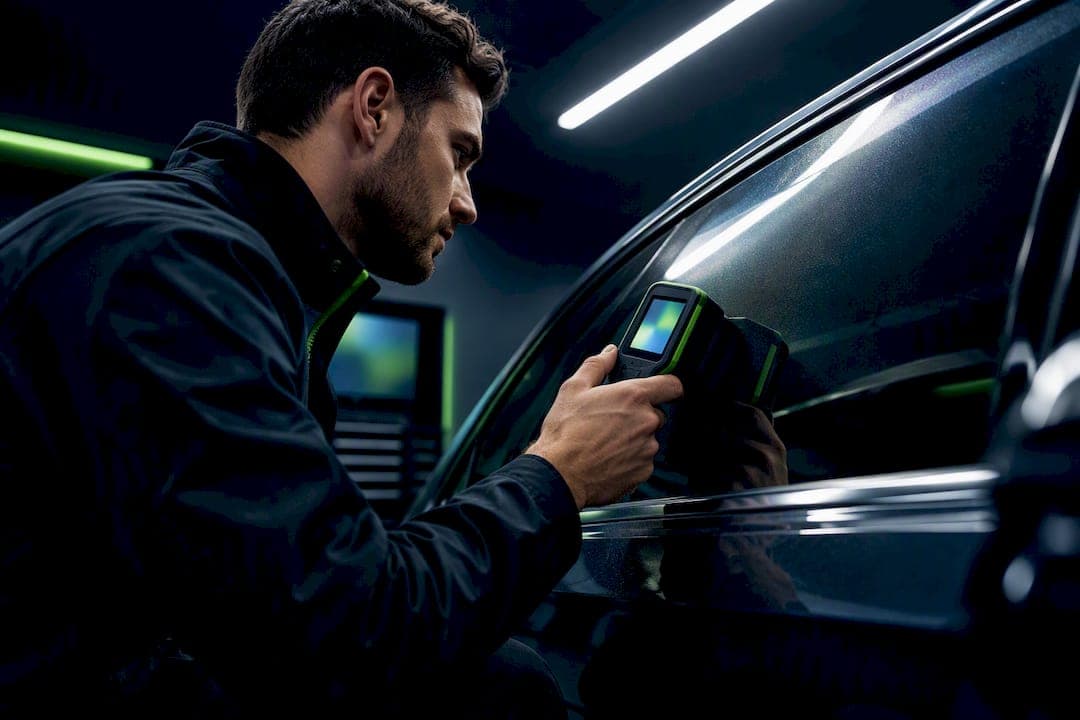
Metallic (metalized or sputtered) window tint can weaken or disrupt some vehicle radio-frequency signals, and the severity depends on the film's metal construction and where your antenna sits. GPS, AM/FM, satellite radio, and marginal cell signals are the systems most likely to suffer. Key fobs rarely lose meaningful range. If you're chasing a dropped-signal mystery after a tint job, run the diagnostic checks below before you blame your phone or your car.
TL;DR:
- Metallic films, especially sputtered types, create a continuous conductive layer that can significantly disrupt GPS, AM/FM, and satellite radio signals if antennas are positioned near heavily tinted windows.
- The interference is most noticeable in areas with weak signals and on rear-window antennas, which are typically most affected by metallic tint's reflectivity and electrical conductivity.
- Testing for tint-related signal loss involves comparing window-up and window-down performance, changing vehicle orientation, and testing outside the vehicle with different devices.
- Ceramic and carbon films offer comparable heat rejection without RF interference, making them better options for drivers who rely heavily on GPS and cellular signals.
- Fixing signal issues often requires replacing metallic tint with non-metallic options like ceramic or carbon films, especially if the original tint is sputtered metallic, with proper installation and testing practices essential.
Table of Contents
- What Causes Metallic Tint Interference
- Which Devices Show Symptoms First
- How to Test for Tint-Caused Signal Problems
- Metallic Tint vs. Ceramic, Carbon, and Dyed Film
- Fixing Interference Without Starting Over
- What Installers See on the Shop Floor
- Balancing Heat Protection Against Signal Reliability
- Get a Signal-Safe Tint Job Done Right
- Sources
- FAQ
What Causes Metallic Tint Interference
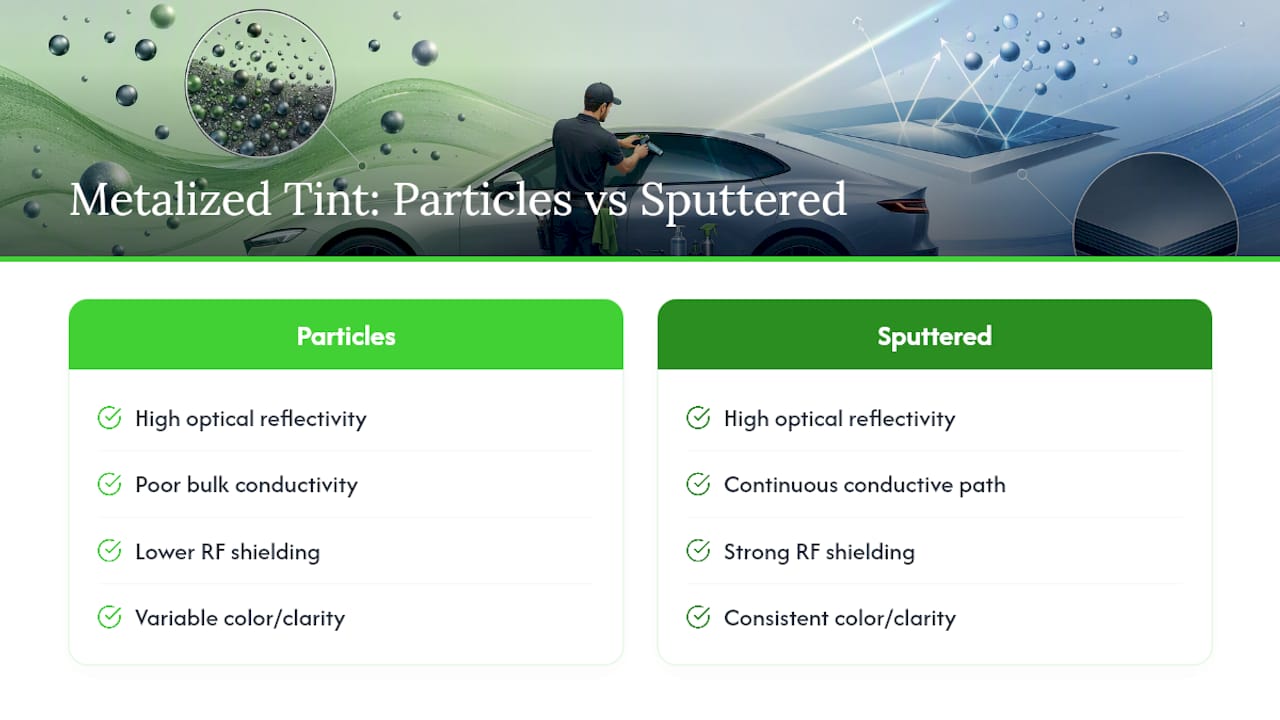
Metalized tint gets its heat-blocking punch from actual metal, either tiny embedded particles or a sputtered layer deposited in ultra-thin coats. Both types reflect infrared light effectively, which is exactly why people choose metallic film in the first place. Metal that reflects light also tends to reflect or absorb radio waves, and that's where the trouble starts.
The physics splits into two separate behaviors that get confused constantly. One is optical interference, the colorful shimmer or rainbow effect you sometimes see on metallic film. That comes from thin-film interference, where light bounces between layers and produces constructive and destructive wave patterns, similar to what you see on a soap bubble. It's a visual effect and has nothing to do with your phone's signal bars dropping.
The other is RF shielding, and this is the real culprit. A continuous conductive layer acts like a partial Faraday cage. Radio waves hit the metal and get reflected back out, absorbed as heat, or scattered in directions that scramble the signal your antenna is trying to receive. Research on metalized microstructures shows that thin metallic layers create strong reflectivity through multi-bounce reflection interference, and that same continuity that makes the film reflective optically is what gives it a conductive path electrically.
Not all metallic films behave the same way. Older-style films use discrete metal particles, essentially tiny islands of aluminum or similar pigment suspended in the film matrix. Manufacturer data on metallic effect pigments confirms these are genuinely conductive metals, but because the particles don't touch each other edge-to-edge, the layer as a whole conducts poorly. Sputtered films are different. They're vacuum-deposited in a continuous sheet, which gives better optical clarity and color consistency, but also a much more complete conductive path.
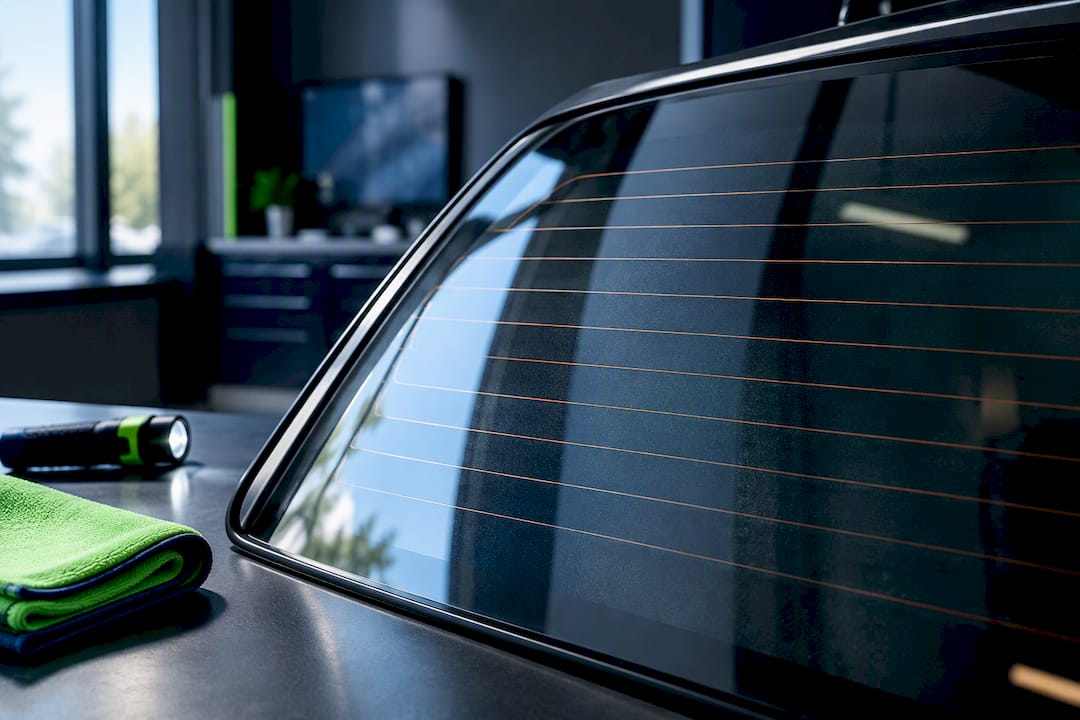
Placement matters too. A rear window carrying most of your metallic tint will hit your AM/FM antenna hardest if that antenna lives on the rear glass or trunk lid. Side windows affect a phone sitting in a cupholder more than they affect a roof-mounted GPS puck. Windshield strips, where legal, sit closest to forward-facing sensors and radar-based safety systems, which is one reason most states restrict how far down windshield tint can go.
Which Devices Show Symptoms First
Not every gadget in your car reacts the same way, and knowing the pattern helps you figure out fast whether tint is actually the problem.
- GPS units and phone navigation often show slower fixes when you first start the car, and worse accuracy in urban canyons, parking garages, or under heavy tree cover, since GPS signals are already weak by the time they reach your dashboard.
- Cell phones lose bars and data speed most noticeably in areas where signal was already marginal, like rural highways or the edge of a carrier's coverage map. A strong signal area may mask the problem entirely.
- AM/FM and satellite radio tend to show static, dropouts, or complete loss of reception, and this hits hardest on vehicles with a rear-window or trunk-mounted antenna sitting directly behind heavily tinted glass.
- Key fobs and remote entry systems rarely lose meaningful range, but a small number of drivers with metalized tint report needing to stand closer to the vehicle than they used to.
Built-in antenna type and location explain most of the variation between two seemingly identical cars behaving differently. A shark-fin roof antenna sits above the metallic layer's worst effects. A glass-embedded rear antenna sits right in the middle of it.
How to Test for Tint-Caused Signal Problems
Before you assume your phone is broken or your car's electronics are failing, run through this sequence. It takes fifteen minutes and rules out almost everything else.
- Compare windows down versus up. Park somewhere with a known weak signal, roll every window down, and check your GPS lock time, phone bars, and radio reception. Roll them back up and check again in the same spot.
- Test the device outside the vehicle. Walk ten feet away with your phone or a handheld GPS unit and confirm the signal improves. If it does, the car itself, not the device, is the variable.
- Change the vehicle's orientation. Turn the car 90 or 180 degrees in the same parking spot. If reception shifts depending on which side faces a cell tower or satellite, that points toward the antenna's relationship to the tinted glass nearest it.
- Swap devices and log results. Try a second phone, a different GPS unit, or a portable radio. Note bars, fix time, and static levels for each, ideally with a timestamped screenshot.
- Escalate if the pattern holds. If windows-down consistently outperforms windows-up across multiple tests, it's time to call your installer or a dealer service department rather than keep guessing.
Pro Tip: Run these tests at the same time of day and location for every trial. Cell tower load and satellite geometry both shift throughout the day, and comparing a 9 a.m. test to a 6 p.m. test will give you false confidence either way.
Metallic Tint vs. Ceramic, Carbon, and Dyed Film
Four film families dominate the market, and they don't behave anywhere close to equally once radio frequency enters the conversation.
Dyed film uses colored dye layers with no metal content, so it has essentially no RF impact, but it also does the least for heat rejection and fades faster than the alternatives.
Metalized film delivers strong heat and glare rejection through its metal particles or sputtered layer, but that same metal is the source of every interference issue covered in this article. Reflectivity is high, sometimes high enough to trigger legal limits in certain states, and cost sits in the middle of the pack.
Carbon film contains no metal at all. It uses carbon particles for heat rejection and UV blocking, performs close to metalized film on infrared rejection without the reflective glare, and carries no RF risk. Cost runs slightly higher than dyed film.
Ceramic film, built with non-conductive ceramic particles, is currently the strongest performer on heat rejection while staying completely non-metallic and RF-neutral. It costs more upfront but tends to outlast the other options and holds color better over time.
- Signal impact: dyed and carbon are lowest, metalized is highest, ceramic is effectively zero.
- Heat rejection: ceramic and metalized lead, carbon is close behind, dyed trails noticeably.
- Reflectivity and glare: metalized is highest, ceramic is moderate, carbon and dyed are lowest.
- Cost: dyed is cheapest, metalized and carbon sit in the middle, ceramic commands the premium.
If you drive a Tesla or another EV with heavy reliance on onboard connectivity, or if you already deal with weak cell coverage where you live, metalized tint is the one to skip. If you rarely use in-car navigation and your cell signal is consistently strong, the risk is smaller, though it's never zero. Community reports on driver forums consistently flag sputtered films as worse offenders than older particle-based metallic tints, which is worth asking about directly before you commit to any metallic product.
Fixing Interference Without Starting Over
You don't always need a full tint replacement to solve a signal problem. Work through these options roughly in order of cost and effort.
- Check connectors first. A loose antenna connection or corroded ground point can mimic tint interference perfectly, and it costs nothing to inspect.
- Relocate or upgrade the antenna. Moving a radio antenna away from the heaviest metallic coverage, or adding an amplified antenna, can restore reception without touching the film at all.
- Add a signal booster for cell service if the vehicle sits in a weak coverage zone regardless of tint. This solves the symptom even when the film stays in place.
- Replace the metalized film with ceramic or carbon. This is the most reliable fix. Expect a real improvement in GPS lock time and radio clarity, at the cost of a full re-tint rather than a patch job.
- Involve the dealer for OEM antenna modules, especially on newer EVs where navigation and cellular hardware are integrated into the glass or roofline rather than a standalone antenna.
Pro Tip: Before any replacement, ask your installer whether the film is sputtered or particle-based metallic. Sputtered layers are more likely to cause the continuous-conductivity problem, and that single question can save you a second tint job.
Ask any installer doing the work about film construction, whether they test signal before calling the job finished, and what the warranty covers if interference shows up after installation. A shop willing to answer all three specifically is one worth trusting with the work.
What Installers See on the Shop Floor
Interference complaints are often linked to two patterns: sputtered films and continuous metallic coverage sitting directly over an antenna zone.
- Sputtered metallic film causes more reported cases than older particle-based metallic tint.
- Rear-window antenna setups show symptoms fastest, often within days of installation.
- The fix in nearly every case is swapping to a ceramic or carbon film, with warranty-backed removal included when the original install was recent.
Full details on diagnosing these cases live in the shop's own breakdown of metalized tint interference causes and fixes.
Balancing Heat Protection Against Signal Reliability
Metallic tint isn't a bad product, it's a mismatched one for certain drivers. We steer EV owners, rideshare drivers who live on GPS, and anyone in a weak-coverage area toward ceramic or carbon almost every time. For a garage-kept weekend car with no navigation dependence, metalized tint's extra glare rejection is a fair trade.
Ask yourself which matters more: shaving a few more degrees off cabin heat, or trusting your phone's signal on a road trip. That answer decides the film.
— Jake
Get a Signal-Safe Tint Job Done Right
Tintandwrapscustoms is the alternative to guessing your way through a DIY film swap or gambling on a shop that won't test signal before calling the job done. Every install happens in a climate-controlled, dust-free facility, and the team's Tesla and EV experience means antenna and sensor zones get mapped before a single sheet of film touches the glass.
If you're dealing with dropped GPS fixes or static-filled radio after a metallic tint job, carbon tint or a full ceramic window tint swap solves it without sacrificing heat rejection. Both come backed by manufacturer-supported warranties, and the shop's five-star reputation reflects the attention paid to details like antenna placement that most installers skip. Reach out through Tintandwrapscustoms to schedule a diagnostic look at your current tint or book a straight replacement, and get a quote before your next road trip turns into another dropped-signal headache.
Sources
- Structural Color from Multi-Bounce Reflection Interference in Metalized Microstructures | ACS Applied Optical Materials
- Metallic Effect Tints (MIXOL) — Technical data
- Thin-film interference — Wikipedia
FAQ
Is Metalized Window Tint Good?
Metalized tint delivers strong heat and glare rejection and holds up well against fading, which makes it a solid performer for that purpose alone. The trade-off is a real risk of GPS, radio, and cell signal interference that ceramic and carbon films don't carry, so it's a better fit for drivers who don't lean heavily on in-car connectivity.
Does Metallic Tint Block Cell Phone Signal?
It can weaken cell signal rather than fully block it, and the effect shows up most in areas where reception was already marginal. Drivers with consistently strong coverage may never notice a difference, while those near the edge of a carrier's network often see dropped bars or slower data.
Can Metallic Tinting Affect the Navigation System?
Yes, metalized film can slow GPS fix times and reduce accuracy, especially in cities, parking structures, or under heavy tree cover where satellite signals are already weak. The effect depends heavily on whether your GPS antenna sits near the heaviest metallic coverage on the glass.
Is Metallic or Ceramic Tint Better?
Ceramic tint is the stronger overall choice for most drivers because it matches or beats metalized film on heat rejection without any RF risk, since ceramic particles carry no conductive metal. Metallic tint still has a place for vehicles with minimal reliance on GPS, radio, or cellular connectivity.