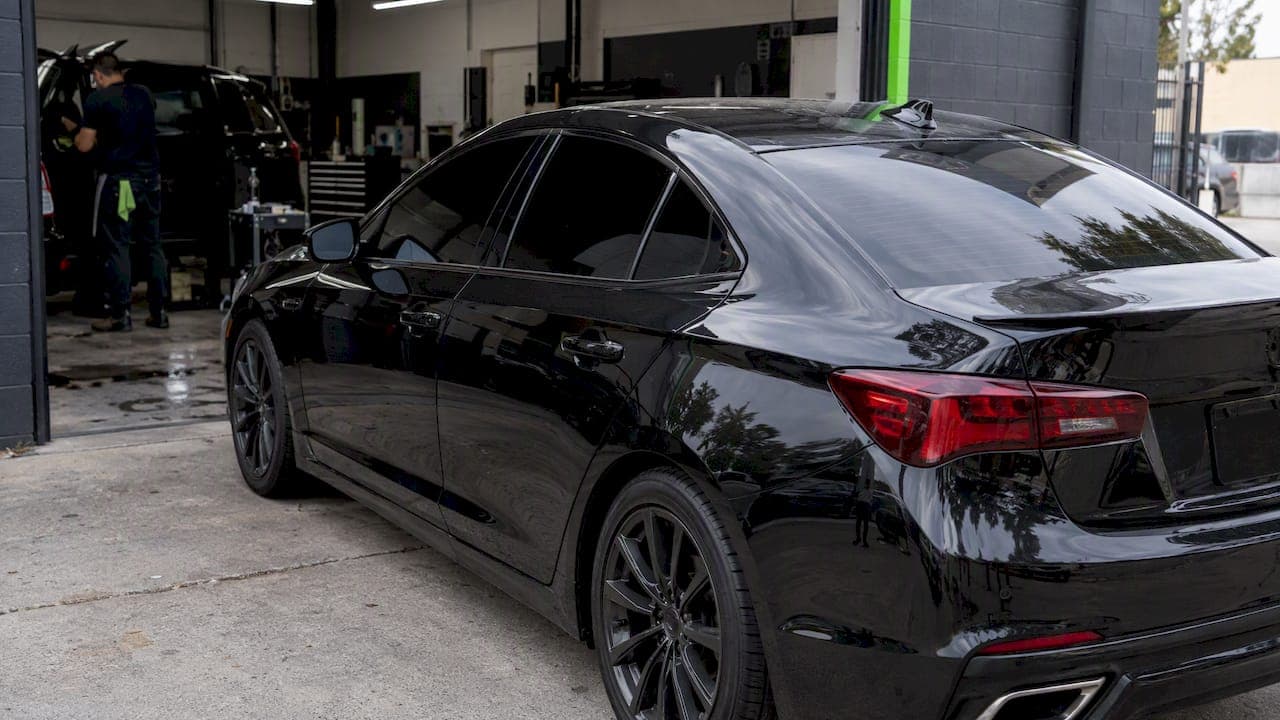
Limo tint is window film that lets about 5% of visible light through, so it blocks roughly 95%. Tint guides use "5%" and "limo tint" interchangeably. Some film lines also sell 2% or 3% shades, which are darker still. In California, 5% film is not legal on the front side windows of an ordinary passenger car. The rules for the rear glass are different, and the details matter.
Below: what the number measures, how 5% compares with the shades most drivers actually choose, what the law says, and what to ask a shop before any film goes on your glass.
TL;DR
- Limo tint means about 5% VLT. Only 5% of visible light passes through, and the lower the number, the darker the film.
- "Limo" describes darkness. It does not describe film type. A 5% film can be dyed, carbon or ceramic.
- Federal rules leave aftermarket tint to the states. In California, 5% film is not allowed on the front side windows of a passenger vehicle.
- UV protection does not depend on darkness. Ceramic films at lighter shades can reject 99% or more of UV.
- Ask for the measured VLT of the finished glass, not just the number printed on the film box.
Table of Contents
- What the percentage actually measures
- Limo tint next to the shades people actually choose
- Is limo tint legal?
- Limo tint vs. ceramic tint: a false choice
- Darker doesn't mean cooler or safer for skin
- How to choose a shade by window
- Perspective: what we tell customers who ask for 5%
- Questions to ask any shop before you book
- Tint, removal and what to do if your tint is too dark
- Book your tint at our Van Nuys shop
- FAQ
- Sources
What the percentage actually measures
Tint percentage refers to VLT, visible light transmission: how much visible light passes through the glass and film together. A 35% film lets 35% of light through. A 20% film lets 20% through. A 5% film lets 5% through. Manufacturer guidance is clear that a lower number means a darker window.
VLT is not a heat rating, and it is not a UV rating. Those are separate specifications:
- VLT: how much visible light gets through.
- UV rejection: how much ultraviolet is blocked.
- TSER (total solar energy rejected): how much of the sun's total energy the film keeps out.
This is the most common misunderstanding about limo tint. Many drivers assume that darker means cooler and safer for skin. It does not work that way. We cover that below.
Limo tint next to the shades people actually choose
Here is how common shades compare in daily use. These are general descriptions, and the real look depends on your glass, your film and the light outside.
| VLT | Common name | What it looks like | Typical use |
|---|---|---|---|
| 5% | Limo tint | Very dark from outside, hard to see out of at night | Privacy on rear glass, show cars |
| 20% | Dark | Dark, but you can make out shapes inside in daylight | Rear windows on SUVs and sedans |
| 35% | Medium | Noticeable tint, easy to see through from inside | Balanced look and visibility |
| 50% | Light | Subtle shade | Drivers who want UV and glare control with a stock look |
| 70%+ | Near clear | Almost unchanged | Front side windows in California |
The gap between shades is bigger than the numbers suggest. Going from 35% to 20% is a visible step. Going from 20% to 5% is a jump to a much darker window. Because the numbers measure light passing through, a 5% film passes a quarter as much light as a 20% film.
What it's like to drive with 5% film
During the day, 5% film gives strong privacy. At night, it is a different story. With so little light getting through, checking blind spots, backing up and spotting pedestrians gets harder. That is why most shops will not put it on a driver's front windows, and why many drivers who love the look still choose lighter film for the glass they look through the most.
The federal government explains the reasoning. NHTSA's interpretations describe light-transmittance standards as a way to keep the driver's view through the glass adequate. The California DMV driver handbook likewise stresses clear vision and glare management as part of safe driving.

Is limo tint legal?
The honest answer: it depends on the state, the window and the vehicle type. Nobody can give you a single yes or no.
Federal rules
Federal standard FMVSS 205 sets a 70% minimum light transmittance for areas that matter to driving visibility. NHTSA also explains that tint applied after the sale is a state matter. So the federal rule does not make 5% film legal everywhere or illegal everywhere.
NHTSA treats limousines and buses differently from passenger cars. In a passenger-car limousine, every window counts as important for driving visibility. In a bus or limousine with a capacity over 10 people, the rear windows may be treated differently under certain conditions. That is where the "limo" name comes from, but it does not turn your sedan into a limousine.

California rules
California law restricts material that changes the color or cuts the light transmittance of the windshield and the side and rear windows. In practice:
- Front side windows: a 70% VLT floor, measured with the film on the glass. Factory glass already blocks some light, so even a light film can put you under the line.
- Windshield: only a narrow strip at the top is allowed. Our guide on windshield tint in California covers it in full.
- Rear side windows and rear window: the rules are looser, and a darker film can be an option. Check the conditions, including mirror requirements, in our California window tint laws guide.
So 5% limo tint can have a place on a California car's rear glass. It does not belong on the front doors of a passenger vehicle.
Clear UV film is a separate pathway
California has a narrow route for clear, colorless film on the front side windows. It requires specified clear material, a minimum film VLT of 88%, compliance with applicable federal glazing requirements and documentation. It is not a loophole for dark tint. If you want that kind of film, read our piece on proof to carry for California front window tint.
Traveling or moving between states
The limit changes at the border. Some states are stricter than California and others are more relaxed. Minnesota, for example, exempts limousines from some tint limits but allows no aftermarket tint on the windshield. A film that is fine at home can draw a ticket in a neighboring state, so check the state where you register and where you drive most.
Limo tint vs. ceramic tint: a false choice
People often ask about the difference between ceramic tint and limo tint. They are not opposites. Limo describes how dark the film is. Ceramic describes what the film is made of.
A ceramic film can be made in a limo-dark shade. A 5% film can also be dyed, carbon or ceramic. Manufacturer specs show nano-ceramic lines in lighter VLTs of 17%, 27% and 39%, each with UV rejection above 99%.
So the real questions are:
- How dark do I want the glass? That is your VLT.
- What construction do I want? Dyed, carbon or ceramic changes heat performance, color stability and signal behavior.
Our two main film families are carbon window tint and ceramic window tint. Both can be matched to the shade that fits your glass and your state's rules.
Darker doesn't mean cooler or safer for skin
Many families come to us for UV protection. The good news is that you don't need limo-dark glass for it. Johnson Window Films states that its automotive films reject 99% or more of harmful UV rays. Technical sheets for other ceramic films show the same range at lighter VLTs.
Heat is similar. TSER and infrared numbers vary by product and test method, and they are not interchangeable with each other or with the cabin temperature you will feel. A pale ceramic film can outperform a dark dyed film on heat. If you are buying for comfort or UV, compare the full spec sheet for the exact film and not the shade alone.
How to choose a shade by window
Here is a practical way to think about it for a typical California daily driver. Treat it as a starting point, then confirm with your installer.
- Front side windows: stay at or above the legal floor. A clear or very light ceramic film still gives glare and UV benefits.
- Rear side windows and rear glass: this is where darker shades such as 20% or 5% are a possibility, depending on the vehicle and the law's conditions. Think about night visibility when reversing.
- Windshield: a narrow top strip at most. Don't tint the full windshield with dark film.
- Tesla and other EVs: large glass areas make film choice more important. Ask the installer about camera, antenna and sensor behavior before you pick a film.
Perspective: what we tell customers who ask for 5%
Most people who ask us about limo tint want one of three things: privacy, a sleek look, or relief from the sun. Only the first two call for 5% film. For the third, we usually recommend a lighter ceramic or carbon film, because UV rejection and heat control come from the film's construction and not its darkness.
We work in a climate-controlled facility, which matters more with dark film than people expect. Dust trapped under a 5% film is harder to spot in daylight, but it shows up as soon as the sun hits the glass at an angle. A clean install is the difference between film that looks custom and film that looks cheap.
We also care about getting the legal side right before you drive away. Before we start, we talk through each window position. You should leave with the film specification and an understanding of what was applied. If a customer wants front-window film that would put them over the line, we say so and offer an option that keeps them legal. We would rather lose that one job than send a customer out to collect a ticket.
For Tesla and other EV owners, we pay close attention to how film sits around the cameras and sensors, so the car behaves as it did from the factory.
— Jake
Questions to ask any shop before you book
These come straight from what an informed buyer should expect. Use them with any installer.
- What will the measured VLT be on each window after installation, with factory glass included?
- Is the film dyed, carbon or ceramic?
- What are the UV rejection and TSER ratings on the spec sheet?
- Will it affect cameras, antennas, GPS, cellular or other vehicle electronics?
- What does the warranty cover: bubbling, fading, peeling, installation defects?
- Will you provide the film documentation?
Don't assume that factory privacy glass equals a given film percentage. Glass and film combine optically, so the installed number can differ from the package number. A shop should measure the finished glass with a calibrated meter.
For fleets and businesses
If you are branding or outfitting several vehicles, treat dark film as a policy decision. Rear privacy film on passenger-transport vehicles may be treated differently from front glazing, but exemptions depend on the jurisdiction and vehicle class. California's rules on sun-screening devices are technical, with requirements such as at least 35% luminous transmittance and no more than 35% reflectivity for permitted removable devices. Before a fleet-wide rollout, approve one sample vehicle, record finished-glass readings and keep written film specifications. If you also want graphics, see our fleet wraps page.
Tint, removal and what to do if your tint is too dark
If you bought a car with film that is darker than the law allows, or old film has turned purple and bubbled, the fix is removal and a fresh install. Our tint removal service strips the old film and adhesive so the new film goes onto clean glass.
Book your tint at our Van Nuys shop
We install window tint, paint protection film, ceramic coating and vehicle wraps at our Van Nuys shop, and we install on Teslas and other EVs. Browse our window tinting options, then contact us through our site and tell us your vehicle, the windows you want done and the look you are after. We'll recommend a shade for each window and explain the reasoning. If you want smoked lights to match darker glass, we also offer headlight and taillight tinting.
FAQ
What is limo tint?
Limo tint is window film dark enough to pass only about 5% of visible light. Some brands sell even darker 2% or 3% films. The name comes from the dark rear glass on limousines.
Is limo tint legal in California?
Not on the front side windows of a passenger vehicle, where the floor is 70% VLT with the film on the glass. Rear windows follow different rules with conditions, so confirm yours with your installer and our California tint law guide.
Can you see through limo tint?
From inside during the day, yes, though everything looks dim. At night visibility drops sharply, which makes reversing and checking blind spots harder. That is why many drivers choose 20% or lighter for the rear.
What is the difference between 20% and 30% tint?
A 20% film passes 20% of visible light and a 30% film passes 30%. The 30% shade is noticeably lighter and easier to see out of, especially at night. Neither is legal on California front side windows.
Does darker tint block more UV?
Not necessarily. UV rejection depends on the film's construction. Ceramic films from major manufacturers list 99% or better UV rejection even in lighter shades.
Sources
- Mastering Tint Percentage Guide, Madico
- NHTSA interpretation on FMVSS 205 and state law
- NHTSA interpretation on federal and state tint rules
- California Vehicle Code 26708.5
- California Vehicle Code 26708.2
- California clear film provisions, AB-1942
- Is 5% window tint legal in California?
- Traditional Series specifications, Hüper Optik
- Automotive spec sheet, Johnson Window Films
- Limousine operators compliance corner, Minnesota DOT
- Safe Driving, California Driver Handbook, DMV