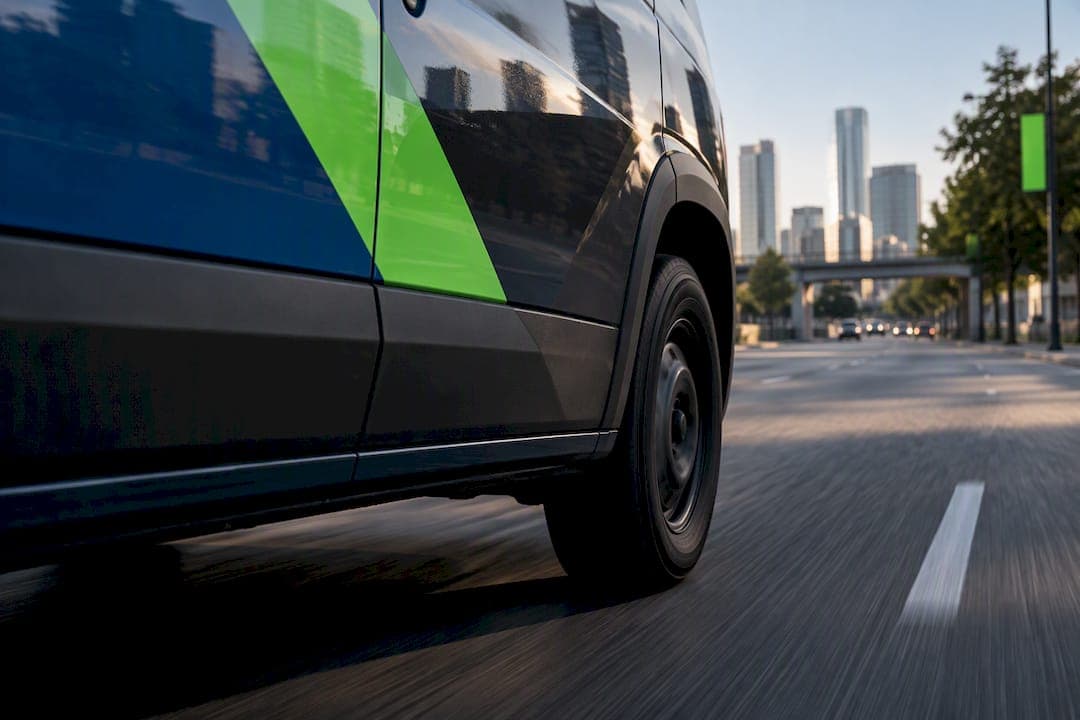
Design your fleet wrap for a three-second impression: 3 to 5 words and one strong visual, nothing more. Everything else in this guide exists to protect that message: durable film, clean proofing, and a mockup review process that catches problems before they hit the road. Before you brief a studio, gather your vector logo files and a complete vehicle list, since those two things determine how fast the project moves.
TL;DR:
- Full wraps provide the best brand exposure, lasting three to seven years, and are most effective on high-mileage vehicles like delivery vans.
- Use high-contrast colors and bold sans-serif fonts approximately 12 inches tall to ensure readability from about 60 meters at highway speed.
- Prioritize a simple message with three to five words and one visual element, avoiding cluttered designs that are unreadable from a distance.
- Cast vinyl offers better durability and flexibility for curves and complex shapes, with non-prorated warranties reducing long-term replacement costs.
- Schedule fleet wrap installations in climate-controlled facilities, and verify warranties and manufacturer-backed guarantees before proceeding.
Table of Contents
- Design rules that survive the road
- Full wrap versus partial coverage and what it means for ROI
- Why film quality and warranty terms decide your real cost
- What to hand your designer before work begins
- Reviewing mockups without slowing the project down
- Installation logistics and keeping the wrap looking sharp
- How a professional shop runs a fleet wrap project
- Legal rules your fleet wrap design needs to respect
- Keeping the wrap consistent with your existing brand identity
- Weather, sun exposure, and how they shape material choices
- What a fleet wrap actually costs and when it pays for itself
- Managing the timeline from approval to finished install
- What most fleet owners get wrong about wrap design
- Ready to get your fleet wrapped right the first time
- Sources
- FAQ
Design rules that survive the road
A driver passing your vehicle at highway speed has about three seconds to register your message before it's gone. That window is the entire design brief. Aim for 3 to 5 words and one primary visual: your business name, what you do, and a way to reach you. Anything longer gets skimmed and forgotten.
Typography carries more weight than most people expect. Use bold sans-serif fonts, never scripts or thin serif faces that blur at speed. The same guidance recommends letter heights around 12 inches on side panels so text stays legible from about 60 meters away. A phone number in a decorative font might look sharp in a design proof and be unreadable from a stoplight.
Color contrast matters as much as size. Dark text on a dark background, or two similarly saturated colors placed next to each other, disappears at distance even when the letters are large enough. Stick to high-contrast pairings and test them against your actual paint color, not just a white mockup background.
Placement rules keep the message consistent across the fleet:
- Put your logo and tagline on the front two-thirds of the side panel, ahead of the rear wheel well.
- Reserve the rear doors for a phone number or website since that's what following traffic reads longest.
- Keep QR codes off side panels entirely: nobody scans a code from a moving car.
- Skip long service lists, certifications, or social handles. Save that detail for your website.
Pro Tip: Print a scaled version of your design at actual letter height and view it from across a parking lot before you approve anything.
Full wrap versus partial coverage and what it means for ROI
Full wraps, partial wraps, and simple decals each cover a different budget and impression level. A full wrap covers the most surface and delivers the strongest all-around brand presence, while a partial wrap concentrates budget on the doors and hood where eyes land first. Decals cost the least but read more like a small sign than a moving billboard.
The economics favor wraps over most other advertising once you spread cost across the wrap's lifespan. A wrapped vehicle can generate tens of thousands of daily impressions, and a full wrap typically lasts 3 to 7 years, which produces a lower cost per impression than a billboard or TV spot over the same stretch. Full details on pricing tiers and what drives them are in our fleet wrap cost breakdown.
To know if it's working, track it:
- Use a dedicated phone number just for the wrapped vehicles.
- Send that number to a landing page separate from your main site.
- Ask every new customer how they found you and log the answer.
Prioritize your highest-mileage vehicles first: delivery vans and service trucks that log daily routes through dense traffic earn back their wrap cost faster than a truck parked most of the week. A fleet tracking system can help confirm which vehicles actually rack up the most road time before you commit budget to all of them.
Why film quality and warranty terms decide your real cost
Not all vinyl performs the same once it's stretched over a bumper or curved mirror housing. Cast film is thinner, more flexible, and holds up on complex curves without cracking, which is why most fleet installers specify it over calendared film for anything beyond flat panels. Calendared vinyl works fine for short-term promotions but tends to shrink and fade faster under daily sun exposure.

A non-prorated manufacturer warranty on premium film can cover full replacement for the warranty period rather than a declining percentage, which lowers total cost of ownership by reducing what you pay out of pocket if the film fails early. Ask your installer which warranty tier applies and get it in writing before signing a contract, not after.
Protective overlaminates add scratch and UV resistance on top of the printed film, which matters most for vehicles that get washed frequently or parked outdoors. Reflective or high-visibility accents on rear panels also improve nighttime recognition for delivery and service fleets.
Cheaper film often means a harder install and a harder removal, which shows up in your installer's labor quote either way. Compare material options and installer recommendations before you lock in a budget.
What to hand your designer before work begins
Rework is expensive and almost always avoidable. Give your studio these before the first sketch:
- Vector logo files (AI, EPS, or SVG) with exact Pantone or CMYK color values, never a screenshot or a low-resolution PNG.
- Outlined fonts or the font files themselves so text doesn't shift when the file opens on another machine.
- Make, model, and year for every vehicle in the fleet, plus straight-on photos of each side.
- A message-priority list split into must-have, should-have, and optional so the designer knows what survives if space runs tight.
Ask for print files at full resolution with proper bleed and safe zones marked, since panel curves and seams eat into usable space differently on every vehicle. Our fleet branding guide walks through a sample brief template you can adapt.
Reviewing mockups without slowing the project down
Never approve a flat design file. Ask for a photoreal mockup rendered on the actual vehicle template, since previewing on the real model catches alignment problems that a flat proof hides completely.
Run through this before you sign off:
- Check the phone number is readable when the mockup is scaled down to simulate a 60-meter distance.
- Confirm the logo doesn't fall across a door seam, handle, or fuel cap.
- Look specifically at rear-door layout, since that's the panel most drivers behind you actually read.
- On box trucks, check the roof and upper panels if the vehicle will be viewed from loading docks or parking structures.
Pro Tip: Request one round of revisions maximum before final approval. More than that usually means the brief was incomplete, not that the design is wrong.
Installation logistics and keeping the wrap looking sharp
A single vehicle wrap typically takes a few days from start to cure, and premium cast film tends to install faster and cleaner than budget vinyl, which cuts your downtime. For multi-vehicle fleets, batching installs in a climate-controlled facility keeps dust and temperature swings from affecting adhesion, something an open-air install can't guarantee regardless of installer skill.
- Schedule fleet installs in batches so at least part of your fleet stays operational at all times.
- Plan for removal costs in advance since de-identifying a vehicle before resale or a rebrand runs a separate labor charge, detailed in our wrap removal cost guide.
- Hand wash wrapped vehicles rather than running them through automatic brush washes, which can lift edges over time.
- Check seams and edges seasonally, especially after extreme heat or cold, and address any lifting early before it spreads.
More on realistic lifespan expectations by film type is in our wrap lifespan guide.
How a professional shop runs a fleet wrap project
A shop that installs fleet wraps daily follows a repeatable sequence: brief collection, template mapping per vehicle, proof rounds, batch scheduling, then install in a controlled environment. Some shops run installs in a climate-controlled facility, which keeps dust and temperature out of the adhesion process and helps ensure quality installations.

For fleets that include Tesla or other EVs, sensor placement and factory-fit panels require installer familiarity, since a misjudged cut near a camera or sensor housing causes real problems. Manufacturer-backed warranties should be part of any quote you request, and a reputable shop will specify the warranty tier in writing rather than leaving it verbal.
Ask your installer for a written timeline from proof approval to final install date, and confirm who handles rework if a panel doesn't match the mockup.
Legal rules your fleet wrap design needs to respect
Fleet wraps aren't purely a creative decision. Most states regulate how much window area can be covered, since visibility restrictions apply to wraps the same way they apply to tint. Windshield and front-side windows typically can't carry opaque graphics beyond a narrow strip, though rules vary by state and by vehicle class.
Commercial vehicles over a certain weight class often carry additional requirements, such as DOT numbers, company name, and city and state of operation displayed in a specific letter size on the doors. These aren't optional design elements. If your fleet includes trucks subject to Federal Motor Carrier Safety Administration rules, confirm the required markings with your compliance officer before finalizing artwork, since a wrap redesign to fix a compliance miss costs far more than building it in from the start.
Reflective tape or lighting requirements on the rear of larger trucks can also dictate where graphics can and cannot go. Build these constraints into your design brief alongside your creative priorities so the studio isn't retrofitting compliance after the fact. When in doubt, check your state's department of motor vehicles guidance or ask your installer, since requirements differ enough by location and vehicle class that a one-size answer isn't reliable.
Keeping the wrap consistent with your existing brand identity
A fleet wrap is often the biggest physical expression of your brand that customers ever see, bigger than a storefront sign or a business card. That means the wrap should use your exact brand colors, not an approximation, and your logo exactly as it appears elsewhere, not a stretched or recolored version to fit a panel shape.
Pull your brand guidelines before the design starts: exact hex or Pantone values, approved logo variations, and any spacing rules around the logo. If your brand doesn't have a formal guideline document, use your website and printed materials as the reference and lock those choices before the studio starts mocking up panels.
Consistency matters most across a mixed fleet. A van, a box truck, and a sedan all have different panel shapes, but the core elements, logo placement logic, color pairing, and message hierarchy, should feel identical across all three. A customer who sees one truck today and a van next week should recognize both as the same company without having to think about it.
Weather, sun exposure, and how they shape material choices
Climate plays a direct role in how long a wrap design actually looks the way it was designed to look. UV exposure fades ink and can cause premium and budget films alike to degrade, though better films and protective overlaminates slow that fade considerably longer than a bargain vinyl does.
Vehicles that spend most of their time parked outdoors in intense sun need a design plan that accounts for eventual fading on the sun-facing side, usually the driver's side in most operating regions. Some fleets stagger wrap replacement schedules so one side doesn't visibly age faster than the other in a way that looks mismatched.
Cold climates introduce a different problem: film contraction and edge lifting around door seams and mirrors when temperatures swing widely. A quality install with proper edge sealing reduces this, but it's worth asking your installer how they handle seams on vehicles that will see freeze-thaw cycles regularly.
Humidity and frequent washing matter too. A wrap that's washed often benefits from a protective overlaminate to resist scratching from brushes and grit, which also keeps colors looking closer to their original saturation for longer.
What a fleet wrap actually costs and when it pays for itself
Budgeting starts with the vehicle count and coverage level you're choosing, full wrap, partial, or decals, since each carries a different price point and a different expected lifespan. A full wrap typically runs in the low thousands per vehicle and lasts 3 to 7 years, which spreads the cost thin once you calculate it per month of service.
Add design fees, proofing rounds beyond the first revision, and installation labor to get a realistic total, then factor in eventual removal cost when the vehicle is sold or the branding changes, since that's a line item people forget until it's due. Our detailed cost and ROI breakdown walks through the full math with example numbers.
ROI timelines depend on how visible your vehicles are day to day. A delivery van running dense urban routes earns back its wrap cost faster than a truck that mostly sits in a yard. Track calls or leads tied to a dedicated phone number for 30 to 60 days after install to get a real read on whether the wrap is generating business, rather than guessing based on impressions alone.
Build a simple line item budget before approving any design: design and proofing, material and print, installation labor, and a reserve for eventual removal. That fourth line is the one most fleet managers skip and later regret.
Managing the timeline from approval to finished install
Once artwork is approved, the clock starts on print production, which typically takes several business days depending on the print shop's queue and how many vehicles are in the batch. Build that lead time into your project plan rather than assuming print happens overnight.
Installation scheduling should follow print completion closely, since finished film sitting in storage too long before install can affect how it lays down. Coordinate with your installer on a batch schedule that keeps enough of your fleet operational at any given time, especially if vehicles need to rotate through a single install bay.
Confirm a hard install date range with your installer once printing is underway, and build in a buffer day or two for weather delays or unexpected panel issues discovered during application. A realistic fleet timeline runs from initial brief to final install in a matter of weeks, not days, once you account for design rounds, proofing, printing, and staged installation across multiple vehicles.
What most fleet owners get wrong about wrap design
The biggest mistake in fleet wrap design isn't a bad logo or a clashing color scheme. It's treating the wrap like a poster instead of a moving sign meant to be read in three seconds by someone who isn't looking for it. Business owners often want to cram in every service they offer, every certification, and a social media handle, and the result reads like nothing at all from more than 20 feet away.
The conventional advice to "make it eye-catching" undersells the real job. Eye-catching without readable is wasted film. The wraps that actually work are the boring ones on paper: one bold word mark, one visual, one phone number, placed exactly where a driver behind you will look. That restraint is harder to sell to a business owner excited about their new branding than a busy, detailed design, but it's the version that gets remembered at a red light.
If you take one thing from this guide, prioritize the message hierarchy before the visual style. Get the words and their order right first, then let the designer make it look good within those limits.
— Jake
Ready to get your fleet wrapped right the first time
Tint & Wraps Customs installs fleet wraps in a climate-controlled Van Nuys facility, which means no dust, no temperature swings, and a finish that matches the proof you approved. Experience with Tesla and EV installations and the availability of manufacturer-backed warranties provide fleet owners with documented coverage options for their vehicles.
- Request a fleet quote with your vehicle count and coverage preference.
- Upload your vehicle list, make, model, and year for each unit.
- Ask for a photoreal mockup before anything goes to print.
Start your project on the fleet wraps page and get a quote built around your actual fleet, not a generic estimate.
Sources
- Vehicle Wrap Design: What Makes Fleet Graphics Actually Work
- Evaluating the total cost of ownership for fleet graphics — 3M
- Vehicle wrap advertising effectiveness data — 4OVER4
- TunedRides vehicle wrap designer
FAQ
How many words should a fleet wrap design actually include?
Keep the primary message to 3 to 5 words plus one visual element, since that's what a passing driver can absorb in the three seconds they have to read it. Anything longer gets skimmed rather than remembered.
Should I wrap my entire fleet or start with a few vehicles?
Start with your highest-mileage vehicles, the ones running daily routes through traffic, since they generate the most impressions per dollar spent. Expand to the rest of the fleet once you've confirmed the design and tracking setup work as expected.
What's the difference between cast and calendared vinyl for fleets?
Cast film is thinner and more flexible, so it holds up better on curved panels and complex vehicle shapes over a multi-year lifespan. Calendared film costs less but tends to shrink and fade faster, making it better suited to short-term promotions than a fleet wrap.
How long does a typical fleet wrap installation take?
A single vehicle wrap generally takes a few days from application through cure time, and premium film tends to install faster than budget vinyl. Multi-vehicle fleets are usually scheduled in batches so part of the fleet stays operational throughout the project.
What should I ask an installer about warranty coverage?
Ask whether the film carries a non-prorated manufacturer warranty, which can cover full replacement rather than a declining percentage if the film fails early, a factor that directly affects your total cost of ownership. Get the warranty tier specified in writing before the contract is signed, not verbally during the sales conversation.