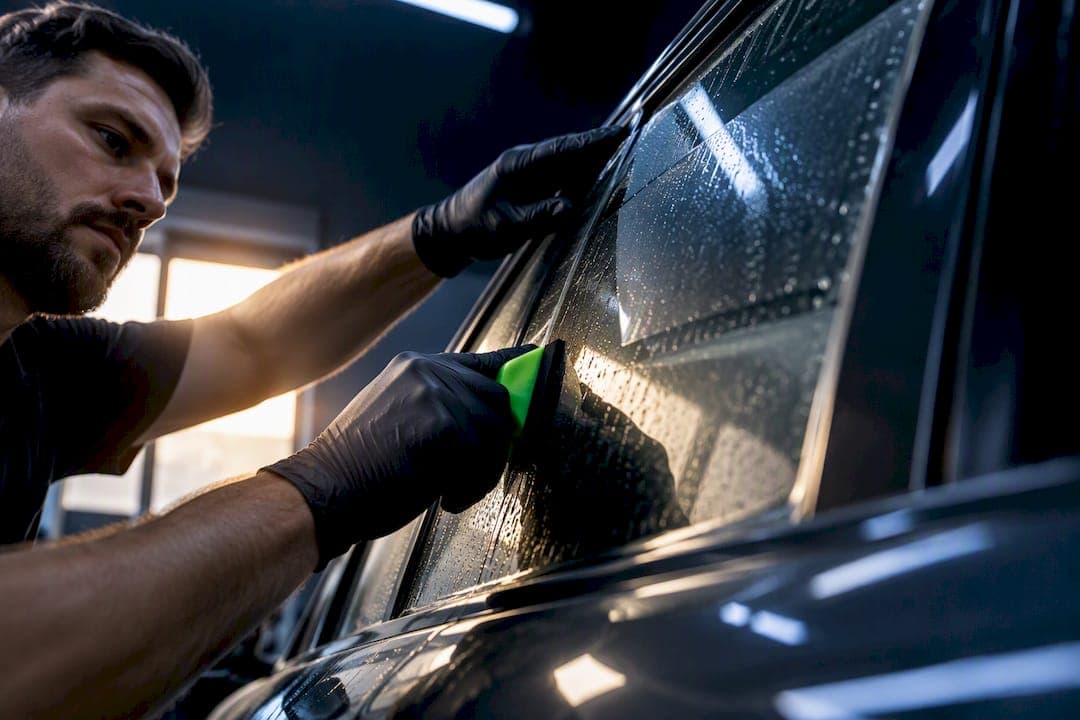
If you drive a connected EV, choose a non-metallic ceramic or nano-ceramic film. It preserves cellular, GPS, Bluetooth, and phone-as-key performance while still cutting cabin heat. The real ev tint signal interference risk comes from metalized films with conductive layers, not tint in general, so the fix is simple: pick the right material and have your installer run a post-install signal check before you drive off.
TL;DR:
- Non-metallic ceramic and nano-ceramic films do not contain conductive metals, eliminating RF interference risk and maintaining essential signals for EV antennas.
- Metalized films with aluminum or copper layers reflect radio waves, often causing GPS, cellular, Bluetooth, and phone-as-key issues in EVs.
- Proper installation involves mapping sensor zones, avoiding antenna lines, and conducting post-install signal checks to prevent connectivity problems.
- Choosing a shop experienced with EV and Tesla vehicles ensures better installation quality, with a climate-controlled environment and comprehensive warranty coverage.
- Using high-quality ceramic tint provides maximum heat rejection without sacrificing connectivity, especially important for frequent over-the-air updates and driver-assist features.
Table of Contents
- Does Window Tint Cause EV Signal Interference?
- Which Tint Materials Actually Block Signals?
- How Do You Choose an EV-Safe Window Tint?
- What About Windshield, Camera, and Sensor Zones?
- How Do You Vet an Installer and Fix Signal Problems?
- What Should You Expect From a Professional EV Tint Shop?
- Is Cutting Heat Worth the Connectivity Tradeoff?
- Get Your EV Tinted Without the Signal Guesswork
- Sources
- FAQ
Does Window Tint Cause EV Signal Interference?
Tint itself isn't the enemy. The metal is. Every EV depends on a cluster of antennas scattered around the body, and any material that includes a conductive metallic layer sitting near those antennas can reflect or absorb the radio waves they need.
Most EVs pack more antennas than drivers realize:
- Roof shark-fin module: cellular (LTE/5G), GPS, and sometimes Wi-Fi
- Rear glass embedded grid: often shares space with the defroster and doubles as an antenna trace
- Windshield-mounted elements: some models route GPS or telematics leads near the top edge
- Dash and pillar-mounted units: Bluetooth and Ultra-Wideband (UWB) for phone-as-key systems
- Door handles and B-pillars: near-field sensors for passive entry
EVs are unusually sensitive to small signal losses because so much of the car's function depends on staying connected. Over-the-air software updates, Tesla's Sentry Mode footage uploads, and Full Self-Driving data all ride on cellular and Wi-Fi links that need consistent bandwidth. Phone-as-key systems rely on Bluetooth Low Energy and UWB for precise proximity detection, and a weak signal there means you're standing at your door digging for a physical key card.
Frequency matters too. Higher-frequency signals like 5G and GPS's L1/L5 bands are more easily blocked by thin conductive layers than lower-frequency AM radio. That's why a car with degraded 4G data might still pull in a talk radio station just fine. The metal doesn't need to be thick to cause problems. Even a microscopically thin sputtered layer, the kind used in older-generation metalized tints, is enough to act like a partial Faraday shield across the glass.
Which Tint Materials Actually Block Signals?

Four film families dominate the market, and only one of them carries real interference risk for EV owners.
Dyed film is the cheapest option. It uses a layer of dye to absorb light and heat, with no metal content, so it poses no RF risk. The tradeoff is weaker infrared rejection and a tendency to fade over a few years.
Carbon film sits in the middle. It's non-conductive, blocks a good share of infrared heat, and resists fading better than dyed film. It's a safe pick for connectivity, just not the top performer for heat rejection.
Ceramic and nano-ceramic film use ceramic particles, not metal, to reject infrared and UV light. Because the particles are non-conductive, ceramic film doesn't interfere with radio-frequency signals the way older metallic tints can, and it delivers the strongest heat rejection of the non-metallic group.
Metalized film is where the risk lives. These films use a thin sputtered or vacuum-deposited layer of aluminum, copper, or similar metal to reflect infrared heat. That same metal layer reflects and absorbs radio waves, which is why metallic window film has been linked to weaker GPS, cellular, and Bluetooth reception in some installations.
Signal risk by film type: Dyed and carbon films carry no meaningful RF risk. Ceramic and nano-ceramic films are engineered to be non-conductive. Metalized films are the category most associated with real-world connectivity complaints.
Owners who've had a metalized film installed often report a specific pattern of symptoms: GPS position jumping around on the map, LTE or 5G dropping out intermittently, phone-as-key taking longer to unlock the car, faint static on AM/FM radio, and slower Sentry or OTA uploads than before the install. None of that means every metalized film fails this way, but the pattern shows up often enough that most installers who specialize in EVs steer clear of it entirely.
How Do You Choose an EV-Safe Window Tint?
Walking into a shop with the right questions saves you from a comeback visit six months later.
- Ask for the product datasheet, not just the marketing name. "Ceramic" gets used loosely in this industry, and not every film labeled ceramic is actually non-metallic. A real datasheet will state infrared rejection percentage, UV rejection, and construction type in plain terms.
- Confirm the film is explicitly described as non-metallic or nano-ceramic. If the installer can't point to that language on the spec sheet, ask why.
- Request post-install signal verification. A quick test call, a GPS lock check, and a phone-as-key unlock attempt take five minutes and catch problems before you leave the lot.
- Match the film to the glass zone. Side and rear windows can usually run darker, higher-performance ceramic film. Windshield areas near cameras call for a lighter, optical-grade film rated for ADAS compatibility.
- Get the warranty in writing before the film goes on, including what happens if a connectivity issue shows up after install.
Pro Tip: Bring your phone into the shop and test your phone-as-key unlock and cellular bars before the appointment starts, then repeat the same test in the same spot right after. That baseline comparison is the fastest way to catch a real problem instead of guessing.
Non-metallic ceramic and nano-ceramic film checks every box here: no conductive layer, strong heat rejection, and enough optical clarity to work safely across most glass zones on a modern EV.
What About Windshield, Camera, and Sensor Zones?

The windshield is where tint mistakes get expensive. Every EV with driver-assist features relies on a front-facing camera cluster mounted near the top of the glass, and Tesla's own service documentation defines strict zones, including the camera field of view, the AS1 line, and the frit border, where coverage or repair work is restricted to avoid throwing off sensor calibration.
A careful installer will:
- Map out the camera's exact field of view before applying anything near the top of the windshield
- Leave the frit (the black ceramic border baked into the glass edge) completely untouched
- Avoid running film or adhesive over embedded defroster and antenna grid lines on the rear glass
- Recalibrate or flag the car for recalibration if any sensor-adjacent work was performed
The bigger risk usually isn't the film itself, it's careless removal of an old film. Peeling metalized tint the wrong way can strip the fragile conductive traces baked into rear glass, and that damage sometimes means a full windshield or backlight replacement rather than a simple redo.
How Do You Vet an Installer and Fix Signal Problems?
Choosing the right shop matters as much as choosing the right film. Before booking, confirm three things: the installer has specific EV or Tesla experience, the work happens in a climate-controlled space free of dust that can trap under the film, and the shop backs its work with a real warranty that covers connectivity complaints, not just bubbling or peeling.
Once the job is done, don't just drive off. Ask the shop to walk through a functional check on the spot:
- Make a test call and confirm cellular bars match what you had before the appointment
- Check that GPS locks onto your location within the usual few seconds
- Test Bluetooth pairing and phone-as-key unlock at the driver's door
- Confirm the rear camera and any ADAS features are reading normally
If something feels off after you get home, work through the problem in order rather than assuming the tint is guilty. First, rule out unrelated causes: dash cams, phone mounts, and aftermarket chargers can all cause their own interference. Next, note exactly which function is degraded and when it started. Comparing signal strength before and after a tint job is standard practice among EV-focused installers precisely because it isolates the film as the variable. If the pattern points to the tint, go back to the shop and ask for a targeted removal and reinstall on the affected panel rather than a full strip job. A reputable shop will diagnose and correct this under warranty instead of shrugging it off.
Pro Tip: If interference shows up only near one specific panel, like the rear window, that's usually a sign of a damaged defroster or antenna grid line rather than a blanket tint problem, and it's a much cheaper fix to isolate.
What Should You Expect From a Professional EV Tint Shop?
A shop that actually understands EVs treats connectivity as part of the job, not an afterthought. Look for a few concrete signs of that mindset:
- A climate-controlled, dust-free installation bay, since contamination under the film causes more comebacks than any material choice
- Specific Tesla and EV installation experience, not just general automotive tint work
- Manufacturer-backed warranties that cover the film itself, not just labor
- A track record of volume, with many vehicles protected, which tends to mean the shop has already seen and solved the edge cases
- A default policy of skipping metalized films entirely on connected vehicles in favor of non-metallic ceramic options
- Post-install functional checks built into the process instead of offered only if you ask
None of that guarantees a perfect install every time. It does mean the shop is set up to catch problems before they become your problem.
Is Cutting Heat Worth the Connectivity Tradeoff?
Here's the part most tint guides skip: darker, more aggressive heat rejection and rock-solid connectivity aren't actually in conflict once you pick the right material. That's the good news. The real tradeoff is between spending more on premium ceramic film versus saving money on a cheaper metalized option that might cost you a comeback visit.
Ceramic film's infrared rejection reduces how hard your HVAC system works on hot days, which translates into a small but real range benefit since climate control draws directly from the same battery that powers the drivetrain. For an owner who leans hard on Full Self-Driving, uploads Sentry footage constantly, or unlocks with a phone every single day, that connectivity margin matters more than an extra percentage point of heat rejection.
My honest recommendation for most owners: run premium non-metallic ceramic on the side and rear glass where you want maximum heat and glare control, and take a more conservative approach on the windshield, prioritizing optical clarity and camera compatibility over darkness. That split gets you comfort and connectivity without gambling on either one.
Get Your EV Tinted Without the Signal Guesswork
Some shops install nano-ceramic and carbon film in a climate-controlled, dust-free bay, designed to avoid contamination and adhesive issues that cause comebacks. Specialists with Tesla and EV installs account for camera zones, antenna placement, and connectivity, not just tint darkness.
Many installs come with a manufacturer-backed warranty, providing coverage if something needs correcting down the line. If you're weighing tint alongside other protection work, paint protection film and ceramic coating are worth asking about in the same visit. Ready to get your EV tinted the right way? Book a consultation through the window tinting page and ask specifically for a post-install signal check on your appointment.
Sources
Technical claims in this article draw on Tesla's own windshield and camera zone guidance, independent writeups on metalized film RF effects, and installer guidance on choosing signal-safe EV tint. Real-world reports of connectivity symptoms and diagnosis round out the practical guidance above.
- Does Metallic Window Film Interfere with GPS and Mobile Signals? A Technical Insight - Knowledge
- Service
FAQ
Does ceramic tint affect cell signal?
No. Ceramic and nano-ceramic films are built with non-conductive ceramic particles rather than metal, so they don't create the reflective layer that causes RF interference in metalized films. Cellular, GPS, and Bluetooth performance typically stay unchanged after a proper ceramic install.
Why do some Tesla owners avoid tinting their windows?
Some owners worry about signal interference from older metalized films, connectivity issues from a bad install, or the risk of damaging embedded antenna and defroster lines during removal. Choosing a non-metallic film and an EV-experienced installer resolves the actual risk without giving up tint altogether.
How bad is 20% tint at night?
Darker tints like 20% VLT (visible light transmission) reduce how much ambient light reaches your eyes, which can make it harder to see in low-light conditions, especially on the front windshield or side windows near your mirrors. This is a visibility tradeoff, not a signal one, so most drivers keep front windows lighter and reserve darker tint for rear and rear-side glass.
Does window tint mess with a radar detector?
Metalized films can weaken the signal a radar detector relies on, similar to how they affect GPS and cellular reception, since both depend on radio waves passing through the glass. Non-metallic ceramic and carbon films don't carry that same conductive layer, so radar detector performance is generally unaffected.
What does Tint & Wraps Customs charge for EV window tinting?
Pricing depends on the vehicle and film selected, and current rates are listed on the window tinting page. Every quote includes the manufacturer-backed warranty and the climate-controlled install process used on all EV work.