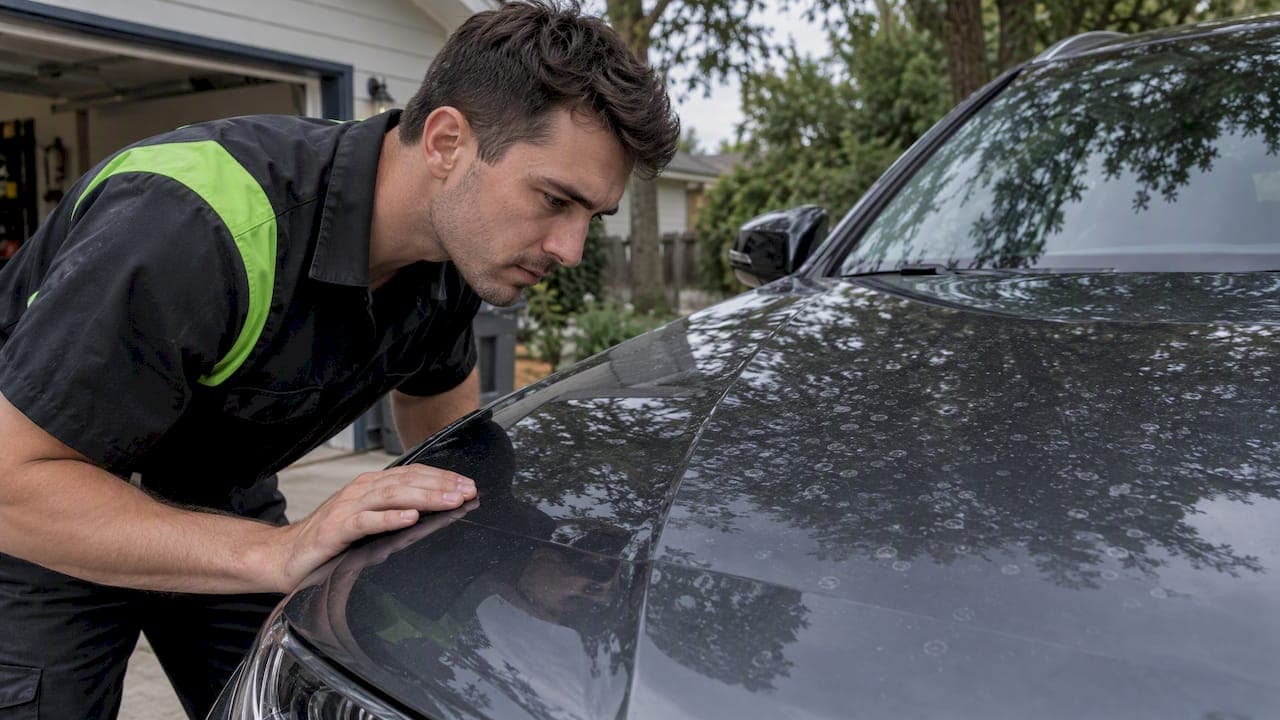
Ceramic coatings reduce the work of cleaning water spots but they do not prevent them entirely. Your first move when you spot a mark is a careful, least-aggressive cleaning and inspection, not a panic call about coating failure. Wash with a pH-neutral soap, dry fully, and look again. If the mark survives that gentle pass, it is time to figure out what you are actually dealing with before reaching for anything stronger.
TL;DR:
- After a neutral pH wash and full dry, wet the mark; if it fades, residue is likely, while persistent rings under angled light suggest etching.
- If the coating cured within the last few days or is under a year old, pause before polishing and get a professional assessment.
- Use a remover labeled safe for coated paint on a cool, shaded panel with a short dwell time; if it fails, seek inspection before polishing.
- After sprinkler, rain, or hard water exposure, rinse promptly; when local water is hard, finish washes with deionized water or forced air.
- Manufacturer warranties typically expect a documented care routine, so record wash dates, products, and professional visits to support any claim.
Table of Contents
- Why Water Spots Form: Minerals, Evaporation, and Etch Mechanisms
- Do Ceramic Coatings Prevent Water Spots? Limits of Hydrophobic Protection
- Diagnose the Spot: A Short Workflow to Tell Deposits From Etch or High Spots
- Safe Removal Methods, Ordered Least to Most Aggressive
- Prevention and Maintenance That Protect Your Coating and Your Warranty
- Installer Protocols and Shop-Level Checks We Follow
- What Owners Get Wrong About Water Spots
- How We Handle Water Spots at Tint & Wraps Customs
- FAQ
- Sources
Why Water Spots Form: Minerals, Evaporation, and Etch Mechanisms
Water itself rarely causes a spot. What causes it is everything dissolved inside the water. When a droplet sits on paint and evaporates, it leaves behind the nonvolatile solids it carried, calcium, magnesium, and silica among them, according to research on etch damage to automotive coatings. That residue is a surface deposit, and it sits on top of the paint or coating rather than inside it.
A separate and more serious mechanism is etch. Acidic droplets, concentrated by evaporation, can trigger hydrolysis in susceptible clearcoats and actually degrade the material underneath, not just sit on top of it.
A few conditions make both problems worse:
- Heat and direct sun speed evaporation and concentrate minerals faster.
- Horizontal panels like hoods and trunks collect and hold droplets longer than vertical sides.
- Dew and slow overnight drying give acidic contaminants more contact time.
Tight beading on a hydrophobic surface can make these marks look sharper and more visible against clean, glossy paint, per the same etch damage research, which is part of why coated cars sometimes seem to show spots more readily than uncoated ones, even though less residue is actually sticking.
Do Ceramic Coatings Prevent Water Spots? Limits of Hydrophobic Protection
A ceramic coating changes how water behaves on your paint. It makes droplets bead, slide, and shed faster, which means less water sits around long enough to evaporate and deposit minerals in the first place. What it does not do is dissolve or remove minerals once a droplet does evaporate. The coating is a barrier layer, not a water softener.
That distinction matters for a few reasons:
- Different coating chemistries carry different chemical resistances, and manufacturer instructions vary by product.
- A coating's rated service life or warranty period describes durability against wear, not immunity from mineral deposits.
- Beading alone does not tell you whether a given droplet's dissolved content was aggressive enough to etch, only that less water stayed in place.
Owners sometimes assume a coated car "shouldn't" spot at all, and that expectation gap is where most of the frustration starts. A coating lowers the odds and softens the severity. It does not take water spots off the table.
Diagnose the Spot: A Short Workflow to Tell Deposits From Etch or High Spots
Before you clean or correct anything, figure out what you are looking at. Treating a surface deposit and a clearcoat etch the same way wastes effort at best and damages the coating at worst.
- Check coating age and cure stage first. A coating that cured within the last few days has different handling rules than one that has been on the car for months, as explained in this guide to ceramic coating cure windows.
- Wash with a pH-neutral shampoo and let the panel dry completely before judging anything.
- Clay or decontaminate lightly if the wash alone does not clear the mark, then rinse and dry again.
- Run a wet-wipe test: if the mark disappears or fades when the panel is wet, it is likely surface residue, not etch.
Pro Tip: Photograph the mark in direct sun and again in shade before you touch it. Lighting changes what a spot looks like more than most owners expect.
If step four and five leave you uncertain, or if the coating is under a year old, stop and get a professional opinion before polishing anything.

Safe Removal Methods, Ordered Least to Most Aggressive
Work through these steps in order and stop as soon as the mark clears. Jumping straight to the strongest option risks damaging the coating for no benefit.
- Rinse and pH-neutral wash. Many spots are nothing more than loose residue that a normal wash lifts. Dry fully and recheck before doing anything else.
- Deionized or filtered rinse, or a controlled blow-dry. Tap water is often the source of the problem, so finishing with filtered water, or drying with forced air instead of a towel, prevents you from reintroducing the same minerals you just removed.
- A water-spot remover labeled safe for coated surfaces. Products built for sealed paint, such as Koch-Chemie's Spotless Ceramic Finish, follow a specific protocol: pre-wash, a reactivation shampoo step, application on a cool or shaded panel, a short dwell time, then wipe-off with a dedicated microfiber.
- Professional correction if the mark persists. If a coating-safe remover does not clear it, the next step is controlled polishing and a layer inspection, not a stronger acid from the garage.
A few handling notes make a real difference at every stage:
- Work on a cool, shaded panel. Heat shortens working time and can bake a remover into the surface.
- Keep dwell times short and check frequently rather than letting a product sit and hope.
- Use a clean, dedicated microfiber for spot removers, separate from your regular wash towels, to avoid cross-contaminating products.
Pro Tip: Never guess with an unlabeled acid "miracle" cleaner on a coated panel. Product instructions exist because coating chemistries react differently, and the wrong combination can strip or dull the layer you are trying to protect.
If a spot survives a coating-safe remover applied correctly, that is a sign you are looking at etch rather than residue, and it needs the kind of layer inspection a shop can do, possibly followed by measured polishing or a partial recoat.
Prevention and Maintenance That Protect Your Coating and Your Warranty
Most water spots are preventable with habits, not products. A few rules cover most of the risk:
- Rinse the car after sprinkler exposure, rain, or any hard-water contact, rather than letting it air-dry on its own.
- Wash with a pH-neutral shampoo on a regular schedule instead of waiting for visible grime.
- Finish washes with a deionized rinse or a blow-dry pass when your local water is hard, since local hardness and total dissolved solids materially affect how much residue is left behind when water evaporates.
- Keep a quick microfiber and spray detailer in the garage for sprinkler mornings so water never sits long enough to evaporate on its own.
Routine maintenance also protects your warranty. Manufacturer-backed coating warranties typically expect a documented care routine, so tracking maintenance against a shop-recommended schedule matters more than most owners realize. A simple log of wash dates, products used, and any professional maintenance visits gives you something concrete if you ever need to make a warranty claim.
Pro Tip: Keep a folder, even just photos on your phone, of wash dates and products used. It turns a warranty conversation from "I think I took care of it" into a documented record.
Installer Protocols and Shop-Level Checks We Follow
We start every water-spot inspection by asking for coating age and cure stage, because that single detail determines which cleaners and corrective steps are even safe to try. A coating cured within days handles differently than one on the car for a year, and cure-stage timing shapes the whole correction approach.
Our shop workflow follows the same escalation order we recommend to owners:
- Diagnose the mark first: deposit, etch, or application high spot.
- Apply the least aggressive decontamination step and recheck before moving further.
- Inspect under magnification and angled light to confirm what the first pass missed.
- Move to controlled polishing or a partial recoat only when the inspection supports it.
Because our installs happen in a climate-controlled, dust-free facility, we can control temperature and shade precisely during corrective work, which matters for any product with a dwell-time window. That control, paired with warranties, is part of why we treat corrective work as a measured, documented process rather than a quick buff-and-go.
What Owners Get Wrong About Water Spots
Most owners treat any visible mark as proof the coating failed, and that assumption leads to unnecessary polishing or, worse, unlabeled acid products applied in a panic. A mark is just a mark until someone inspects it under the right light.
Before any inspection, bring your coating's cure date, any care records you have, and photos taken in both direct sun and shade. Ask what correction approach is being proposed and why, not just what it costs. A surface deposit, a polish job, and a partial recoat are three very different outcomes, and a straight answer up front saves you from surprises later.
— Jake
How We Handle Water Spots at Tint & Wraps Customs
If a coating-safe wash and a labeled spot remover have not cleared a mark, a shop visit is the next sensible step rather than reaching for something stronger at home. We inspect the panel, confirm whether you are dealing with a deposit, an etch, or an application high spot, and walk you through what correction actually involves before we touch anything.

Our ceramic coating services cover the full range from fresh installs to the kind of controlled correction a persistent spot sometimes needs:
- Diagnostic inspection to confirm deposit, etch, or high spot before recommending any fix.
- Coating-safe maintenance washes that follow manufacturer-backed warranty requirements.
- Controlled polishing or partial recoat when a spot turns out to be true etch.
- Experience with electric vehicle fitments means sensors and trim stay untouched during any correction work.
Every install and corrective job happens in a climate-controlled, dust-free facility that keeps temperature and shade consistent for any product with a dwell-time limit. If you are not sure whether what you are looking at is residue or something deeper, book an inspection through our ceramic coating page and we will tell you exactly what you are dealing with before recommending anything.
FAQ
Will I get water spots with ceramic coating?
Yes, a ceramic coating reduces how often spots form and how stubborn they are, but it does not stop mineral deposits from forming once water evaporates on the surface, according to research on etch damage to coatings. Hydrophobic beading sheds most water before it sits long enough to leave residue, but it cannot change what minerals are dissolved in the water that does evaporate.
How can I remove hard water spots from ceramic coating?
Start with a pH-neutral wash and a full dry, then recheck the mark before doing anything more aggressive. If it persists, a water-spot remover labeled safe for coated surfaces, used with a short dwell time on a cool or shaded panel, clears most mineral deposits, as Koch-Chemie's product guidance outlines. A mark that survives that step may be etch and needs a professional inspection.
How can I protect my ceramic coating while also removing water spots?
Rinse off sprinkler or rain exposure promptly instead of letting it air-dry, and finish regular washes with a deionized rinse or blow-dry if your local water is hard. For removal, stick to products labeled safe for sealed or coated paint and follow their dwell-time instructions exactly, since generic acid cleaners can alter coating performance on fresh or sensitive coatings.
How do I get rid of ceramic coating high spots?
High spots are an application defect, not a water-spot issue, and they show up as small raised bumps rather than flat rings. The safe fix depends heavily on how recently the coating cured, which this guide to correcting high spots by cure stage covers, and heavy compounding too early in the cure window can do more harm than the high spot itself.