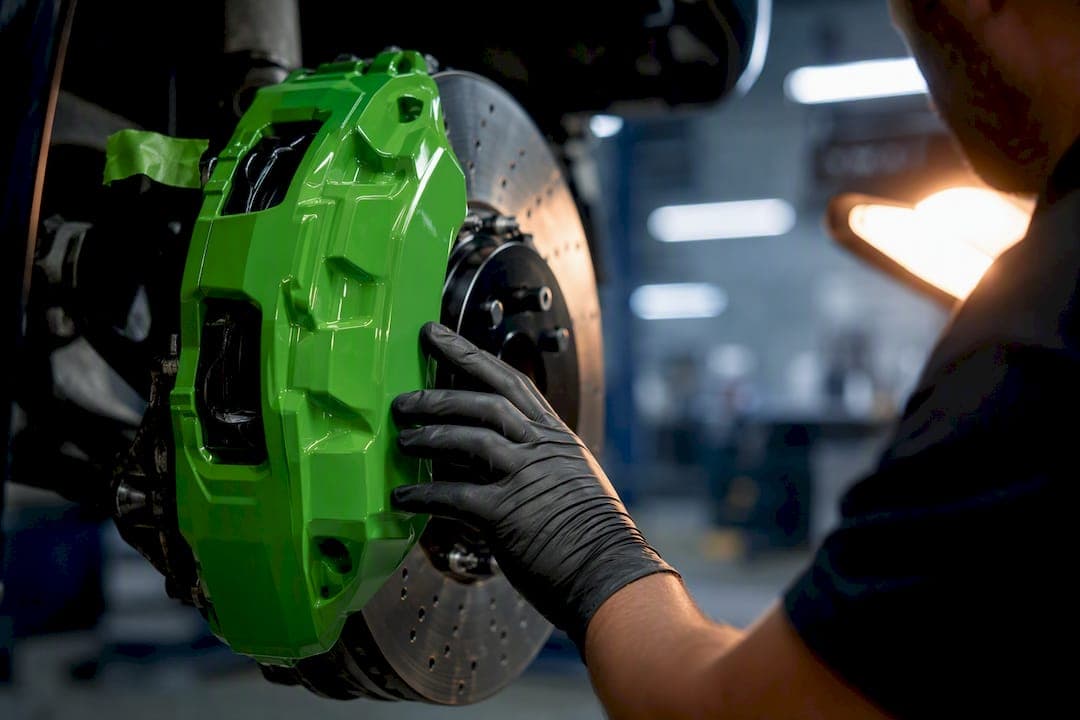
Most drivers pay $60 to $220 per caliper for a basic paint job, $120 to $420 for a pair, and $260 to $1,000 for a full four-caliper set. Powder coating and ceramic finishes run higher, often $400 to $900 for a properly prepped set. The single biggest swing factor is prep work: whether the shop degreases, sands, or fully media-blasts before applying anything. Get two or three local quotes before committing, and only reach for a DIY kit if you're doing a simple, low-heat repaint on clean calipers.
TL;DR:
- The average cost for a basic paint job ranges from $60 to $220 per caliper, with higher prices for powder coating and ceramic finishes.
- Costs vary significantly based on prep work, caliper complexity, finish details, and shop type, often leading to large quote disparities.
- Replacing or reassembling calipers during coating adds substantial labor costs, especially if hardware or brake lines are involved.
- High-temp coatings, including ceramic, can last over five years on daily drivers, but shorter lifespans are typical in harsh conditions or with poor prep.
- Bundling caliper coating with other services like wheel coating reduces costs and ensures quality, whereas vague quotes or skipping teardown risks poor results.
Table of Contents
- How Much Does Brake Caliper Coating Cost?
- What Affects the Price of Caliper Coating?
- Paint vs. Powder Coating vs. Ceramic: Which Finish Should You Pick?
- Should You DIY Caliper Painting or Hire a Pro?
- What Happens During a Professional Coating Job?
- Real-World Pricing Scenarios You Can Budget Against
- How to Save Money and Spot a Bad Quote
- Does Removing and Reinstalling Calipers Cost Extra?
- How Often Should You Recoat Brake Calipers?
- Why We Price Caliper Coating the Way We Do
- Get an Accurate Caliper Coating Quote
- Sources
How Much Does Brake Caliper Coating Cost?
Brake caliper coating cost breaks down differently depending on whether you're paying per caliper, per pair, or for a full set, and shops price it all three ways depending on their volume and equipment.
For standard enamel or epoxy paint jobs, expect $60 to $220 per single caliper, $120 to $420 for a pair on one axle, and $260 to $1,000 for all four. That range assumes calipers in reasonably clean, rust-free condition and a single-color finish, no metallics, no logos, no multi-tone work. Powder coating shifts the math: per-caliper pricing runs $40 to $120, with full sets of two to four calipers commonly landing between $75 and $320, and premium jobs occasionally topping $500.
Caliper size matters more than most owners expect. Small calipers typically run $50 to $150, medium calipers $100 to $300, and large performance calipers (think big-brake kits with six or eight pistons) $200 to $500 each.
| Service Level | Per Caliper | Pair (One Axle) | Full Set (4) |
|---|---|---|---|
| Basic paint | $60 to $220 | $120 to $420 | $260 to $1,000 |
| Powder coat | $40 to $120 | $75 to $220 | $150 to $500+ |
| Premium/ceramic | $150 to $300 | $300 to $500 | $400 to $900 |
Assumptions baked into these numbers: standard passenger-car calipers, one finish color, and typical regional labor rates. Add hardware kits, shipping to a specialist coater, or a rush turnaround, and your final invoice climbs past the average quickly.
What Affects the Price of Caliper Coating?
Two quotes for the "same job" can differ by hundreds of dollars, and it almost always comes down to four variables.
- Prep level. A simple degrease-and-scuff job costs far less than sanding, and both cost less than full media blasting, which strips old paint and corrosion down to bare metal and adds real labor time.
- Caliper complexity. Multi-piston or multi-piece calipers take longer to mask and disassemble; a four-piston Brembo-style caliper eats more shop time than a single-piston floating caliper.
- Color and finish complexity. Metallic finishes, clear-coat layers, decals, and multi-color designs (think a contrasting logo) add labor hours a solid single-color job doesn't require.
- Labor rate by shop type. A mobile coater working out of a van charges differently than a dedicated powder-coating shop, and a high-end custom shop with a climate-controlled booth prices its overhead into every quote.
Caliper condition is the wildcard nobody budgets for. Rust, seized bolts, and corroded pistons turn a routine job into a teardown project, and that's before the coating even goes on.
Paint vs. Powder Coating vs. Ceramic: Which Finish Should You Pick?
The finish you choose changes both the price and how long the job actually lasts.
- Liquid paint goes on with a brush or spray gun, air-dries or low-bake cures, and can often be done on-car if the shop masks carefully. It's the cheapest option and the fastest turnaround, but it's also the least heat-tolerant of the three.
- Powder coating requires the caliper to come off the car. The part gets media-blasted, electrostatically coated with dry powder, and cured in an oven at high heat. That off-car process is why powder jobs run $40 to $120 per caliper instead of matching basic paint pricing, but the tradeoff is a noticeably tougher, more chip-resistant finish.
- Ceramic and high-temp coatings sit at the top of the price ladder, often landing in that $400 to $900 full-set range for premium jobs. These are formulated specifically to resist brake dust buildup and repeated thermal cycling, which matters most for owners who track their cars or drive aggressively.
A basic painted finish can hold up for several years under normal street driving, but that lifespan depends heavily on how well the surface was prepped beforehand. Skip the sanding step and even a good paint will start flaking within a season or two.
Should You DIY Caliper Painting or Hire a Pro?
Deciding between a weekend project and a shop appointment comes down to your calipers' condition and how much risk you're willing to accept.
- Price out the DIY route first. A basic caliper paint kit runs $50 to $150 for cleaner, high-temp paint, brushes, and masking supplies. You'll spend an afternoon degreasing, masking off rotors and hoses, and applying two or three coats with limited cure options compared to a shop oven.
- Check for rust and seized hardware before you commit. If bolts won't budge or you see corrosion around the pistons, that's a sign the job needs a lift, air tools, and someone who does this regularly.
- Hire a pro for powder coating or ceramic finishes. These require equipment you don't have at home, an oven capable of proper cure temperatures, and experience masking pistons and seals so the coating doesn't compromise brake function.
- Factor in the brake-bleed step. Any job requiring full caliper removal means the brake system gets opened up, and that reassembly should include a proper bleed. If you're not comfortable bleeding brakes correctly, that alone is reason enough to hand the job to a mechanic.
DIY makes sense for a clean, low-mileage caliper getting a cosmetic refresh. It stops making sense the moment rust, warranty concerns, or brake-line disassembly enter the picture.
What Happens During a Professional Coating Job?
A shop quote should reflect a real workflow, not just "drop it off, pick it up." The standard sequence starts with inspection, moves to teardown if needed, then prep (degrease, sand, or media blast), coating application, cure time, and reassembly.
- Media blasting and hardware or seal replacement are the steps that most often push a quote higher than the number you saw online.
- Turnaround typically runs a few days to a week for powder or ceramic work, since curing and QA checks take time; rush service usually carries a surcharge.
- Some coaters reassemble and bleed brakes in-house; others hand the calipers back to you or a separate mechanic for reinstallation. Ask which applies before you book, since that labor isn't always included in the quoted price.
Real-World Pricing Scenarios You Can Budget Against
Seeing the math laid out helps more than a range ever will. Here's how three different jobs typically shake out.
The low-cost scenario assumes clean calipers and no disassembly. The premium example includes full teardown and hardware replacement, which is exactly where most "surprise" invoices come from.
How to Save Money and Spot a Bad Quote
Bundling helps more than almost any other tactic. If you're already having wheel ceramic coating done, the wheels are off the car anyway, so pairing that work with caliper coating cuts the incremental labor significantly. The same logic applies to alloy wheel protection, since a shop already elbow-deep in wheel work has easy access to calipers too.
- Ask directly whether the quote includes masking, hardware replacement, and reassembly, since some shops price those as separate line items.
- Confirm whether the shop bleeds brakes after reassembly or expects you to arrange that separately.
- Walk away from vague scopes, no warranty on the finish, or anyone offering to spray calipers on-car without proper masking of pistons and seals.
Pro Tip: Book during a shop's slower midweek days and ask for a written scope of work before you drop the car off. A one-page breakdown of prep, finish, and warranty terms protects you if the final bill doesn't match the verbal quote.
Does Removing and Reinstalling Calipers Cost Extra?
Yes, and this is where a lot of quotes quietly balloon. Any coating job that requires the caliper to leave the car, which includes powder coating and most ceramic finishes, means someone has to jack the vehicle, pull the wheel, unbolt the caliper, and disconnect it from the brake line or cap the line if it stays connected.
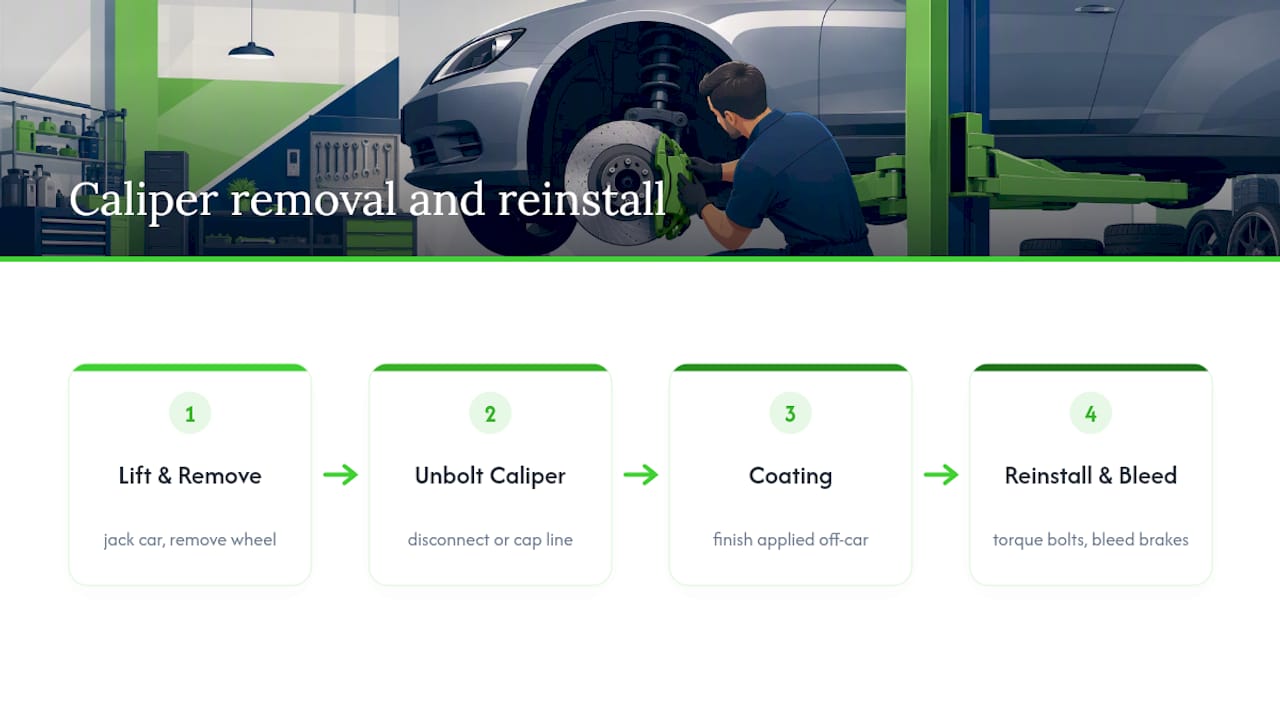
That teardown labor isn't decoration on the invoice. Removing calipers, dealing with seized hardware, and handling brake-bleed duties after reinstallation are among the biggest labor drivers in the entire job. A caliper with corroded bolts can add 30 minutes or more per corner just to get it off cleanly without snapping a fastener.
Reinstallation carries its own cost. Torque specs matter for caliper mounting bolts, and if the brake line was disconnected, the system needs a proper bleed to clear air and restore firm pedal feel. Skipping that step, or doing it poorly, is a safety issue, not a cosmetic one. This is exactly why many powder-coating and ceramic jobs get split between two providers: a coating specialist handles the finish, and a mechanic handles removal, reinstallation, and bleeding.
If your shop bundles all of that under one roof, expect the labor portion of your quote to reflect it. A quote that seems suspiciously low for a powder-coated set is worth a second look. Someone might be skipping the teardown labor, which usually means they're coating calipers on-car with limited masking, a shortcut that shows up as overspray on your rotors within a few months.
How Often Should You Recoat Brake Calipers?
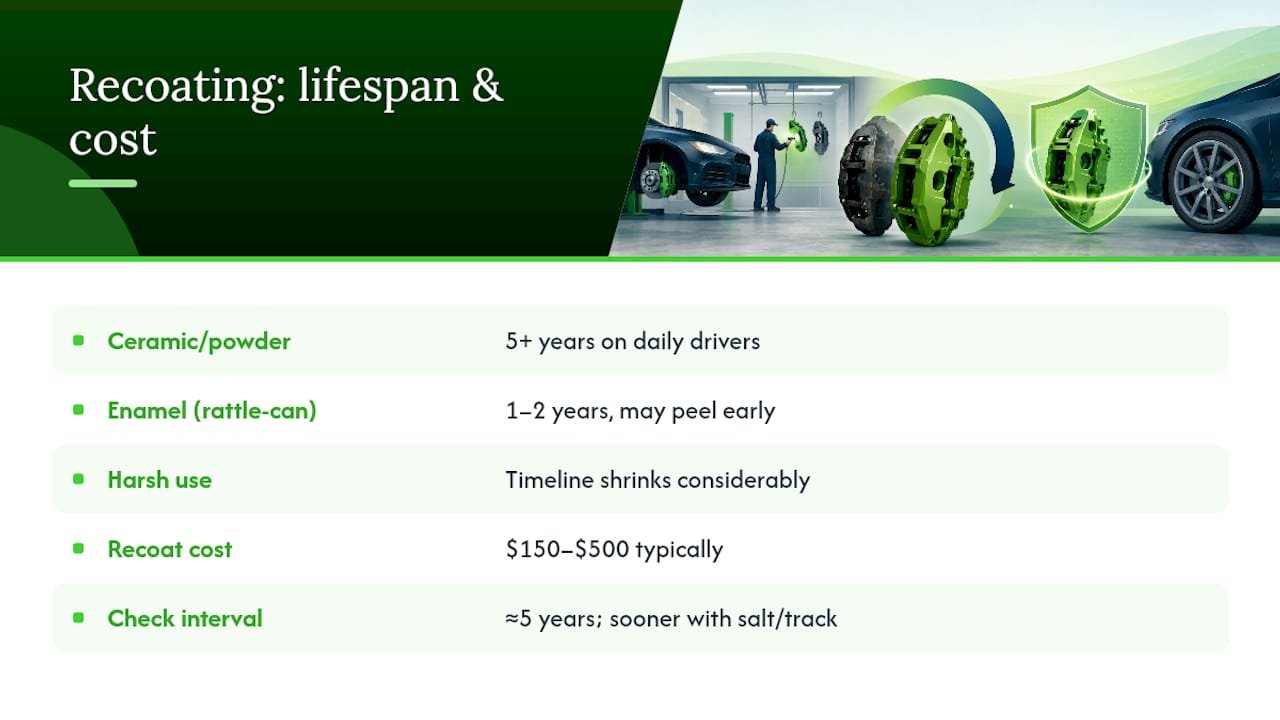
Recoating frequency depends almost entirely on the finish you chose the first time and how the vehicle is driven. A well-prepped ceramic or high-temp powder finish on a daily driver can realistically last five years or more before it needs attention. Track cars, trucks that see heavy towing, or vehicles in road-salt climates will see that timeline shrink considerably, since repeated thermal cycling and brake dust exposure are exactly what these coatings are built to resist.
Basic enamel paint has a shorter practical lifespan. Durability depends heavily on prep quality and the coating's heat resistance, and a rattle-can job without proper sanding can start peeling within a year or two, especially near the piston areas where heat concentrates.
Budget-wise, a full recoat generally costs less than the original job if the calipers don't need major rework. You're paying for stripping the old finish and reapplying, not a full teardown with hardware replacement, unless rust has set in underneath. That's typically a $150 to $500 range depending on finish type, size, and whether the shop needs to media-blast off the old coating first.
Watch for early warning signs: chipping near the piston boots, discoloration from overheating, or flaking at the edges where masking met bare metal. Catching those early keeps a touch-up job from turning into a full strip-and-recoat months down the road. Build a rough five-year check-in into your maintenance calendar, sooner if you drive aggressively or live somewhere winters mean regular exposure to road salt.
Why We Price Caliper Coating the Way We Do
Tintandwrapscustoms works out of a climate-controlled facility, and that matters more for coating than most people assume. Temperature and humidity swings during cure are exactly what cause the peeling and uneven adhesion that turn a good-looking job into a warranty headache six months later. Combine that with over 1,000 vehicles protected and manufacturer-backed warranty support, including EV and Tesla-specific experience, and the pricing reflects fewer callbacks, not padded margins. For daily drivers, we typically steer owners toward high-temp powder; for track-driven or performance builds, ceramic earns its higher price tag through real thermal resistance.
— Jake
Get an Accurate Caliper Coating Quote
Tintandwrapscustoms is the alternative to guessing your way through a caliper job over email and hoping the quote holds. Because every coating happens in the same climate-controlled bay used for our paint protection and ceramic coating work, you get a fixed scope up front instead of a number that grows once your calipers are on the lift.
To get a fast, accurate estimate, send over your vehicle make and model, a few close-up photos of your calipers (rust, piston count, existing paint condition all matter), your desired finish, and whether you want us to handle teardown and reinstallation. Your quote will spell out prep steps, finish type, and warranty terms before any work starts, and most bookings can be scheduled within a week or two depending on season. If you're already planning ceramic coating or wheel work, mention it, since bundling often trims labor costs on both jobs. Head to Tintandwrapscustoms to request your estimate and lock in a service date.
Sources
- Brake Caliper Painting Cost – Cost Insider
- How much does it cost to powder coat brake calipers? | CarsBibles