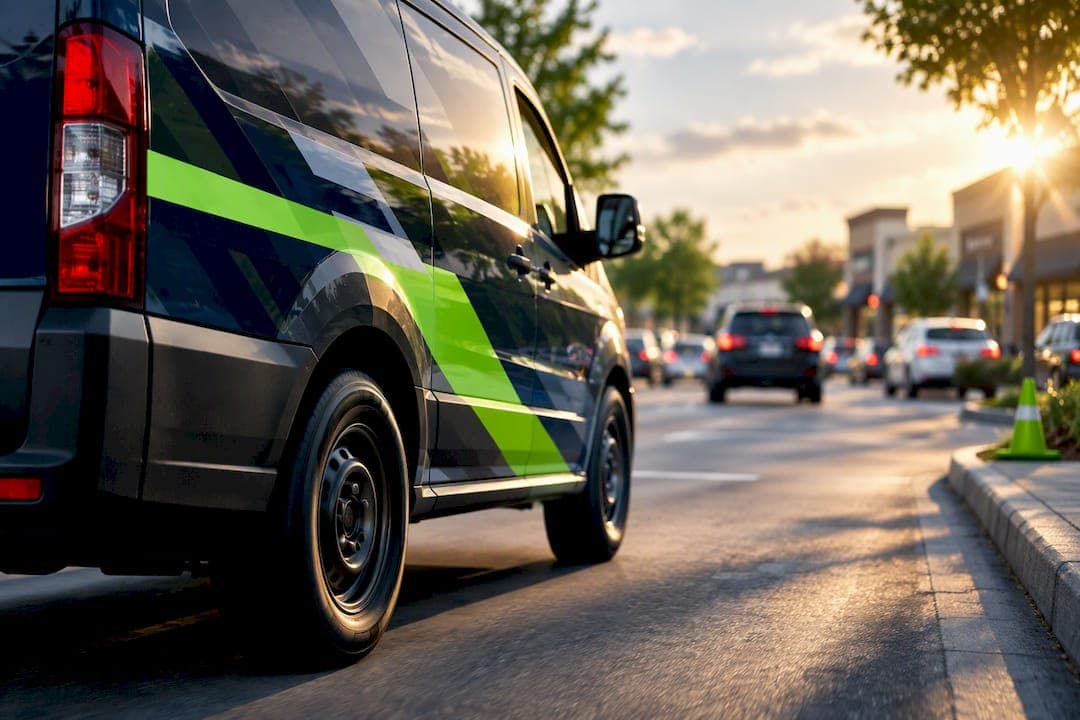
Yes, vehicle wraps are typically a cost-effective long-term marketing asset for local businesses when measured properly. A wrapped vehicle can generate an estimated 30,000 to 70,000 daily impressions on active routes, and a full wrap generally runs $2,500 to $5,000. This guide shows you how to turn those numbers into a real ROI calculation instead of a guess.
TL;DR:
- Vehicle wraps can generate between 30,000 and 70,000 daily impressions, with a full wrap costing $2,500 to $5,000 and lasting 3 to 7 years.
- Cost-per-thousand impressions for wraps ranges from $0.04 to $0.15, making them a highly cost-effective marketing channel compared to digital and out-of-home media.
- Measuring ROI requires tracking actual leads using dedicated phone numbers, landing pages, promo codes, and pre/post installation comparison periods.
- Wraps are most profitable for businesses with high drive-time visibility, such as service or delivery vehicles parked at relevant locations and routed through target neighborhoods.
- Installation quality, including climate-controlled processes and warranties, significantly influences a wrap’s lifespan and long-term advertising value.
Table of Contents
- How vehicle wraps create marketing value
- Typical costs and lifespan for a vehicle wrap
- How to calculate vehicle wrap ROI
- Measurement and attribution best practices for a credible ROI number
- Tactics that increase wrap ROI
- Why installation quality shapes long-term wrap value
- Practical verdict and decision checklist
- How Tint & Wraps Customs supports wrap ROI from installation to measurement
- Primary sources and industry references
- Sources
- FAQ
How vehicle wraps create marketing value
A wrap works differently than most advertising because it does not ask anyone to seek it out. It shows up in traffic, in parking lots, at job sites, wherever the vehicle already goes for work. That is why the impressions estimate matters more for wraps than for almost any other channel: the audience is a byproduct of routine driving, not a media buy.
Industry printers and trade groups commonly cite 30,000 to 70,000 impressions per day for a wrapped vehicle running normal urban or suburban routes. That range depends heavily on where the vehicle spends its time: a delivery van circling the same ten-mile radius all day accumulates repeat exposure with the same households, while a service truck jumping between job sites across a metro area picks up more unique viewers but less repetition. Either pattern counts toward impressions, but they build brand recognition differently.

Recall is where wraps tend to outperform channels that cost far more per impression. The same industry data reporting the daily impression range also points to strong recall for wrapped vehicles compared with static signage, though recall is a brand metric, not a sales metric. Someone remembering your logo on the highway does not mean they called you that week. It means your name entered their consideration set, which is valuable but different from a direct-response ad.
That distinction shows up clearly in cost-per-thousand comparisons. Industry estimates put wrap CPMs around $0.04 to $0.15, a fraction of typical billboard, television, or digital display CPMs. A few reasons wraps post such low per-impression costs:
- The media cost is paid once at installation, not on a recurring buy.
- The vehicle earns impressions during routes you were already driving for work.
- There is no daily or monthly renewal fee once the wrap is installed.
Wrap CPMs are commonly estimated between $0.04 and $0.15 per thousand impressions, according to industry statistics compiled by 4OVER4. That gap versus traditional out-of-home and digital display is the core argument for wraps as a cost-effective channel, provided the impressions actually reach people likely to buy from you.
Typical costs and lifespan for a vehicle wrap
Budgeting for a wrap means separating the advertising line item from everything else the vehicle does for your business. Start with the install itself.
- A full wrap typically costs $2,500 to $5,000, depending on vehicle size and design complexity.
- Partial wraps run roughly 40 to 60% less than a full wrap, per the same industry pricing data, since they cover less surface area and take less labor.
- Fleet jobs often come with per-vehicle discounts once you commit to multiple units, which our fleet wrap pricing breakdown covers in more detail.
- Lifespan generally falls in a 3 to 7 year range, depending on film quality, installation quality, and how much sun and road exposure the vehicle sees.
Cast vinyl tends to hold up longer than calendared vinyl, especially on horizontal panels like hoods and roofs that take the most UV exposure. Vertical panels, doors and rear panels, typically outlast horizontal ones because they see less direct sun.
Your total cost picture should include design work, material grade, installation labor, and any vehicle downtime while it is wrapped. Removal and eventual re-wrap, if you rebrand or refresh the design, are real future costs worth planning for rather than surprises. Our guide to wrap maintenance covers the upkeep that helps a wrap reach the long end of that lifespan window.
Pro Tip: Keep your wrap's paint-protection value separate from its advertising value in your books: one offsets future paint repair costs, the other is a marketing expense, and mixing them muddies both calculations.
How to calculate vehicle wrap ROI
The core ROI formula for a wrap is the same one you would use for any marketing spend:
- Add up total wrap costs: design, materials, installation, and any downtime cost.
- Estimate incremental revenue attributed to the wrap using tracking data (covered in the next section).
- Subtract costs from incremental revenue, then divide by total costs to get your ROI percentage.
So: (Incremental revenue attributed to the wrap minus total wrap costs) divided by total wrap costs.
There is a second, complementary way to value a wrap: earned media value. Instead of tracking direct leads, you estimate what the impressions would have cost through paid channels. If your wrap generates impressions at an estimated $0.04 to $0.15 CPM and a comparable digital display buy in your market runs several dollars per thousand impressions, the gap represents media value you are not paying for every month. This method is useful for justifying the spend to a partner or board, but it does not replace tracking real leads.
Here is how a worked example flows, using illustrative numbers only:
- Say a full wrap costs $4,000 installed and the vehicle drives local routes for a year.
- At an estimated 40,000 impressions a day, that is roughly 14.6 million annual impressions, a planning estimate, not a guarantee of unique viewers.
- If a conservative 0.01% of impressions convert to an inquiry, that is about 1,460 inquiries a year, and if 5% of inquiries convert to a sale worth $150 average ticket, that is 73 sales, or $10,950 in revenue.
- Under that conservative scenario, ROI works out to ($10,950 minus $4,000) divided by $4,000, or about 174%.
- An optimistic scenario, doubling the conversion rate, pushes revenue past $21,000 and ROI above 400%.
Those figures are illustrative math built on assumptions you should replace with your own tracked numbers once the wrap has been running for a few months. The formula matters more than any single scenario: costs are fixed and known upfront, while revenue attribution depends entirely on how well you track what the wrap actually produces.
Measurement and attribution best practices for a credible ROI number
The biggest mistake business owners make with wrap ROI is assuming every new call after installation came from the wrap. OAAA's media-optimization research recommends treating out-of-home formats, including vehicle wraps, as an incremental contributor within your broader marketing mix rather than crediting them with total sales. That means measuring lift, not claiming causation for every lead that shows up during the wrap's lifespan.
A practical tracking setup for a single vehicle or small fleet includes:
- A unique phone number dedicated to the wrap, separate from your main business line.
- A dedicated landing page with UTM parameters that only the wrap's URL points to.
- A promo code specific to the wrap that staff can log at point of sale.
- A CRM source field or a simple "how did you hear about us" question on new customer forms.
Run your comparison across a pre and post window, ideally at least three months before and after installation, to smooth out normal week-to-week noise in lead volume. Where your business has multiple locations or service areas, a geographic control area, one zone without a wrapped vehicle compared against one with a wrapped vehicle, gives you a cleaner read than a single before-and-after snapshot.
Pro Tip: Log the exact installation date and any redesign or re-wrap date the moment they happen. That single detail becomes the anchor for every pre/post comparison you run afterward.
Econometric thinking matters here because raw impression counts feel precise but overstate certainty. The OAAA's findings point to incremental sales lift as the more honest measure of what a media investment like a wrap actually contributed, rather than assuming a one-to-one link between impressions and revenue.
Tactics that increase wrap ROI
Design and placement decisions change how much of your impression count actually converts. A checklist worth running before your wrap goes into production:
- Use high-contrast colors so the design reads clearly from a distance and at speed.
- Keep the phone number and website large enough to read in a few seconds.
- Settle on a single primary call to action rather than listing every service you offer.
- Avoid cluttering the panel with logos, certifications, and taglines competing for attention.
Where you park and drive matters as much as the design. Choose visible parking at job sites and near foot traffic rather than tucking the vehicle in a back lot, and route through the neighborhoods where your customers actually live when schedules allow. Coordinating the wrap's launch with a digital promotion, matching the CTA on social ads to the one on the vehicle, reinforces the message across channels instead of splitting it.
Pro Tip: Test one wrapped vehicle before committing to a full fleet. If your tracking numbers show real lift after a pilot, a fleet wrap rollout compounds that awareness across more routes at once.
Why installation quality shapes long-term wrap value
A wrap's advertising math only holds up if the material survives its expected lifespan without bubbling, fading, or peeling early. Installation quality is a bigger variable here than most business owners expect. Climate-controlled, dust-free installation reduces the trapped debris and adhesion problems that cause premature failure on horizontal panels exposed to sun and road grit.

Manufacturer-backed warranties matter for the same reason: they shift the risk of a material or install defect away from the business owner's marketing budget. When a wrap needs early replacement due to a workmanship issue rather than normal wear, a warranty prevents that cost from quietly eating into your calculated ROI.
Shops that log installation dates, film batch and warranty terms, and follow-up inspection notes give business owners a cleaner record for the pre/post measurement approach described earlier. That paper trail matters when you are trying to isolate the wrap's contribution from other changes happening in your business during the same period.
Practical verdict and decision checklist
Wraps make the most sense for businesses with high drive-time visibility: service vehicles, delivery fleets, contractors parking at visible job sites. They make less sense for a vehicle that spends most of its time in a garage or a low-traffic route.
Before committing:
- Confirm your vehicle covers real daily visibility, not just occasional trips.
- Start with one vehicle or a partial wrap, a unique tracking number, and a three-month measurement window.
- If your exposure is mostly digital or your customers rarely see you on the road, a blended approach pairing a modest wrap with paid search or social may outperform a full fleet wrap alone.
How Tint & Wraps Customs supports wrap ROI from installation to measurement
Getting the ROI math right starts with a wrap that survives its expected lifespan and looks sharp the entire time. Tint & Wraps Customs installs vehicle wraps and fleet wraps in a climate-controlled, dust-free facility, which matters directly for the lifespan assumptions in your ROI calculation.
For Tesla and EV owners, the shop's experience with electric vehicle installs means panel fit and sensor placement are handled without the guesswork that can come with a general shop. Every wrap installation carries a manufacturer-backed warranty, so a material or workmanship issue does not become a hidden cost against your marketing budget.
| What you get | Why it matters for ROI |
|---|---|
| Climate-controlled installation | Reduces early failure risk that shortens wrap lifespan |
| Manufacturer-backed warranty | Protects against workmanship-related replacement costs |
| EV and Tesla install experience | Avoids sensor and fit issues that add rework costs |
If you are setting up a pilot, you may want to consider tracking number setup and landing page basics alongside your installation appointment. Preparing your vehicle's paint before a wrap goes on is worth doing right, and our friends at Alternative Car Care handle repair and maintenance work that can precede a wrap install. Visit our vehicle wraps page to see current options or request a quote for your vehicle or fleet.
Primary sources and industry references
The impression, CPM, cost, and lifespan figures in this guide come from industry statistics compiled by 4OVER4. The measurement framing, treating wraps as an incremental contributor rather than a sole driver of sales, follows OAAA's research on out-of-home ROI. Guidance on separating a wrap's protective and resale value from its advertising value comes from Edmunds.
Sources
- Out-of-home advertising drives significant ROI gains through incremental budget reallocation (OAAA)
- 4over4
- Should I wrap my car? | Edmunds
FAQ
Is car wrapping profitable?
A wrap can be profitable when the impressions it generates translate into tracked leads that exceed the installation cost. Profitability depends on your vehicle's actual road visibility and how well you track incremental revenue, not on the wrap alone.
Can I make money wrapping my car?
Wrapping a personal vehicle to advertise a business can generate leads if the vehicle gets meaningful daily exposure and you track results with a dedicated phone number or landing page. Without tracking in place, it is difficult to know whether any new business actually came from the wrap.
Will my car lose value if I wrap it?
A quality wrap generally protects the original paint underneath it, which can help preserve resale condition rather than hurt it, according to Edmunds. Any value impact depends on the film quality, how well it was installed, and how carefully it was removed.
How much does it cost to get a 1500 truck wrapped?
Pricing for a full-size truck wrap generally falls within the $2,500 to $5,000 range reported for full wraps industry-wide, with partial wraps costing less. Exact pricing depends on the vehicle's size, design complexity, and the shop doing the install; quotes are generally provided based on specific vehicle and design.